The following artwork is part of a series of 56 paintings on biblical themes by Kazakh artist Nelly Bube (born 1949):
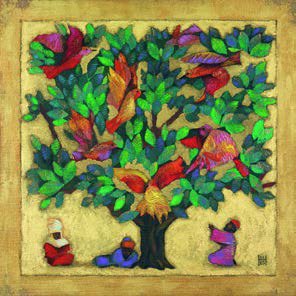
Copyright by Norwegian Bible Society , used with permission.
For other images of Nelly Bube in TIPs, see here.

Καὶ ἔλεγεν, Πῶς ὁμοιώσωμεν τὴν βασιλείαν τοῦ θεοῦ ἢ ἐν τίνι αὐτὴν παραβολῇ θῶμεν;
The Parable of the Mustard Seed
30He also said, “With what can we compare the kingdom of God, or what parable will we use for it?
The following artwork is part of a series of 56 paintings on biblical themes by Kazakh artist Nelly Bube (born 1949):
Copyright by Norwegian Bible Society , used with permission.
For other images of Nelly Bube in TIPs, see here.
Following is the translation of Mark 4:30-32 into Russian Sign Language with a back-translation underneath:
Source: Russian Bible Society / Российское Библейское Общество
Jesus also gave an explanation of what the Kingdom of God is like. For example, there are different kinds of seeds. There are bigger seeds and there are smaller seeds. There is the smallest seed, and if you plant it in the ground, it will grow into a big plant. Birds will make nests on it. And so is the Kingdom of God.
Иисус еще дал такое объяснение, чему подобно Царство Божье. Например, есть разные семена. Бывают семена побольше, а бывают совсем маленькие. Есть одно самое маленькое семя, а если посадить его в землю, из него вырастет большое растение. Птицы будут вить гнезда на нем. Вот так же и Царство Божье.
Back-translation by Luka Manevich
<< Mark 4:26-29 in Russian Sign Language
Mark 4:33-34 in Russian Sign Language >>
Following is the translation of Mark 4:26-33a into Mexican Sign Language with back-translations into Spanish and English underneath:
© La Biblia en LSM / La Palabra de Dios
Jesús dijo: “Otro ejemplo, en la tierra de un campo un hombre sembró semillas, y cuando estaba listo el hombre se fue. ¿El hombre sabe hacer las plantas? No, él no sabe.
Las semillas sólas hacen la planta crecer, el hombre duerme y al día siguiente se despierta, y duerme y al día siguiente etc. La planta crece y después el hombre viene y ve que está listo y cosecha.
Eso parece a uds, la gente que cree que v a estar junto con Dios en su reino.
Oigan, otro ejemplo, dejame ver, mira, hay muchas diferentes semillas, pero la más pequeña es la mostaza, pero cuando cae en la tierra la planta crece fuerte y vence las otras plantas, y en la planta los pájaros pueden sentarse en sus nidos.
Eso es parecido a uds que creen en Dios, que ya están junto con Él en su reino.”
Jesús siguió a contar otras historias y muchos diferentes ejemplos.
Jesus said: “Another example, in de ground of a field a man sowed seeds and when he was ready the man went away. Does the man know how to make the plants? No, he does not know.
“The seeds on their own make the plant grow, the man sleeps and wakes up the next day, and sleeps and the next day… and so on. The plant grows and afterwards the man comes and sees that it is ready and harvests.
“This is like you people who believe that you will be together with God in his kingdom.
“Listen, another example, let me see, look here, there are many different kinds of seeds but the smallest is the mustard. But when it falls in the soil a strong plant grows, stronger than other plants, and in it birds can sit on their nests.
“This is like you people who believe in God who are already together with him in his kingdom.”
Jesus went on to tell other stories and many different examples.
Source: La Biblia en LSM / La Palabra de Dios
<< Mark 4:26-33a in Mexican Sign Language
Mark 4:33b-34 in Mexican Sign Language >>
The Greek that is usually translated as “parable” in English is translated in other languages in a number of ways:
In British Sign Language it is translated with a sign that combines the signs for “tell-a-story” and “compare.” (Source: Anna Smith)
“Parable” in British Sign Language (source: Christian BSL, used with permission)
Scot McKnight (in The Second Testament, publ. 2023) translates it into English as analogy because “the Greek word has the sense of tossing down something alongside something else. Hence an analogy.”
See also image and figures of speech.
In the German Gute Nachricht (Good News) translation of 1982, this occurrence of the Greek term which is translated in most English versions of “kingdom (of God or heaven)” is translated with a form of “once God finalizes his creation (or “work”) . . . ” (Wenn Gott sein Werk vollendet . . .). For an explanation of the differentiated translation in German as well as translation choices in a number of languages, see Kingdom (of God / heaven).
The inclusive “we” specifically includes the addressee (“you and I and possibly others”), while the exclusive “we” specifically excludes the addressee (“he/she/they and I, but not you”). This grammatical distinction is called “clusivity.” While Semitic languages such as Hebrew or most Indo-European languages such as Greek or English do not make that distinction, translators of languages with that distinction have to make a choice every time they encounter “we” or a form thereof (in English: “we,” “our,” or “us”).
For this verse, translators typically select the inclusive form (including the followers). (Source: Velma Pickett and Florence Cowan in Notes on Translation January 1962, p. 1ff.)
SIL International Translation Department (1999) notes that the exclusive form is also possible having Jesus only referring to himself.
Following are a number of back-translations of Mark 4:30:
Like a number of other East Asian languages, Japanese uses a complex system of honorifics, i.e. a system where a number of different levels of politeness are expressed in language via words, word forms or grammatical constructs. These can range from addressing someone or referring to someone with contempt (very informal) to expressing the highest level of reference (as used in addressing or referring to God) or any number of levels in-between.
One way Japanese shows different degree of politeness is through the usage of an honorific construction where the morpheme are (され) is affixed on the verb as shown here in the widely-used Japanese Shinkaiyaku (新改訳) Bible of 2017. This is particularly done with verbs that have God as the agent to show a deep sense of reverence. Here, iw-are-ru (言われる) or “say” is used.
(Source: S. E. Doi, see also S. E. Doi in Journal of Translation, 18/2022, p. 37ff. )
No comments yet.
Leave a Reply
You must be logged in to post a comment.