For the phrases “they have thrown down your altars, and killed your prophets (…). I alone am left, and they are seeking my life, to take it away,'” see Romans 11:3.
Pantokrator
The Ancient Greek Septuagint translation of the Hebrew Bible used the word pantokrator (παντοκράτωρ) or “Ruler of All” as a translation of the second part of the Hebrew term YHWH Tz’vaót (יְהוָ֨ה צְבָא֜וֹת) or “Lord of hosts” (see here) and occasionally ʼĒl Šadạy (אֵל שַׁדַּי), translated in English commonly as “God Almighty.” In the deuterocanonical/apocryphal books, pantokrator might have also been used in the original writing. The New Testament uses it one time in the writings of Paul (2 Cor. 6:18) and several times in the book of Revelation (see esp. Rev. 1:8).
One of the most influential icon styles of the Orthodox church has developed from this concept: Christ Pantocrator. In this icon style, Christ is looking straight at the viewer, his right hand is typically spelling a short form of “Jesus Christ” (see the bottom of the entry on Jesus and icons for an explanation), and his left hand holds a New Testament. His head is often surrounded by a halo.
The earliest preserved icon is found in the Greek Orthodox Saint Catherine’s Monastery on Mount Sinai from the 6th century:

In order to express the two natures of Christ, the two sides of the face are not symmetrical. The right side might represent the qualities of his divinity, while his left side represents human nature. (Source )
Orthodox icons are not drawings or creations of imagination. They are in fact writings of things not of this world. Icons can represent our Lord Jesus Christ, the Virgin Mary, and the Saints. They can also represent the Holy Trinity, Angels, the Heavenly hosts, and even events. Orthodox icons, unlike Western pictures, change the perspective and form of the image so that it is not naturalistic. This is done so that we can look beyond appearances of the world, and instead look to the spiritual truth of the holy person or event. (Source )
“Almighty” is translated in Newari as “the strongest of all” (source: Newari Back Translation) and in the English Job translation by E.L. Greenstein (2019) as name: “Shaddai.”
See also LORD of hosts.
covenant
The Hebrew, Greek, Ge’ez, and Latin that are translated as “covenant” in English are translated in a variety of ways. Here are some (back-) translations:
- Mossi: “helping promise”
- Vai: “a thing-time-bind” (i.e. “an arrangement agreed upon for a period of time”)
- Loma (Liberia): “agreement”
- Northwestern Dinka: “agreement which is tied up” (i.e. “secure and binding”)
- Chol: “a word which is left”
- Huastec: “a broken-off word” (“based on the concept of ‘breaking off a word’ and leaving it with the person with whom an agreement has been reached”)
- Tetelcingo Nahuatl: “a death command” (i.e. “a special term for testament”)
- Piro: “a promised word”
- Eastern Krahn: “a word between”
- Yaka: “promise that brings together” (source for this and all above: Bratcher / Nida)
- Nabak: alakŋaŋ or “tying the knot” (source: Fabian 2013, p. 156)
- Kâte: ʒâʒâfic or “tie together” (source: Renck 1990, p. 108)
- Nyamwezi: ilagano: “agreement, contract, covenant, promise” (source: Pioneer Bible Translators, project-specific translation notes in Paratext)
- Bariai: “true talk” (source: Bariai Back Translation)
- Q’anjob’al: “put mouths equal” (representing agreement) (source: Newberry and Kittie Cox in The Bible Translator 1950, p. 91ff. )
- Manikion, Indonesian: “God’s promise” (source: Daud Soesilo)
- Natügu: nzesz’tikr drtwr: “oneness of mind” (source: Brenda Boerger in Beerle-Moor / Voinov, p. 164)
- Tagalog: tipan: mutual promising on the part of two persons agreeing to do something (also has a romantic touch and denotes something secretive) (source: G. Henry Waterman in The Bible Translator 1960, p. 24ff. )
- Tagbanwa: “initiated-agreement” (source: Tagbanwa Back Translation)
- Guhu-Samane: “The concept [in Mark 14:24 and Matthew 16:28] is not easy, but the ritual freeing of a fruit and nut preserve does afford some reference. Thus, ‘As they were drinking he said to them, ‘On behalf of many this poro provision [poro is the traditional religion] of my blood is released.’ (…) God is here seen as the great benefactor and man the grateful recipient.” (Source: Ernest Richert in The Bible Translator, 1965, p. 81ff. )
- Chichewa: pangano. This word can also be translated as a contract, agreement, or a treaty between two parties. In Chewa culture, two people or groups enter into an agreement to help each other in times of need. When entering into an agreement, parties look at the mutual benefits which will be gained. The agreement terms are mostly kept as a secret between the parties and the witnesses involved. (Source: Mawu a Mulungu mu Chichewa Chalero Back Translation)
Law (2013, p. 95) writes about how the Ancient Greek Septuagint‘s translation of the Hebrew berith was used by the New Testament writers as a bridge between the Old and New Testaments (click or tap here to read more):
“Right from the start we witness the influence of the Septuagint on the earliest expressions of the Christian faith. In the New Testament, Jesus speaks of his blood being a kaine diatheke, a ‘new covenant.’ The covenant is elucidated in Hebrews 8:8-12 and other texts, but it was preserved in the words of Jesus with this language in Luke 22:20 when at the Last Supper Jesus said, ‘This cup that is poured out for you is the new covenant in my blood. Jesus’s blood was to provide the grounds for the ‘new covenant,’ in contrast to the old one his disciples knew from the Jewish scriptures (e.g., Jeremiah 31:31-34). Thus, the earliest Christians accepted the Jewish Scriptures as prophecies about Jesus and in time began to call the collection the ‘Old Testament’ and the writings about Jesus and early Christianity the ‘New Testament,’ since ‘testament’ was another word for ‘covenant.’ The covenant promises of God (berith in Hebrew) were translated in the Septuagint with the word diatheke. In classical Greek diatheke had meant ‘last will, testament,’ but in the Septuagint it is the chosen equivalent for God’s covenant with his people. The author of Hebrews plays on the double meaning, and when Luke records Jesus’ announcement at the Last Supper that his blood was instituting a ‘new covenant,’ or a ‘new testament,’ he is using the language in an explicit contrast with the old covenant, found in the Jewish scriptures. Soon, the writings that would eventually be chosen to make up the texts about the life and teachings of Jesus and the earliest expression of the Christian faith would be called the New Testament. This very distinction between the Old and New Testaments is based on the Septuagint’s language.”
See also establish (covenant) and covenant (book).
Learn more on Bible Odyssey: Covenant in the Hebrew Bible .
altar
The Greek, Latin and Hebrew that is translated as “altar” in English is translated in a number of ways:
- Obolo: ntook or “raised structure for keeping utensils (esp. sacrifice)” (source: Enene Enene)
- Muna: medha kaefoampe’a or “offering table” (source: René van den Berg)
- Luchazi: muytula or “the place where one sets the burden down”/”the place where the life is laid down” (source: E. Pearson in The Bible Translator 1954, p. 160ff. )
- Tzotzil: “where they place God’s gifts” (source: John Beekman in Notes on Translation, March 1965, p. 2ff.)
- Tsafiki: “table for giving to God” (source: Bruce Moore in Notes on Translation 1/1992, p. 1ff.)
- Noongar: karla-kooranyi or “sacred fire” (source: Warda-Kwabba Luke-Ang)
- Uma: “offering-burning table” (source: Uma Back Translation)
- Yakan: “place for sacrificing” (source: Yakan Back Translation)
- Tagbanwa: “burning-place” (source: Tagbanwa Back Translation)
- Tibetan: mchod khri (མཆོད་ཁྲི།) or “offering throne” (source: gSungrab website )
- Bura-Pabir: “sacrifice mound” (source: Andy Warrren-Rothlin)
- Kalanga: “fireplace of sacrifice” (source: project-specific notes in Paratext)
The Ignaciano translators decided to translate the difficult term in that language according to the focus of each New Testament passage in which the word appears (click or tap here to see the rest of this insight
Willis Ott (in Notes on Translation 88/1982, p. 18ff.) explains:
- Matt. 5:23,24: “When you take your offering to God, and arriving, you remember…, do not offer your gift yet. First go to your brother…Then it is fitting to return and offer your offering to God.” (The focus is on improving relationships with people before attempting to improve a relationship with God, so the means of offering, the altar, is not focal.)
- Matt. 23:18 (19,20): “You also teach erroneously: ‘If someone makes a promise, swearing by the offering-place/table, he is not guilty if he should break the promise. But if he swears by the gift that he put on the offering-place/table, he will be guilty if he breaks the promise.'”
- Luke 1:11: “…to the right side of the table where they burn incense.”
- Luke 11.51. “…the one they killed in front of the temple (or the temple enclosure).” (The focus is on location, with overtones on: “their crime was all the more heinous for killing him there”.)
- Rom. 11:3: “Lord, they have killed all my fellow prophets that spoke for you. They do not want anyone to give offerings to you in worship.” (The focus is on the people’s rejection of religion, with God as the object of worship.)
- 1Cor. 9:13 (10:18): “Remember that those that attend the temple have rights to eat the foods that people bring as offerings to God. They have rights to the meat that the people offer.” (The focus is on the right of priests to the offered food.)
- Heb. 7:13: “This one of whom we are talking is from another clan. No one from that clan was ever a priest.” (The focus in on the legitimacy of this priest’s vocation.)
- Jas. 2:21: “Remember our ancestor Abraham, when God tested him by asking him to give him his son by death. Abraham was to the point of stabbing/killing his son, thus proving his obedience.” (The focus is on the sacrifice as a demonstration of faith/obedience.)
- Rev. 6:9 (8:3,5; 9:13; 14:18; 16:7): “I saw the souls of them that…They were under the table that holds God’s fire/coals.” (This keeps the concepts of: furniture, receptacle for keeping fire, and location near God.)
- Rev. 11:1: “Go to the temple, Measure the building and the inside enclosure (the outside is contrasted in v. 2). Measure the burning place for offered animals. Then count the people who are worshiping there.” (This altar is probably the brazen altar in a temple on earth, since people are worshiping there and since outside this area conquerors are allowed to subjugate for a certain time.)
See also altar (Acts 17:23).
In the Hebraic English translation of Everett Fox it is translated as slaughter-site and likewise in the German translation by Buber / Rosenzweig as Schlachtstatt.
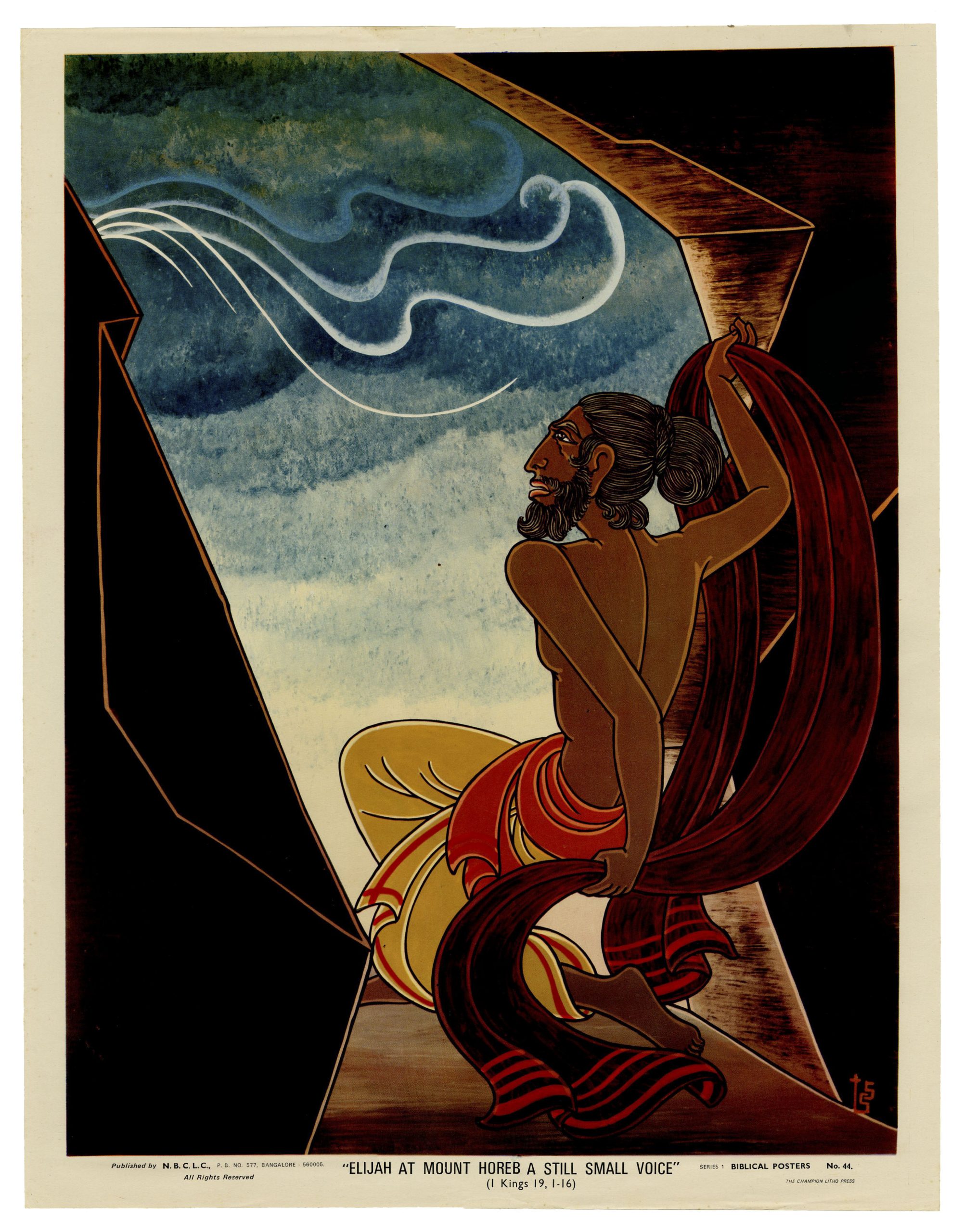
Elijah at Mount Horeb - A Still Small Voice

Artwork by Sister Marie Claire , SMMI (1937–2018) from Bengaluru, India.
For more information about images by Sister Marie Claire and ways to purchase them as lithographs, see here .
For other images of Sister Marie Claire paintings in TIPs, see here.
complete verse (1 Kings 19:10)
Following are a number of back-translations as well as a sample translation for translators of 1 Kings 19:10:
- Kupsabiny: “He replied, ‘My God, you are the one who rule everything. I devoted myself to your work. But the people of Israel have refused your covenant. They have torn down the altar and they have killed all your prophets. I am the only one left, and I am being sought to be killed.” (Source: Kupsabiny Back Translation)
- Newari: “He replied, "I have had much zeal for the great God, the LORD Almighty, the Israelites have abandoned your covenant, they have torn down your altars and have killed your prophets with the sword. I alone am still remaining. They have also been trying to kill me."” (Source: Newari Back Translation)
- Hiligaynon: “He replied, ‘O LORD God Almighty, I serve you [intensifier] faithfully. But the Israelinhon rejected their covenant with you, they destroyed your altars, and killed your prophets. I am the only one left, and they are-trying to kill me also.’” (Source: Hiligaynon Back Translation)
- English: “Elijah replied, ‘I have zealously served you, Yahweh, God Almighty. But the Israeli people have broken the agreement that they made with you. They have torn down your altars, and they have killed all of your prophets. I am the only one whom they have not killed, and now they are trying to kill me, too. So I am running away from them.’” (Source: Translation for Translators)
prophet
Eugene Nida wrote the following about the translation of the Hebrew, Aramaic and Greek terms that are typically translated with “prophet” in English:
“The tendency in many translations is to use ‘to foretell the future’ for ‘prophesy,’ and ‘one who foretells the future’ for ‘prophet.’ This is not always a recommended usage, particularly if such expressions denote certain special native practices of spirit contact and control. It is true, of course, that prophets of the Bible did foretell the future, but this was not always their principal function. One essential significance of the Greek word prophētēs is ‘one who speaks forth,’ principally, of course, as a forth-teller of the Divine will. A translation such as ‘spokesman for God’ may often be employed profitably.” (1947, p. 234f.)
Following is a list of (back-) translations from other languages (click or tap for details):
- San Blas Kuna: “one who speaks the voice of God”
- Central Pame and Vai: “interpreter for God”
- Kaqchikel, Navajo (Dinė), Yaka: “one who speaks for God”
- Northern Grebo: “God’s town crier” (see more about this below)
- Sapo: “God’s sent-word person”
- Shipibo-Conibo, Ngäbere: “one who speaks God’s word”
- Copainalá Zoque: “one who speaks-opens” (a compound meaning “one who discloses or reveals”)
- Sierra Totonac: “one who causes them to know” (in the sense of “revealer”)
- Batak Toba: “foreteller” (this and all the above acc. to Nida 1961, p. 7)
- Western Bukidnon Manobo: “one who is inspired of God” (Source: Western Bukidnon Manobo Back Translation)
- Alekano: “the true man who descended from heaven” (source: Ellis Deibler in Notes on Translation June 1986, p. 36ff.)
- Aguaruna: “teller of God’s word” (source: M. Larson / B. Moore in Notes on Translation February 1970, p. 1-125)
- Ekari: “person who speaks under divine impulse”
- Mandarin Chinese: 先知 xiānzhī — “one who foreknows” (or the 1946/1970 translation by Lü Zhenzhong: 神言人 shényánrén — “divine-word-man”)
- Uab Meto: “holy spokesman” (source for this and two above: Reiling / Swellengrebel)
- Kouya: Lagɔɔ gbʋgbanyɔ — “the one who seeks God’s affairs” (source: Saunders, p. 269)
- Kafa: “decide for God only” (source: Loren Bliese)
- Martu Wangka: “sit true to God’s talk” (source: Carl Gross)
- Eastern Highland Otomi: “word passer” (source: John Beekman in Notes on Translation November 1964, p. 1-22)
- Obolo: ebi nriran: “one with power of divine revelation” (source: Enene Enene)
- Mairasi: nonondoai nyan: “message proclaimer” (source: Enggavoter 2004)
- Highland Totonac: “speaker on God’s behalf”
- Central Tarahumara: “God’s preacher” (source for this and above: Waterhouse / Parrott in Notes on Translation October 1967, p. 1ff.)
- Coatlán Mixe: “God’s word-thrower”
- Ayutla Mixtec: “one who talks as God’s representative”
- Isthmus Mixe: “speaker for God” (source for this and two above: Viola Waterhouse in Notes on Translation August 1966, p. 86ff.)
- Mezquital Otomi / Paasaal: “God’s messenger” (source: Waterhouse / Parrott in Notes on Translation October 1967, p. 1ff. and Fabian N. Dapila in The Bible Translator 2024, p. 415ff.)
- Noongar: Warda Marridjiny or “News Traveling” (source: Warda-Kwabba Luke-Ang)
- Kutu: mtula ndagu or “one who gives the prediction of the past and the future” (Source: Pioneer Bible Translators, project-specific translation notes in Paratext)
- Ebira: ọnịsẹ, a neologism that combines the prefix ọn for “a person” with ịsẹ for “prediction” (source: Scholz /Scholz 2015, p. 49)
- French 1985 translation by Chouraqui: inspiré or “inspired one” (“someone in whom God has breathed [Latin: in + spiro]) (source: Watson 2023, p. 45)
In Ixcatlán Mazatec a term is used that specifically includes women. (Source: Robert Bascom)
About the translation into Northern Grebo:
“In some instances these spiritual terms result from adaptations reflecting the native life and culture. Among the Northern Grebo people of Liberia, a missionary wanted some adequate term for ‘prophet,’ and she was fully aware that the native word for ‘soothsayer’ or ‘diviner’ was no equivalent for the Biblical prophet who spoke forth for God. Of course, much of what the prophets said referred to the future, and though this was an essential part of much of their ministry, it was by no means all. The right word for the Gbeapo people would have to include something which would not only mean the foretelling of important events but the proclamation of truth as God’s representative among the people. At last the right word came; it was ‘God’s town-crier.’ Every morning and evening the official representative of the chief goes through the village crying out the news, delivering the orders of the chief, and announcing important coming events. ‘God’s town-crier’ would be the official representative of God, announcing to the people God’s doings, His commands, and His pronouncements for their salvation and well-being. For the Northern Grebo people the prophet is no weird person from forgotten times; he is as real as the human, moving message of the plowman Amos, who became God’s town-crier to a calloused people.” (source: Nida 1952, p. 20)
In American Sign Language it is a person who sees into the future:
“Prophet” in American Sign Language (source )
In British Sign Language it is is translated with a sign that depicts a message coming from God to a person (the upright finger) and then being passed on to others. (Source: Anna Smith)
“Prophet” in British Sign Language (source: Christian BSL, used with permission)
See also prophesy and prophesy / prophetic frenzy.
Learn more on Bible Odyssey: How to Recognize a Biblical Prophet .
See also seer.
addressing God
Translators of different languages have found different ways with what kind of formality God is addressed.
Click or tap here to see the rest of this insight
Like many languages (but unlike Greek or Hebrew or modern English), Tuvan uses a formal vs. informal 2nd person pronoun (a familiar vs. a respectful “you”). Unlike other languages that have this feature, however, the translators of the Tuvan Bible have attempted to be very consistent in using the different forms of address in every case a 2nd person pronoun has to be used in the translation of the biblical text.
As Voinov shows in Pronominal Theology in Translating the Gospels (in: The Bible Translator 2002, p. 210ff. ), the choice to use either of the pronouns many times involved theological judgment. While the formal pronoun can signal personal distance or a social/power distance between the speaker and addressee, the informal pronoun can indicate familiarity or social/power equality between speaker and addressee.
In these verses, in which humans address God, the informal, familiar pronoun is used that communicates closeness.
Voinov notes that “in the Tuvan Bible, God is only addressed with the informal pronoun. No exceptions. An interesting thing about this is that I’ve heard new Tuvan believers praying with the formal form to God until they are corrected by other Christians who tell them that God is close to us so we should address him with the informal pronoun. As a result, the informal pronoun is the only one that is used in praying to God among the Tuvan church.”
In Gbaya, “a superior, whether father, uncle, or older brother, mother, aunt, or older sister, president, governor, or chief, is never addressed in the singular unless the speaker intends a deliberate insult. When addressing the superior face to face, the second person plural pronoun ɛ́nɛ́ or ‘you (pl.)’ is used, similar to the French usage of vous.
Accordingly, the translators of the current version of the Gbaya Bible chose to use the plural ɛ́nɛ́ to address God. There are a few exceptions. In Psalms 86:8, 97:9, and 138:1, God is addressed alongside other “gods,” and here the third person pronoun o is used to avoid confusion about who is being addressed. In several New Testament passages (Matthew 21:23, 26:68, 27:40, Mark 11:28, Luke 20:2, 23:37, as well as in Jesus’ interaction with Pilate and Jesus’ interaction with the Samaritan woman at the well) the less courteous form for Jesus is used to indicate ignorance of his position or mocking.” (Source Philip Noss)
In the most recent Manchu translation of 1835 (a revision of an earlier edition from 1822), God is never addressed with a pronoun but with “father” (ama /ᠠᠮᠠ) instead. Chengcheng Liu (in this post on the Cambridge Centre for Chinese Theology blog ) explains: “In Manchu tradition, as in Chinese etiquette, second-person pronouns could be considered disrespectful when speaking to superiors or spiritual beings. Manchu Shamanist prayers avoided si [‘you’] and sini [‘your’] for this very reason. To use them for God would be, in Lipovzoff’s [one of the two translators] words, ‘the most uncouth and indecent way to speak to the Almighty — as if He were a servant or slave.’ There was also a grammatical problem. In Manchu, si and sini could refer to both singular and plural subjects. For a faith that insisted on the singularity of God, this was potentially confusing. By contrast, repeating ama removed any ambiguity.”
In Dutch, Afrikaans, Gronings, and Western Frisian translations, God is always addressed with the formal pronoun.
See also formal pronoun: disciples addressing Jesus, female second person singular pronoun in Psalms.

Leave a Reply
You must be logged in to post a comment.