
blaspheme, blasphemy

The Hebrew, Aramaic, Greek, Ge’ez, and Latin that is translated as “blasphemy” or “blaspheme” is translated in various forms:

alone (Japanese honorifics)

Click or tap here to see the rest of this insight.

Like a number of other East Asian languages, Japanese uses a complex system of honorifics, i.e. a system where a number of different levels of politeness are expressed in language via words, word forms or grammatical constructs. These can range from addressing someone or referring to someone with contempt (very informal) to expressing the highest level of reference (as used in addressing or referring to God) or any number of levels in-between. One way to do this is through the usage (or a lack) of an honorific prefix as shown here in the widely-used Japanese Shinkaiyaku (新改訳) Bible of 2017.

The Hebrew and Greek that is translated as “alone” (or, in Matthew 19:17, “only”) in English is translated in the Shinkaiyaku Bible as o-hitori (おひとり or お一人), combining “one person” (hitori) with the respectful prefix o-. (Source: S. E. Doi, see also S. E. Doi in Journal of Translation, 18/2022, p. 37ff. )

scribe

The Greek that is usually translated as “scribe” in English “were more than mere writers of the law. They were the trained interpreters of the law and expounders of tradition.”

Here are a number of its (back-) translations:

  • Yaka: “clerk in God’s house”
  • Amganad Ifugao: “man who wrote and taught in the synagogue”
  • Navajo (Dinė): “teaching-writer” (“an attempt to emphasize their dual function”)
  • Shipibo-Conibo: “book-wise person”
  • San Blas Kuna: “one who knew the Jews’ ways”
  • Loma: “educated one”
  • San Mateo del Mar Huave: “one knowing holy paper”
  • Central Mazahua: “writer of holy words”
  • Indonesian: “expert in the Torah”
  • Pamona: “man skilled in the ordinances” (source for this and all above: Bratcher / Nida)
  • Sinhala: “bearer-of-the-law”
  • Marathi: “one-learned-in-the-Scriptures”
  • Shona (1966): “expert of the law”
  • Balinese: “expert of the books of Torah”
  • Ekari: “one knowing paper/book”
  • Tboli: “one who taught the law God before caused Moses to write” (or “one who taught the law of Moses”) (source for this and 5 above: Reiling / Swellengrebel)
  • Noongar: Mammarapa-Warrinyang or “law man” (source: Warda-Kwabba Luke-Ang)
  • Mairasi: “one who writes and explains Great Above One’s (=God’s) prohibitions” (source: Enggavoter 2004)
  • Chichewa: “teacher of Laws” (source: Ernst Wendland)
  • North Alaskan Inupiatun: “teachers of law”
  • Huehuetla Tepehua: “writer”
  • Yatzachi Zapotec: “person who teaches the law which Moses wrote”
  • Alekano: “man who knows wisdom” (source for this and four above: M. Larson / B. Moore in Notes on Translation February 1970, p. 1-125.)
  • Saint Lucian Creole French: titcha lwa sé Jwif-la (“teacher of the law of the Jews”) (source: David Frank in Lexical Challenges in the St. Lucian Creole Bible Translation Project, 1998)
  • Chichimeca-Jonaz: “one who teaches the holy writings”
  • Atatláhuca Mixtec: “teacher of the words of the law”
  • Coatlán Mixe: “teacher of the religious law”
  • Lalana Chinantec: “one who is a teacher of the law which God gave to Moses back then”
  • Tepeuxila Cuicatec: “one who know well the law” (Source for this and four above: Viola Waterhouse in Notes on Translation August 1966, p. 86ff.)
  • Huixtán Tzotzil: “one who mistakenly thought he was teaching God’s commandments”(Huixtán Tzotzil frequently uses the verb -cuy to express “to mistakenly think something” from the point of view of the speaker; source: Marion M. Cowan in Notes on Translation 20/1966, pp. 6ff.)
  • Sumau: “law-knowing men” (source: this blog post by Todd Owen)
  • German das Buch translation by Roland Werner (publ. 2009-2022): “theologian” and in the 1964 translation by Helmut Riethmüller: “theologian of scriptures” (Schrifttheologe)
  • English translation by Scot McKnight (in The Second Testament, publ. 2023): Covenant Code scholar

In British Sign Language it is translated with a sign that combines the signs for “expert” and “law.” (Source: Anna Smith)


“Scribe” in British Sign Language (source: Christian BSL , used with permission)
forgive, forgiveness

The concept of “forgiveness” is expressed in varied ways through translations. Following is a list of (back-) translations from some languages:

  • Tswa, North Alaskan Inupiatun, Panao Huánuco Quechua: “forget about”
  • Navajo (Dinė): “give back” (based on the idea that sin produces an indebtedness, which only the one who has been sinned against can restore)
  • Huichol, Shipibo-Conibo, Eastern Highland Otomi, Uduk, Tepo Krumen: “erase,” “wipe out,” “blot out”
  • Highland Totonac, Huautla Mazatec: “lose,” “make lacking”
  • Tzeltal: “lose another’s sin out of one’s heart”
  • Lahu, Burmese: “be released,” “be freed”
  • Ayacucho Quechua: “level off”
  • Yatzachi Zapotec: “cast away”
  • Chol: “pass by”
  • Wayuu: “make pass”
  • Kpelle: “turn one’s back on”
  • Chicahuaxtla Triqui: “cover over” (a figure of speech which is also employed in Hebrew, but which in many languages is not acceptable, because it implies “hiding” or “concealment”)
  • Tabasco Chontal, Huichol: “take away sins”
  • Toraja-Sa’dan, Javanese: “do away with sins”
  • San Blas Kuna: “erase the evil heart” (this and all above: Bratcher / Nida, except Tepo Krumen: Peter Thalmann in Holzhausen / Riderer 2010, p. 25f.)
  • Eggon: “withdraw the hand”
  • Mískito: “take a man’s fault out of your heart” (source of this and the one above: Kilgour, p. 80)
  • Gamale Kham: “unstring someone” (“hold a grudge” — “have someone strung up in your heart”) (source: Watters, p. 171)
  • Hawai’i Creole English: “let someone go” (source: Jost Zetzsche)
  • Cebuano: “go beyond” (based on saylo)
  • Iloko: “none” or “no more” (based on awan) (source for this and above: G. Henry Waterman in The Bible Translator 1960, p. 24ff. )
  • Tzotzil: ch’aybilxa: “it has been lost” (source: Aeilts, p. 118)
  • Suki: biaek eisaemauwa: “make heart soft” (Source L. and E. Twyman in The Bible Translator 1953, p. 91ff. )
  • Warao: “not being concerned with him clean your obonja.” Obonja is a term that “includes the concepts of consciousness, will, attitude, attention and a few other miscellaneous notions” (source: Henry Osborn in The Bible Translator 1969, p. 74ff. See other occurrences of Obojona in the Warao New Testament.)
  • Martu Wangka: “throw out badness” (source: Carl Gross)
  • Mairasi: “dismantle wrongs” (source: Enggavoter 2004)
  • Nyulnyul: “have good heart” (source )
  • Kyaka: “burn the jaw bones” — This goes back to the pre-Christian custom of hanging the jaw bones of murdered relatives on ones door frame until the time of revenge. Christians symbolically burned those bones to show forgiveness which in turn became the word for “forgiveness” (source: Eugene Nida, according to this blog )
  • Koonzime: “remove the bad deed-counters” (“The Koonzime lay out the deeds symbolically — usually strips of banana leaf — and rehearse their grievances with the person addressed.”) (Source: Keith and Mary Beavon in Notes on Translation 3/1996, p. 16)
  • Arapaho: “setting is aside” (source )
  • Ngbaka: ele: “forgive and forget” (Margaret Hill [in Holzhausen & Ridere 2010, p. 8f.] recalls that originally there were two different words used in Ngbaka, one for God (ɛlɛ) and one for people (mbɔkɔ — excuse something) since it was felt that people might well forgive but, unlike God, can’t forget. See also this lectionary in The Christian Century .
  • Amahuaca: “erase” / “smooth over” (“It was an expression the people used for smoothing over dirt when marks or drawings had been made in it. It meant wiping off dust in which marks had been made, or wiping off writing on the blackboard. To wipe off the slate, to erase, to take completely away — it has a very wide meaning and applies very well to God’s wiping away sins, removing them from the record, taking them away.”) (Source: Robert Russel, quoted in Walls / Bennett 1959, p. 193)
  • Gonja / Dangme: “lend / loan” (in the words of one Dangme scholar: “When you sin and you are forgiven, you forget that you have been forgiven, and continue to sin. But when you see the forgiveness as a debt/loan which you will pay for, you do not continue to sin, else you have more debts to pay” — quoted in Jonathan E.T. Kuwornu-Adjaottor in Ibadan Journal of Religious Studies 17/2 2010, p. 67ff. )
  • Kwere: kulekelela, meaning literally “to allow for.” Derived from the root leka which means “to leave.” In other words, forgiveness is leaving behind the offense in relationship to the person. It is also used in contexts of setting someone free. (Source: Megan Barton)
  • Merina Malagasy: mamela or “leave / let go (of sin / mistakes)” (source: Brigitte Rabarijaona)
  • Mauwake: “take away one’s heaviness” (compare sin as “heavy”) (source: Kwan Poh San in this article )

See also this devotion on YouVersion .

sin

The Hebrew, Ge’ez, and Greek that is typically translated as “sin” in English has a wide variety of translations.

The Greek ἁμαρτάνω (hamartanō) carries the original verbatim meaning of “miss the mark” and likewise, many translations contain the “connotation of moral responsibility.”

  • Loma: “leaving the road” (which “implies a definite standard, the transgression of which is sin”)
  • Navajo (Dinė): “that which is off to the side” (source for this and above: Bratcher / Nida)
  • Toraja-Sa’dan: kasalan, originally meaning “transgression of a religious or moral rule” and in the context of the Bible “transgression of God’s commandments” (source: H. van der Veen in The Bible Translator 1950, p. 21ff. )
  • Kaingang: “break God’s word”
  • Bariai: “bad behavior” (source: Bariai Back Translation)
  • Sandawe: “miss the mark” (like the original meaning of the Greek term) (source for this and above: Ursula Wiesemann in Holzhausen / Riderer 2010, p. 36ff., 43)
  • Nias: horö, originally a term primarily used for sexual sin. (Source: Hummel / Telaumbanua 2007, p. 256)
  • Mauwake: “heavy” (compare forgiveness as “take away one’s heaviness”) (source: Kwan Poh San in this article )

In Shipibo-Conibo the term is hocha. Nida (1952, p. 149) tells the story of its choosing: “In some instances a native expression for sin includes many connotations, and its full meaning must be completely understood before one ever attempts to use it. This was true, for example, of the term hocha first proposed by Shipibo-Conibo natives as an equivalent for ‘sin.’ The term seemed quite all right until one day the translator heard a girl say after having broken a little pottery jar that she was guilty of ‘hocha.’ Breaking such a little jar scarcely seemed to be sin. However, the Shipibos insisted that hocha was really sin, and they explained more fully the meaning of the word. It could be used of breaking a jar, but only if the jar belonged to someone else. Hocha was nothing more nor less than destroying the possessions of another, but the meaning did not stop with purely material possessions. In their belief God owns the world and all that is in it. Anyone who destroys the work and plan of God is guilty of hocha. Hence the murderer is of all men most guilty of hocha, for he has destroyed God’s most important possession in the world, namely, man. Any destructive and malevolent spirit is hocha, for it is antagonistic and harmful to God’s creation. Rather than being a feeble word for some accidental event, this word for sin turned out to be exceedingly rich in meaning and laid a foundation for the full presentation of the redemptive act of God.”

In Warao it is translated as “bad obojona.” Obojona is a term that “includes the concepts of consciousness, will, attitude, attention and a few other miscellaneous notions.” (Source: Henry Osborn in The Bible Translator 1969, p. 74ff. ). See other occurrences of Obojona in the Warao New Testament.

Martin Ehrensvärd, one of the translators for the Danish Bibelen 2020, comments on the translation of this term: “We would explain terms, such that e.g. sin often became ‘doing what God does not want’ or ‘breaking God’s law’, ‘letting God down’, ‘disrespecting God’, ‘doing evil’, ‘acting stupidly’, ‘becoming guilty’. Now why couldn’t we just use the word sin? Well, sin in contemporary Danish, outside of the church, is mostly used about things such as delicious but unhealthy foods. Exquisite cakes and chocolates are what a sin is today.” (Source: Ehrensvärd in HIPHIL Novum 8/2023, p. 81ff. )

See also sinner.

complete verse (Luke 5:21)

Following are a number of back-translations of Luke 5:21:

  • Noongar: “The Law Men and the Pharisees began speaking together, ‘Who is this man? He mocks God! God only can forgive sins!” (Source: Warda-Kwabba Luke-Ang)
  • Uma: “Those religion teachers and Parisi people spoke in their hearts, they said: ‘Who does that person think he is [lit, who very-(enclitic) is that person], that is dared to say his life is the same with God? there is no-one who can forgive sins, just only God.'” (Source: Uma Back Translation)
  • Yakan: “When the teachers of the religious law and the Pariseo heard what Isa said there, they immediately asked among themselves, they said, ‘What sort of person is this? He speaks as if he is God. Who can forgive sin other than God.’ (lit. if not the one-only God.)” (Source: Yakan Back Translation)
  • Western Bukidnon Manobo: “And then those Pharisee people and the teachers of the Law, they thought in their breath, ‘Who is this person who transgresses God? He’s pretending to be God, because the only one who can forgive sins is God.'” (Source: Western Bukidnon Manobo Back Translation)
  • Kankanaey: “Whereupon those Pharisees and teachers of the law, they said in their thoughts, ‘Why did he say that? He is making-himself -equal to God. Because who do-you-suppose (rhet. question) has authority to forgive sins if not God only?'” (Source: Kankanaey Back Translation)
  • Tagbanwa: “When those explainers of law and those Pariseo heard, in their minds was, ‘Just who is this fellow who, in speaking, makes-himself-out-to-be-God? Isn’t it so that only God can forgive sin?'” (Source: Tagbanwa Back Translation)

Pharisee

The Greek that is a transliteration of the Hebrew Pərūšīm and is typically transliterated into English as “Pharisee” is transliterated in Mandarin Chinese as Fǎlìsài (法利賽 / 法利赛) (Protestant) or Fǎlìsāi (法利塞) (Catholic). In Chinese, transliterations can typically be done with a great number of different and identical-sounding characters. Often the meaning of the characters are not relevant, unless they are chosen carefully as in these cases. The Protestant Fǎlìsài can mean something like “Competition for the profit of the law” and the Catholic Fǎlìsāi “Stuffed by/with the profit of the law.” (Source: Zetzsche 1996, p. 51)

In Finnish Sign Language it is translated with the sign signifying “prayer shawl”. (Source: Tarja Sandholm)


“Pharisee” in Finnish Sign Language (source )

In British Sign Language it is translated with a sign that depicts “pointing out the law.” (Source: Anna Smith)


“Pharisee” in British Sign Language (source: Christian BSL, used with permission)

In French Sign Language it is translated with a sign that depicts the box of the phylacteries attached to the forehead:


“Pharisees” in French Sign Language (source: La Bible en langue des signes française )

Scot McKnight (in The Second Testament, publ. 2023) translates it into English as Observant. He explains (p. 302): “Pharisee has become a public, universal pejorative term for a hypocrite. Pharisees were observant of the interpretation of the Covenant Code called the ‘tradition of the elders.’ They conformed their behaviors to the interpretation. Among the various groups of Jews at the time of Jesus, they were perhaps closest to Jesus in their overall concern to make a radical commitment to the will of God (as they understood it).”

See also Nicodemus.

Learn more on Bible Odyssey: Pharisees .

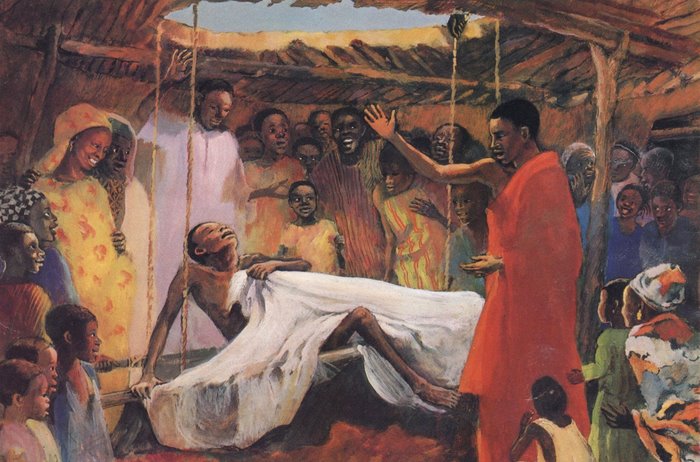
Jesus Heals a Paralyzed Man

Following is a 1973 painting of the JESUS MAFA project, a response to New Testament readings from the Lectionary by a Christian community in Cameroon, Africa. Each of the readings was selected and adapted to dramatic interpretation by the community members. Photographs of their interpretations were made, and these were then transcribed to paintings:

From Art in the Christian Tradition , a project of the Vanderbilt Divinity Library, Nashville, TN. Image retrieved March 23, 2026. Original source: librairie-emmanuel.fr.