The Greek that is translated “born again” or “born from above” in English is translated in Xicotepec De Juárez Totonac as “have new life,” in Tenango Otomi as “live anew,” in Tojolabal as “become new like a little baby” (source: M. Larson / B. Moore in Notes on Translation February 1970, p. 1-125), or in Iu Mien as ganh siang-yungz jiex or “again newly-born pass-through” (source: Arisawa 2017, p. 515)
The EnglishThe Translator’s New Testament (publ. 1973) translates this term in a way to cover both sides of its ambiguity: reborn from above.
The now commonly-used English idiom “born again” (meaning to be revived) was first coined in 1382 in the English translation by John Wycliffe (in the spelling borun ayen). (Source: Crystal 2010, p. 288)
For other idioms in English that were coined by Bible translation, see here.
The Greek in John 3:3 that is translated as “no one can see the kingdom of God” or similar in English is translated in Lalana Chinantec as “God cannot rule over anyone . . .. ” (Source: Larson 1998, p. 108)
The Greek that is often translated in English as “truly, truly, I tell you” or similar is translated in the Russian BTI translation (publ. 2015) as Поверьте Мне (Pover’te Mne) or “trust me.” (Source: Andy Warren-Rothlin)
“It is unusual for anyone to seek out another at night unless it is desired to be kept secret. Betel nut and condiments are laid out to welcome the guest even at the late hour. Nicodemus’s robe and bared shoulder show he is a religious devotee.”
For more images by Sawai Chinnawong in TIPs see here.
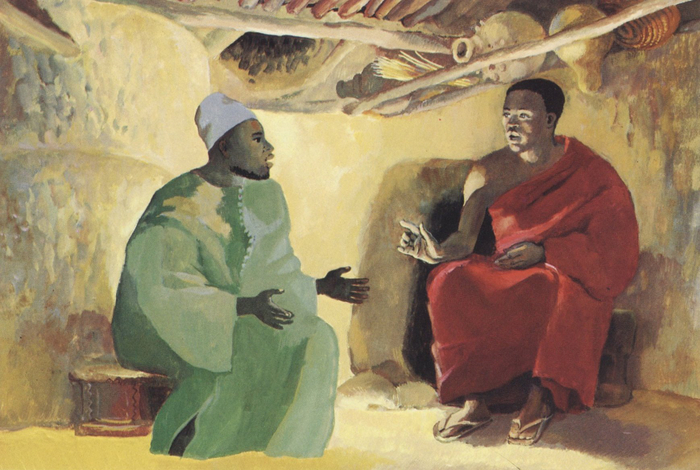
The following 1973 painting “Nicodemus” of the JESUS MAFA project is a response to New Testament readings from the Lectionary by a Christian community in Cameroon, Africa. Each of the readings was selected and adapted to dramatic interpretation by the community members. Photographs of their interpretations were made, and these were then transcribed to paintings:
Here we see Jesus patiently teaching about the kingdom of God to a perplexed Nicodemus, whose hands are in a gesture of questioning. Nicodemus has, like so many before and since, gotten caught up in the literal and limited understanding of the scriptures. Jesus attempted to explain the nature of reality in different terms that thereby he (and we) might be transformed. The boundaries we place on ourselves can be escaped if only we are brave enough to venture beyond them. Shall we remain in the cover of night with Nicodemus or step into the light that Jesus offers?
From Art in the Christian Tradition, a project of the Vanderbilt Divinity Library, Nashville, TN. Image retrieved March 23, 2026. Original source: librairie-emmanuel.fr.
In the GermanGute Nachricht (Good News) translation of 1982, this occurrence of the Greek term which is translated in most English versions of “kingdom (of God or heaven)” is translated with “God’s new world” (Gottes neue Welt). The das Buch translation by Roland Werner (publ. 2009-2022), also in German, translates these occurrences as “God’s new reality” (about Werner’s translation, see here .
For an explanation of the differentiated translation in German as well as translation choices in a number of languages, see Kingdom (of God / heaven).
Following are a number of back-translations of John 3:3:
Uma: “Yesus said saying to him: ‘These my words are very true: if a person is not born again, he will not become a subject of God in his Kingdom.'” (Source: Uma Back Translation)
Yakan: “Isa answered he said, ‘Truly I tell you, if a person is not born again, he is not able to see the ruling of God/kingdom of God.'” (Source: Yakan Back Translation)
Western Bukidnon Manobo: “And Jesus answered saying, ‘What I say to you is true that a person can only be included among the people whom God rules over if he allows himself to be born again.'” (Source: Western Bukidnon Manobo Back Translation)
Kankanaey: “‘This that I tell you (sing.) is true,’ said Jesus in reply. ‘If a person is not born again, he can not join-in-experiencing God’s ruling.'” (Source: Kankanaey Back Translation)
Tagbanwa: “Jesus answered, saying, ‘This really is the truth which I will tell you. No-one can be included in the kingdom of God unless he has been given birth to again.'” (Source: Tagbanwa Back Translation)
Tenango Otomi: “Jesus said, ‘Truly I tell you that he who doesn’t live anew cannot be in God’s hand.'” (Source: Tenango Otomi Back Translation)
Illustration by Horst Lemke (1922-1985) for the GermanGute Nachricht für Sie – NT68, one of the first editions of the Good News Bible in German of 1968. Lemke was a well-known illustrator who illustrated books by Erich Kästner , Astrid Lindgren and many others.
(To view the different translations of this term in a simplified graphical form on a new page, click or tap here.)
There are various approaches to the translation of the Greek theos, the Latin Deus, and the Hebrew elohim or el that are translated as “God” in English. Click or tap here to see more.
While some of the main language groups of European languages have the origin of their translations go back to somewhat nebulous sources (see below), many other languages use a translation that can be more easily traced back to its original meaning.
Click or tap here to see the translations by many Germanic, Romance, Slavic, Turkic, Celtic, or Indo-Iranian languages.
Romance languages use a term that derives from the LatinDeus (and is unrelated to the Greek θεός) which itself comes from Proto-Indo-European deywós “sky, heaven” (source: Wiktionary ) (see Catalan: Déu; French: Dieu; Galician/Portuguese: Deus; Italian: Dio; Spanish: Dios; Romanian: Dumnezeu [from: domine deus])
Celtic languages use a word that goes back to the Proto-Indo-European dyew- (“shine,” “sky / heaven”): Irish and Scottish Gaelic use Dia, Manx uses Jee, Breton uses Doue, and Cornish and Welsh use Duw
The orgin of the Basque word for “God” — Jainko — is unclear. One possible explanation is that it’s a contraction from Jaungoikoa, itself a portmanteau from jaun “lord” and goiko “who is on high.” (Source: Blas Pedro Uberuaga )
Some Turkic languages either use a form of “Allah” or a term that goes back to the Proto-Turkic *teŋri or *taŋrï (“god; sky, heaven”): Turkish: Tanrı, South Azerbaijani: تاری / Tarı, or Yakut: Таҥара / Tañara, or Chuvash: Турӑ / Tura
Eugene Nida (1947, p. 204ff.) provided a theoretical framework for ways to select a translation for “God.” (Click or tap here to see)
“The name for God in an aboriginal language is one of the keystones to the entire theological structure and Bible teaching. The problem is by no means as simple as it may at first appear. Some translators, not finding in the pagan religious system, exactly the word which they think appropriate, have introduced a foreign name for God, e.g. Spanish Dios or English God. They have thought that such a word would have prestige because it comes from the language of a culturally dominant group. The fact that such a borrowed word seems to have no bad connotations appears to justify its use. It is assumed that the native people will automatically come to understand by the borrowed word for ‘God’ exactly what we understand by the same term. The translator has counted upon taking a word with zero meaning and giving it the proper content. This is not so easily done as imagined. In almost every case the native will immediately try to equate this new name of God with one of the gods of his own religious system. Since all people attempt to understand the unknown in terms of the known, it will not be very long before the natives will have worked out what seems to them a perfectly consistent equivalent for the new term.
“On the other hand, the translator may attempt to use some native word for ‘God’ which seems applicable. A further investigation may reveal that there are many characteristics which are given to this god in native legend which are quite inconsistent with Biblical truth. The translator’s examination must be thorough, for he does not want to run the risk of using a term which does not contain at least the central core of meaning which is essential.
“The translator should not be fearful of using a native word for ‘God.’ He should remember that in terms of the native culture the Greek word theos, the Latin deus, and the Gothic guþ could hardly be termed exact equivalents to the concept of God as taught in the Bible. Nevertheless, these terms did possess the essential core of meaning. It is interesting to note that they are generic terms. In no case were they the names of one particular god. The use of names such as Zeus, Jupiter, or Woden would not have been wise, for these specific names included a great deal of legend as to the individual peculiarities, excesses, and immoral actions of the particular gods. In the generic terms, however, there existed enough of the fundamental core of religious significance that they have been used successfully. In Greek, theos designated any god. In the plural it could be used to include all the gods. In the Bible this generic term is used and made to apply specifically to only one God. The Christians took a term which designated any important supernatural entity and by context and teaching made it apply to only one such entity. Where this same situation exists in another culture, there is no reason for believing that this process could not be repeated, and with good results.
“In choosing the name for God it is important to consider the usage of the trade language. Very frequently the native church is assimilated into the church group speaking the trade language or the national language. The native church also draws much of its leadership from among those who speak the trade language. A similar name for God is valuable, but it is not absolutely essential.”
Indigenous terms
Following are examples of what Nida above considers “native words.” (Click or tap here to see)
Lakota: Wakȟáŋ Tȟáŋka (“the universal spiritual power” — source: Steve Berneking in Beerle-Moor / Voinov 2015, p. 119 — click or tap here to see more)
“The Lakota translators have intentionally chosen to use the traditional Lakota name of the Deity instead of the name ‘God.’ Past missionary movements across North America have colonized Indian people to assume that the word ‘God’ is the appropriate gloss for traditional understandings of the Deity. Even more troubling, the waves of violence — physical, social, and psychological — were more often than not carried out in the name of ‘God.’ In an intentional strike against this violence (…) these Lakota translators are using the name Wakȟáŋ Tȟáŋka. Wakȟáŋ Tȟáŋka is the universal spiritual power, sometimes wrongly rendered in English ‘Creator’ or ‘Great Spirit.’ In Lakota spirituality, however, Wakȟáŋ Tȟáŋka is not personified with any name. What Christians would refer to as ‘God’ is understood as a spiritual force or energy that permeates all of creation and is manifest in numerous ways in the world around us at any given moment and in any given place. So, to assume that the name ‘God’ is an appropriate gloss to translate Wakȟáŋ Tȟáŋka fully and culturally not only reflects some latent ‘imperial’ attitude, it also negates and oppresses the deep understanding of Wakȟáŋ Tȟáŋka for the Lakota people. Therefore, the choice of the Lakota translators to bring Wakȟáŋ Tȟáŋka into the biblical text is an attempt to heal and to reconcile the brokenness in the history of their people.”
Ebira: Ohomorihi (“the great one that makes the rain” — as farmers the Ebira people depend on rain made by God for survival) (Source: David O Moomo in Scriptura 88 (2005), p. 151ff. )
Northwestern Ojibwa: Kishemanitoo (“the Great Spirit”) (Donald Hekman in Notes on Translation 1999, p. 17ff.)
Mohawk: Rawenní:io: “Supreme Being,””Great Spirit,” or “God”
Southern Sotho: Molimo or “the one who is above” (source: Bühlmann 1950, p. 146)
Ap Ma: Yamom (“the creator” — click or tap here to see more)
“Yamom is the creator. He made the trees and everything else we see in the world around us. There is no tradition as to where Yamom lives, and he is never seen. ‘We do not know him directly. We know only that he was in his own place and at his word everything was created. A person might sit somewhere and reflect, ‘How could such a thing as a coconut tree grow out of that nut?’ The answer is that these things that people could never do could only have been done by Yamom. Yamom is sometimes referred to as Yadima, which means ‘word’ or ‘story.’ It is a kind of euphemism so that one doesn’t have to say the real name. There is a feeling that if the name is used carelessly, the person may experience some kinds of problems. According to the traditional culture, Yamom himself never gave anyone direct messages. However, the konim ‘spirits,’ would sometimes mention him: ‘Yamom says the rains are coming,’ or ‘Yamom says the eels are coming.'”
Keapara: palagu (“God” or “spirit of humanness” — click or tap here to see more)
“Apart from the meaning ‘God,’ palagu is used in ordinary speech to mean something like ‘spirit of humanness.’ Each person is born with their own palagu, and this is what makes them able to become mature human beings. If the palagu leaves a person, then that person will begin to act in strange ways. In this way it is rather like the English word ‘mind.’ There is a special concern for babies, because the palagu of a baby is easily separated from the baby. When preparing to give a baby a bath, or if a person is carrying a baby under big trees, or at night, people are often encouraged to call out Kivani palaguna O, onove rake kaumai — ‘Baby’s spirit, come after us.’ If the baby’s palagu does not come, then the baby will become very fussy and difficult. The family must then try to figure out how to get the palagu to come back. Perhaps they will pray. There is often a feeling that something has gone wrong within the family, and this must be straightened out before the baby’s palagu will return.”
Mbandja: Chuchu (the traditional maker of world and mankind — click or tap here to see more)
“People claim that he made the world and mankind. What is more, he likes mankind. But his people did not like him. To escape from him, they ran away and have practically forgotten about him, though he has never forgotten about them. Here, embedded in the legends of the people, lies the truth which the missionary may use. He may show the people how far they have wandered from God and how He has not forgotten about them. In fact, He sent His Son in order that He might reconcile them to Himself.”
Kovai: Yoba Maro (variant of Molo, a traditional cultural hero)
In Zimakani there were supernatural beings called ‘bi’buki. The stars are among the ‘bi’buki, as are the sun and moon. Kau was the traditional god of the Zimakani, their ancestral folk hero. They would say Kau is our ‘bi’buki. Using this term as a base, a form ‘Bi’bukia’mene was developed. It means ‘The True (masculine, singular) ‘bi’buki‘ This is the term being used for ‘God.'”
Matigsalug Manobo: Manama — Traditionally known as creator of the lesser gods as well the earth
Thai: phra’ cao (พระเจ้า) (“Divine Lord”) (Phra’ cao is also used to refer to the king in Thailand; source: Stephen Pattemore — see also pronoun for “God”).
Bacama: Həmɨnpwa: “king of up” (“In pre-Christian days, this was the name for the highest among the gods. Sometimes the shorter form Pwa is used.” Source: David Frank in this blog post )
Giziga: Bumbulvuŋ — “derived from the phrase Buy mulvuŋ, meaning ‘chief of spirits of ancestors.'”
North Mofu: Bay’ərlam — “also meaning ‘chief of spirits of ancestors.'” (Source for this and above: Michel Kenmogne in Noss 2007, p. 381f.)
Tiv: Aondo — “sky” — created the earth and everything within it (source )
Yoruba: Ọlọrun — “the mightiest among the mightiest” (source )
Igbo: Chineke — “God in the morning of creation” or “the God who creates” or “God and the Creator” (source )
Northern Qiandong Miao (Hmu): vaŋ55 vɛ55 or “heavenly king,” a term coming from Hmu animist/shaminist religion (source: Joakim Enwall in Eber / Wan / Walf 1999, p. 217)
Dholuo: Nyasaye, likely meaning “one who has to be entreated” (source: Mary Mercy Kobimbo in The Bible Translator, p. 213ff.). 2022note that this origin is disputed; source: Jim Harries). Ths ame term is also used by the neighboring Luhya (or: Luhyia) languages Saamia (in the spelling Nasaae); Wanga; Tsotso; Nyore; East Nyala; and Logooli. John Ommani (in Greed 2025, p. 251) points out that “In Luhyia, God is referred to as Nyasaye wooMulembe or “God of peace”. This is a term borrowed from the neighboring Luo language. Despite the Luhyia having their own word for God, Were, they took on the new term as one way of sharing in linguistic hospitality. When the Luhyia greet one another, they are wishing each other that aspect of God which is peace. From this cultural understanding, the goal of the mission of God is a people who are at peace with one another and with the environment in which they live.”
Northern Ngbandi: Nzapa — Nzapa is the traditional creator and the ultimate cause of all things. He rarely intervenes directly in the affairs of men but has created the spirits and they are his messengers and workers here below, interfering, meddling, or assisting in the details of life. The ancestral spirits in particular are important in the government of society. The Ngbandis speak of Nzapa saying, “Nzapa is there above everything.” He is indeed conceived of as being quite detached and disinterested in his creation. — Source: Quentin Nelson in The Bible Translator 1957, p. 145ff. )
Toraja-Sa’dan: Puang Matua, an indigenous term with the meaning of “the Lord enthroned in the midst of the firmament,” a supreme being with other gods under him. In Christian meaning today the one and only God. (Source: H. van der Veen in The Bible Translator 1950, p. 21ff. )
Konkomba: Uwonbɔr or Uwumbɔr — Uwonbɔr is an “ancient God of a bygone era and distant dreams, who no longer had any relationship with the tribe. Uwonbɔr was the creator of everything: heaven and earth, and the first family. At first he was very close to earth but then, according to the Konkombas, ‘One of our ancestors committed a wicked deed and because of that offence Uwonbɔr no longer wishes to be God of the Konkombas.’ The details of that terrible crime have long since been forgotten, but because of it Uwonbɔr went far away and took heaven with him. There was no way back to meet Uwonbɔr any more, so the people had to seek other ways of minimising the suffering caused by his absence.” (Source: Lidorio 2007, p. 21)
Lamba: ŵaLesa — the prefix ŵa is a plural form for “proper names when addressing and referring to persons in any position of seniority or honor.” While this was avoided in early translations to avoid possible misunderstandings of more than one God, once the church was established it was felt that it was both “safe” and respectful to use the honorific (pl.) prefix. (Source C. M. Doke in The Bible Translator 1958, p. 57ff. )
Ngaju: Hatalla — the name of the the male part of the supreme male/female god of the indigenous Kaharingan religion . (See Hermonogenes Ugang in The Bible Translator1987, p. 433ff. about this somewhat controversial choice.) The Ma’anyan New Testament uses a parallel choice with Alatalla. The Ma’anyans traditionally are also followers of Kaharingan.
Nias: Lowalangi, literally “he who cannot be seen in the sky.” Lowangali was understood as the highest deity within the traditioal belief system (source: Hummel / Telaumbanua 2007)
Yala: Ɔwɔ — this term traditionally covered the following semantic areas: spirit; creator and ultimate cause of everything; father of all; Male counterpart of aje; related to aje as a husband is to a wife; above all other spiritual powers; gives or withholds rain; gives each person a special gift at birth; knows everything; watches over the world with an all-seeing eye; sky (source: Eugene Bunkowske in The Bible Translator 1977, p. 226ff. )
Maquiritari: Wanaadi (click or tap here to see more)
“During my early years as translation consultant with the Bible Society in South America, I had the privilege of checking the translation of the New Testament into the Maquiritari language spoken in south-western Venezuela. As we neared the completion of that New Testament. I began to feel increasingly uneasy about the word for ‘God,’ Diyo, which the team was using. Each time I voiced my concern about the fact that the name was borrowed from a European language and not a Maquiritari name, the translators assured me that they too, felt uncomfortable about that name, but that there was nothing they could do about it, because the Maquiritari language just did not have an adequate word. There was, they said, a culture hero called Wanaadi. He was spoken of as having done some of the things the Bible ascribes to God, but he was also the ‘lyingest,’ ‘cheatingest’ and most immoral character in tribal folklore and hence totally unfit for the divine name in the Bible.
“When we had completed checking the New Testament I still could not shake off my uneasiness about the divine name, so I asked that the team take several months to pray and to listen carefully to see if there really was no local name for God that could be used. I promised that if after three months of honest search on their part, they did not turn up an adequate answer. 1 would authorize the printing of the New Testament using the loanword Diyo to express God.
“Before two months had passed I received an excited letter. The translators, true to their promise, had accompanied a team of evangelists to a remote corner of Maquiritariland. The evangelists preached and taught and the translators listened. To the surprise of the translators the evangelists, all Maquiritari church elders, dropped the name Diyo and preached only about Wanaadi as soon as they got into the previously unevangelized area. The trip lasted several weeks and during the whole time the name Diyo was never used.
“On the way home the translators confronted the evangelists with the question: ‘How come you always used the name Wanaadi among these people while in our churches at home you always use Diyo to speak about God?’
“The answer: ‘These people know no Spanish, so they have never heard the name Dios or Diyo. The only name for God they know is Wanaadi.’
“’But what about all the deception and all the acts of immorality which Wanaadi committed? How could he be the God of the Bible?’
“The answer: ‘Oh, those things? Don’t you know that they are all bad gossip stories that the devil invented so that the people would not follow Wanaadi‘s way?’
“With one bold stroke a whole tribal mythology of the now ‘bad’ stories about Wanaadi had been reinterpreted. And the end result was that the church decided to use Wanaadi rather than Diyo to express God in the New Testament about to be printed.
Ajië: Bao (“a spirit,” “an ancestor,” or “a corpse” — source: Clifford, p. 79-91 — click or tap here to see more)
Maurice Leenhardt, the missionary and translator in charge of the first and only Ajië translation “believed at first that the Melanesian experience of Divinity could be brought directly over into Christianity. In 1905 he began experimenting with using bao (a spirit, an ancestor, or corpse) to clarify in the native language the ‘visions’ spoken of in the Gospels. (…) The Christian God had to appropriate the essence of Melanesian spirits by taking possession of their generic name, Bao. (…) [Leenhardt wrote to his father in 1913:] If Jehovah is really that which is visible since the creation then the pagans must have an obscure revelation of God at the heart of their beliefs. This is a minimum of experiences upon which the preaching of the Gospel can be based, And this we shouldn’t reject the entire jumble of their gods in order to give them a new god with a foreign name; rather we should search for the word in their language, even the strangest word, into which can be translated the visible experience of God. (…) The bao concept would have to be reunderstood, not as a generic term but capitalized, as a personal name. (…) Leenhardt was encouraged by his discovery that bao had always been a highly adaptable concept. It could apply not merely to a corpse, recent ancestor, or magical divinity, but its masculine ‘power’ could sometimes fuse spontaneously with feminine-totemic principle of life. (…) In adopting the language of totemic myth to evoke the Christian Bao (…) Leenhardt in effect broadened the God of European orthodoxy in two crucial ways. In translating his deity, the missionary made ‘Him’ more androgynous, a totem-bao of feminine ‘life’ as well as of masculine power.”
Ngäbere: Ngöbö (source: Nida 152, p. 37f. — click or tap here to see more)
Nida tells this story: “Frequently the translator is indebted to pagan shamans for some of the most important terms. For years Efrain Alphonse tried to find the Ngäbere name for ‘God.’ Many of the people did not know the word, and others refused to give it. Though there was a belief in a beneficent Creator, His name was too sacred to be known by the uninitiated. On one occasion, Mr. Alphonse went with some of his Ngäbe helpers to visit an old medicine woman back in the recesses of the tropical forest of Bocas del Toro. After being ushered into the presence of this greatly revered (…) woman, they answered at length the many questions she asked. Finally she began to chant and sing and as her voice rose higher and higher, she shouted out in trance-like ecstacy so that all could hear, ‘These men are talking about Ngöbö, the God of heaven and earth, Listen to them!’ There was the name ‘Ngöbö,’ the very word which Mr. Alphonse had been seeking for so many years. It came from the lips of a native diviner and sorceress, but all agreed that this was the name of God, and throughout the years it has been used by the Ngäbe Christians.”
Gbaya: sõ (originally: “to ooze; to anoint, to rub on” also “spirit” later “god” and finally a proper name for “God” — source: Noss, Current Tends 2002, p. 157ff. — click or tap here to see more)
“When the Gbaya translator of the Bible, like the Protestant and Catholic missionaries who first translated Scripture texts into Gbaya, adopts the traditional term for God, what does this mean theologically? The issue is not whether this term fits into the broad sweep of African Traditional Religion as it is referred to by modem African theologians, but what kind of God is this? The noun sõ may be derived from the verb so which means ‘to ooze; to anoint, to rub on.’ This term, which may have a basic meaning similar to ‘spirit,’ has come to be used as the equivalent of ‘god’ and as a proper name for ‘God.’ Folk etymology explains that this word depicts the unique power of God in that he created himself like sap oozing from the trunk of a tree. This God is the Creator God who created Adam and Eve and who also created the Gbaya ancestors. To the Gbaya this is YHWH of the Old Testament. (…) The theological implications of this practice are two-fold. First, the use of a vernacular term offers legitimacy to traditional beliefs. Secondly, there may appear to be a clash between the God of the Old Testament and the God of the translated text if the traditional term is retained (…) Lamin Sanneh observes two possible explanations with regard to this issue (1988:18). The first is that what any one language may say may not totally describe God; the second is that all languages may be inherently inadequate with regard to religious truth. Gbaya readers interpret the translated text in the light of tradition and transmitted knowledge. Adam and Eve are seen against the backdrop of the folklore heroes, Wanto and his wife Laaiso. Like Adam and Eve, Wanto and Laaiso are archetypes of humankind whose descendants pay the price of their misdeeds in those ancient times of the beginning. Just as Adam and Eve suffer the consequences of their deeds and are deprived of their pristine garden, so also Wanto and Laaiso lose the paradise that is created for them by an unknown benefactor of Gbaya myth.”
Wayuu: Maleiwa (“Wayuus had automatically made the correspondence between the Christian God and their own Maleiwa. They considered them identical” — source: Nida 1947, p. 207)
“If we take an African example and consider the Akan of Ghana we see that they recognize Onyame or Onyankopon as the supreme God. Both of these names are personal and cannot be pluralized, but they also recognize the abosom, called idols or fetishes in the earlier dictionaries, but now called god/gods by Akan scholars. A is the prefix which pluralizes a root, bo means ‘stone’ or rock’ and som means ‘to worship.’ Thus the word as a whole literally means ‘rock things people worship.’ While the above example is from a single tribal society, the model it presents is duplicated in many, if not most West African societies. In such situations, the local word ‘gods’ will probably cover the domain of two Hebrew words gods and idols.”
Northern Indian languages including Hindi, Nepali, Assamese, and Bengali use “Ishwar (Assamese: ঈশ্বৰ, Bengali: ঈশ্বর) or Param-Ishwar (“Supreme Ishwar”) (Hindi and Bengali: परमेश्वर). “This is a term used widely in Hindu scriptures in different senses. It is mainly used as a title, usually associated with the Hindu god ‘Siva.’ But there are passages in some scriptures where Ishwar is used as a name of a personal god who is the maker or master of the universe.”
Southern Indian languages tend to use Deva, “another term tor a divine being. But this is not a personal name: it is a term to refer to any divine being, of which there are plenty in the Hindu pantheon. The term means ‘respectable or glorious being,’ so it has a positive sense.” Languages include Gujarati: દેવ, Kannada: ದೇವರ, Marathi: देव, Malayalam: ദൈവം, Tamil தேவன், Telugu దేవుడు (source for this and above: B. Rai in The Bible Translator 1992, p. 443ff. and Hooper, p. 86f.). This term is also used in some Indonesian languages: Sangir and Batak Toba: Debata (source: Rosin, p. 200)
“The word is Polynesian, although it has long been used in parts of Melanesia too. In Polynesia, it originally had various meanings, many of which were very distant from the Christian meaning. In the first place there are countless atuas, while the Christian God is one only, even though He be a Trinity in Unity — and that difficulty would have to be faced later. But at bottom an atua is only a spirit, not necessarily masculine, or good or powerful, and certainly a very poor foundation for conveying the Christian concept of God. The term atua is applied to gods possessing personal names, as well as to ancestral spirits and even to dead chiefs. In many ways its coverage corresponds to that of kami in Japanese. In Samoa one could even speak of an atua of war, thunder, etc. Yet this term atua has been employed everywhere in Polynesia by all the missions, from the first efforts of the London Missionary Society up to the present time.” (Source: A. Capell in The Bible Translator 1969, 154ff.)
See here for a representation of “Atua” by Māori artist Darryn George.
The Indonesian “Tuhan,” which is also used in Malay and Urak Lawoi’ (as Tuhat) possibly derives from atua as well (source: Stephen Pattemore)
The Mongolian Bible uses two, competing translations: burhan (Бурхан) — “Buddha” or Yertentsin Ezen (Ертөнцийн Эзэн) — “Master of the Universe.” (Source Daud Soesilio in Noss 2007, p. 179; click or tap here to see more)
“There has been significant disagreement within the Mongolian Christian community regarding the correct terms to use for the name of God and other key theological terms. The first Mongolian meaning-based New Testament, published in 1990, uses a composite name for God, Yertentsin Ezen, which translates literally as ‘Master of the Universe.’ Their conviction was that new Christians should not be confused into equating the biblical God with Buddha, through use of the local term burhan ‘Buddha’ (Bur means burhesen or ‘covered, everything, the whole universe’; and han means ‘king/ruler’). (…) However, another group that prepared a formal-equivalence Bible in Mongolian, first published in 2000, insisted that the local term burhan is suitable to refer to the biblical God. (For more, see also this statement of the Bible Society of Mongolia )
The Seediq term Utux Baraw is a combination of the traditional word for “spirit” (utux) and “above” (see also the entry for Seediq in tetragrammaton (YHWH)). Likewise, the term of the neighboring Atayal is Utux Kayal (“Spirit of the Sky”). (Source: Covell 1998, p. 246)
Western Arrarnta: Altjirra or “The Dreaming One” (see also the Pitjantjatjara translation in Word / Logos) (source: Boer 2008, p. 155)
The Nyarafolo Senoufo term Kulocɛliɛ is the proper name of the traditional supreme God. David DeGraaf (in: Notes on Translation 3/1999, p. 34ff.) explains some of the considerations of using that name (click or tap here to see more)
“In Nyarafolo, the term that of necessity must be used to translate ‘elohim (when its referent is the creator God) is Kulocɛliɛ. Although this is a proper name, there is really no other term in the language available. [Problems that required workarounds for that solution included that] Kulocɛliɛ could not be possessed or pluralized. Like the moon, Kulocɛliɛ is both distant and unique in the universe. Thus, it makes no more sense to talk of ‘your Kulocɛliɛ’ or ‘the Kulocɛliɛ of Abraham’ than it does to talk of ‘your moon’ or ‘the moon of Abraham’.'”
In Burmese, the formerly Buddhist term bhuraah’ (ဘုရား) is used. LaSeng Dingrin (in Missiology 37/4, 2009, p. 485ff.) explains: “In the case of the fundamental Christian term ‘God,’ Judson [the translator of the first and still widely-used translation of the Bible into Burmese] would not have been able to communicate the Christian concept of God without borrowing, and then Christianizing, the term bhuraah’ (God or god) from Burmese Buddhism. In a Burmese Buddhist way of thinking, the term bhuraah’ denotes a variety of meanings, including the Buddha, who is ‘the highest and holiest of human beings,’ among other attributes. Further, bhuraah’ is considered ‘the highest name’ or ‘the noblest religious term,’ which is given to the Buddha. More importantly, bhuraah’ or Buddha or Buddha bhuraah’ (as addressed by Burmese Buddhists), as a human who has become awakened and has attained nibbān’ (Pali, nibbāna; Sanskrit, nirvana), rejects such Christian concepts of God as the eternal Creator, Lord and Savior, and so on. (…) However, when Christianized and used along with such divine attributes as thāvara (Pali, ‘eternal’), the Buddhist expression thāvara bhuraah’ (‘eternal God’) not only becomes authentically Christian but also can convey the concepts of God as taught by Christianity.” (See also the Burmese entry for grace)
In Khmer, Preah (ព្រះ), a word from the same root was used. In the most recent translation (the Today’s Khmer Version or ព្រះគម្ពីរភាសាខ្មែរបច្ចុប្បន្), however, Preah Chea Mcheasa (ព្រះជាម្ចាស់) or “Illustrious one who is master” is used, since “the Khmer language does not have an exact word to denote this unique, supreme divine Being, the source of all life and with whom human beings can establish an intimate, personal relationship.” (Source: Joseph Hong in The Bible Translator 1996, 233ff. )
Tibetan: dkon mchog (དཀོན་མཆོག), lit. “rare + highest, foremost, perfect.” This term was originally used in referring to the so-called “Buddhist Trinity”: Buddha, dharma (the teachings), and sangha (the community of disciples). (Source: Erik Andvik in The Bible Translator 2024, p. 117ff.)
Kako: Ndjambie or “spider” (click or tap here to see more)
William Reyburn (in Reyburn 2002, p. 180f.; 193) explains: “God in the Kako language is Ndjambie which means spider. Although there are many kinds of spiders such as Black Widow, Jumping Spider and Water Spider each with its distinctive name, Ndjambie is a generic term and denotes a space spider busily weaving webs in the heavens to prevent the heavenly bodies such as stars and moon from crashing through the web and falling to earth. Even so, the frequent sight of a shooting star is believed to be the result of a tear in the web allowing a star to plummet earthward.
In no sense is Ndjambie a personal God who might intercede on someone’s behalf. Neither is he a creator God for he has had nothing to do with the creation of the heavenly bodies he attends to. His role is that of sustainer, keeping the heavens in order and preventing celestial chaos. It must be remembered that in the African night where no city lights obscure the view, the starry skies are a brilliant dome of gem-like luminosity.”
Responding to doubts that Ndjambie might not express the idea of a Supreme Being, Gwe Nemeno, Reyburn’s language teacher and associate explained: “Ndjambie is our word and Ndjambie changes as we learn new things that he has done.”
Adoptions of terms from other languages
Translations of God with loan words (what Nida above styles as “introduction of a foreign name for God”) include the following. (Click or tap here to see)
The term used for God is Allah or some variation of this word in most predominantly Muslim regions in the Middle East (Arabic, Pashto, Urdu, Dari, etc.), but also in other Muslim parts of the world as a loan word from Arabic, including in Wolof (Yàlla), Kpelle (Ɣâla), Hausa and Pulaar (Allah), Malay, Crimean Tatar (Алла) and Indonesian (Allah — depending on the version sometimes for YHWH and in exchange with Tuhan — see Atua above — click or tap here to see more)
Reasons for using Allah include that “the loan word Allah is the Arabic equivalent of the Hebrew names of God El, Elohim, Eloah in the Hebrew Old Testament;” that “Arab Christians from before the dawn of Islam have been praying to Allah, and Allah was used by Christian theologians writing in Arabic. So the Christian usage of Allah is actually older than Islam;” “Allah is the word used for ‘God’ in all Arabic versions of the Bible;” “Christians in countries like Algeria, Egypt, Iraq, Jordan, Lebanon, Indonesia, Malaysia, Brunei, and other places in Asia and Africa where the languages are in contact with Arabic, have almost all been using the word Allah as the Creator God and the God and Father of the Lord Jesus Christ.” (Source: D. Soesilo in The Bible Translator 2001, p. 414ff. )
A number of languages in predominantly Spanish-speaking areas are using forms of Spanish Dios, including Tojolabal (Dyosi), Poqomchi’ (Tiox), Chol (Dios), Quetzaltepec Mixe (Tios), Kekchí, K’iche’ (all: Dios) (Source: Robert Bascom). In Southern KalingaApudyus is a combination of Dyus, a form of Dios, plus the honorary prefix Apo. Ottman (p. 130) shows that in the 16th century the use of Dios in materials for Classical Nahuatl equated with a proper name for “God”: “The new God not only has the proper name of ‘Dios,’ rather than ‘God,’ in accordance with the almost universal practice of the Church in the Spanish Indies, but is not always referred to as a ‘god’ at all, as if the word were irretrievably contaminated by its association with the old deities.”
A number of languages in Papua New Guinea use the English “God” and the German “Gott” (dating back to the German occupation of PNG in the late 19th and early 20th centuries), including Tok Pisin / Waboda / Mussau-Emira: God, West Kewa: Gote, Goto, Onobasulu: Gode, Bamu, and Yagaria: Godi (Source: Norm Mundhenk in The Bible Translator 2004, p. 215ff. ). Other languages with Bible translations that use the German “Gott” under the influence of German missionaries include Arawak in Suriname (source: Jabini 2015, p. 21).
The traditional Kâte term Anutu was adopted by a number of other languages in Papua New Guinea: Adzera: Anutu; Dedua: Anutu; Nukna: Ánutu — source: Norm Mundhenk in The Bible Translator 2004, p. 215ff. ) — click or tap here to see more)
“‘Anutu’ — despite his apparent insignificance in the mythological system — could not be placated by humans. ….Thus, although the … name Anutu had several variations and was understood in several ways, it was apparently for the Kâte people, living in the cradle of the Lutheran Mission, the most acceptable translation for ‘the Lord’ or ‘God.’ (…) Kâte was selected by the early Lutheran missionaries working in the area to serve as a church lingua franca. As the Lutheran church spread through the Finisterre Mountains and on into the Highlands, the Kâte language went along. God therefore became known in all of these areas as Anutu. In areas where the Lutherans remain strong, the name Anutu tends to be used even today. In other areas, such as among the Melpa speakers around Mount Hagen, many Lutherans continue to use Anutu, but this name has not been acceptable to Christians of other denominations. On the other hand, Anutu is still used in the Baiyer River area, north of Mount Hagen, even though most Christians in the area are now Baptist rather than Lutheran.”
The Bunun term kamisama is a loan word from the JapaneseKami-sama (神様) that was adopted during the Japanese occupation of Taiwan. (Source: Covell 1998, p. 246)
Translations of attributes of God for a translation of “God”
A translation principle not described by Nida is the translation of “God” with descriptive terms. Following are some examples. (Click or tap here to see)
Navajo (Dinė): “the Eternal Spirit” (Navajo also uses the English borrowing “God” in the combination Diyin God: “Holy God”)
Cheyenne: Ma’heo’o or “All-Father” (see this page with an explanation of why Ma’heo’o doesn’t actually mean what was intended but how it is nevertheless used until today)
Guhu-Samane: Ohonga (“Someone who is permanently sitting on a chair. The word for ‘king’ is derived from the same word.” — source for this above: Norm Mundhenk in The Bible Translator 2004, p. 215ff. )
Aja: Mawu (“there is nothing greater”) (source: Joshua Ham)
Una: Er Imtamnyi: “He heaven-One” (source: Dick Kroneman)
Sawi: Myao Kodon (“Greatest Spirit”) (source: Richardson 1974, p. 148)
Pirahã: Baíxi Hioóxio (“Up-High Father”) (source: Everett 2008, p. 265)
Angami Naga: Ukepenuopfüe (“the one who gave birth to us”), also a mythological character of Angami Naga culture
Pochuri Naga: Saküüwuowa — a formal translation of the Angami Naga Ukepenuopfüe (see above), although slightly incorrect since it litrerally means “the one who enables to give birth.” Pochuri Naga Christians did not have a Bible until 2015 and used the Angami Naga Bible instead from which they adopted the term for “God,” even though there was a native term (Nyiaza) which might have been better suited. But by the time the Pochuri Bible was ready to be released, though, the Angami loan word had taken hold and was widely preferred by the Christian community. (Source for this and one above: Aheto Sema in The Bible Translator 2011, p. 236ff. — not that that article, from a member of the Bible Society of India, still unsuccessfully pleads to adopt Nyiaza)
Samo: oye ayo (“our authority person”) (source: Source: Shaw / Van Engen 2003. p. 178) — click or tap here to see more)
Daniel Shaw explains the genesis of this term: “Eventually I discovered the concept of the ayo, of the oldest among a group of brothers who lived in a longhouse. This was a benevolent, caring man who was never in charge but always in control — a traffic director for the entire household. They spoke of him as ‘the authority person.’ When combined with an all-inclusive possessive pronoun this term eventually became the term we used for God — oye ayo, ‘our authority person.’ When extended to all the people who ‘sleep in all the places of the earth’ (a way to communicate “the world”) the Samo began to appreciate God in a whole new way, in relationship to themselves and to their enemies. The relationship between the ayo and those in a longhouse reflected a strong, caring concern for everyone in the household — ‘love.’ For the Samo, a very practical, down to earth people surviving in a hostile environment, belief was a matter of experience. How do they know something is true? They see it, hear it, feel it! In short, they experience truth. This has profound implications far beyond trying to translate John 3:16. It relates to the broader context of all of John chapter 3, including Nicodemus’s awe of Christ and Israel’s experience with the brass serpent in the desert, particular experiences tied to the history of a specific people in a particular time and place. More broadly, it is about how humans experience God.”
Translations of “God” in maturing contexts
In some cases it took failed attempts before finding the “right” translation for “God.” (Click or tap here to see)
“When the first missionaries, teachers, and catechists came to the Huli country in the 1950s, they may have done some investigation of the Huli worldview before they began to preach.
“But they apparently did not find any obvious local word for ‘God,’ and they began teaching the people about ‘Ngode,’ a Huli-ized form of the English name. In recent years some Huli people have suggested that in fact the Huli did have their own name for God: ‘Datagaliwabe.’
“This led the missionaries of both the Evangelical Church of Papua and of the Roman Catholic Church to investigate the matter more carefully. It soon became clear that there was a traditional figure with the name Datagaliwabe who was still talked about by the Huli people.
“According to traditional Huli belief, Datagaliwabe lives up above the clouds in a place called Dahuliya andaga. This is in fact the term which has been used to translate ‘heaven’ in the Huli Bible. Datagaliwabe is very concerned about how people act. People know what is right, but they often act in ways that they know are not right. When they do this, Datagaliwabe may punish them. He is able to know what people are doing wherever they are. It is not possible to hide one’s actions from him or to deceive him. If a person wants to get away from one of the evil spirits, one can always run away to another area. One cannot run away from Datagaliwabe.
Before Huli people became Christian, they were very much afraid of powerful spirits who could do much to harm them, such as causing sickness. It was important to make offerings to appease these spirits and to keep them on one’s good side.
Datagaliwabe was not like these evil spirits who had to be ‘paid’ in order to get their help. One never made offerings to him. Therefore he must be God.
“In times of sickness or trouble, people would sometimes call out, ‘Father Datagaliwabe, help me.’ All of these traditional beliefs certainly supported the possible connection of Datagaliwabe with God. On the other hand, there was at least one problem. For the Huli, Datagaliwabe was not the creator. The old Huli stories said that it was the Sun (Ni) who created the world. This seemed to be a relatively small point that could easily be dealt with. The most serious problem seemed in fact to be that Christians were used to calling God Ngode.
“Would they be willing to change? The translation of the Old Testament was in process while this investigation was going on, so the matter was discussed in detail by the checking team, which included representatives of almost all of the major churches working in the area. Most of the group felt that it was willing to give Datagaliwabe a chance. As books were being completed, it was the policy of the team to publish trial editions. So for several years an experiment was conducted, using both Ngode and Datagaliwabe together in the text. Readers were told that they were not supposed to read both names, but to choose whichever one they preferred.
“In the meantime, a more serious problem surfaced. Representatives from one of the churches on the edge of the language argued that in their area Datagaliwabe has other characteristics different from those described above, which make it inappropriate to use this name as a name for God. As the time for publication of the Bible neared, it was clearly necessary to make a choice. At first, different churches made different choices, and it looked as though the Bible Society might be put in the unhappy position of having to publish separate editions with different names for God. However, as the Huli people thought about the implications of this decision, they themselves realized that some other solution must be found. Representatives from the different churches were invited to another series of meetings, where they were apparently convinced of the importance of finding a single solution that everyone could accept.
“The eventual decision was to continue the practice of the various trial editions, printing both names together in the text, as ‘Ngode Datagaliwabe.'”
“Missionaries working in the Pawaia language reported that the local people had originally been using the word “Got.” However, this name had been confused by the people with “an unsavory character in a legend.” Because of this the missionaries decided to try an expression meaning “The Powerful One.” They say that the term chosen has been accepted by the people.” (Source for this and above: Norm Mundhenk in The Bible Translator 2004, p. 215ff. )
East Asian translation controversies
The first East Asian language where the translation of “God” turned into a controversy was Japanese with translations of Latin catechisms by the Jesuit mission under the leader ship of Francis Xavier (1506-1552). (Click or tap here to see)
Higashibaba (2001, p. 5ff.) retells the story:
The translator [of the catechism] was Anjirō, a native of Kagoshima, and the first Japanese Christian baptized in Goa in 1548. He landed in Kagoshima with Xavier in 1549. Historians have provided a rather unfair account of Anjirō. Almost all historical writings on the Jesuit mission to Japan mention Anjirō, but their accounts usually focus on his problematic translation of the Christian “God” into the Buddhist “Dainichi (大日)” (Mahāvairocana ), the central deity of the esoteric Shingon Buddhism. Dainichi, literally “the Great Sun” or “the Great Illumination,” is the embodiment of the reality of the universe and is the central buddha in the doctrine of the Shingon school. Based on the information given by the Japanese, the Jesuits understood Dainichi as indicating not a personal God of Christianity, but “the material beneath things, the materia prima of the scholastic. They therefore believed that Dainichi was not a correct translation of their God.
Accordingly, historians have described Anjirō as an uneducated man whose “mistranslation” caused serious trouble for the Jesuit mission in Japan. What is missing in this depiction of Anjirō is an analysis ot the inter-religious context in which any translation of the religious literature is involved. A sketch of the process through which Anjirō made his translation helps clarify why such a translation would occur.
As the first Japanese translator of a Christian text and as the first Japanese Christian, Anjirō’s life is an inspiring story. A merchant in the trading port Kagoshima, Anjirō as acquainted with Portuguese merchants. He was hiding in a monastery after committing a murder when a Portuguese trading ship anchored in the bay of Kagoshima.
Anjirō found a Portuguese merchant named Alvaro Vas, who, listening to what happened to Anjirō wrote a reference for him to the captain of a Navio ship in a nearby port, asking the captain to take care of him. Anjirō, however, mistakenly brought the reference to Jorge Alvares, the captain of another ship anchoring there who happened to be a great friend of Francis Xavier. The captain Alvares took care of Anjirō and decided to entrust him to Xavier in Malacca.
Anjirō thus boarded on Alvares’ ship together with his brother and servants and left Kagoshima in 1546.
Anjirō finally met Xavier in Malacca in December 1547 through the arrangement of Alvares. Anjirō made a good impression on Xavier, who sent him to Collegio de São Paulo in Goa the following March. Two months later Anjirō became the first Japanese Christian, baptized by Bishop João de Albuquerque with the name Paulo de Santa Fé. (…)
Anjirō’s understanding of Portuguese and Christianity was good, but his knowledge of Japanese religion and the quality of his written Japanese were not those of an educated man. Anjirō could talk about his own understanding of Japanese religion but he had little knowledge of “religion in scripture.” He could write vulgar kana letters, but he did not know how to read or write the language of religious texts. For an informant and translator, that difficulty was a problem.
Xavier knew that Anjirō was uneducated, but his greatest concern was Anjirō’s inability to provide scriptural information on Japanese religion. (…) Anjirō was an able man. His intellectual talent was an advantage which Xavier recognized upon their first encounter in Malacca, and it motivated Xavier to go to Japan. Anjirō measured up to the ex- pectations of European missionaries by becoming n good Christian, and his understanding 01 Christian doctrine was impressive in the eyes of the Jesuits. But it was unfortunate that Anjirō was given the task of translation. His knowledge of the Japanese language and religions was only average, and furthermore reading sixteenth-century Japanese religious texts required knowledge of Chinese, almost exclusively the property of elite intellectuals. Accordingly, by telling Anjirō to translate a catechism into Japanese, Xavier was, consciously or not, expecting from Anjirō the skills and knowledge of an intellectual cleric or scholar, a Japanese counterpart to himself.
The problem surfaced [with the translation was dainichi] when Xavier visited Yamaguchi in April of 1551, less than two years after he had started preaching Dainichi. Xavier found an unexpected popularity of his Christian preaching among Buddhist monks of the Shingon school, who thought that the Jesuits were sharing and spreading the same Buddhist teaching. Xavier, on his part, wondered if bonzes shared his Christian teachings. To clarify the point, he asked the bonzes about the mystery of the Blessed Trinity; and whether they believed and preached that the Second Person of the Trinity had become a man and died upon the cross in order to redeem humankind. The Buddhist monks, of course, knew nothing about this, and Xavier immediately stopped using Dainichi and began to use the Latin word Deus (デウス) for God.
Had Xavier anticipated such confusions? Most likely he had. The problem of the Dainichi translation essentially reflected an ignorance of the formal Buddhist meaning of Dainichi on the parts of Anjirō and Xavier. As for Anjirō, we must not overlook that his translation of God into Dainichi was preceded by his explanation of Dainichi in Portuguese when he was requested to provide information on Japanese religion. This is a significant point for understanding the real issue of Anjirō’s translation. Before the Jesuits explained Christianity in Japanese, Anjirō was asked to explain Japanese religion in Portuguese. Just as the Jesuits had to use Buddhist terminology to explain the Christian message, Anjirō had to use Christian terminology to explain Japanese religion. Moreover, as far as “religious” knowledge was concerned, Anjirō then probably had more knowledge of Christianity, which he learned in a college, than he had of Japanese religion, in which he had no education. In explaining Japanese religion to the Jesuits, his knowledge of the Christian teaching, ironically enough, misled the Jesuits about Japanese religion, exactly as Buddhist terms misled the Japanese in their understandings of Christianity.
Subsequent missionaries in China were keenly aware of Xavier’s experiences in Japan, still the translation of the Greek theos and the Hebrew elohim (or in the case of early Catholics, the Latin deus) into Literary and Mandarin Chinese was easily the most passionately discussed translation in the history of Bible translation. (Click or tap here to see)
Jesuit missionaries that had come to China in the late 16th century had to find a Chinese term for “God.” An early Chinese term for “God” was dousi 陡斯, a mere transliteration of the Latin deus, but from 1583 on tianzhu — “Lord of Heaven” — was used. It was seen to be of no or little previous religious coinage. Very soon, though, the leader of the Jesuit mission Matteo Ricci, embraced the terms tian 天 — “heaven” — and shangdi 上帝 he had found the Christian God in Chinese literature. After Ricci’s death this caused conflict in the Catholic mission, because Franciscan and Dominican missionaries understood these terms as too pre-occupied by Chinese notions of religion. The question was eventually brought to Rome during the 1630s. In 1705 and again in 1742 the Vatican forbade the use of these terms. The whole episode is known as one part of the “Question of Rites.” The Catholic church in China today still employs tianzhu 天主for the translation of “God,” clearly shown in the Chinese term for “Catholicism” — tianzhujiao 天主教.
Protestants who arrived much later started to have a similar argument in in 1847, when missionaries of various nationalities and Protestant denominations attempted to have a common Bible version for China. This lead to the greatest controversy of the Protestant mission in China, the “Term Question.”
For them, the most important terms in question were shen 神 and shangdi 上帝.
“The side supporting shen held that it was the only true translation for the biblical ‘God,’ even though it never had had this meaning historically because of the absence of a Chinese monotheistic faith. However, it was comparable to the Greek θεός and the Latin deus in its being a generic term describing the highest class of Chinese gods, including shangdi. This also made it possible to use this term in the plural. For these reasons, shen was held to be the term which could best be adapted to the meaning of the Christian God. Shangdi, on the other hand, was understood as a name rather than a generic term, which could not be used in the plural.
“The other side maintained that the Christian God had revealed himself in ancient China, especially during the time of the Zhou dynasty (ca. 1122-255 BC). Belief in him had been set forth even in the Confucian classics, where shangdi was described as the highest deity. Shangdi was regarded in Chinese mythology as the creator of all things, including shen, which in most cases meant ‘spirit’ and in only very rare cases ‘deity,’ although it was used for ‘false gods.’ Shen could not be used for ‘God’ but only for another person of the Trinity, namely the ‘Spirit.’ This final point complicated the matter immensely, and made a compromise much more difficult because the shen advocates had determined ling 灵 to be the right term for Spirit.’
“These few examples only touch the surface of the numerous arguments that were raised from either side. The reasons behind the arguments were of an ideological nature and basic for the understanding of mission work in China. Those who argued for shen were convinced that the Chinese had never known the Christian God, and had therefore no equivalent term to describe him; they believed, however, that shen could grow into a suitable term. The other side represented an Old Testament belief that God had revealed himself even in China, and had been to some extent known throughout Chinese history. They believed that it was only necessary to ‘reawaken’ the Chinese knowledge of Christianity, whereas the other side had to introduce a whole new concept. In addition, the conflict often also had the appearance of a national struggle, because to a high degree the lines were drawn between British (and German) (pro-shangdi) and American missionaries (pro-shen).
“This conflict resulted in various editions of Bibles being published by the different sides with their respective preferred terminology. A modern analysis of the conflict even reveals a positive aspect of the use of two terms. According to at least one view, one of the terms represents a concept of divine immanence (shen), while the other one represents transcendence (shangdi) which gives the Chinese church an advantage that other churches don’t have.
“The same kind of pragmatism can be found in the fact that the (one character term) shen is typically preceded by a ‘reverential’ space which allowed the printing plates to be used twice by accommodating the (two character term shangdi.” (Source: Zetzsche 1999, p. 83f., 90, 275).
While the Korean translation of “God” did not develop into as full-blown a conflict as the one in China, it’s still interesting to follow. (Click or tap here to see)
“The Protestant translation of elohim and theos in Korean is ha-na-nim 하나님, the supreme deity revered and worshiped by most of the Korean people even when their national religions were Confucianism, Buddhism, or Taoism.” (Source: Min Suk Kee in The Bible Translator 2013, p. 332ff. )
According to Ahn (2011, p. iif.) there “was a significant theological continuity between the Chinese and Korean Term Questions. The Term Question in both China and Korea proceeded on a similar pattern; it was a terminological controversy between an indigenous theistic term (Chinese Shangdi and Korean Ha-na-nim) on the one hand and a neologism (Chinese Tianzhu and the corresponding Korean Ch’on-zhu) or a generic term (Chinese Shen and the corresponding Korean Shin) on the other hand. Central to both Term Questions was the theological issue of whether a primitive monotheism, congruent with Christian belief, had existed among the Chinese and Koreans. It will suggest that whilst those who adhered to a degeneration theory of the history of religions used either Shangti or Ha-na-nim as the name of the God of the Bible, those who rejected the existence of primitive monotheism preferred to use the neologism or the generic term.
“[However], a significant divergence between the Term Question in China and that in Korea. Whereas the Term Question in China became polarized for over three centuries between two equal and opposite parties — between the Jesuits (Shangdi) and the Dominicans-Franciscans (Tianzhu), and later between the Shangdi party and the Shen party in Protestant missions, in Korea it was a short-term argument for three decades between a vast majority (of the Ha-na-nim party) and a small minority (the opponents of Ha-na-nim). (…) The disproportion in Korea in favor of Ha-na-nim was due to the much closer analogy between Ha-na-nim and the Christian trinity, as seen in the Dan-Gun myth [of Ha-na-nim sending his son to earth], than was the case with Shangdi in Chinese religion. For this reason, the thesis concludes by suggesting that the adoption of the indigenous monotheistic term, Ha-na-nim, in a Christian form contributed to the higher rate of growth of the Korean church compared to that of the church in China.”
Kee agrees: “(…) Such a rapid growth of Christianity in Korea should be ascribed to ha-na-nim, the indigenous god deeply rooted and long revered in the hearts of Koreans. Surely, as some evangelists have claimed, the Israelite god was incarnated as ha-na-nim in Korea. Or, to put it the other way round, ‘ha-na-nim was baptized to be born again,’ as Sung Deuk Ok has wittily observed.”
The popularity of ha-na-nim is maybe even more surprising since, unlike the similar Catholic term ha-neu-nim 하느님 for God, it is ungrammatical in Korean. Kee says:
“Reviewing the history of the survival of the name is truly intriguing. We may enjoy the irony which is evident when a logical absurdity no longer matters in the face of purely practical considerations. Ha-na-nim is composed of ha-na and nim. While the latter means ‘dear one’ or ‘lord,’ the tricky problem lies with the first part, ha-na. The earliest form of this is ha-nă or ha-nal meaning ‘heaven,’ which orthographically developed into both ha-nal and ha-neul. When the suffix nim is added, they are spelled, respectively, ha-na-nim (하나님) and ha-neu-nim (하느님), with the phoneme /l/ (ㄹ) omitted, as is common in Korean orthography. Though both mean the same, ‘heavenly lord,’ ha-na-nim was much preferred to ha-neu-nim. This is partly due to a wordplay on ha-na. While it is a shortened form of ha-năl (“heaven”), ha-na by itself, independent of ha-năl, signifies the number ‘one.’ Consequently ha-na-nim, regardless of its original meaning ‘heavenly lord,’ sounds like a proud reference to ‘One Lord.’
“Could the spelling ha-neu-nim possibly challenge ha-na-nim again in the future? I would answer that this is very unlikely and unnecessary. The name ha-na-nim may be absurd, but ironically its inherent weakness may turn to great advantage in situations where it is challenged. The proud oneness of the Christian God implied and applied in the name must be left untouched.”
God’s gender
A number of languages are using female words to translate the Greek theos and the Hebrew elohim and have developed different strategies to deal with that. (Click or tap here to see)
In Albanian, the word for “God” is Perëndi(a) (originally: “kingly power,” “majesty”). While Perëndi(a) is strictly speaking a feminine noun it is always translated in the masculine form in the Albanian Bible (source: Altin Hysi)
In Mundang, “God” is translated with the feminine term Masing, but since third person singular pronouns don’t have genders in Mundang, it does not interfere with the image of God as that of a male being. (Source: Rodney Venberg in The Bible Translator 1984, p. 415ff. )
In Tswana, “God” is translated with Modimo, the traditional term for the highest deity and one that “cannot be given human or other specific characteristics (including gender) without distorting the Name Modimo’s original meaning.” Gomang Seratwa Ntloedibe-Kuswani (in Dube / Wafula 2017, p. 97ff.) explores that in the process of using that Modimo in Bible translation, it came to be increasingly understood as male and having personal attributes. A similar process took place in Shona with the term Mwari (originally: “the great spirit,” also devoid of gender and personhood (source: Dora R. Mbuwayesango in Dube / Wafula 2017, p. 115ff.)
In Turkana the term for “God” is the grammatically feminine Akuj. What specifically presents a problem is that the term for “Lord” is Ekapolon which is masculine and that the compound phrase Ekapolon Akuj is used for “YHWH” in the ongoing Old Testament translation. “This combination does not match well and causes problems in the choice of prefixes for verbs and adjectives in reference to YHWH. Since this word is very crucial, it is important to go about it very carefully and to consult reviewers and church leaders before any decision is reached.” (Source: Gerrit van Steenbergen) (See also tetragrammaton (YHWH)).
An often-quoted example for the use of a feminine word to translate “God” is that of Iraqw. Aloo Mojola (in Noss 2007, p. 159f.) tells this story: “An illustrative example of this process may be seen in the case of the name of the deity for the Iraqw of northern Tanzania. The Iraqw-speaking Christians initially preferred the use of the traditional Iraqw name for God, Looah. Interestingly, Looah satisfies the Christian qualities and attributes for the supreme God, such as creator of the universe, loving, empowering and sustaining the created order, providing for all, concerned about fairness and justice, requiring mercy, moral order, etc. The complication came from the fact that Looah, in the Iraqw religious world view, is understood and believed to be both female and Mother. This belief is justified in terms of the traditional cultural roles expected of human mothers as creators, as those who give birth to the new, as being more loving and more caring, as those who provide for the family. This is in clear contrast to human males who in that system are compared to thee Evil one and the destroyer, Neetlangw (equated with Satan in the Christian system). Iraqw Christian leaders, however, believing the Christian God to be of male gender, held that a Christianized Looah cannot be female as required by the traditional Iraqw religious logic. Since the Iraqw linguistic system already classifies Looah as female, it proved impossible to give masculine gender to Looah, who in the collective unconscious of the people cannot be anything but female. And so in the vernacular translation the name Looah, although still widely in use even by some Christian evangelists, has been dropped from the newly translated Iraqw Bible (publ. 2003) and replaced with the Swahili name for God, Mungu. Moreover, Mungu in the Iraqw Bible is given a masculine gender as well. In the Swahili/Bantu cosmology, gender marking is not essential. The Bantu linguistic system operates on a system of semantic classification whereby the divine being is placed in the class of humans/persons. This has doubtlessly introduced some internal contradictions in the Iraqw religious mind and speech which may take time to resolve. A number of similar unsatisfactory solutuions have had to be adopted to satisfy Christian sensibilities — but also for lack of solutions attracting a wider consensus.”
Elsewhere, Mojola says (see here ): “In the case of the Iraqw the question still arises: why was it necessary to borrow the name of God from the Swahili? Borrowing God’s name from another language is very uncommon here in East Africa. I have encountered only one other example, in North-eastern Zaire where the missionary translators following a mission board decision decided to borrow Mungu God’s name in Swahili for use by the Alur of North-eastern Zaire. The Alur are a Nilotic group also found in Uganda. The Uganda Alur and their Zaire counterpart are essentially one people only separated by an artificial border. The missionaries who worked on this problem in Zaire found the local deity objectionable and not suitable to be taken as a starting point. They concluded that the local deity as they were led to understand on the basis of their observations and preconceptions, had more in common with the devil than with the God of the Bible as they understood it. Interestingly, on the Uganda side of the border the deity rejected in Zaire was adopted for use in the church and in the Alur-Uganda Bible but not in the as yet unfinished Alur-Zaire Bible translation. The latter preferred the Swahili Mungu.”
In Paiwan articles don’t differentiate differentiate between genders but whether the noun refers to someone personal of something non-personal. The paiwan Christians insisted on using a non-personal pronoun with the word for God (Cemas) because “to use a personal article with God would single him out from other gods as if he were one of many.” (Source: Covell 1998, p. 246)



Leave a Reply
You must be logged in to post a comment.