The Greek that is transliterated as “Nicodemus” in English is translated in Mandarin Chinese as Nígēdémù (尼哥德慕) in the Protestant tradition. This is an unremarkable transliteration if it were not for the transliteration that was used until a revision of the Union Version in 1988: Nígēdǐmǔ (尼哥底母) which could also be read as “mother of Ni’s older brother,” and which had become one of the most often-cited examples in calls for a revision. (Source: Zetzsche)
In Spanish Sign Language it is translated with with the signs for “thinking” and “bearded one” (the latter is used for “Pharisees”). (Source: Steve Parkhurst)
“It is unusual for anyone to seek out another at night unless it is desired to be kept secret. Betel nut and condiments are laid out to welcome the guest even at the late hour. Nicodemus’s robe and bared shoulder show he is a religious devotee.”
For more images by Sawai Chinnawong in TIPs see here.
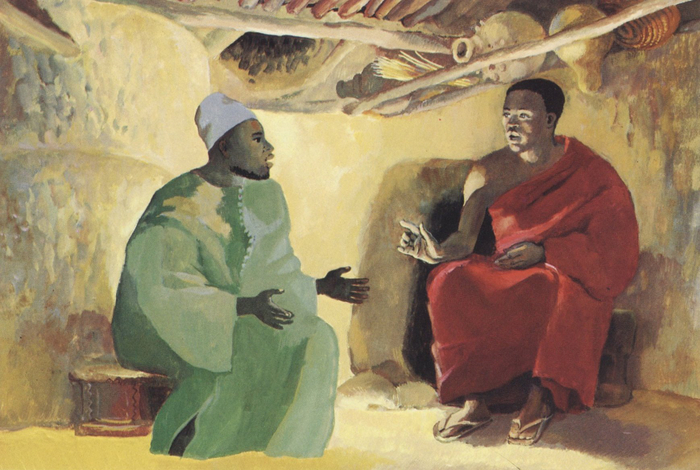
The following 1973 painting “Nicodemus” of the JESUS MAFA project is a response to New Testament readings from the Lectionary by a Christian community in Cameroon, Africa. Each of the readings was selected and adapted to dramatic interpretation by the community members. Photographs of their interpretations were made, and these were then transcribed to paintings:
Here we see Jesus patiently teaching about the kingdom of God to a perplexed Nicodemus, whose hands are in a gesture of questioning. Nicodemus has, like so many before and since, gotten caught up in the literal and limited understanding of the scriptures. Jesus attempted to explain the nature of reality in different terms that thereby he (and we) might be transformed. The boundaries we place on ourselves can be escaped if only we are brave enough to venture beyond them. Shall we remain in the cover of night with Nicodemus or step into the light that Jesus offers?
From Art in the Christian Tradition, a project of the Vanderbilt Divinity Library, Nashville, TN. Image retrieved March 23, 2026. Original source: librairie-emmanuel.fr.
Following are a number of back-translations of John 3:4:
Huehuetla Tepehua: “How can an old man get little and be born again? Can he get inside his mother and be born again?”
Xicotepec De Juárez Totonac: “. . . How can a grown man have a new life? He cannot enter into the womb of his mother to be born again.”
Alekano: “. . . One having become big, how will he appear new? How will he enter up into his mother’s stomach and she give birth? ” (Source for this and above: M. Larson / B. Moore in Notes on Translation February 1970, p. 1-125.)
Uma: “Nikodemus said: ‘Can a person who is already old be born again? Can he put himself in the womb of his mother and be born a second time?'” (Source: Uma Back Translation)
Yakan: “Nikodemus said, ‘How can a person be born again when he is already old? He cannot enter again the womb of his mother and be born again.'” (Source: Yakan Back Translation)
Western Bukidnon Manobo: “And this Nicodemus asked saying, ‘How can a man who is already old be born again? He can’t return back to the stomach of his mother so that he can be born again.'” (Source: Western Bukidnon Manobo Back Translation)
Kankanaey: “And then Nicodemus inquired, ‘How perhaps can a grown-man be born again? Can-he-return do-you-suppose into the stomach of his mother in order to then be born a-second-time (lit. repeat to be born)?'” (Source: Kankanaey Back Translation)
Tagbanwa: “Nicodemo asked, ‘How can a person be born again when he is now old/mature? Can he yet enter again into the womb of his mother and be born again?'” (Source: Tagbanwa Back Translation)
Tenango Otomi: “Nicodemus asked, ‘But how can he? How can a man who is old again live anew? Can he again enter into the inside of his mother in order to again live anew?'” (Source: Tenango Otomi Back Translation)
Illustration by Horst Lemke (1922-1985) for the GermanGute Nachricht für Sie – NT68, one of the first editions of the Good News Bible in German of 1968. Lemke was a well-known illustrator who illustrated books by Erich Kästner , Astrid Lindgren and many others.
Living Water is produced for the Bible translation movement in association with Lutheran Bible Translators. Lyrics derived from the ESV® Bible (The Holy Bible, English Standard Version®).
In Greek this verse consists of an introductory statement (“Nicodemus said to him”) followed by two questions, which Good News Translation makes into one question followed by an exclamation. For reasons of style, the phrase Nicodemus asked is placed between the question and the exclamation.
Grown man (so also Jerusalem Bible) is literally “old man,” but in the present context the emphasis is not that on age, but rather on maturity; the contrast is between a baby and a full-grown man. Born again (Phillips “born a second time”) is literally “born,” but here the reference is clearly to that of being born a second time.
Obviously, Nicodemus took the word rendered again in Good News Translation to mean again rather than “from above” (its other possible meaning). How Nicodemus understood the word does not necessarily imply what Jesus meant by it or how John intended it to be understood when used by Jesus in the preceding verse. It is impossible to find in English a word or phrase which would carry the possible double meaning that the word again has in verse 3. Since the reply of Nicodemus would sound foolish if Jesus’ words were translated “from above” in verse 3, it seems necessary to employ again in that verse. Similarly, although the verb used in verse 3 can have the meaning “to be born” or “to be begotten,” on the basis of Nicodemus’ reply to Jesus, it is in keeping with the overall context to translate it “to be born.”
Since it is almost impossible in most receptor languages (even as in English) to find a single word which will mean both “again” and “from above,” it may be desirable to have a marginal note here, indicating that the same Greek word can have both senses. Such a note will help the reader understand how the reply of Jesus can shift to an emphasis on the spiritual birth. An alternative translation would be inadequate, since it would not explain to the reader the original ambiguity in the Greek text.
There is often an advantage in shifting the second question posed by Nicodemus to an emphatic statement, especially in languages in which rhetorical questions are rare. It is evident that Nicodemus is not asking whether a man can enter his mother’s womb and be born a second time; rather he is emphasizing the impossibility of such a thing happening. Therefore, “He certainly cannot enter…!”
Quoted with permission from Newman, Barclay M. and Nida, Eugene A. A Handbook on the Gospel of John. (UBS Handbook Series). New York: UBS, 1980. For this and other handbooks for translators see here .
How can a man be born when he is old?: This is a rhetorical question. It expresses surprise and disbelief. Nicodemus was surprised that Jesus suggested being born again. There are two ways to translate this expression of surprise:
• Use a rhetorical question: For example:
But if a person is already old, how can he be born again? (New Century Version)
• Use a statement: For example:
I don’t believe anyone who is already old can be born ⌊again⌋ . -or-
It is impossible for an old person to be born/reborn.
Translate this expression of surprise in a way that is natural in your language.
In his rhetorical question, Nicodemus implied a general truth, but one that also applied to himself. He understood that Jesus implied that he needed to be born again. But as a leader of the Jews, he was a mature man, probably over forty (40). It may be more natural to make it explicit that this general truth applied to himself. For example:
I am already old. How can I am be born ⌊now⌋ ? -or-
How can anyone old ⌊like me⌋ be born?
3:4b
Can he enter his mother’s womb a second time to be born?: This is another rhetorical question. Nicodemus used it to express surprise and disbelief. Nicodemus was saying that it is impossible to be born physically a second time. An adult cannot enter his mother’s womb, which is where a baby grows in his mother before birth. There are at least two ways to translate this question:
• Use a rhetorical question. For example:
He cannot enter his mother’s body again. So how can a person be born a second time? (New Century Version)
• Use a statement. For example:
He certainly cannot enter his mother’s womb and be born a second time! (Good News Translation)
Translate this rhetorical question in a way that is natural in your language. It is important to use language that is acceptable in your culture for public reading. It may be necessary to use a euphemism for womb. For example, the New Century Version in the quote above has translated his mother’s womb as “his mother’s body.”
General Comment on 3:4a–b
The rhetorical questions in 3:4a and 3:4b are both used as statements that express Nicodemus’ doubts about what Jesus said. He did not understand what Jesus meant, and it sounded impossible. In some languages it may be more natural to combine the questions into one. For example:
How can a grown man ever be born a second time? (Contemporary English Version)
Another possible way to translate this verse is to follow the New Living Translation (2004). It still uses two questions, but the first is a real question that indicates Nicodemus did not understand Jesus’ words:
“What do you mean?” exclaimed Nicodemus. “How can an old man go back into his mother’s womb and be born again?” (New Living Translation (2004))



Leave a Reply
You must be logged in to post a comment.