
The Greek that is typically translated in English as “sign” is translated in Huehuetla Tepehua as “thing to be marveled at” (source: Larson 1889, p. 279) and in Mairasi as “big work” (source: Enggavoter 2004).
rabbi
The Hebrew word that is transliterated in Greek and typically in English as “rabbi” is translated in Indonesian and Malay as guru — “teacher” — or bapak guru — “father teacher” in recent translations. (The only exception that is the Alkitab Versi Borneo of 2015 that transliterates as rabi.) (Source: Daud Soesilo in The Bible Translator 1996, p. 335ff. )
See also teacher.
Religious leaders sought him out to find answers to life's deepest questions

“It is unusual for anyone to seek out another at night unless it is desired to be kept secret. Betel nut and condiments are laid out to welcome the guest even at the late hour. Nicodemus’s robe and bared shoulder show he is a religious devotee.”
Drawing by Sawai Chinnawong who employs northern and central Thailand’s popular distinctive artistic style originally used to depict Buddhist moral principles and other religious themes; explanation by Paul DeNeui. From That Man Who Came to Save Us by Sawai Chinnawong and Paul H. DeNeui, William Carey Library, 2010.
For more images by Sawai Chinnawong in TIPs see here.
The following 1973 painting “Nicodemus” of the JESUS MAFA project is a response to New Testament readings from the Lectionary by a Christian community in Cameroon, Africa. Each of the readings was selected and adapted to dramatic interpretation by the community members. Photographs of their interpretations were made, and these were then transcribed to paintings:
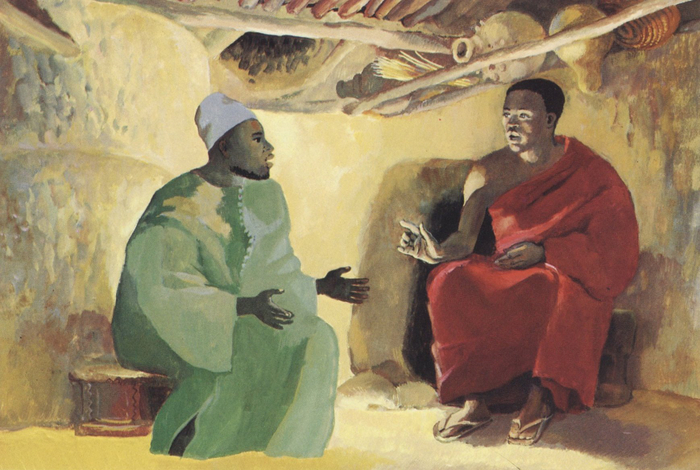
Here we see Jesus patiently teaching about the kingdom of God to a perplexed Nicodemus, whose hands are in a gesture of questioning. Nicodemus has, like so many before and since, gotten caught up in the literal and limited understanding of the scriptures. Jesus attempted to explain the nature of reality in different terms that thereby he (and we) might be transformed. The boundaries we place on ourselves can be escaped if only we are brave enough to venture beyond them. Shall we remain in the cover of night with Nicodemus or step into the light that Jesus offers?
From Art in the Christian Tradition , a project of the Vanderbilt Divinity Library, Nashville, TN. Image retrieved March 23, 2026. Original source: librairie-emmanuel.fr.
addressing Jesus in Nepali
The various Greek terms that are translated as “Lord,” “teacher,” or “rabbi” in English are translated in the Simple Nepali Holy Bible (2008) as guru-jyuu (गुरुज्यू). Guru simply means “teacher” and the honorific suffix -jyuu is added to it. Instead of guru-jyuu one can also simply use guru, which does not sound impolite. However, guru-jyuu is more respectful and thus preferable. (Source: Chitra Chhetri in The Bible Translator 2009, p. 73ff. )
complete verse (John 3:2)
Following are a number of back-translations of John 3:2:
- Uma: “One night, he came to meet-with Yesus, he said to him: ‘Teacher, what we (excl.) know [is], you are a teacher sent by God, because there is no person who can do miracles like what you do, if God is not with him.'” (Source: Uma Back Translation)
- Yakan: “One night he went to Isa and he said, ‘Sir, we (excl.) know that you are a teacher sent here by God. For you would not be able to do the wonder-causing works that you do if you were not given power by God.'” (Source: Yakan Back Translation)
- Western Bukidnon Manobo: “He went to Jesus at night, and he said to Jesus, ‘Datu, we know that you are a teacher whom God has sent, because the miracles which you do, the only one who can do like this is a person to whom God has given power.'” (Source: Western Bukidnon Manobo Back Translation)
- Kankanaey: “One night, he went to where Jesus was and said to him, ‘Sir teacher, we (excl.) know that God has sent you (sing.) to teach us (excl.). Because absolutely no one can-do the amazing signs that you (sing.) have-been-doing if God is not with him.'” (Source: Kankanaey Back Translation)
- Tagbanwa: “One night he made-a-house-call on Jesus. He said, ‘Teacher, we (excl.) know that you are a Teacher raised up by God, because no-one can do amazing things like you are doing unless he is being helped by God.'” (Source: Tagbanwa Back Translation)
- Tenango Otomi: “This Nicodemus went one night to talk with Jesus. He said, ‘Teacher. We know that God has sent you to teach us. Because no one can do the signs you do if God doesn’t enable him.'” (Source: Tenango Otomi Back Translation)
inclusive vs. exclusive pronoun (John 3:2)
Many languages distinguish between inclusive and exclusive first-person plural pronouns (“we”). (Click or tap here to see more details)
The inclusive “we” specifically includes the addressee (“you and I and possibly others”), while the exclusive “we” specifically excludes the addressee (“he/she/they and I, but not you”). This grammatical distinction is called “clusivity.” While Semitic languages such as Hebrew or most Indo-European languages such as Greek or English do not make that distinction, translators of languages with that distinction have to make a choice every time they encounter “we” or a form thereof (in English: “we,” “our,” or “us”).
For this verse, translators typically select the exclusive form (excluding Jesus).
Source: Velma Pickett and Florence Cowan in Notes on Translation January 1962, p. 1ff.
formal pronoun: religious leaders addressing Jesus
Like many languages (but unlike Greek or Hebrew or English), Tuvan uses a formal vs. informal 2nd person pronoun (a familiar vs. a respectful “you”). Unlike other languages that have this feature, however, the translators of the Tuvan Bible have attempted to be very consistent in using the different forms of address in every case a 2nd person pronoun has to be used in the translation of the biblical text.
As Voinov shows in Pronominal Theology in Translating the Gospels (in: The Bible Translator 2002, p. 210ff. ), the choice to use either of the pronouns many times involved theological judgment. While the formal pronoun can signal personal distance or a social/power distance between the speaker and addressee, the informal pronoun can indicate familiarity or social/power equality between speaker and addressee.
Here, religious leaders or their representatives are addressing Jesus with the formal pronoun, showing respect. Compare that with the typical address with the informal pronoun of the religious leaders. Voinov gives two reasons for the outliers. One is a “pretense of respect. These occasions are usually marked by their use of titles of respect such as ‘teacher.'” The other reason is sincere respect, such as in the case of the lawyer in Mark 12 or Nicodemus in John 3.
respectful form of "do" (nasaru)
Click or tap here to see the rest of this insight.
Like a number of other East Asian languages, Japanese uses a complex system of honorifics, i.e. a system where a number of different levels of politeness are expressed in language via words, word forms or grammatical constructs. These can range from addressing someone or referring to someone with contempt (very informal) to expressing the highest level of reference (as used in addressing or referring to God) or any number of levels in-between.
One way to do this is through the usage of lexical honorific forms, i.e., completely different words, as shown here in the widely-used Japanese Shinkaiyaku (新改訳) Bible of 2017. In these verses, nasaru (なさる), the respectful form of suru (する) or “do,” is used.
(Source: S. E. Doi, see also S. E. Doi in Journal of Translation, 18/2022, p. 37ff. )
Leave a Reply
You must be logged in to post a comment.