
The Greek that is translated as “betray” in English does not have an immediately corresponding term in Tado. The term that was chosen there was “sell.” (Source: Budy Karmoy in this blog post )
formal pronoun: Jesus addressing his disciples and common people
Like many languages (but unlike Greek or Hebrew or English), Tuvan uses a formal vs. informal 2nd person pronoun (a familiar vs. a respectful “you”). Unlike other languages that have this feature, however, the translators of the Tuvan Bible have attempted to be very consistent in using the different forms of address in every case a 2nd person pronoun has to be used in the translation of the biblical text.
As Voinov shows in Pronominal Theology in Translating the Gospels (in: The Bible Translator 2002, p. 210ff. ), the choice to use either of the pronouns many times involved theological judgment. While the formal pronoun can signal personal distance or a social/power distance between the speaker and addressee, the informal pronoun can indicate familiarity or social/power equality between speaker and addressee.
Here, Jesus is addressing his disciples, individuals and/or crowds with the formal pronoun, showing respect.
In Nepali translations, Jesus addresses his disciples and other people with the medium honorific pronoun timīlē (तिमीले) or timīlēharū (तिमीलेहरू). This disciples respond with a high honorific pronoun. (Source: Chitra Chhetri in The Bible Translator 2009, p. 73ff. )
In most Dutch translations, Jesus addresses his disciples and common people with the informal pronoun, whereas they address him with the formal form.
disciple
The Greek that is often translated as “disciple” in English typically follows three types of translation: (1) those which employ a verb ‘to learn’ or ‘to be taught’, (2) those which involve an additional factor of following, or accompaniment, often in the sense of apprenticeship, and (3) those which imply imitation of the teacher.
Following are some examples (click or tap for details):
- Ngäbere: “word searcher”
- Yaka: “one who learned from Jesus”
- Navajo (Dinė), Western Highland Purepecha, Tepeuxila Cuicatec, Lacandon: “one who learned”
- San Miguel El Grande Mixtec: “one who studied with Jesus”
- Northern Grebo: “one Jesus taught”
- Toraja-Sa’dan: “child (i.e., follower) of the master”
- Indonesian: “pupil” (also used in many Slavic languages, including Russian [ученик], Bulgarian [учени́к], Ukrainian [учень], or Polish [uczeń] — source: Paul Amara)
- Central Mazahua: “companion whom Jesus taught”
- Kipsigis, Loma, Copainalá Zoque: “apprentice” (implying continued association and learning)
- Cashibo-Cacataibo: “one who followed Jesus”
- Huautla Mazatec: “his people” (essentially his followers and is the political adherents of a leader)
- Highland Puebla Nahuatl: based on the root of “to imitate” (source for this and all above: Bratcher / Nida)
- Chol: “learner” (source: Larson 1998, p. 107)
- Waorani: “one who lives following Jesus” (source: Wallis 1973, p. 39)
- Ojitlán Chinantec: “learner” (Source: M. Larson / B. Moore in Notes on Translation February 1970, p. 1-125.)
- Javanese: “pupil” or “companion” (“a borrowing from Arabic that is a technical term for Mohammed’s close associates”)
- Cherokee: “those by whom one is followed” (source: Bender / Belt 2025, p. 23)
- German: Jünger or “younger one” (source for this and one above: Reiling / Swellengrebel)
- German New Testament translation by Berger / Nord (publ. 1999): Jüngerinnen und Jünger or “female and male disciples.” Note that Berger/Nord only use that translation in many cases in the gospel of Luke, “because especially according to Luke (see 8:1–3), women were part of the extended circle of disciples” (see p. 452 and looked up at his disciples).
- Noongar: ngooldjara-kambarna or “friend-follow” (source: Warda-Kwabba Luke-Ang)
-
French 1985 translation by Chouraqui: adept or “adept” (as in a person who is skilled or proficient at something). Watson (2023, p. 48ff.) explains (click or tap here to see more):
[Chouraqui] uses the noun “adept,” which is as uncommon in French as it is in English. It’s an evocative choice on several levels. First, linguistically, it derives — via the term adeptus — from the Latin verb adipiscor, “to arrive at; to reach; to attain something by effort or striving.” It suggests those who have successfully reached the goal of their searching, and implies a certain struggle or process of learning that has been gradually overcome. But it’s also a term with a very particular history: in the Middle Ages, “adept” was used in the world of alchemy, to describe those who, after years of labor and intensive study, claimed to have discovered the Great Secret (how to turn base metals like lead into gold); it thus had the somewhat softened meaning of “someone who is completely skilled in all the secrets of their field.”
Historians of religion often use the term adept with reference to the ancient mystery religions that were so prevalent in the Mediterranean in the centuries around the time of Jesus. An adept was someone who, through a series of initiatory stages, had penetrated into the inner, hidden mysteries of the religion, who understood its rituals, symbols, and their meaning. To be an adept implied a lengthy and intensive master-disciple relationship, gradually being led further and further into the secrets of the god or goddess (Isis-Osiris, Mithras, Serapis, Hermes, etc.) — secrets that were never to be revealed to an outsider.
Is “adept” a suitable category in which to consider discipleship as we see it described in the Gospels? On some levels, the link is an attractive one, drawing both upon the social-religious framework of the ancient Mediterranean, and upon certain aspects of intimacy and obscurity/secrecy that we see in the relationship of Jesus and those who followed him. The idea that disciples are “learners” — people who are “on the way” — and that Jesus is portrayed as (and addressed as) their Master/Teacher is accurate. But the comparison is unsatisfactory on several other levels.
First, the Gospels portray Jesus’s ministry as a largely public matter — there is relatively little of the secrecy and exclusiveness that is normally associated with both the mystery cults and medieval alchemy. Jesus’s primary message is not destined for a small, elite circle of “initiates” — although the Twelve are privy to explanations, experiences and teachings that are not provided to “the crowds.” For example, in Matthew 13:10-13:
Then the disciples came and asked him, “Why do you speak to [the crowds] in parables?” He answered, “To you it has been given to know the secrets of the kingdom of heaven, but to them it has not been given. For to those who have, more will be given, and they will have an abundance; but from those who have nothing, even what they have will be taken away. The reason I speak to them in parables is that ‘seeing they do not perceive, and hearing they do not listen, nor do they understand.’”
Etymologically, adeptus suggests someone who “has arrived,” who has attained a superior level of understanding reserved for very few. However, what we see in the Gospels, repeatedly, is a general lack of comprehension of many of Jesus’s key teachings by many of those who hear him. Many of his more cryptic sayings would have been virtually incomprehensible in their original context, and would only make sense in retrospect, in the wake of the events of Jesus’s passion, death, and resurrection. The intense master-student relationship is also lacking: the Gospels largely portray “the disciples” as a loose (and probably fluctuating) body of individuals, with minimal structure or cohesion. Finally, there seems to be little scholarly consensus about the degree to which the mystery cults had made inroads in Roman-ruled Palestine during the decades of Jesus’s life. According to Everett Ferguson in his Backgrounds of Early Christianity.
Although Christianity had points of contact with Stoicism, the mysteries, the Qumran community, and so on, the total worldview was often quite different….So far as we can tell, Christianity represented a new combination for its time…. At the beginning of the Christian era a number of local mysteries, some of great antiquity, flourished in Greece and Asia Minor. In the first century A.D. the vonly mysteries whose extension may be called universal were the mysteries of Dionysus and those of the eastern gods, especially Isis.
And Norman Perrin and Dennis C. Duling note, in their book The New Testament:
Examples of such mystery religions could be found in Greece… Asia Minor… Syria-Palestine… Persia… and Egypt. Though the mysteries had sacred shrines in these regions, many of them spread to other parts of the empire, including Rome. There is no clearly direct influence of the mysteries on early Christianity, but they shared a common environment and many non-Christians would have perceived Christians as members of an oriental Jewish mystery cult.56
Given the sparse archaeological and literary evidence from this period regarding mystery cults in Roman Palestine, and the apparent resistance of many Palestinian Jews to religious syncretism, Chouraqui’s use of the noun adept implies a comparison between the historical Jesus and mystery cults that is doubtful, on both the levels of chronology and religious culture. Personally, I believe this choice suggests a vision of Jesus that distances him from the religious world of ancient Judaism, thus creating a distorted view of what spiritually inspired him. But the idea of the disciples as “learners” on a journey (as the Greek term suggests) is a striking one to consider; certainly, the Gospels show us the Twelve as people who are growing, learning, and developing…but who have not yet “arrived” at the fullness of their vocation.
Scot McKnight (in The Second Testament, publ. 2023) translates it into English as apprentice.
In Luang several terms with different shades of meaning are being used.
- For Mark 2:23 and 3:7: maka nwatutu-nwaye’a re — “those that are taught” (“This is the term used for ‘disciples’ before the resurrection, while Jesus was still on earth teaching them.”)
- For Acts 9:1 and 9:10: makpesiay — “those who believe.” (“This is the term used for believers and occasionally for the church, but also for referring to the disciples when tracking participants with a view to keeping them clear for the Luang readers. Although Greek has different terms for ‘believers’, ‘brothers’, and ‘church’, only one Luang word can be used in a given episode to avoid confusion. Using three different terms would imply three different sets of participants.”)
- For Acts 6:1: mak lernohora Yesus wniatutunu-wniaye’eni — “those who follow Jesus’ teaching.” (“This is the term used for ‘disciples’ after Jesus returned to heaven.”)
Source: Kathy Taber in Notes on Translation 1/1999, p. 9-16.
In American Sign Language it is translated with a combination of the signs for “following” plus the sign for “group.” (Source: Ruth Anna Spooner, Ron Lawer)
“disciples” in American Sign Language, source: Deaf Harbor
In British Sign Language a sign is used that depicts a group of people following one person (the finger in the middle, signifying Jesus). Note that this sign is only used while Jesus is still physically present with his disciples. (Source: Anna Smith)
“Disciple in British Sign Language (source: Christian BSL, used with permission)
See also disciples (Japanese honorifics).
sinner
The Greek that is translated as “sinner” in English is translated in various ways:
- “people with bad hearts” (“it is not enough to call them ‘people who do bad things,’ for though actions do reflect the heart, yet it is the hearts with which God is primarily concerned — see Matt. 15:19“) in Western Kanjobal
- “people who are doing wrong things in their hearts” in San Blas Kuna (source for this and above: Nida 1952, p. 148)
- “people with bad stomachs” in Q’anjob’al (source: Newberry and Kittie Cox in The Bible Translator 1950, p. 91ff. )
- “those others who don’t fully obey our laws” in Tagbanwa (source: Tagbanwa Back Translation)
- “people with dirty hearts” or “people who are called ‘bad'” in Mairasi (source: Enggavoter 2004).
- “those who owe sin” in Central Mazahua and Teutila Cuicatec (source: Waterhouse / Parrott in Notes on Translation October 1967, p. 1ff.)
- “those without (or: “who don’t know”) God” (Gottlose) in the German New Testament translation by Berger / Nord (publ. 1999)
- “people of bad deeds” in Bariai (source: Bariai Back Translation)
- “rejected/despised people” in Kupsabiny (source: Kupsabiny Back Translation)
complete verse (Matthew 26:45)
Following are a number of back-translations of Matthew 26:45:
- Uma: “After he prayed, he returned again to his three disciples and said to them: ‘Are you still lying down and sleeping? Look, the time has come for me the Child of Mankind to be sold and handed over to evil people.” (Source: Uma Back Translation)
- Yakan: “When Isa came back to his disciples, he said to them, ‘Are you still sleeping and resting? Listen, the time has come. I, the Son of Man will soon be handed over to the holding/into the hands of sinful people.” (Source: Yakan Back Translation)
- Western Bukidnon Manobo: “And then he returned to them and he said, ‘So you are still lying around sound asleep? I, the Older Sibling of Mankind, this is already the time when I am handed over to wicked men.” (Source: Western Bukidnon Manobo Back Translation)
- Kankanaey: “Then he returned to where his disciples were and he said to them, ‘Why (exclamation) you’re still enjoying being-asleep! The hour that God has designated has already arrived, and I who am Child of a Person, I will be handed-over to sinful people.” (Source: Kankanaey Back Translation)
- Tagbanwa: “After he had prayed, he again returned to those three. On arriving, he said, ‘Are you still sleeping, just wanting to rest? Surely the hour has come that I who am the One From Heaven Born of Man/human have been traded. I will now be handed over to people who are sinners.” (Source: Tagbanwa Back Translation)
- Tenango Otomi: “Again he went to where his learners were and said: ‘Again you are sleeping, men? Well, now has come the hour that the Man who came from heaven will be delivered over to the evil people.” (Source: Tenango Otomi Back Translation)
Gethsemane

Hand colored stencil print on momigami by Sadao Watanabe (1962). Image taken with permission from the SadaoHanga Catalogue where you can find many more images and information about Sadao Watanabe. For other images of Sadao Watanabe art works in TIPs, see here.
Following is a painting (“Jesus’ agony in the garden of Gethsemane”) by Kim Ki-chang (1913-2001):

Kim Ki-chang (pen name: Unbo) had been deaf and partially mute since the age of 7. He painted a series of 30 paintings for the “Life of Christ” cycle in 1952 during the Korean War. Kim portrayed Jesus as a seonbi / 선비, or a Joseon Period (1392-1910) gentleman scholar, wearing a gat / 갓 (hat) and dopo / 도포 (robe). For other images of Kim Ki-chang art works in TIPs, see here.
Following is a painting (“Prayer at Gethsemane”) by He Qi:

He Qi © 2021 All Rights Reserved.
Image taken from He Qi Art . For purchasing prints of this and other artworks by He Qi go to heqiart.com . For other images of He Qi art works in TIPs, see here
Following is a painting in the Hamzanama style:

Prayer at Gethsemane, 2017-2018, Paul Abraham with Manish Soni, Opaque watercolour and natural pigments on hand-made paper, © Sarmaya Arts Foundation. (2018.33.12)
Following is a 1973 painting of the JESUS MAFA project, a response to New Testament readings from the Lectionary by a Christian community in Cameroon, Africa. Each of the readings was selected and adapted to dramatic interpretation by the community members. Photographs of their interpretations were made, and these were then transcribed to paintings:
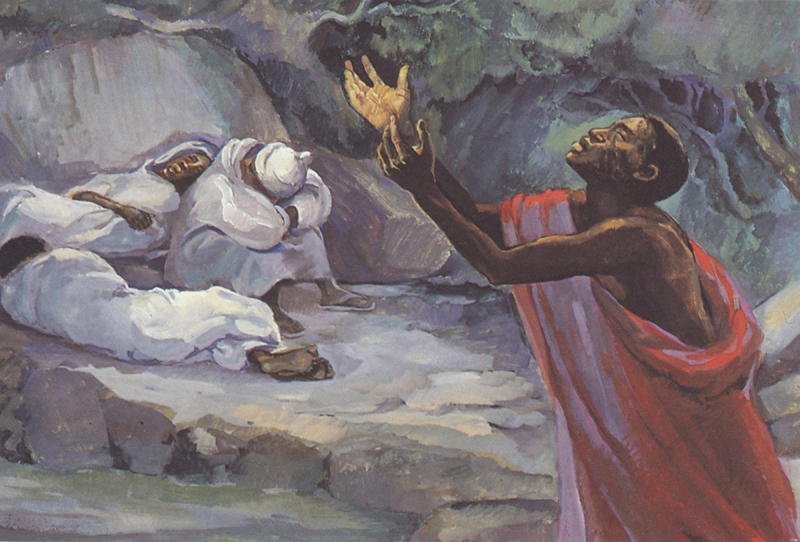
From Art in the Christian Tradition , a project of the Vanderbilt Divinity Library, Nashville, TN. Image retrieved March 23, 2026. Original source: librairie-emmanuel.fr.
The following is a stained glass window from 1906 and made by R. T. Giles & Co. of Minneapolis for the First Presbyterian Church, Salt Lake City, Utah :

Photo by NateBergin, hosted by Wikimedia Commons under a Creative Commons Attribution 4.0 International license

Stained glass is not just highly decorative, it’s a medium which has been used to express important religious messages for centuries. Literacy was not widespread in the medieval and Renaissance periods and the Church used stained glass and other artworks to teach the central beliefs of Christianity. In Gothic churches, the windows were filled with extensive narrative scenes in stained glass — like huge and colorful picture storybooks — in which worshipers could ‘read’ the stories of Christ and the saints and learn what was required for their religious salvation. (Source: Victoria and Albert Museum )
Son of Man
The Greek that is translated as “Son of Man” is mostly used by Jesus to refer to himself as well as in the prophecies of Daniel and Enoch (see Enoch 17:34 et al). It is translated in the following languages as (click or tap for details):
- San Miguel El Grande Mixtec: “One who is a person”
- Tzotzil: “I who am equal with men” or “The Older Brother of Everybody” (“expressing the dignity and authority of the Messiah and the universality of his work”)
- Chuj: “One who became human”
- Terêna: “The True Man”
- Tenango Otomi: “The Man Appointed” (i.e. the man to whom authority has been delegated) (source for this and preceding: Beekman, p. 189-190, see also Ralph Hill in Notes on Translation February 1983, p. 35-50)
- Huehuetla Tepehua: “Friend of all men”
- Aguaruna: “One who was born becoming a person” (source for this and two above: M. Larson / B. Moore in Notes on Translation February 1970, p. 1-125.)
- Western Bukidnon Manobo: “Older Sibling of Mankind” (source: Western Bukidnon Manobo Back Translation)
- Kankanaey: “Child of a Person” (source: Kankanaey Back Translation)
- Tagbanwa: “One From Heaven Born of Man/human?” (source: Tagbanwa Back Translation)
- Tenango Otomi: “Man who came from heaven” (source: Tenango Otomi Back Translation)
- Yatzachi Zapotec: “One who God sent, who was born a human” (a direct translation would have suggested “that the father is unknown due to the indiscretions of the mother” and where “he is the son of people” is used when one wants to disclaim responsibility for or relationship with a child caught in some mischief — source: Reiling / Swellengrebel)
- Kâte: Ŋic Fâri Wâtuŋne or “the man who is a true support” (source: Renck, p. 106)
- Mezquital Otomi: “The son who became a person” (Source: B. Moore / G. Turner in Notes on Translation 1967, p. 1ff.)
- Alekano: “The true man who descended from heaven” (source: Ellis Deibler in Notes on Translation June 1986, p. 36ff.)
- Central Tarahumara: “One who has been stood up to help” (“This suggests that Christ has been given authority to some appointed task. A very generic word, help, was selected to fill in the lexically obligatory purpose required by the word which means to appoint or commission. Usually this word is used of menial tasks but not exclusively. The choice of this generic term retains the veiled reference to the character of Christ’s work which He intended in using the ‘Son of Man’ title.”)
- Chicahuaxtla Triqui: “He who is relative of all people.” (“The Triqui word for relative is a rather generic term and in its extended sense sometimes is diluted to neighbor and friend. But the primary meaning is relative.”)
- Xicotepec De Juárez Totonac: “Sibling of All People”
- Tepeuxila Cuicatec: “The Person who Accompanies All People” (“The literal equivalents ‘son of man’ and ‘son of people’ were both rejected because of the false inference of natural birth involving a human father. Furthermore, it was necessary to expand any translation of the Bible by the addition of the pronoun ‘I’ so as to clarify the fact that Jesus is using the third person in referring to Himself. A common expression used by the Cuicatecos when difficulties befall someone, is to say to that one, ‘don’t worry, we are accompanying you.’ By this they mean they share that person’s sorrow. When wedding guests arrive at the home of a son who has just been married, they say to the father, ‘We have come to accompany you.’ By this they mean that they have come to share the father’s joy. These expressions do not refer to ordinary physical accompaniment, which is expressed by a set of different verbs. For example, visits are always announced by some such greeting as, “I have come to visit you,’ ‘I have come to see you,’ or ‘I have come to ask you something.’ The desire to accompany a friend on a journey is expressed by saying, ‘I will go with you.’ Translation helpers used the verb ‘accompany’ in constructing the phrase ‘I, the Person who Accompanies All People.'(…) It reflects the fact that Jesus closely identified Himself with all of us, understands our weaknesses, shares our burdens, rejoices with us in times of gladness, etc.”) (source for this and the three preceding: Beekman in Notes on Translation January 1963, p. 1-10)
- Guhu-Samane: “Elder-brother-man” (“Since the term denotes an elder brother in every way such as honor, power, leadership, representation of the younger, etc. it is a meaningful and fitting — though not ostentatious — title.” Source: Ernest Richert in The Bible Translator 1965, p. 198ff. )
- Avaric: “Son of Adam” (“from Islam, which means ‘human'”) (source: Magomed-Kamil Gimbatov and Yakov Testelets in The Bible Translator 1996, p. 434ff. )
- Navajo (Dinė): Diné Silíi’ii — “Man he-became-the-one-who” (“This terra presented a difficulty not only in Navajo but also one peculiar to all the Athapaskan languages. It lies in the fact that all these languages, so far as we know, have a word phonetically similar to the Navajo diné which has three meanings: ‘man, people in general,’ ‘a man,’ ‘The People’ which is the name the Navajos use for themselves. (The name Navajo was first used by the Spanish explorers.) Although it seemed natural to say diné biye’ ‘a-man his-son,’ this could also mean ‘The-People their-son’ or ‘a-Navajo his-son,’ in contrast to the son of a white man or of another Indian tribe. Since the concept of the humanity of Christ is so important, we felt that diné biye’ with its three possible meanings should not be used. The term finally decided on was Diné Silíi’ii ‘Man he-became-the-one-who.’ This could be interpreted to mean ‘the one who became a Navajo,’ but since it still would impart the idea of Christ’s becoming man, it was deemed adequate, and it has proven acceptable to the Navajos.”) (Source: Faye Edgerton in The Bible Translator 1962, p. 25ff. )
- Toraja-Sa’dan: “Child descended in the world” (“using a poetic verb, often found in songs that [deal with] the contacts between heaven and earth”) (source: Reiling / Swellengrebel)
- Obolo: Gwun̄ Ebilene: “Child of Human” (source: Enene Enene).
- Mairasi: Jaanoug Tat: “Person Child” (source: Enggavoter 2004)
- Morelos Nahuatl: “Christ who became man”
- Teutila Cuicatec: “One Who Accompanies all people”
- Isthmus Mixe: “Jesus Christ, the one who is a person” (source for this and two above: Viola Waterhouse in Notes on Translation August 1966, p. 86ff.)
- Northern Puebla Nahuatl: “Son of men” (source: B. Moore / G. Turner in Notes on Translation 1967, p. 1ff.)
- Inga: ” . . .: “One who became Man” (source: S. Levinsohn in Journal of Translation 18/2022, p. 67ff. )
- Costa Rican Sign Language: “It was impossible to translate the expression ‘Son of Man.’ The son-man sign simply means ‘male child.’ The Costa Rican Sign Language (LESCO) team opted for an interpretation of the term and translated it ‘Jesus.'” (Source: Elsa Tamez (in The Bible Translator 2008, p. 59ff. )
- Lokạạ: wẹẹn wạ ọnẹn or “son of a person.” “This translation is symbolic in that it uses indigenous Lokạạ words. However, since the publication of the New Testament in 2006, this phrase has gained popularity within contemporary Lokạạ society as an expression to describe an important person whose career is going well. In the New Testament, the phrase ‘son of man’ is used to describe Jesus as prototypically human, but the Lokạạ phrase is now being used to describe an exceptional person in Lokạạ society.” (Source: J.A. Naudé, C.L. Miller Naudé, J.O. Obono in Acta Theologica 43/2, 2023, p. 129ff. )
In many West African languages, using a third person reference as a first person indicator is common practice with a large range of semantic effects. Languages that use the exact expression “son of man” as a self-reference or reference to another person include Lukpa, Baatonum, Mossi (“son of Adam”), Yoruba (“son of person”), Guiberoua Béte, or Samo. (Source: Lynell Zogbo in: Omanson 2000, p. 167-188.)
In Swahili the expression Mwana wa Mtu or mwana wa mtu or “son/daughter of human person,” which is used by several Bible translations, also has “the idiomatic meaning of ‘a human being’” (source: Jean-Claude Loba-Mkole in An Intercultural Criticism of New Testament Translations 2013, see here). The same is true for the Lingala expression Mwana na Moto — “son/daughter of human person.” (Ibid.)
In Balinese “we are again bordering on theological questions when we inquire as to which vocabulary shall be used to translate the texts where Jesus speaks of himself as ‘the Son of man.’ One of the fixed rules governing the use of these special vocabularies is that one may never use the deferential terms in speaking of oneself. This would be the extreme of arrogance. Now if one considers the expression ‘Son of man’ primarily as a description of ‘I,’ then one must continually indicate the possessions or actions of the Son of man by Low Balinese words. In doing this the mystery of the expression is largely lost. In any case the vocabulary used in most of the contexts would betray that Jesus means the title for himself.
“However, a distinction can actually be made in Balinese between the person and the exalted position he occupies. For example, the chairman of a judicial body may employ deferential terms when referring to this body and its chairman, without this being taken as an expression of arrogance. Considered from this standpoint, one may translate in such a way that Jesus is understood as using such deferential words and phrases in speaking of himself. The danger is, however, that the unity between his person and the figure of “the Son of man” is blurred by such usage.
“On request, the New Testament committee of the Netherlands Bible Society advised that ‘the sublimity of this mysterious term be considered the most important point and thus High Balinese be used.'”
Source: J.L. Swellengrebel in The Bible Translator 1950 , p. 124ff.
In Malay, Barclay Newman (in The Bible Translator 1974, p. 432ff. ) reports on the translation of “Today’s Malay Version” (Alkitab Berita Baik) of 1987:
“One of the first things that we did in working through the earlier part of the New Testament was to decide on how we would translate some of the more difficult technical terms. It was immediately obvious that something must be done with the translation of ‘the Son of Man,’ since the literal rendering anak manusia (literally ‘child of a man’) held absolutely no meaning for Malay readers. We felt that the title should emphasize the divine origin and authority of the one who used this title, and at the same time, since it was a title, we decided that it should not be too long a phrase. Finally, a phrase meaning ‘the One whom God has ordained’ was chosen (yang dilantik Allah). It is interesting to note that the newly-begun Common Indonesian (Alkitab Kabar Baik, published in 1985) has followed a similar route by translating ‘the One whom God has chosen’ (yang depilih Allah).”
In Libras (Brazilian Sign Language) it is translated with a sign that brings together three concepts: God, Son and human. (Source: Missão Kophós )
“Son of Man” in Libras (source )
See also Son of God.
See also Translation commentary on Matthew 8:20 and learn more on Bible Odyssey: The Son of Man .
Honorary "are" construct denoting God ("say")
Click or tap here to see the rest of this insight.
Like a number of other East Asian languages, Japanese uses a complex system of honorifics, i.e. a system where a number of different levels of politeness are expressed in language via words, word forms or grammatical constructs. These can range from addressing someone or referring to someone with contempt (very informal) to expressing the highest level of reference (as used in addressing or referring to God) or any number of levels in-between.
One way Japanese shows different degree of politeness is through the usage of an honorific construction where the morpheme are (され) is affixed on the verb as shown here in the widely-used Japanese Shinkaiyaku (新改訳) Bible of 2017. This is particularly done with verbs that have God as the agent to show a deep sense of reverence. Here, iw-are-ru (言われる) or “say” is used.
(Source: S. E. Doi, see also S. E. Doi in Journal of Translation, 18/2022, p. 37ff. )
Leave a Reply
You must be logged in to post a comment.