
The Greek that is translated as “betray” in English does not have an immediately corresponding term in Tado. The term that was chosen there was “sell.” (Source: Budy Karmoy in this blog post )
Gethsemane

Hand colored stencil print on momigami by Sadao Watanabe (1962). Image taken with permission from the SadaoHanga Catalogue where you can find many more images and information about Sadao Watanabe. For other images of Sadao Watanabe art works in TIPs, see here.
Following is a painting (“Jesus’ agony in the garden of Gethsemane”) by Kim Ki-chang (1913-2001):

Kim Ki-chang (pen name: Unbo) had been deaf and partially mute since the age of 7. He painted a series of 30 paintings for the “Life of Christ” cycle in 1952 during the Korean War. Kim portrayed Jesus as a seonbi / 선비, or a Joseon Period (1392-1910) gentleman scholar, wearing a gat / 갓 (hat) and dopo / 도포 (robe). For other images of Kim Ki-chang art works in TIPs, see here.
Following is a painting (“Prayer at Gethsemane”) by He Qi:
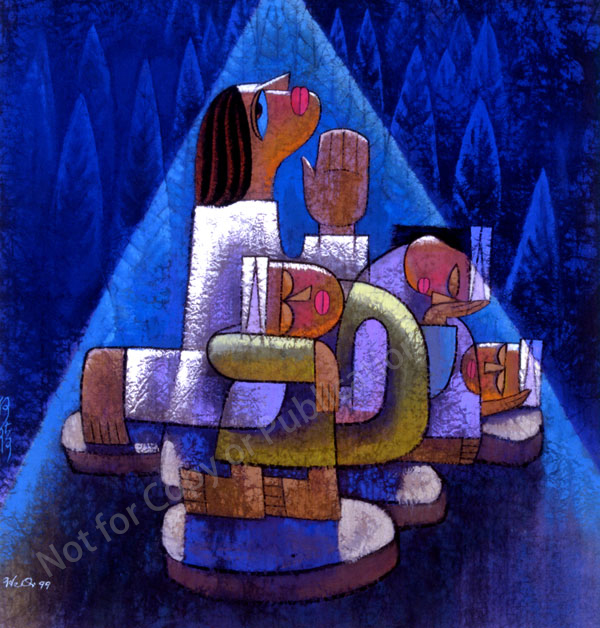
He Qi © 2021 All Rights Reserved.
Image taken from He Qi Art . For purchasing prints of this and other artworks by He Qi go to heqiart.com . For other images of He Qi art works in TIPs, see here
Following is a painting in the Hamzanama style:

Prayer at Gethsemane, 2017-2018, Paul Abraham with Manish Soni, Opaque watercolour and natural pigments on hand-made paper, © Sarmaya Arts Foundation. (2018.33.12)
Following is a 1973 painting of the JESUS MAFA project, a response to New Testament readings from the Lectionary by a Christian community in Cameroon, Africa. Each of the readings was selected and adapted to dramatic interpretation by the community members. Photographs of their interpretations were made, and these were then transcribed to paintings:
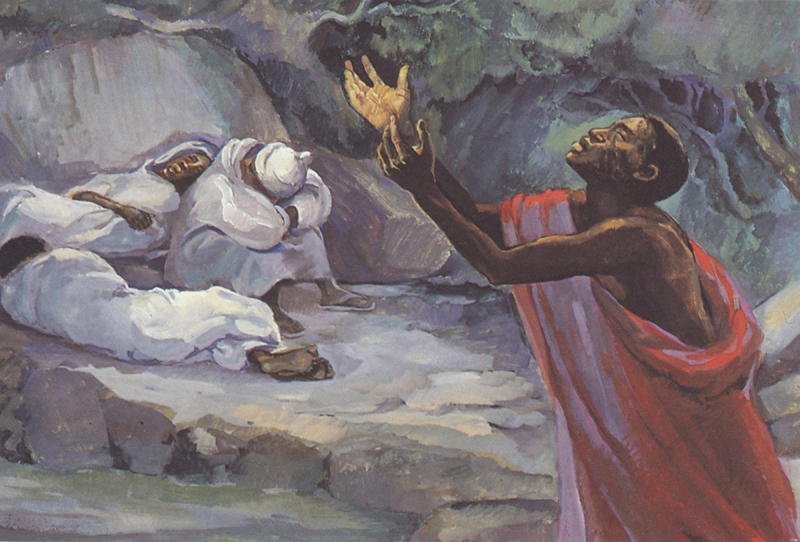
From Art in the Christian Tradition , a project of the Vanderbilt Divinity Library, Nashville, TN. Image retrieved March 23, 2026. Original source: librairie-emmanuel.fr.
The following is a stained glass window from 1906 and made by R. T. Giles & Co. of Minneapolis for the First Presbyterian Church, Salt Lake City, Utah :

Photo by NateBergin, hosted by Wikimedia Commons under a Creative Commons Attribution 4.0 International license

Stained glass is not just highly decorative, it’s a medium which has been used to express important religious messages for centuries. Literacy was not widespread in the medieval and Renaissance periods and the Church used stained glass and other artworks to teach the central beliefs of Christianity. In Gothic churches, the windows were filled with extensive narrative scenes in stained glass — like huge and colorful picture storybooks — in which worshipers could ‘read’ the stories of Christ and the saints and learn what was required for their religious salvation. (Source: Victoria and Albert Museum )
inclusive vs. exclusive pronoun (Matt. 26:46 / Mark 14:42)
Many languages distinguish between inclusive and exclusive first-person plural pronouns (“we”). (Click or tap here to see more details)
The inclusive “we” specifically includes the addressee (“you and I and possibly others”), while the exclusive “we” specifically excludes the addressee (“he/she/they and I, but not you”). This grammatical distinction is called “clusivity.” While Semitic languages such as Hebrew or most Indo-European languages such as Greek or English do not make that distinction, translators of languages with that distinction have to make a choice every time they encounter “we” or a form thereof (in English: “we,” “our,” or “us”).
For this verse, translators typically select the inclusive form (including Peter, James and John).
Source: Velma Pickett and Florence Cowan in Notes on Translation January 1962, p. 1ff.
complete verse (Matthew 26:46)
Following are a number of back-translations of Matthew 26:46:
- Uma: “Get up! Look, here comes the person who will sell me. Let’s go.'” (Source: Uma Back Translation)
- Yakan: “Stand up, let’s go. Look, here is the man who betrays me.'” (Source: Yakan Back Translation)
- Western Bukidnon Manobo: “Get up. Here is the one who is betraying me. Let’s go meet him.'” (Source: Western Bukidnon Manobo Back Translation)
- Kankanaey: “Get-up, because here-now is-coming the one who will betray me. Let’s go meet (him).'” (Source: Kankanaey Back Translation)
- Tagbanwa: “Get up now and let’s be going. There now is that one who traded me!'” (Source: Tagbanwa Back Translation)
- Tenango Otomi: “Get up. Here comes the one to betray me, let’s go meet him.'” (Source: Tenango Otomi Back Translation)
1st person pronoun referring to God (Japanese)
Click or tap here to see the rest of this insight.
Like a number of other East Asian languages, Japanese uses a complex system of honorifics, i.e. a system where a number of different levels of politeness are expressed in language via words, word forms or grammatical constructs. These can range from addressing someone or referring to someone with contempt (very informal) to expressing the highest level of reference (as used in addressing or referring to God) or any number of levels in-between.
One way Japanese shows different degree of politeness is through the choice of a first person singular and plural pronoun (“I” and “we” and its various forms) as shown here in the widely-used Japanese Shinkaiyaku (新改訳) Bible of 2017. The most commonly used watashi/watakushi (私) is typically used when the speaker is humble and asking for help. In these verses, where God / Jesus is referring to himself, watashi is also used but instead of the kanji writing system (私) the syllabary hiragana (わたし) is used to distinguish God from others.
(Source: S. E. Doi, see also S. E. Doi in Journal of Translation, 18/2022, p. 37ff. )
See also pronoun for “God”.
Sung version of Matthew 26
Translation commentary on Matthew 26:46
Rise, let us be going is clearly stated in modern English by Good News Translation: “Get up, let us go.” See is more naturally “Look.” My betrayer is at hand can be “the man who has betrayed me is here.”
Quoted with permission from Newman, Barclay M. and Stine, Philip C. A Handbook on the Gospel of Matthew. (UBS Handbook Series). New York: UBS, 1988. For this and other handbooks for translators see here .
Leave a Reply
You must be logged in to post a comment.