The following artwork is part of a series of 56 paintings on biblical themes by Kazakh artist Nelly Bube (born 1949):
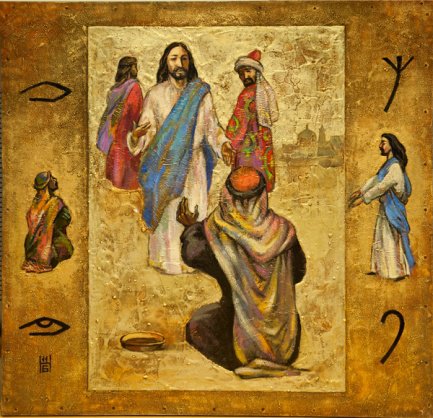
Copyright by Norwegian Bible Society , used with permission.
For other images of Nelly Bube in TIPs, see here.

καὶ ἐπετίμων αὐτῷ πολλοὶ ἵνα σιωπήσῃ· ὁ δὲ πολλῷ μᾶλλον ἔκραζεν, Υἱὲ Δαυίδ, ἐλέησόν με.
48Many sternly ordered him to be quiet, but he cried out even more loudly, “Son of David, have mercy on me!”
The following artwork is part of a series of 56 paintings on biblical themes by Kazakh artist Nelly Bube (born 1949):
Copyright by Norwegian Bible Society , used with permission.
For other images of Nelly Bube in TIPs, see here.
Following is the translation of Mark 10:46-52 into Russian Sign Language with a back-translation underneath:
Source: Russian Bible Society / Российское Библейское Общество
Jesus and his disciples came to the city of Jericho. After a while they left the city. Jesus was followed by a large crowd of people. By the side of the road where Jesus was walking with the crowd behind him, a man named Bartimaeus was sitting. He was blind, a poor beggar, and he was sitting there begging for alms. He heard that a crowd was passing by, and in it came Jesus from the city of Nazareth. Then he began to shout:
— Jesus, descendant of King David! Please have mercy on me!
The people around him forbade him to shout. But the beggar shouted even louder: “Jesus, descendant of David! Please have mercy on me!”
Jesus stopped and said: “Bring the blind man to me.” The men came to the blind man and said, “Get up, Jesus is calling you.”
The blind man got up, took off his cloak, and came to Jesus.
Jesus asked:
— What do you want me to do for you?
The blind man answered:
— Teacher! I want to see.
Jesus said:
— Your faith has saved you! Go!
The blind man’s eyes opened and he began to see clearly. He was very happy. Jesus went on and the blind man followed Jesus.
Иисус вместе с учениками пришли в город Иерихон. Спустя какое-то время, они ушли оттуда. За Иисусом следовала большая толпа народу. Возле дороги, по которой шел Иисус, а за ним толпа народа, сидел человек по имени Бар-Тимай. Он был слепой, бедный нищий, он сидел и просил милостыню. Он услышал, что мимо проходит толпа, а в ней идет Иисус из города Назарета. И тогда он стал кричать:
— Иисус, потомок царя Давида! Прошу, помилуй меня!
Люди вокруг стали ему запрещать кричать. Но нищий кричал еще громче: «Иисус, потомок Давида! Прошу, помилуй меня!»
Иисус остановился и сказал: «Приведите ко мне слепого». Люди подошли к слепому и сказали: «Вставай, тебя зовет Иисус».
Слепой встал, снял с себя накидку и подошел к Иисусу.
Иисус спросил:
— Что ты хочешь, чтобы я сделал для тебя?
Слепой ответил:
— Учитель! Я хочу видеть.
Иисус сказал:
— Твоя вера спасла тебя! Ступай!
Глаза слепого прозрели и он начал все хорошо видеть. Он очень обрадовался. Иисус продолжил идти дальше, а слепой последовал за Иисусом.
Back-translation by Luka Manevich
<< Mark 10:35-45 in Russian Sign Language
Mark 11:1-11 in Russian Sign Language >>
The Hebrew, Aramaic, Greek, Ge’ez, and Latin terms that are typically translated as “mercy” (or “compassion” or “kindness”) in English are translated in various ways. Bratcher / Nida classify them in (1) those based on the quality of heart, or other psychological center, (2) those which introduce the concept of weeping or extreme sorrow, (3) those which involve willingness to look upon and recognize the condition of others, or (4) those which involve a variety of intense feelings.
While the English mercy originates from the Latin merces, originally “price paid,” Romance languages (Italian, Spanish, Corsican, Catalan, Friulian) and other Germanic languages (German, Swedish, Danish — Barmherzigkeit, barmhärtighet and barmhjertighed, respectively) tend to follow the Latin misericordia, lit. “misery-heart.”
Here are some other (back-) translations:
See also steadfast love and Seat of the Mind / Seat of Emotions.
Following is the translation of Mark 10:46-52 into Mexican Sign Language with back-translations into Spanish and English underneath:
© La Biblia en LSM / La Palabra de Dios
Jacobo y Juan fueron (a Jesús) y dijeron: “Maestro nosotros dos queremos pedir algo, por favor dinos que sí.”
Jesús (dijo): “¿Qué es lo que quieren decirme?”
Dijeron: “Cuando tú llegues a ser el rey superior sentado en el trono ¿podemos nosotros dos estar sentados a ambos lados de ti?”
Jesús (dijo): “No saben lo que me dicen. Mira, por ejemplo, un poco adelante yo beberé una copa amarga. ¿Uds lo pueden?
Otro ejemplo: yo bajaré en el agua del mar, quiere decir que sufriré fuertemente. ¿Uds lo aceptarían?” Los dos (dijeron que) sí podrían.
Jesús dijo: “yo sufriré e igual en el futuro uds dos sufrirán, pero antes Dios ya ha elegido dos personas que estarán sentados a ambos lados de mi, yo no puede elegirlos.”
Los diez discípulos estaban furiosos y pensaban que Jacobo y Juan eran malos.
Jesús se volteó (hacia los diez) y los llamó y los discípulos vinieron. (Jesús dijo): “Uds saben que en otros países los líders abusan a todas las personas simples, y los mandan.
Uds, los discípulos, no copien esta mentalidad, apartense.
Si uds quieren ser líderes deben servir y ayudar, el líder más importante debe ser humilde y servir y ayudar a las personas.
El hijo de hombre ha venido, ¿y todas las personas lo sirven? No, el opuesto, el hijo de hombre sirve a todas las personas.
El hijo de hombre acepta morir en lugar de ellos para salvar a muchas personas.”
Jesus and the disciples went to Jericho and afterwards Jesus and the disciples left together.
Many people walked alongside them and there was a man, Bartimaeus, who was blind, sitting there, he was poor and was begging.
He heard the multitude walk by and said: “What’s happening?” The people said: “Jesus of Nazareth is there.”
Bartimaeus shouted: “Jesus, you descendant of the family of David, take pity on me and help me!” The people walking in the crowd said: “Be quiet!”
Bartimaeus shouted again, more strongly: “Jesus, you descendant of the family of David, take pity on me and help me!” Jesus stopped and turned around and said: “Call the man to come.”
The people said: “Jesus is calling you, be pleased and happy, get up, let’s go.”
Bartimaeus got up, took off his cloak and walked up to Jesus.
Jesus said: “How do you want me to help you?”
He said: “Teacher, a long time ago I could see well, and now I’m blind. I want my eyes to be opened again, that I may see.”
Jesus (said): You have already been healed because of your faith, you can go.”
Instantly the eyes of Bartimaeus were opened and he saw, and he followed Jesus accompanying him in the crowd.
Source: La Biblia en LSM / La Palabra de Dios
<< Mark 10:35-45 in Mexican Sign Language
Mark 11:1-11 in Mexican Sign Language >>
In many West African languages, using a third person reference as a first person indicator is common practice with a large range of semantic effects. Languages that use the exact expression “son of man” as a self-reference or reference to another person include Lukpa, Baatonum, Mossi (“son of Adam”), Yoruba (“son of person”), Guiberoua Béte, or Samo. (Source: Lynell Zogbo in: Omanson 2000, p. 167-188.)
In Swahili the expression Mwana wa Mtu or mwana wa mtu or “son/daughter of human person,” which is used by several Bible translations, also has “the idiomatic meaning of ‘a human being’” (source: Jean-Claude Loba-Mkole in An Intercultural Criticism of New Testament Translations 2013, see here). The same is true for the Lingala expression Mwana na Moto — “son/daughter of human person.” (Ibid.)
In Balinese “we are again bordering on theological questions when we inquire as to which vocabulary shall be used to translate the texts where Jesus speaks of himself as ‘the Son of man.’ One of the fixed rules governing the use of these special vocabularies is that one may never use the deferential terms in speaking of oneself. This would be the extreme of arrogance. Now if one considers the expression ‘Son of man’ primarily as a description of ‘I,’ then one must continually indicate the possessions or actions of the Son of man by Low Balinese words. In doing this the mystery of the expression is largely lost. In any case the vocabulary used in most of the contexts would betray that Jesus means the title for himself.
“However, a distinction can actually be made in Balinese between the person and the exalted position he occupies. For example, the chairman of a judicial body may employ deferential terms when referring to this body and its chairman, without this being taken as an expression of arrogance. Considered from this standpoint, one may translate in such a way that Jesus is understood as using such deferential words and phrases in speaking of himself. The danger is, however, that the unity between his person and the figure of “the Son of man” is blurred by such usage.
“On request, the New Testament committee of the Netherlands Bible Society advised that ‘the sublimity of this mysterious term be considered the most important point and thus High Balinese be used.'”
Source: J.L. Swellengrebel in The Bible Translator 1950 , p. 124ff.
In Malay, Barclay Newman (in The Bible Translator 1974, p. 432ff. ) reports on the translation of “Today’s Malay Version” (Alkitab Berita Baik) of 1987:
“One of the first things that we did in working through the earlier part of the New Testament was to decide on how we would translate some of the more difficult technical terms. It was immediately obvious that something must be done with the translation of ‘the Son of Man,’ since the literal rendering anak manusia (literally ‘child of a man’) held absolutely no meaning for Malay readers. We felt that the title should emphasize the divine origin and authority of the one who used this title, and at the same time, since it was a title, we decided that it should not be too long a phrase. Finally, a phrase meaning ‘the One whom God has ordained’ was chosen (yang dilantik Allah). It is interesting to note that the newly-begun Common Indonesian (Alkitab Kabar Baik, published in 1985) has followed a similar route by translating ‘the One whom God has chosen’ (yang depilih Allah).”
In Libras (Brazilian Sign Language) it is translated with a sign that brings together three concepts: God, Son and human. (Source: Missão Kophós )
“Son of Man” in Libras (source )
See also Son of God.
See also Translation commentary on Matthew 8:20 and learn more on Bible Odyssey: The Son of Man .
Following are a number of back-translations of Mark 10:48:
The name that is transliterated as “David” in English means “beloved.” (Source: Cornwall / Smith 1997 )
In Spanish Sign Language it is translated with the sign signifying king and a sling (referring to 1 Samuel 17:49 and 2 Samuel 5:4). (Source: John Elwode in The Bible Translator 2008, p. 78ff. )
“Elizabeth” in Spanish Sign Language, source: Sociedad Bíblica de España
In German Sign Language it is only the sling. (See here ).
“David” in German Sign Language (source )
For more information on translations of proper names with sign language see Sign Language Bible Translations Have Something to Say to Hearing Christians .
The (Protestant) Mandarin Chinese transliteration of “David” is 大卫 (衛) / Dàwèi which carries an additional meaning of “Great Protector.”
Learn more on Bible Odyssey: David .
No comments yet.
Leave a Reply
You must be logged in to post a comment.