The name that is transliterated as “Nazareth” in English is translated in Hungarian Sign Language with a sign that refers to blossoming and spring: it depicts the growth of young shoots. The word Nazareth is derived from the Hebrew word netzer, which means bud, blossom, sprout, or shoot. This linguistic connection is particularly significant for Messianic prophecies, such as in the Book of Isaiah: A shoot will come up from the stump of Jesse; from his roots a Branch (netzer) will bear fruit (Isaiah 11:1). Thus, the sign in sign language does not only identify a city, but also visually connects Nazareth with the prophetic title of Jesus. The translation highlights that the sign in sign language is essentially a visual exegesis: with a single motion, it teaches the profound etymological connection between the name of the city and the promise of the Savior. The sign is more than just a word, a label; it is simultaneously a commentary, an interpretation. (Source: Jenjelvi Biblia and HSL Bible Translation Group)
The Greek that is translated in English as “have mercy on me” is translated in Roviana as “(Son of David,) love me, help me!” (source: Carl Gross) and in Mairasi as “(Daud’s Child,) desire my face (=love me)” (source: Enggavoter 2004).
Click or tap here to see the rest of this insight.
Like a number of other East Asian languages, Japanese uses a complex system of honorifics, i.e. a system where a number of different levels of politeness are expressed in language via words, word forms or grammatical constructs. These can range from addressing someone or referring to someone with contempt (very informal) to expressing the highest level of reference (as used in addressing or referring to God) or any number of levels in-between. One way to do this is through the usage of appropriate suffix title referred to as keishō (敬称) as shown here in the widely-used Japanese Shinkaiyaku (新改訳) Bible of 2017 by either using -san or –sama with the latter being the more formal title.
In these verses, Jesus is addressed in the Shinkaiyaku Bible as Iesu-sama (イエス様), combining the transliteration for “Jesus” and the suffix title –sama. Note: In Luke 24:23, Iesu-sama is used as a replacement for the pronoun “he.” (Source: S. E. Doi, see also S. E. Doi in Journal of Translation, 18/2022, p. 37ff. )
Retrotraducciones en español (haga clic o pulse aquí)
Jacobo y Juan fueron (a Jesús) y dijeron: “Maestro nosotros dos queremos pedir algo, por favor dinos que sí.”
Jesús (dijo): “¿Qué es lo que quieren decirme?”
Dijeron: “Cuando tú llegues a ser el rey superior sentado en el trono ¿podemos nosotros dos estar sentados a ambos lados de ti?”
Jesús (dijo): “No saben lo que me dicen. Mira, por ejemplo, un poco adelante yo beberé una copa amarga. ¿Uds lo pueden?
Otro ejemplo: yo bajaré en el agua del mar, quiere decir que sufriré fuertemente. ¿Uds lo aceptarían?” Los dos (dijeron que) sí podrían.
Jesús dijo: “yo sufriré e igual en el futuro uds dos sufrirán, pero antes Dios ya ha elegido dos personas que estarán sentados a ambos lados de mi, yo no puede elegirlos.”
Los diez discípulos estaban furiosos y pensaban que Jacobo y Juan eran malos.
Jesús se volteó (hacia los diez) y los llamó y los discípulos vinieron. (Jesús dijo): “Uds saben que en otros países los líders abusan a todas las personas simples, y los mandan.
Uds, los discípulos, no copien esta mentalidad, apartense.
Si uds quieren ser líderes deben servir y ayudar, el líder más importante debe ser humilde y servir y ayudar a las personas.
El hijo de hombre ha venido, ¿y todas las personas lo sirven? No, el opuesto, el hijo de hombre sirve a todas las personas.
El hijo de hombre acepta morir en lugar de ellos para salvar a muchas personas.”
Jesus and the disciples went to Jericho and afterwards Jesus and the disciples left together.
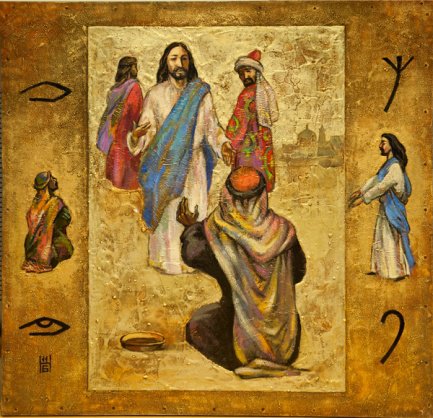
Many people walked alongside them and there was a man, Bartimaeus, who was blind, sitting there, he was poor and was begging.
He heard the multitude walk by and said: “What’s happening?” The people said: “Jesus of Nazareth is there.”
Bartimaeus shouted: “Jesus, you descendant of the family of David, take pity on me and help me!” The people walking in the crowd said: “Be quiet!”
Bartimaeus shouted again, more strongly: “Jesus, you descendant of the family of David, take pity on me and help me!” Jesus stopped and turned around and said: “Call the man to come.”
The people said: “Jesus is calling you, be pleased and happy, get up, let’s go.”
Bartimaeus got up, took off his cloak and walked up to Jesus.
Jesus said: “How do you want me to help you?”
He said: “Teacher, a long time ago I could see well, and now I’m blind. I want my eyes to be opened again, that I may see.”
Jesus (said): You have already been healed because of your faith, you can go.”
Instantly the eyes of Bartimaeus were opened and he saw, and he followed Jesus accompanying him in the crowd.
The Hebrew, Aramaic, Greek, Ge’ez, and Latin terms that are typically translated as “mercy” (or “compassion” or “kindness”) in English are translated in various ways. Bratcher / Nida classify them in (1) those based on the quality of heart, or other psychological center, (2) those which introduce the concept of weeping or extreme sorrow, (3) those which involve willingness to look upon and recognize the condition of others, or (4) those which involve a variety of intense feelings.
While the Englishmercy originates from the Latinmerces, originally “price paid,” Romance languages (Italian, Spanish, Corsican, Catalan, Friulian) and other Germanic languages (German, Swedish, Danish — Barmherzigkeit, barmhärtighet and barmhjertighed, respectively) tend to follow the Latin misericordia, lit. “misery-heart.”
Jesus and his disciples came to the city of Jericho. After a while they left the city. Jesus was followed by a large crowd of people. By the side of the road where Jesus was walking with the crowd behind him, a man named Bartimaeus was sitting. He was blind, a poor beggar, and he was sitting there begging for alms. He heard that a crowd was passing by, and in it came Jesus from the city of Nazareth. Then he began to shout:
— Jesus, descendant of King David! Please have mercy on me!
The people around him forbade him to shout. But the beggar shouted even louder: “Jesus, descendant of David! Please have mercy on me!”
Jesus stopped and said: “Bring the blind man to me.” The men came to the blind man and said, “Get up, Jesus is calling you.”
The blind man got up, took off his cloak, and came to Jesus.
Jesus asked:
— What do you want me to do for you?
The blind man answered:
— Teacher! I want to see.
Jesus said:
— Your faith has saved you! Go!
The blind man’s eyes opened and he began to see clearly. He was very happy. Jesus went on and the blind man followed Jesus.
Original Russian back-translation (click or tap here):
Иисус вместе с учениками пришли в город Иерихон. Спустя какое-то время, они ушли оттуда. За Иисусом следовала большая толпа народу. Возле дороги, по которой шел Иисус, а за ним толпа народа, сидел человек по имени Бар-Тимай. Он был слепой, бедный нищий, он сидел и просил милостыню. Он услышал, что мимо проходит толпа, а в ней идет Иисус из города Назарета. И тогда он стал кричать:
— Иисус, потомок царя Давида! Прошу, помилуй меня!
Люди вокруг стали ему запрещать кричать. Но нищий кричал еще громче: «Иисус, потомок Давида! Прошу, помилуй меня!»
Иисус остановился и сказал: «Приведите ко мне слепого». Люди подошли к слепому и сказали: «Вставай, тебя зовет Иисус».
Слепой встал, снял с себя накидку и подошел к Иисусу.
Иисус спросил:
— Что ты хочешь, чтобы я сделал для тебя?
Слепой ответил:
— Учитель! Я хочу видеть.
Иисус сказал:
— Твоя вера спасла тебя! Ступай!
Глаза слепого прозрели и он начал все хорошо видеть. Он очень обрадовался. Иисус продолжил идти дальше, а слепой последовал за Иисусом.
Following are a number of back-translations of Mark 10:47:
Uma: “When Bartimeus heard that Yesus the Nazaret person was going by, he called out, he said: ‘Yesus descendant of King Daud! Show-pity/love-to me!'” (Source: Uma Back Translation)
Yakan: “When he heard that Isa, the man of Nasaret was the one passing by – surprise -, he called out loud, he said, ‘O Isa, descendant of King Da’ud, have pity on me.'” (Source: Yakan Back Translation)
Western Bukidnon Manobo: “And when he heard that it was Jesus of Nazareth and company passing by, he called out loudly, and he said, ‘Hey, Jesus, descendant of long ago King David, pity me!'” (Source: Western Bukidnon Manobo Back Translation)
Kankanaey: “When he heard that Jesus from-Nazaret was there, he shouted-right-out saying, ‘Hey Jesus! Descendant of David! Please have-mercy!'” (Source: Kankanaey Back Translation)
Tagbanwa: “When he knew that Jesus the taga Nazaret was there, he called out saying, ‘Jesus, descendant of king David, do pity me!'” (Source: Tagbanwa Back Translation)

Leave a Reply
You must be logged in to post a comment.