The Greek that is translated as “paralytic” in English is translated by the Panjabi translation in Persian script with the common expression “one struck by paralysis.” (Source: Yousaf Sadiq in The Bible Translator 2021, p. 189ff.)
In Cherokee “paralysis” is translated as “loss of control” (source: Bender / Belt 2025, p. 33).
“Successful Thai gatherings are always crowded. Four people carrying a wooden bed is a symbol of death to Thai people. Here Jesus symbolizes resurrection by raising the man from the sick bed back to health in body and soul.”
A few days passed. There was a house in the town of Capernaum. Jesus came there. A rumor went around among the people that Jesus was there. Many, many people began to come to the house. The house was full, it was very crowded, there was no room, even outside. Everyone wanted to hear Jesus. And Jesus preached to them.
There was one man there, a sick man. He was paralyzed, his body was not moving. He was lying down and four men were carrying him on a stretcher. They wanted to help him, to bring him to Jesus so that Jesus could heal him. And so they carried the sick man. There was a crowd of people around. Those men tried to push the crowd apart, but it was very crowded. There was no way through. They began to think what to do. They saw that the roof of the house was flat, and there was a ladder attached to the house, which led directly to the roof. And they decided: let’s climb up! All four of them climbed up to the roof. They took a thick stick and began to break a hole in the roof. The roof was flat, made of clay and reeds. And so they made a hole in the roof and pulled apart the clay and reeds. It was a big round hole. They looked down and there was Jesus preaching. They got excited. Jesus looked up at them from below and smiled.
— “I know you have faith in me!
And the four men used ropes to pull the stretcher with the sick man up onto the roof, and then carefully lowered him down into the hole below. Jesus watched the stretcher being lowered, and when it came down in front of him, he said:
— My son, your sins are forgiven!
And in the midst of the crowd sat several teachers of the law. They shuddered with indignation, and began to talk and point at Jesus:
— How dare Jesus say, “Your sins are forgiven”! God alone can forgive sins! And Jesus says such things! He is insulting God.
They were very indignant.
Jesus realized what they were thinking and said:
— Enough! Why are you slandering me? I am asking you a question. There are two things: which one is easier?
First I say to him, “Your sins are forgiven.”
The second thing: Here is a paralyzed man lying down. I say to him, “Get up, roll up your mat, and go home!”
Which of these two things is easier? The first thing is easier. It’s easier to say, “Your sins are forgiven.”
And so you see I’m here on earth right now. I have the power to forgive the sins of people who sin and do evil deeds. So here I am saying to this paralyzed man, “Get up, roll up your mat and get on your feet.”
The crowd around was amazed. Look, look — everyone said — we know this man could not walk, but he stood up. We have never seen such a miracle before! Everyone was amazed and glorified God.
Original Russian back-translation (click or tap here):
Прошло несколько дней. В городе Капернаум был один дом. Туда пришел Иисус. Между людьми повсюду пошел слух, что там Иисус. И многие-многие люди стали приходить в этот дом. Дом переполнился, было очень тесно, места не было даже снаружи. Все хотели послушать Иисуса. И Иисус им проповедовал.
Там был один человек, больной. Он был парализован, его тело не двигалось. Он лежал, а четыре человека несли его на носилках. Они хотели помочь ему, поднести его к Иисусу, чтобы Иисус исцелил его. И вот они несут больного. Кругом толпа народа. Те люди пытались раздвинуть толпу, но было очень тесно. Нет пути. Они стали думать, что делать. Видят они: у дома крыша плоская, а к дому приставлена лестница, которая ведет прямо на крышу. И решили: давайте заберемся! Все вчетвером забрались на крышу. Взяли толстую палку и стали пробивать дыру в крыше. Крыша была плоская, была она сделана из глины и тростника. И вот они делают дыру в крыше, раздвигают глину и тростник. Получилась большая круглая дыра. Смотрят вниз, а там Иисус проповедует. Они обрадовались. Иисус снизу на них посмотрел, улыбнулся.
Иисус говорит:
— Я знаю, у вас есть вера в Меня!
А эти четыре человека на веревках подтянули носилки с больным на крышу, а потом аккуратно опустили в дыру вниз. Иисус смотрел, как носилки опускаются, и когда они перед ним опустились, он сказал:
— Сын мой! Твои грехи тебе прощаются!
А среди толпы сидели несколько учителей закона. Они даже вздрогнули от возмущения и стали недовольно переговариваться, показывая на Иисуса:
— Да как же Иисус смеет говорить «твои грехи прощены»! Только один Бог может прощать грехи! А Иисус такое говорит! Он оскорбляет Бога.
Они были очень возмущены.
Иисус понял, о чем они думают, и сказал:
— Довольно! Зачем на меня клевещете? Я вам задаю вопрос. Есть две вещи: какая из них проще?
Первая вещь. Я ему говорю: «Твои грехи прощены».
Вторая вещь. Вот парализованный человек лежит. Я ему говорю: «Вставай, сверни свой коврик и ступай домой!»
Что из этих двух вещей проще? Первая вещь проще. Проще сказать: «Твои грехи прощены».
И вот вы видите, что я сейчас здесь, на земле. Я имею власть прощать грехи людей, которые грешат и совершают злые дела. Вот я говорю этому парализованному человеку: «Вставай, скатай свой коврик и ступай».
И о чудо! Этот человек поднялся, тело его сделалось здоровым. С восторгом он смотрит на свои руки и ноги. Он скатал свой коврик, взял его под мышку и радостный пошел.
Толпа вокруг была изумлена. Смотрите, смотрите — говорили все — мы знаем, этот человек не мог ходить, а он встал. Мы такого чуда никогда раньше не видели! Все изумлялись и прославляли Бога.
Retrotraducciones en español (haga clic o pulse aquí)
Unos días después en el mismo pueblo de Capernaúm Jesús otra vez fue a una casa.
La gente lo vio y dijo: “Jesús está en la casa allá, vengan”, y la todos fueron a la casa y entraron y estaba llena de gente, y afuera de la puerta todas las personas estaban intentando a ver a Jesús que estaba predicando.
Afuera había un hombre que no podía caminar, su cuerpo era paralizado y estaba acostado. 4 Personas fueron a ayudarlo y llevaron su camilla, pero vieron que estaba lleno de gente y no podían entrar, ¿cómo?
Vieron: “la azotea, bien, vengan”, y los 4 subieron cargando la camilla, y arriba pusieron la camilla en el piso y empezaron a quitar la techumbre.
Jesús estaba predicando y miró hacia arriba y vio que estaban quitando la techumbre.
Los hombres estaban quitando la techumbre, y cuando estaba todo bien, levantaron la camilla y la bajaron con cuerda, y la camilla con el hombre estaba bajando.
Jesús miró hacia arriba y pensó: huy, ellos tienen fe, y cuando la camilla había bajado dijo: “tus pecados son perdonados.”
Los maestros de la ley que estaban sentados lo vieron y pensaron: absurdo, Jesús habla mal, él es irrespetuoso contra Dios, ¿cómo puede ser?
Sólo Dios puede perdonar a las personas, y puede borrar pecados, ¿qué piensa él?
Pero Jesús lo sintió adentro y lo sabía y volvió a verlos diciendo: “Maestros de la ley, ¿porqué piensan e imaginanse que yo hizo algo mal?
Alto, yo les pregunto ¿cúal sería más fácil, decirle: ‘tus pecados ya son perdonados’ o decirle: ‘levantate, arregla tu camilla, guardala y vete’? ¿Cuál piensan uds?
Oigan, aqui en el mundo hay uno, el hijo del hombre, que tiene autoridad y que puede perdonar los pecados a la gente.
Uds me ven y son testigos (y dijo al hombre): levantate, arregla tu camilla y guardalo y vete a tu casa.”
El hombre acostado notó que todo su cuerpo se había sanado y se paró, arregló su camilla, lo guardó y se fue caminando.
Todas las personas lo vieron (y dijeron): “Esto jamás habíamos visto, hoy lo vemos por primera vez, huy, ¡qué maravilloso es Dios!”
Some days later in the same village of Capernaum Jesus went to a house again.
The people saw him and said: “There is Jesus, over there in the house, come” and the multitude went to the house and entered it and it was full of people, and outside the door all those people were trying to see as Jesus preached.
Outside there was a man who could not walk, his body was paralyzed and he was lying down. Four persons came to help him, they carried his stretcher over, but then they saw that it was full of people and they could not go in, how?
They saw: “Oh good, the roof, come” and the four of them went up carrying the stretcher and upstairs they put down the stretcher and started to take away the roofing.
Jesus was preaching and he looked up and saw them take away the roofing.
The men were taking out the roofing and when all was ready they took the stretcher and lowered it with a rope and the stretcher with the man went down.
Jesus looked up and thought: wow, they have faith, and when the stretcher had been lowered he said: “Your sins have been forgiven.”
The teachers of the law that were sitting there saw this and they thought: this is ridiculous, Jesus speaks badly, without respect, against God, how can he do that?
Only God can forgive people their sins, what is he thinking?
But Jesus felt this and knew it, and he turned to them and said: “Teachers of the law, why do you think and imagine that I did something bad?
“Now stop, let me ask you which you think is easier, to tell him: ‘your sins have already been forgiven’ or to tell him: get up, arrange your stretcher, put it under your am and go’? Which one do you think?
“Listen, here in the world there is one person, the son of man, who has authority and can forgive people their sins.
“You see me and are witnesses (and he said to the man): get up, arrange your stretcher, put it under your arm and go home.”
The man who was lying down felt that his whole body had healed and he got up, arranged his stretcher, took it under his arm and walked out.
All the people saw it (and said): “Who have never seen this before, today is the first time we have seen it, wow, God is wonderful!”
The Hebrew, Ge’ez, and Greek that is typically translated as “sin” in English has a wide variety of translations.
The Greek ἁμαρτάνω (hamartanō) carries the original verbatim meaning of “miss the mark” and likewise, many translations contain the “connotation of moral responsibility.”
Loma: “leaving the road” (which “implies a definite standard, the transgression of which is sin”)
Navajo (Dinė): “that which is off to the side” (source for this and above: Bratcher / Nida)
Toraja-Sa’dan: kasalan, originally meaning “transgression of a religious or moral rule” and in the context of the Bible “transgression of God’s commandments” (source: H. van der Veen in The Bible Translator 1950, p. 21ff. )
Bariai: “bad behavior” (source: Bariai Back Translation)
Sandawe: “miss the mark” (like the original meaning of the Greek term) (source for this and above: Ursula Wiesemann in Holzhausen / Riderer 2010, p. 36ff., 43)
Nias: horö, originally a term primarily used for sexual sin. (Source: Hummel / Telaumbanua 2007, p. 256)
In Shipibo-Conibo the term is hocha. Nida (1952, p. 149) tells the story of its choosing: “In some instances a native expression for sin includes many connotations, and its full meaning must be completely understood before one ever attempts to use it. This was true, for example, of the term hocha first proposed by Shipibo-Conibo natives as an equivalent for ‘sin.’ The term seemed quite all right until one day the translator heard a girl say after having broken a little pottery jar that she was guilty of ‘hocha.’ Breaking such a little jar scarcely seemed to be sin. However, the Shipibos insisted that hocha was really sin, and they explained more fully the meaning of the word. It could be used of breaking a jar, but only if the jar belonged to someone else. Hocha was nothing more nor less than destroying the possessions of another, but the meaning did not stop with purely material possessions. In their belief God owns the world and all that is in it. Anyone who destroys the work and plan of God is guilty of hocha. Hence the murderer is of all men most guilty of hocha, for he has destroyed God’s most important possession in the world, namely, man. Any destructive and malevolent spirit is hocha, for it is antagonistic and harmful to God’s creation. Rather than being a feeble word for some accidental event, this word for sin turned out to be exceedingly rich in meaning and laid a foundation for the full presentation of the redemptive act of God.”
Martin Ehrensvärd, one of the translators for the DanishBibelen 2020, comments on the translation of this term: “We would explain terms, such that e.g. sin often became ‘doing what God does not want’ or ‘breaking God’s law’, ‘letting God down’, ‘disrespecting God’, ‘doing evil’, ‘acting stupidly’, ‘becoming guilty’. Now why couldn’t we just use the word sin? Well, sin in contemporary Danish, outside of the church, is mostly used about things such as delicious but unhealthy foods. Exquisite cakes and chocolates are what a sin is today.” (Source: Ehrensvärd in HIPHIL Novum 8/2023, p. 81ff. )
Following are a number of back-translations of Mark 2:10:
Uma: “I, the Child of Mankind, I do have authority in the world to forgive sins. But if I say to this lame person: ‘Your (sing.) sins are forgiven,’ you do not know whether they are really forgiven or not. But if I say: ‘Get up, roll up your (sing.) mat, and walk,’ you will see whether it happens or not. So I will show you that I have authority to forgive sin.’ From there, he turned to that lame person,” (Source: Uma Back Translation)
Yakan: “I heal this man in order that you will know that I, the Son of Mankind, have authority here in this world to forgive sins.'” (Source: Yakan Back Translation)
Western Bukidnon Manobo: “By healing this man now, I will show you that I, the Older Sibling of Mankind, I have authority here on the earth to forgive sin.’ Then he said to the man who was paralyzed, he said,” (Source: Western Bukidnon Manobo Back Translation)
Kankanaey: “But if that is so, I will then say what is difficult in order to thereby confirm to you that I who am Child of a Person have authority on this earth (lit. surface of this earth) to forgive sins.’ Then he said to that cripple,” (Source: Kankanaey Back Translation)
Tagbanwa: “Therefore I will heal this illness of his so that you will realize that as for me, who am the One From Heaven Born of Man/human, I do indeed have authority here under the heavens to forgive sins.’ And then he said to that person who was paralyzed,” (Source: Tagbanwa Back Translation)
Kim text for oral translation: “It’s good, so that you know that the Son of Man has the power on the earth to forgive sins, I say to the paralysed person:” (Source: Bayamy Tchande Awakde in The Bible Translator 2025, p. 23ff.)
English translation by Michael Pakaluk (2019): “… But so that you may know that the Son of Man has authority on earth to forgive sins…’ — now he speaks to the paralytic –”
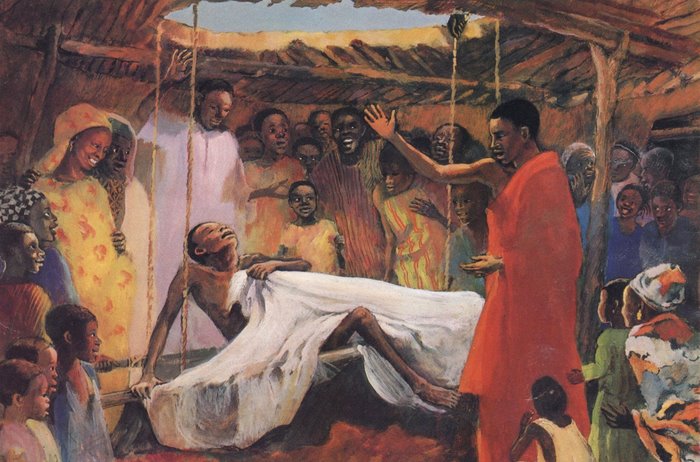
Following is a 1973 painting of the JESUS MAFA project, a response to New Testament readings from the Lectionary by a Christian community in Cameroon, Africa. Each of the readings was selected and adapted to dramatic interpretation by the community members. Photographs of their interpretations were made, and these were then transcribed to paintings:
From Art in the Christian Tradition, a project of the Vanderbilt Divinity Library, Nashville, TN. Image retrieved March 23, 2026. Original source: librairie-emmanuel.fr.
The Greek that is translated as “Son of Man” is mostly used by Jesus to refer to himself as well as in the prophecies of Daniel and Enoch (see Enoch 17:34 et al). It is translated in the following languages as (click or tap for details):
Tzotzil: “I who am equal with men” or “The Older Brother of Everybody” (“expressing the dignity and authority of the Messiah and the universality of his work”)
Tenango Otomi: “The Man Appointed” (i.e. the man to whom authority has been delegated) (source for this and preceding: Beekman, p. 189-190, see also Ralph Hill in Notes on Translation February 1983, p. 35-50)
Aguaruna: “One who was born becoming a person” (source for this and two above: M. Larson / B. Moore in Notes on Translation February 1970, p. 1-125.)
Western Bukidnon Manobo: “Older Sibling of Mankind” (source: Western Bukidnon Manobo Back Translation)
Kankanaey: “Child of a Person” (source: Kankanaey Back Translation)
Tagbanwa: “One From Heaven Born of Man/human?” (source: Tagbanwa Back Translation)
Tenango Otomi: “Man who came from heaven” (source: Tenango Otomi Back Translation)
Yatzachi Zapotec: “One who God sent, who was born a human” (a direct translation would have suggested “that the father is unknown due to the indiscretions of the mother” and where “he is the son of people” is used when one wants to disclaim responsibility for or relationship with a child caught in some mischief — source: Reiling / Swellengrebel)
Kâte: Ŋic Fâri Wâtuŋne or “the man who is a true support” (source: Renck, p. 106)
Mezquital Otomi: “The son who became a person” (Source: B. Moore / G. Turner in Notes on Translation 1967, p. 1ff.)
Alekano: “The true man who descended from heaven” (source: Ellis Deibler in Notes on Translation June 1986, p. 36ff.)
Central Tarahumara: “One who has been stood up to help” (“This suggests that Christ has been given authority to some appointed task. A very generic word, help, was selected to fill in the lexically obligatory purpose required by the word which means to appoint or commission. Usually this word is used of menial tasks but not exclusively. The choice of this generic term retains the veiled reference to the character of Christ’s work which He intended in using the ‘Son of Man’ title.”)
Chicahuaxtla Triqui: “He who is relative of all people.” (“The Triqui word for relative is a rather generic term and in its extended sense sometimes is diluted to neighbor and friend. But the primary meaning is relative.”)
Tepeuxila Cuicatec: “The Person who Accompanies All People” (“The literal equivalents ‘son of man’ and ‘son of people’ were both rejected because of the false inference of natural birth involving a human father. Furthermore, it was necessary to expand any translation of the Bible by the addition of the pronoun ‘I’ so as to clarify the fact that Jesus is using the third person in referring to Himself. A common expression used by the Cuicatecos when difficulties befall someone, is to say to that one, ‘don’t worry, we are accompanying you.’ By this they mean they share that person’s sorrow. When wedding guests arrive at the home of a son who has just been married, they say to the father, ‘We have come to accompany you.’ By this they mean that they have come to share the father’s joy. These expressions do not refer to ordinary physical accompaniment, which is expressed by a set of different verbs. For example, visits are always announced by some such greeting as, “I have come to visit you,’ ‘I have come to see you,’ or ‘I have come to ask you something.’ The desire to accompany a friend on a journey is expressed by saying, ‘I will go with you.’ Translation helpers used the verb ‘accompany’ in constructing the phrase ‘I, the Person who Accompanies All People.'(…) It reflects the fact that Jesus closely identified Himself with all of us, understands our weaknesses, shares our burdens, rejoices with us in times of gladness, etc.”) (source for this and the three preceding: Beekman in Notes on Translation January 1963, p. 1-10)
Guhu-Samane: “Elder-brother-man” (“Since the term denotes an elder brother in every way such as honor, power, leadership, representation of the younger, etc. it is a meaningful and fitting — though not ostentatious — title.” Source: Ernest Richert in The Bible Translator 1965, p. 198ff. )
Navajo (Dinė): Diné Silíi’ii — “Man he-became-the-one-who” (“This terra presented a difficulty not only in Navajo but also one peculiar to all the Athapaskan languages. It lies in the fact that all these languages, so far as we know, have a word phonetically similar to the Navajo diné which has three meanings: ‘man, people in general,’ ‘a man,’ ‘The People’ which is the name the Navajos use for themselves. (The name Navajo was first used by the Spanish explorers.) Although it seemed natural to say diné biye’ ‘a-man his-son,’ this could also mean ‘The-People their-son’ or ‘a-Navajo his-son,’ in contrast to the son of a white man or of another Indian tribe. Since the concept of the humanity of Christ is so important, we felt that diné biye’ with its three possible meanings should not be used. The term finally decided on was Diné Silíi’ii ‘Man he-became-the-one-who.’ This could be interpreted to mean ‘the one who became a Navajo,’ but since it still would impart the idea of Christ’s becoming man, it was deemed adequate, and it has proven acceptable to the Navajos.”) (Source: Faye Edgerton in The Bible Translator 1962, p. 25ff. )
Toraja-Sa’dan: “Child descended in the world” (“using a poetic verb, often found in songs that [deal with] the contacts between heaven and earth”) (source: Reiling / Swellengrebel)
Obolo: Gwun̄ Ebilene: “Child of Human” (source: Enene Enene).
Mairasi: Jaanoug Tat: “Person Child” (source: Enggavoter 2004)
Costa Rican Sign Language: “It was impossible to translate the expression ‘Son of Man.’ The son-man sign simply means ‘male child.’ The Costa Rican Sign Language (LESCO) team opted for an interpretation of the term and translated it ‘Jesus.'” (Source: Elsa Tamez (in The Bible Translator 2008, p. 59ff. )
Lokạạ: wẹẹn wạ ọnẹn or “son of a person.” “This translation is symbolic in that it uses indigenous Lokạạ words. However, since the publication of the New Testament in 2006, this phrase has gained popularity within contemporary Lokạạ society as an expression to describe an important person whose career is going well. In the New Testament, the phrase ‘son of man’ is used to describe Jesus as prototypically human, but the Lokạạ phrase is now being used to describe an exceptional person in Lokạạ society.” (Source: J.A. Naudé, C.L. Miller Naudé, J.O. Obono in Acta Theologica 43/2, 2023, p. 129ff. )
In many West African languages, using a third person reference as a first person indicator is common practice with a large range of semantic effects. Languages that use the exact expression “son of man” as a self-reference or reference to another person include Lukpa, Baatonum, Mossi (“son of Adam”), Yoruba (“son of person”), Guiberoua Béte, or Samo. (Source: Lynell Zogbo in: Omanson 2000, p. 167-188.)
In Swahili the expression Mwana wa Mtu or mwana wa mtu or “son/daughter of human person,” which is used by several Bible translations, also has “the idiomatic meaning of ‘a human being’” (source: Jean-Claude Loba-Mkole in An Intercultural Criticism of New Testament Translations 2013, see here). The same is true for the Lingala expression Mwana na Moto — “son/daughter of human person.” (Ibid.)
In Balinese “we are again bordering on theological questions when we inquire as to which vocabulary shall be used to translate the texts where Jesus speaks of himself as ‘the Son of man.’ One of the fixed rules governing the use of these special vocabularies is that one may never use the deferential terms in speaking of oneself. This would be the extreme of arrogance. Now if one considers the expression ‘Son of man’ primarily as a description of ‘I,’ then one must continually indicate the possessions or actions of the Son of man by Low Balinese words. In doing this the mystery of the expression is largely lost. In any case the vocabulary used in most of the contexts would betray that Jesus means the title for himself.
“However, a distinction can actually be made in Balinese between the person and the exalted position he occupies. For example, the chairman of a judicial body may employ deferential terms when referring to this body and its chairman, without this being taken as an expression of arrogance. Considered from this standpoint, one may translate in such a way that Jesus is understood as using such deferential words and phrases in speaking of himself. The danger is, however, that the unity between his person and the figure of “the Son of man” is blurred by such usage.
“On request, the New Testament committee of the Netherlands Bible Society advised that ‘the sublimity of this mysterious term be considered the most important point and thus High Balinese be used.'”
“One of the first things that we did in working through the earlier part of the New Testament was to decide on how we would translate some of the more difficult technical terms. It was immediately obvious that something must be done with the translation of ‘the Son of Man,’ since the literal rendering anak manusia (literally ‘child of a man’) held absolutely no meaning for Malay readers. We felt that the title should emphasize the divine origin and authority of the one who used this title, and at the same time, since it was a title, we decided that it should not be too long a phrase. Finally, a phrase meaning ‘the One whom God has ordained’ was chosen (yang dilantik Allah). It is interesting to note that the newly-begun Common Indonesian (Alkitab Kabar Baik, published in 1985) has followed a similar route by translating ‘the One whom God has chosen’ (yang depilih Allah).”