In Aekyom, years are counted as “turtles” (ambum).
Norm Mundhenk tells this story:
“Recently I was checking some New Testament material in the Aekyom language of western Papua New Guinea. It seemed relatively clear until suddenly we came to a passage that started, ‘When Jesus had 12 turtles, …’ Surely I had misunderstood what they said.
“‘Did you say that Jesus had 12 turtles?’
“‘Let us explain! Around here there is a certain time every year when river turtles come up on the banks and lay their eggs. Because this is so regular, it can be used as a way of counting years. Someone’s age is said to be how many turtles that person has. So when we say that Jesus had 12 turtles, we mean that Jesus was 12 years old.’
“It was of course the familiar story of Jesus’ trip with his parents to Jerusalem. And certainly, as we all know, Jesus did indeed have 12 turtles at that time!”
In Tok Pisin, krismas (derived from “christmas”) is taken as the fixed annual marker, so Jesus had 12 “christmases” (Jisas i gat 12-pela krismas pinis) or Abram (in Gen. 12:4) had 75 (Abram i gat 75 krismas) (source: Norm Mundhenk). In Noongar it is biroka kadak or “summers had” (source: Warda-Kwabba Luke-Ang).
The term that is transliterated as “Abram” in English is translated in American Sign Language with the sign signifying sojourning with a staff, clearly differentiating it from Abraham. (Source: Ruth Anna Spooner, Ron Lawer)
“Abram” in American Sign Language, source: Deaf Harbor
Similarly, in Vietnamese (Hanoi) Sign Language it is translated with a sign that demonstrates that he has to wander from his home. (Source: The Vietnamese Sign Language translation team, VSLBT)
“Abram” in Vietnamese Sign Language, source: SooSL
The Hebrew and Greek that is transliterated as “Lot” in English is translated in Spanish Sign Language with a sign that signifies “cousin,” referring to the fact that Lot is Abraham’s cousin (see Genesis 11:27). (Source: Steve Parkhurst)
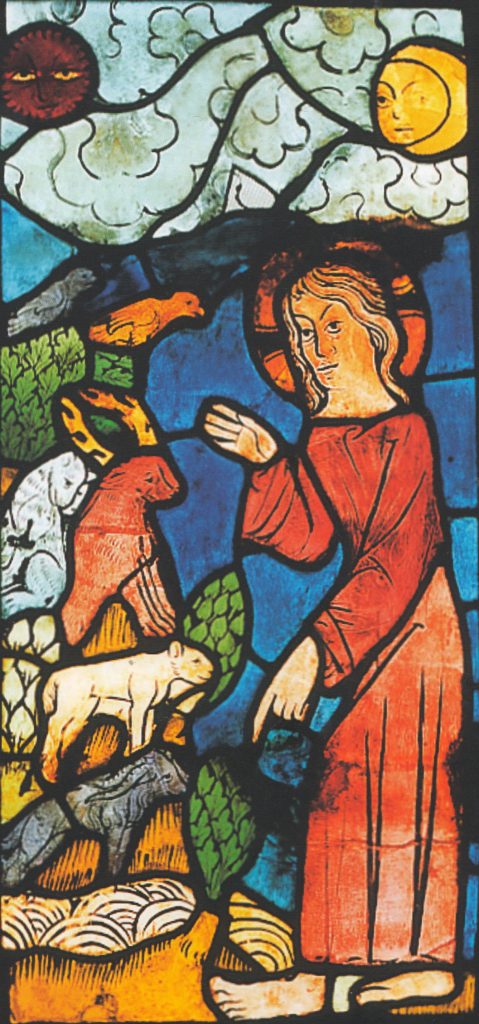
The following is a stained glass window from the Three choir windows in the Marienkirche, Frankfurt (Oder), Germany, of the 14th century, depicting God creating the animals:
Source: Der gläserne Schatz: Die Bilderbibel der St. Marienkirche in Frankfurt (Oder), Neuer Berlin Verlag, 2005, copyright for this image: Brandenburgisches Landesamt für Denkmalpflege und Archäologisches Landesmuseum
Stained glass is not just highly decorative, it’s a medium which has been used to express important religious messages for centuries. Literacy was not widespread in the medieval and Renaissance periods and the Church used stained glass and other artworks to teach the central beliefs of Christianity. In Gothic churches, the windows were filled with extensive narrative scenes in stained glass — like huge and colorful picture storybooks — in which worshipers could ‘read’ the stories of Christ and the saints and learn what was required for their religious salvation. (Source: Victoria and Albert Museum )
Following are a number of back-translations as well as a sample translation for translators of Genesis 12:4:
Kankanaey: “At the time-when- God -said that, seventy five were the years of Abram. He believed/obeyed what God commanded and departed from Haran.” (Source: Kankanaey Back Translation)
Newari: “Abram went to the place to which the LORD told him ‘Go!’. Lot also went with him. When Abram left Haran, he was completing 75 years.” (Source: Newari Back Translation)
Hiligaynon: “So Abram left Haran and went to Canaan, according to what- the LORD -had-told him. Abram was 75 years of-age at-that-time. His nephew Lot went (with) him. He also brought his wife Sarai and all their wealth/properties and servants that they gathered at Haran. When they arrived in Canaan,” (Source: Hiligaynon Back Translation)
English: “So Abram left Haran town, as Yahweh told him to do. Abram was 75 years old when he left there along with his wife, Sarai, and his nephew, Lot.” (Source: Translation for Translators)
Click or tap here to see the rest of this insight.
Like a number of other East Asian languages, Japanese uses a complex system of honorifics, i.e. a system where a number of different levels of politeness are expressed in language via words, word forms or grammatical constructs. These can range from addressing someone or referring to someone with contempt (very informal) to expressing the highest level of reference (as used in addressing or referring to God) or any number of levels in-between.
One way Japanese shows different degree of politeness is through the usage of an honorific construction where the morpheme rare (られ) is affixed on the verb as shown here in the widely-used Japanese Shinkaiyaku (新改訳) Bible of 2017. This is particularly done with verbs that have God as the agent to show a deep sense of reverence. Here, ōse-rare-ru (仰せられる) or “say” is used.



Leave a Reply
You must be logged in to post a comment.