justice

The Greek, Hebrew, Aramaic and Latin that is translated as “justice” in English is translated in American Sign Language with a sign that describes the quality or principle of fairness, righteousness, and impartiality in treating other people. A literal back-translation of the signs are “FOLLOW(God is implied) ACTIONS, DECISIONS JUST-RIGHT”. A more idiomatic back-translation would be: “actions and decisions are right/fitting/just in accordance to God’s will.” The movement in the signs itself helps to indicate that this is a noun, not a verb. (Source: Ruth Anna Spooner, Ron Lawer)


“Justice” in American Sign Language, source: Deaf Harbor

desert / wilderness

The Greek, Hebrew, Ge’ez, and Latin that is translated as “desert” or “wilderness” in English is translated in a number of ways:

  • Mairasi: “a place where noisiness is cut off (or: stops)” (source: Enggavoter 2004)
  • Muna: pandaso bhalano pr “big barren-field” (source: René van den Berg)
  • Balinese: “barren field” (source: J.L. Swellengrebel in The Bible Translator 1950, p. 75ff. )
  • Wantoat: “uninhabited place” (source: Holzhausen 1991, p. 38)
  • Umiray Dumaget Agta: “where no people dwell” (source: Larson 1998, p. 98)
  • Shipibo-Conibo: “where no house is” (source: James Lauriault in The Bible Translator 1951, p. 32ff. )
  • Amri Karbi: “waterless region/place” (source: Philippova 2021, p. 368)
  • Ocotlán Zapotec: “large empty place” (source: B. Moore / G. Turner in Notes on Translation 1967, p. 1ff.)
  • Pa’o Karen: “jungle” (denoting a place without any towns, villages and tilled fields) (source: Gordon Luce in The Bible Translator 1950, p. 153f. )
  • Low German translation by Johannes Jessen, publ. 1933, republ. 2006: “steppe”
  • Yakan: “the lonely place” (source: Yakan Back Translation)
  • Western Bukidnon Manobo: “a land where no people lived” (source: Western Bukidnon Manobo Back Translation)
  • Kankanaey: “the place with no inhabitants” (source: Kankanaey Back Translation)
  • Cherokee: inage or “far away downstream” (source: Bender / Belt 2025, p. 16)
  • Matumbi uses various term: lubele (desert, sandy place without water) — used in John 11:54, lupu’ngu’ti (a place where no people live, can be a scrub land, a forest, or a savanna) — used in Mark 1:3 et al.), and mwitu (a forest, a place where wild animals live) — used in Mark 1:13 et al.) (Source: Pioneer Bible Translators, project-specific notes in Paratext)
  • Chichewa Contemporary translation (2002/2016): chipululu: a place uninhabited by people with thick forest and bush (source: Mawu a Mulungu mu Chichewa Chalero Back Translation)
  • Adioukrou: loj or “savannah” — “land that is not village, nor forest, nor field (source: Hill 2006)

Note that in Luke 15:4, usually a term is used that denotes pastoral land, such as “eating/grazing-place,” in Tagbanwa (source: Tagbanwa Back Translation).

See also wilderness and desolate wilderness.

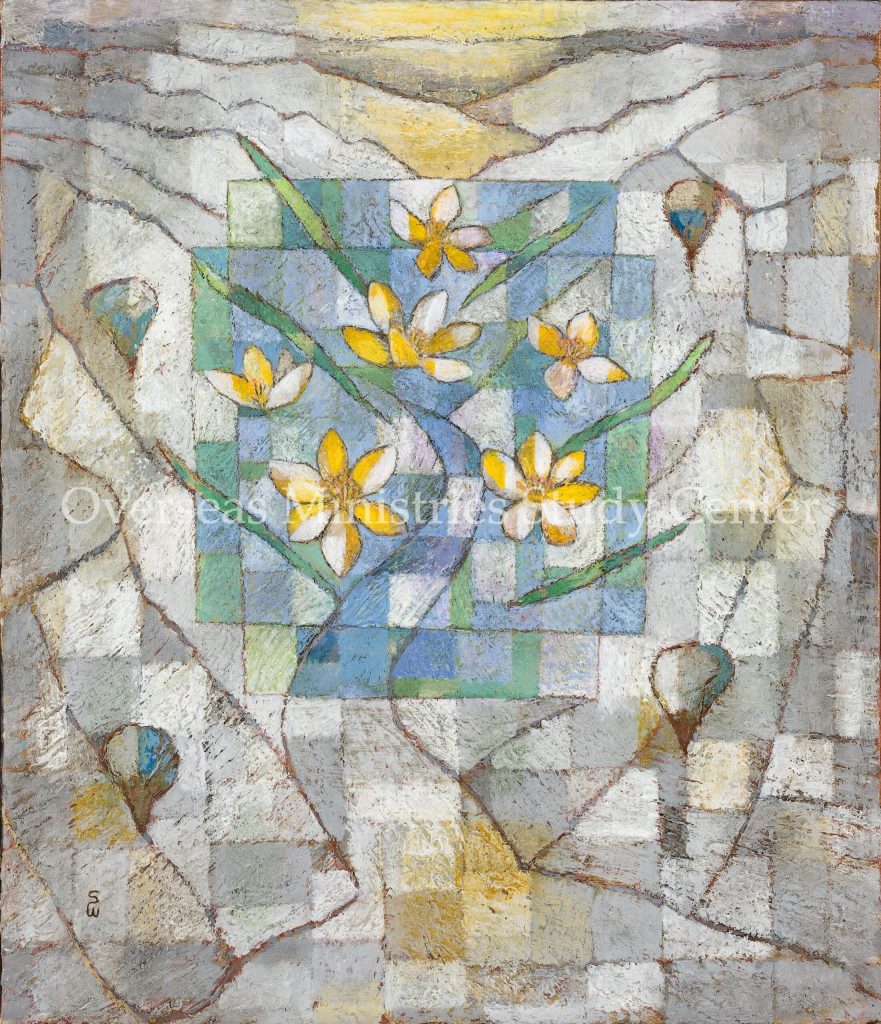
The Glory of the LORD in the Wilderness

Painting by Soichi Watanabe, used with permission by the Overseas Ministries Study Center (OMSC) at Princeton Theological Seminary. You can purchase this and many other artworks by artists in residence at the OSMC in high resolution and without a watermark via the OSMC website .

“A resident of Koshigaya City, Saitama, Japan, Soichi Watanabe was the 2008-09 OMSC artist in residence. Watanabe graduated in 1982 from the Ochanomizu Art School in Tokyo after having earned, a decade earlier, an economics degree from Tohoku Gakuin University in Sendai. He teaches at a private art school that he started in 1982. Following his 1982 graduation, Soichi founded a private art school where he and his wife work together to help others experience the joy of art.

“Soichi was drawn to God as an undergraduate student during a home Bible study when he encountered Mark 8:35: ‘Whoever wants to save his life will lose it, but whoever loses his life for me and for the gospel will save it.’ Further study of the New Testament led him to realize that he was both ‘stubborn and self-centered.’ He recalls that ‘the richness of the biblical world overwhelmed me and at the same time tortured me.’

“Shortly thereafter he chose to submit his life to God at an evening worship service. ‘I really heard a voice telling me to accept the salvation of Jesus on the cross and to follow him,’ remembers Soichi. From that point on he has been determined to serve God through his abilities. As a follower of Jesus, Soichi points to his faith as the foundation from which he works as an artist. In his art book Jesus Walking With Us (2004), he writes, ‘I realize that [my works] are my own humble responses to God’s calling in my life… . The images are often given to me through the words of God at worship services on Sundays and during my daily devotion. I have the earnest hope that I will go on painting to praise the Lord.'” (Source )

About this image, Watanabe says: “The books of Dr. Kosuke Koyama inspired me to make this painting. Through his books and lectures, he taught us to pray and to act for the realization of peace and righteousness in this world. He also prayed for me and prompted me to make Christian art, emphasizing that I should bear witness to the Gospel through artwork, since the language of the Bible is so visually evocative.” (Source: OMSC 2010, p. 40)

See other images of Soichi Watanabe.

complete verse (Isaiah 32:16)

Following are a number of back-translations as well as a sample translation for translators of Isaiah 32:16:

  • Kupsabiny: “Truth/justice shall happen and righteousness
    in the whole land.” (Source: Kupsabiny Back Translation)
  • Newari: “And justice will take shelter in the wilderness,
    and righteousness will live in the fertile field.” (Source: Newari Back Translation)
  • Hiligaynon: “Justice and righteousness will-spread in the desolate-place and in the fruitful field.” (Source: Hiligaynon Back Translation)
  • English: “If you read what is written in the book that contains messages from Yahweh, you will find out what he will do in Edom.
    All of those animals and birds will be there,
    and each one will have a mate,
    because that is what Yahweh has promised,
    and his Spirit will cause them all to gather there.” (Source: Translation for Translators)

righteous, righteousness

The Greek, Hebrew, Ge’ez, and Latin terms that are translated in English mostly as “righteous” or “righteousness” (see below for a discussion of the English translation) are most commonly expressed with concept of “straightness,” though this may be expressed in a number of ways. (Click or tap here to see the details)

Following is a list of (back-) translations of various languages:

  • Bambara, Southern Bobo Madaré, Chokwe (ululi), Amganad Ifugao, Chol, Eastern Maninkakan, Toraja-Sa’dan, Pamona, Batak Toba, Bilua, Tiv: “be straight”
  • Laka: “follow the straight way” or “to straight-straight” (a reduplicated form for emphasis)
  • Sayula Popoluca: “walk straight”
  • Highland Puebla Nahuatl, Kekchí, Muna: “have a straight heart”
  • Kipsigis: “do the truth”
  • Mezquital Otomi: “do according to the truth”
  • Huautla Mazatec: “have truth”
  • Yine: “fulfill what one should do”
  • Indonesian: “be true”
  • Navajo (Dinė): “do just so”
  • Anuak: “do as it should be”
  • Mossi: “have a white stomach” (see also happiness / joy)
  • Paasaal: “white heart” (source: Fabian N. Dapila in The Bible Translator 2024, p. 415ff.)
  • (San Mateo del Mar Huave: “completely good” (the translation does not imply sinless perfection)
  • Nuer: “way of right” (“there is a complex concept of “right” vs. ‘left’ in Nuer where ‘right’ indicates that which is masculine, strong, good, and moral, and ‘left’ denotes what is feminine, weak, and sinful (a strictly masculine viewpoint!) The ‘way of right’ is therefore righteousness, but of course women may also attain this way, for the opposition is more classificatory than descriptive.”) (This and all above from Bratcher / Nida except for Bilua: Carl Gross; Tiv: Rob Koops; Muna: René van den Berg)
  • Central Subanen: “wise-good” (source: Robert Brichoux in OPTAT 1988/2, p. 80ff. )
  • Xicotepec De Juárez Totonac: “live well”
  • Mezquital Otomi: “goodness before the face of God” (source for this and one above: Viola Waterhouse in Notes on Translation August 1966, p. 86ff.)
  • Eastern Huasteca Nahuatl: “the result of heart-straightening” (source: Nida 1947, p. 224)
  • Eastern Highland Otomi: “entirely good” (when referred to God), “do good” or “not be a debtor as God sees one” (when referred to people)
  • Carib: “level”
  • Tzotzil: “straight-hearted”
  • Ojitlán Chinantec: “right and straight”
  • Yatzachi Zapotec: “walk straight” (source for this and four previous: John Beekman in Notes on Translation November 1964, p. 1-22)
  • Makonde: “doing what God wants” (in a context of us doing) and “be good in God’s eyes” (in the context of being made righteous by God) (note that justify / justification is translated as “to be made good in the eyes of God.” (source: Pioneer Bible Translators, project-specific notes in Paratext)
  • Aari: The Pauline word for “righteous” is generally rendered by “makes one without sin” in the Aari, sometimes “before God” is added for clarity. (Source: Loren Bliese)
  • North Alaskan Inupiatun: “having sin taken away” (Source: Nida 1952, p. 144)
  • Nyamwezi: wa lole: “just” or “someone who follows the law of God” (source: Pioneer Bible Translators, project-specific translation notes in Paratext)
  • Venda: “nothing wrong, OK” (Source: J.A. van Roy in The Bible Translator 1972, p. 418ff. )
  • Ekari: maakodo bokouto or “enormous truth” (the same word that is also used for “truth“; bokouto — “enormous” — is being used as an attribute for abstract nouns to denote that they are of God [see also here]; source: Marion Doble in The Bible Translator 1963, p. 37ff. ).
  • Guhu-Samane: pobi or “right” (also: “right (side),” “(legal) right,” “straightness,” “correction,” “south,” “possession,” “pertinence,” “kingdom,” “fame,” “information,” or “speech” — “According to [Guhu-Samane] thinking there is a common core of meaning among all these glosses. Even from an English point of view the first five can be seen to be closely related, simply because of their similarity in English. However, from that point the nuances of meaning are not so apparent. They relate in some such a fashion as this: As one faces the morning sun, south lies to the right hand (as north lies to the left); then at one’s right hand are his possessions and whatever pertains to him; thus, a rich man’s many possessions and scope of power and influence is his kingdom; so, the rich and other important people encounter fame; and all of this spreads as information and forms most of the framework of the people’s speech.”) (Source: Ernest Richert in Notes on Translation 1964, p. 11ff.)
  • Haroti (Hadauti): “blameless in God’s eyes” (source: Vikram Mukka in Christianity Today )
  • German New Testament translation by Berger / Nord (publ. 1999): Gerechtheit, a neologism to differentiate it from the commonly-used Gerechtigkeit which can mean “justice” but is more often used in modern German as “fairness” (Berger / Nord especially use Gerechtheit in Letter to the Romans) or Gerechtestun, also a neologism, meaning “righteous deeds” (especially in Letter to the Ephesians)
  • “did what he should” (Eastern Highland Otomi)
  • “a clear man, good [man]” (Mairasi) (source: Enggavoter 2004)
  • Cherokee: “with heart” (source: Bender / Belt 2025, p. 29)

The English translation of righteousness, especially in the New Testament is questioned by Nicholas Wolterstorff (2008, p. 110ff.) (Click or tap here to see the details)

Those who approach the New Testament solely through English translations face a serious linguistic obstacle to apprehending what these writings say about justice. In most English translations, the word “justice” occurs relatively infrequently. It is no surprise, then, that most English-speaking people think the New Testament does not say much about justice; the Bibles they read do not say much about justice. English translations are in this way different from translations into Latin, French, Spanish, German, Dutch — and for all I know, most languages.

The basic issue is well known among translators and commentators. Plato’s Republic, as we all know, is about justice. The Greek noun in Plato’s text that is standardly translated as “justice” is dikaiosunē (δικαιοσύνη); the adjective standardly translated as “just” is dikaios (δίκαιος). This same dik-stem occurs around three hundred times in the New Testament, in a wide variety of grammatical variants.

To the person who comes to English translations of the New Testament fresh from reading and translating classical Greek, it comes as a surprise to discover that though some of those occurrences are translated with grammatical variants on our word “just,” the great bulk of dik-stem words are translated with grammatical variants on our word “right.” The noun, for example, is usually translated as “righteousness,” not as “justice.” In English we have the word “just” and its grammatical variants coming horn the Latin iustitia, and the word “right” and its grammatical variants coining from the Old English recht. Almost all our translators have decided to translate the great bulk of dik-stem words in the New Testament with grammatical variants on the latter — just the opposite of the decision made by most translators of classical Greek.

I will give just two examples of the point. The fourth of the beatitudes of Jesus, as recorded in the fifth chapter of Matthew, reads, in the New Revised Standard Version, “Blessed are those who hunger and thirst for righteousness, for they will be filled.” The word translated as “righteousness” is dikaiosunē. And the eighth beatitude, in the same translation, reads “Blessed are those who are persecuted for righteousness’ sake, for theirs is the kingdom of heaven.” The Greek word translated as “righteousness” is dikaiosunē. Apparently, the translators were not struck by the oddity of someone being persecuted because he is righteous. My own reading of human affairs is that righteous people are either admired or ignored, not persecuted; people who pursue justice are the ones who get in trouble.

It goes almost without saying that the meaning and connotations of “righteousness” are very different in present-day idiomatic English from those of “justice.” “Righteousness” names primarily if not exclusively a certain trait of personal character. (…) The word in present-day idiomatic English carries a negative connotation. In everyday speech one seldom any more describes someone as righteous; if one does, the suggestion is that he is self-righteous. “Justice,” by contrast, refers to an interpersonal situation; justice is present when persons are related to each other in a certain way. There is, indeed, a long tradition of philosophical and theological discussion on the virtue of justice. But that use of the term has almost dropped out of idiomatic English; we do not often speak any more of a person as just. And in any case, the concept of the virtue of justice presupposes the concept of those social relationships that are just.

So when the New Testament writers speak of dikaiosunē, are they speaking of righteousness or of justice? Is Jesus blessing those who hunger and thirst for righteousness or those who hunger and thirst for justice?

A thought that comes to mind is that the word changed meaning between Plato and the New Testament. Had Jesus’ words been uttered in Plato’s time and place, they would have been understood as blessing those who hunger and thirst for the social condition of justice. In Jesus’ time and place, they would have been understood as blessing (hose who hunger and thirst for righteousness — that is, for personal moral rectitude.

Between the Hebrew Bible and the Greek New Testament there came the Septuagint translation of the Hebrew Bible into Greek. (…) One of the challenges facing the Septuagint translators was how to catch, in the Greek of their day, the combination of mishpat (מִשְׁפָּט) with tsedeq (צֶ֫דֶק). Tsedeq that we find so often in the Old Testament, standardly translated into English as justice and righteousness. The solution they settled on was to translate tsedeq as dikaiosunē, and to use a term whose home use was in legal situations, namely, krisis (κρίσις), to translate mishpat. Mishpat and tsedeq became krisis and dikaiosunē. For the most part, this is also how they translated the Hebrew words even when they were not explicitly paired with each other: mishpat (justice) becomes krisis, tsedeq (righteousness) becomes dikaiosunē. The pattern is not entirely consistent, however; every now and then, when mishpat is not paired off with tsedeq, it is translated with dikaiosunē or some other dik-stem word (e.g., 1 Kings 3:28, Proverbs 17:23, Isaiah 61:8).

I think the conclusion that those of us who are not specialists in Hellenistic Greek should draw from this somewhat bewildering array of data is that, in the linguistic circles of the New Testament writers, dikaiosunē did not refer definitively either to the character trait of righteousness (shorn of its negative connotations) or to the social condition of justice, but was ambiguous as between those two. If dikaiosunē had referred decisively in Hellenistic Greek to righteousness rather than to justice, why would the Septuagint translators sometimes use it to translate mishpat, why would Catholic translators [into the 1980s] usually translate it as “justice,” and why would all English translators sometimes translate it as “justice”? (All earlier Latin-based Catholic translations, the New American Bible and the Jerusalem Bible, both of which appeared in the early 1970s have most occurrences of dik-stem words translated with variants on “just.” In subsequent revisions of the New American Bible, and in the New Jerusalem Bible, these translations have been altered to translations along the lines of righteousness. Other translations that use a form of justice or “doing right / rightness” include the British New English Bible [1970] and Revised English Bible [1989] and some newer translations such as by Hart [2017], Ruden [2021] or McKnight [2023]).

Conversely, if it referred decisively to justice, why would the Septuagint translators usually not use it to translate mishpat, and why would almost all translators sometimes translate it as “righteousness”? Context will have to determine whether, in a given case, it is best translated as “justice” or as “righteousness” — or as something else instead; and if context does not determine, then it would be best, if possible, to preserve the ambiguity and use some such ambiguous expression as “what is right” or “the right thing.”

Let me make one final observation about translation. When one takes in hand a list of all the occurrences of dik-stem words in the Greek New Testament, and then opens up almost any English translation of the New Testament and reads in one sitting all the translations of these words, a certain pattern emerges: unless the notion of legal judgment is so prominent in the context as virtually to force a translation in terms of justice, the translators will prefer to speak of righteousness.

See also respectable, righteous, righteous (person), devout, and She is more in the right(eous) than I.

Translation commentary on Isaiah 32:16

Then justice will dwell in the wilderness, and righteousness abide in the fruitful field: There will be justice and righteousness (see verse 1) when God makes the land of Judah fertile again. The wilderness and the fruitful field represent the land as a whole (so Good News Translation), so justice will dwell in the wilderness and righteousness abide in the fruitful field are metaphors for the return of these two qualities to all who live in the land. Some languages may find it difficult to speak of these abstract qualities as “living” in a place. If so, the examples below provide helpful alternatives.

The two parallel lines of this verse form a chiasmus in Hebrew, which is shown in the following literal rendering: and will dwell > in the wilderness > justice > < and righteousness < in the fruitful field < will remain. This chiastic structure provides emphasis. These two lines are also an example of all-inclusive parallelism. There will be justice and righteousness in both areas mentioned here.

Translation examples for this verse are:

• Then justice will prosper in the wilderness,
and righteousness will flourish in the fruitful field.

• Then in the wilderness people will act with justice,
and in the fertile land they will exercise righteousness.

Quoted with permission from Ogden, Graham S. and Sterk, Jan. A Handbook on Isaiah. (UBS Helps for Translators). New York: UBS, 2011. For this and other handbooks for translators see here .