The Hebrew and Greek that is translated as “adultery” in English (here etymologically meaning “to alter”) is typically understood as “marital infidelity.” It is (back-) translated in the following ways:
Toraja-Sa’dan: “to measure the depth of the river of (another’s) marriage”
North Alaskan Inupiatun: “married people using what is not theirs” (compare “fornication” which is “unmarried people using what is not theirs”) (source for this and all above: Bratcher / Nida)
The Greek that is usually translated as “scribe” in English “were more than mere writers of the law. They were the trained interpreters of the law and expounders of tradition.”
Tboli: “one who taught the law God before caused Moses to write” (or “one who taught the law of Moses”) (source for this and 5 above: Reiling / Swellengrebel)
Noongar: Mammarapa-Warrinyang or “law man” (source: Warda-Kwabba Luke-Ang)
Mairasi: “one who writes and explains Great Above One’s (=God’s) prohibitions” (source: Enggavoter 2004)
Chichewa: “teacher of Laws” (source: Ernst Wendland)
Lalana Chinantec: “one who is a teacher of the law which God gave to Moses back then”
Tepeuxila Cuicatec: “one who know well the law” (Source for this and four above: Viola Waterhouse in Notes on Translation August 1966, p. 86ff.)
Huixtán Tzotzil: “one who mistakenly thought he was teaching God’s commandments”(Huixtán Tzotzil frequently uses the verb -cuy to express “to mistakenly think something” from the point of view of the speaker; source: Marion M. Cowan in Notes on Translation 20/1966, pp. 6ff.)
Germandas Buch translation by Roland Werner (publ. 2009-2022): “theologian” and the 1998 translation by Walter Jens: “interpreter of scriptures” (Schriftausleger)
English translation by Scot McKnight (The Second Testament, publ. 2023): Covenant Code scholar
In British Sign Language it is translated with a sign that combines the signs for “expert” and “law.” (Source: Anna Smith)
“Scribe” in British Sign Language (source: Christian BSL , used with permission)
Image taken from He Qi Art . For purchasing prints of this and other artworks by He Qi go to heqiart.com . For other images of He Qi art works in TIPs, see here.
Following is a painting by Kim Ki-chang (1913-2001):
Kim Ki-chang (pen name: Unbo) had been deaf and partially mute since the age of 7. He painted a series of 30 paintings for the “Life of Christ” cycle in 1952 during the Korean War. Kim portrayed Jesus as a seonbi / 선비, or a Joseon Period (1392-1910) gentleman scholar, wearing a gat / 갓 (hat) and dopo / 도포 (robe). For other images of Kim Ki-chang art works in TIPs, see here.
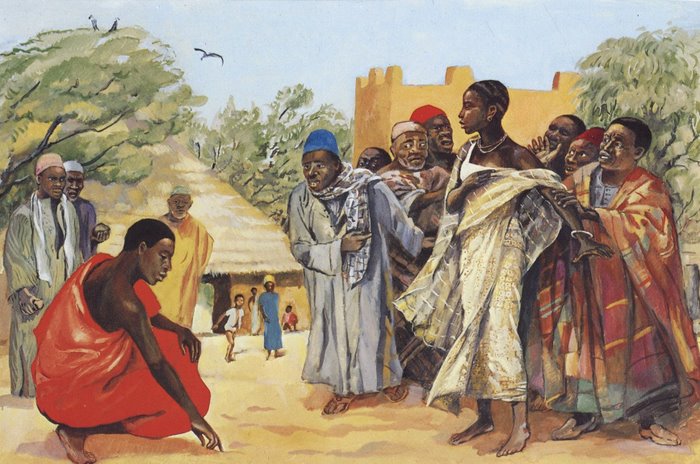
Following is a 1973 painting of the JESUS MAFA project, a response to New Testament readings from the Lectionary by a Christian community in Cameroon, Africa. Each of the readings was selected and adapted to dramatic interpretation by the community members. Photographs of their interpretations were made, and these were then transcribed to paintings:
From Art in the Christian Tradition, a project of the Vanderbilt Divinity Library, Nashville, TN. Image retrieved March 23, 2026. Original source: librairie-emmanuel.fr.
Following are a number of back-translations of John 8:3:
Uma: “While he was teaching, the religious teachers with the Parisi people arrived, bringing a woman whom they had caught while she was committing adultery, they made her stand in the midst of the people.” (Source: Uma Back Translation)
Yakan: “Then there was a certain woman brought to Isa by the Pariseo and the teachers of the religious law. This woman had been caught in adultery. They made her to face the crowds.” (Source: Yakan Back Translation)
Western Bukidnon Manobo: “And the Pharisees and the teachers of the law, they brought to him a woman whom they had caught while she was committing adultery against her husband. And they brought that woman in front of Jesus there in the midst of the people.” (Source: Western Bukidnon Manobo Back Translation)
Kankanaey: “Just-then teachers of the law and Pharisees arrived bringing a woman that had been caught-in-the-act of committing-adultery (lit. manning-with). They stood-her-up in front of the many-people.” (Source: Kankanaey Back Translation)
Tagbanwa: “When Jesus was now teaching, some explainers of the law and some Pariseo arrived. They were bringing with them a married woman they had arrested who had a man. They caused that woman to stand in their presence,” (Source: Tagbanwa Back Translation)
Tenango Otomi: “The teachers of the law along with the Pharisees brought a woman who had been caught upon finding her with a man who was not her husband. She was stood in the middle.” (Source: Tenango Otomi Back Translation)
The Greek that is a transliteration of the Hebrew Pərūšīm and is typically transliterated into English as “Pharisee” is transliterated in Mandarin Chinese as Fǎlìsài (法利賽 / 法利赛) (Protestant) or Fǎlìsāi (法利塞) (Catholic). In Chinese, transliterations can typically be done with a great number of different and identical-sounding characters. Often the meaning of the characters are not relevant, unless they are chosen carefully as in these cases. The Protestant Fǎlìsài can mean something like “Competition for the profit of the law” and the Catholic Fǎlìsāi “Stuffed by/with the profit of the law.” (Source: Zetzsche 1996, p. 51)
In Finnish Sign Language it is translated with the sign signifying “prayer shawl”. (Source: Tarja Sandholm)
Scot McKnight (in The Second Testament, publ. 2023) translates it into English as Observant. He explains (p. 302): “Pharisee has become a public, universal pejorative term for a hypocrite. Pharisees were observant of the interpretation of the Covenant Code called the ‘tradition of the elders.’ They conformed their behaviors to the interpretation. Among the various groups of Jews at the time of Jesus, they were perhaps closest to Jesus in their overall concern to make a radical commitment to the will of God (as they understood it).”
Living Water is produced for the Bible translation movement in association with Lutheran Bible Translators. Lyrics derived from the ESV® Bible (The Holy Bible, English Standard Version®).
The teachers of the Law and the Pharisees is a common expression in the other Gospels, though it occurs only here in the Gospel of John. Most translations render teachers of the Law as “scribes” (New English Bible “the doctors of the law”). To translate as “scribes” is misleading. Originally one of the main functions of these men was to make copies of the Law, but by New Testament times they were the recognized authorities on the Law. The teachers of the Law and the Pharisees is apparently a set phrase. Most of the teachers of the Law probably belonged to the Pharisaic party.
Teachers of the Law may also be rendered “those who explained the Law,” in the sense of “showed what the Law meant.” Note, however, that it may be necessary to employ a plural, namely, “laws,” since some receptor languages lack a singular form which would be interpreted as a collective.
In some languages certain problems are encountered in using definite articles, such as “the teachers” and “the Pharisees,” because this usage would imply that all the teachers and all the Pharisees were involved. Therefore, it may be necessary in some languages to use an equivalent such as “some teachers of the Law and some Pharisees.”
In some ancient manuscripts committing adultery appears as “committing sin,” perhaps in anticipation of the close of verse 11. No translations seem to follow this alternative reading. As suggested in connection with the title of this section, it may be necessary to say “who had been arrested while sleeping with a man who was not her husband.”
They made her stand before them all (Jerusalem Bible “making her stand there in full view of everybody”; Moffatt “making her stand forward”) is translated rather literally in Revised Standard Version “placing her in the midst” (see New English Bible “Making her stand out in the middle”). The meaning is that the woman was made to stand before the people before whom she was to be tried. (The same expression is used in Acts 4.7: They made the apostles stand before them.) It should be noted that, contrary to the Law of Moses (Lev 20.10; Deut 22.22), only the woman was brought to trial.
Quoted with permission from Newman, Barclay M. and Nida, Eugene A. A Handbook on the Gospel of John. (UBS Handbook Series). New York: UBS, 1980. For this and other handbooks for translators see here .
The Jewish religious leaders set a trap for Jesus. They wanted to force Jesus to say something that they could use against him in a trial. They asked him to decide what to do about a woman who they found committing adultery. (That means that she was having sexual activity with someone who was not her husband.)
8:3a
The scribes and Pharisees:The scribes and Pharisees were the authorities on the Jewish religious law. This phrase also occurs in Matthew 23:2, 13, 15, and in reverse order in Luke 15:2. See how you translated it there. Because not all the scribes and Pharisees came to Jesus, it may be natural to say:
Some of the scribes and Pharisees
scribes: The Greek word that the Berean Standard Bible translates as scribes refers to men who studied, interpreted, and taught the Law of Moses. The original work of these men was to make copies of the laws of Moses by hand. In New Testament times, that was no longer their main task. They remained the recognized experts on the law though.
Here are some ways to translate this word:
teachers of the law of Moses (Contemporary English Version)
-or-
teachers of religious law (New Living Translation (2004))
-or-
experts on the law
Pharisees: The Pharisees were a Jewish religious group or party. It was very important to them to obey all of the Jewish religious laws very carefully and exactly. Some, or possibly most, of the scribes were also Pharisees.
Here are some ways to translate this word:
• Transliterate the word Pharisees according to the sounds of your language and indicate that it refers to people. For example:
Farisi members
-or-
men of the Parises
• Transliterate the word Pharisees and indicate that it refers to a group of people with certain beliefs. For example:
people belonging to the Farise religious sect/group
-or-
members of the religious group called the Farasi
See how you translated Pharisees in 4:1 and 7:48, and translate it the same way here.
brought to Him a woman caught in adultery: In this context the word brought indicates that the men had ordered or forced the woman to come with them. They led her to Jesus. In some languages it may be necessary to say where the men brought her. For example:
brought ⌊to him/Jesus⌋ a woman who had been caught in adultery
a woman caught in adultery: This phrase indicates that someone had seen this woman lying with a man who was not her husband. Use an expression that is suitable for public use and for public reading in church.
The verb phrase caught is passive. There are at least two ways to translate it:
• Use a passive verb. For example:
a woman who had been caught in bed with a man who wasn’t her husband (Contemporary English Version)
-or-
a woman who had been seen in an immoral act
• Use an active verb. For example:
we (excl.) have caught this woman in bed with another man
-or-
someone has seen this woman committing adultery
adultery: The Greek word that the Berean Standard Bible translates as adultery indicates that the woman was married to someone else. It does not indicate whether or not the man was married.
8:3b
They made her stand before them: The Greek expression that the Berean Standard Bible translates as before them is more literally “in the middle.” The religious leaders forced the woman to stand in front of the people who were there listening to Jesus. They wanted to accuse her publicly. Here is another way to translate this phrase:
and made her stand there in the middle
In some languages it may be natural to start a new sentence here. For example:
They made her stand in front of everyone. (God’s Word)
-or-
They put her in front of the crowd. (New Living Translation (2004))



Leave a Reply
You must be logged in to post a comment.