adultery

The Hebrew and Greek that is translated as “adultery” in English (here etymologically meaning “to alter”) is typically understood as “marital infidelity.” It is (back-) translated in the following ways:

  • Highland Totonac: “to do something together”
  • Yucateco: “pair-sin”
  • Ngäbere: “robbing another’s half self-possession” (compare “fornication” which is “robbing self-possession,” that is, to rob what belongs to a person)
  • Kaqchikel, Chol: “to act like a dog” (see also licentiousness)
  • Toraja-Sa’dan: “to measure the depth of the river of (another’s) marriage”
  • North Alaskan Inupiatun: “married people using what is not theirs” (compare “fornication” which is “unmarried people using what is not theirs”) (source for this and all above: Bratcher / Nida)
  • Purari: “play hands with” or “play eyes with”
  • Chicahuaxtla Triqui: “talk secretly with spouses of our fellows”
  • Isthmus Zapotec: “go in with other people’s spouses”
  • Tzeltal: “practice illicit relationship with women”
  • Huehuetla Tepehua: “live with some one who isn’t your wife”
  • Central Tarahumara: “sleep with a strange partner”
  • Hopi: “tamper with marriage” (source for this and seven above: Waterhouse / Parrott in Notes on Translation October 1967, p. 1ff.)
  • German: Ehebrecher or “marriage breaker” / Ehe brechen or “breaking of marriage” (source: Zetzsche)
  • In Falam Chin the term for “adultery” is the phrase for “to share breast” which relates to adultery by either sex. (Source: David Clark)
  • In Ixcatlán Mazatec a specification needs to be made to include both genders. (Source: Robert Bascom)
  • Likewise in Hiligaynon: “commit-adultery-with-a-man or commit-adultery-with-a-woman” (source: Hiligaynon Back Translation)

See also adultery, adulterer, adulteress, and you shall not commit adultery.

teacher

The Greek that is translated as “teacher” (also: “master”) in English is translated in the 1941 Yiddish by Einspruch as rebe (רֶבּי) or “Rabbi” in an effort to identify Jesus as a teacher of the Jews. (Source: Naomi Seidmann in Elliott / Boer 2012, p. 151ff.)

Likewise, a number of Hebrew translations, including the 2018 and 2020 editions by the The Bible Society in Israel also use “Rabbi” (רַבִּי).

See also rabbi.

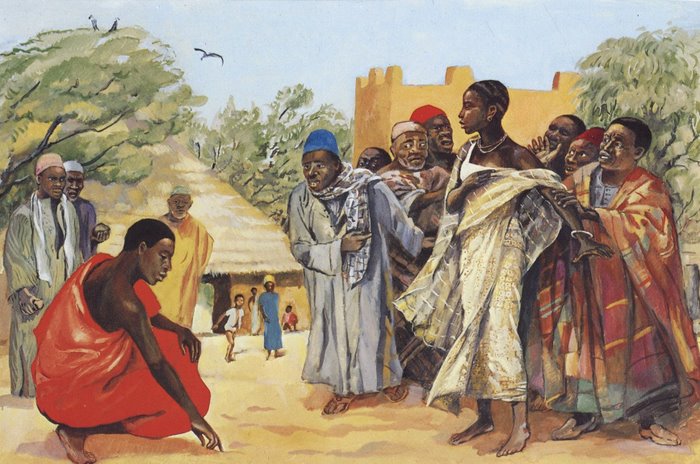
The woman caught in adultery

He Qi © 2021 All Rights Reserved.

Image taken from He Qi Art . For purchasing prints of this and other artworks by He Qi go to heqiart.com . For other images of He Qi art works in TIPs, see here.

Following is a painting by Kim Ki-chang (1913-2001):

Kim Ki-chang (pen name: Unbo) had been deaf and partially mute since the age of 7. He painted a series of 30 paintings for the “Life of Christ” cycle in 1952 during the Korean War. Kim portrayed Jesus as a seonbi / 선비, or a Joseon Period (1392-1910) gentleman scholar, wearing a gat / 갓 (hat) and dopo / 도포 (robe). For other images of Kim Ki-chang art works in TIPs, see here.

Following is a 1973 painting of the JESUS MAFA project, a response to New Testament readings from the Lectionary by a Christian community in Cameroon, Africa. Each of the readings was selected and adapted to dramatic interpretation by the community members. Photographs of their interpretations were made, and these were then transcribed to paintings:

From Art in the Christian Tradition , a project of the Vanderbilt Divinity Library, Nashville, TN. Image retrieved March 23, 2026. Original source: librairie-emmanuel.fr.

Learn more on Bible Odyssey: The Woman Caught in Adultery .

complete verse (John 8:4)

Following are a number of back-translations of John 8:4:

  • Uma: “They said to Yesus: ‘Teacher, that woman was caught red-handed [lit., caught fish-trap] committing adultery!” (Source: Uma Back Translation)
  • Yakan: “They said to Isa, ‘Sir, this woman has been caught in adultery.” (Source: Yakan Back Translation)
  • Western Bukidnon Manobo: “And they said to Jesus, ‘Teacher, this woman we caught committing adultery against her husband.” (Source: Western Bukidnon Manobo Back Translation)
  • Kankanaey: “Then they said to Jesus, ‘Sir teacher, this woman, she was caught-in-the-act of committing-adultery.” (Source: Kankanaey Back Translation)
  • Tagbanwa: “and they said to Jesus, ‘Teacher, this woman, she was caught having a man.” (Source: Tagbanwa Back Translation)
  • Tenango Otomi: “Then Jesus was told, ‘Teacher. This woman here was caught upon finding her with a man who was not her husband.” (Source: Tenango Otomi Back Translation)

Translation commentary on John 8:4

To Jesus is literally “to him.” Good News Translation makes the pronominal reference explicit.

This woman would have been a married woman, because according to Jewish Law adultery had to do with the unfaithfulness of the wife. An unmarried woman who had sexual relations with a married man was not considered an adulteress. In the ancient world the woman was looked upon as the property of her husband, and so originally the basic sin in adultery was the sin against the woman’s husband. Her sin was that she had allowed herself to be used by another man.

Quoted with permission from Newman, Barclay M. and Nida, Eugene A. A Handbook on the Gospel of John. (UBS Handbook Series). New York: UBS, 1980. For this and other handbooks for translators see here .

SIL Translator’s Notes on John 8:4

8:4

and said: The speech indicator said introduces a direct quotation and is first in the sentence. In some languages it may be more natural to put it in another place. It may also be natural to start a new sentence here. For example:

“Teacher,” they said to Jesus, “this woman was caught in the act of adultery….” (New Living Translation (2004))

Teacher: The Greek word that the Berean Standard Bible translates as Teacher was a polite title for a Jewish religious leader. It was a title of respect for a Jewish man who had authority to teach about God. In some languages the suitable way to address a religious teacher may be:

Sir
-or-
Master

Do not use a term that can refer only to a school teacher.

this woman was caught in the act of adultery: This is an accusation. The men accused the woman of committing adultery. They said that someone had seen her do it. They did not say who her male partner was or why they did not bring him also.

This clause is similar to that in 8:3a but adds the words in the act. These words emphasize that the men had definite proof of the adultery. There was no doubt that she was guilty.

Here is another way to translate this clause:

this woman was caught sleeping with a man who isn’t her husband (Contemporary English Version)

this woman was caught: This is a passive clause. There are at least two ways to translate it:

Use a passive verb. For example:

this woman has been caught in the act of adultery (English Standard Version)

Use an active verb. For example:

We caught this woman in the act of adultery. (God’s Word)

Use the verb form that is most natural in your language.

© 2020 by SIL International®
Made available under the terms of a Creative Commons Attribution-ShareAlike 4.0 License (CC BY-SA) creativecommons.org/licenses/by-sa/4.0.
All Scripture quotations in this publication, unless otherwise indicated, are from The Holy Bible, Berean Standard Bible.
BSB is produced in cooperation with Bible Hub, Discovery Bible, OpenBible.com, and the Berean Bible Translation Committee.