The Greek that is often translated as “trespass” or “transgression” in English is translated as “missing the commandment” in Kipsigis and “to step beyond the law” in Navajo (Dinė). (Source: Bratcher / Nida 1961)
In Tepeuxila Cuicatec it is translated as “thing not reached.” Marjorie Davis (in The Bible Translator 1952, p. 34ff. ) explains: “[This] implies that the goal was not reached, the task was not finished, or of finished, it was not satisfactorily done. According to the Cuicateco way of thinking of one does not what is expected of him, he offends [or: trespasses] and is an offence.”
The Greek and Hebrew terms that are translated as “redeem” or “redemption” in most English translations (see more on that below) are translated in Kissi as “buying back.” “Ownership of some object may be forfeited or lost, but the original owner may redeem his possession by buying it back. So God, who made us for Himself, permitted us to accept or reject Him. In order to reconcile rebellious mankind He demonstrated His redemptive love in the death of His Son on our behalf.
“The San Blas Kuna describe redemption in a more spiritual sense. They say that it consists of ‘recapturing the spirit.’ A sinful person is one in rebellion against God, and he must be recaptured by God or he will destroy himself. The need of the spirit is to be captured by God. The tragedy is that too many people find their greatest pleasure in secretly trying to elude God, as though they could find some place in the universe where He could not find them. They regard life as a purely private affair, and they object to the claims of God as presented by the church. They accuse the pastor of interfering with the privacy of their own iniquity. Such souls, if they are to be redeemed, must be ‘recaptured.'” (Source: Nida 1952, p. 138)
Click or tap here for more translations or “redeem” / “redemption”
In Ajië a term is used, nawi, that refers to the “custom of planting a small tree on land cursed either by the blood of battle or some calamity.” Clifford (1992, p. 83ff.) retells the story: “Maurice Leenhardt tells how he finally arrived at a term that would express ‘redemption.’ Previous missionaries had interpreted it as an exchange — an exchange of life, that of Jesus for ours. But in Melanesian thinking more strict equivalents were demanded in the exchanges structuring social life. It remained unclear to them how Jesus’ sacrifice could possibly redeem mankind. So unclear was it that even the natas [Melanesians pastors] gave up trying to explain a concept they did not understand very well themselves and simply employed the term “release.” So the matter stood, with the missionary driven to the use of cumbersome circumlocutions, until one day during a conversation on 1 Corinthians 1:30, [Melanesian pastor and Leenhardt’s co-worker] Boesoou Erijisi used a surprising expression: nawi. The term referred to the custom of planting a small tree on land cursed either by the blood of battle or some calamity. ‘Jesus was thus the one who has accomplished the sacrifice and has planted himself like a tree, as though to absorb all the misfortunes of men and to free the world from its taboos.’ Here at last was a concept that seemed to render the principle of ‘redemption’ and could reach deeply enough into living modes of thought. ‘The idea was a rich one, but how could I be sure I understood it right?’ The key test was in the reaction of students and natas to his provisional version. They were, he reports, overjoyed with the ‘deep’ translation.”
In Folopa, the translation team also found a deeply indigenous term. Neil Anderson (in Holzhausen 1991, p. 51) explains: “While I was explaining the meaning of the [concept] to the Folopa men, I could see their faces brighten. They said that this was a common thing among them: ‘If someone falls a tree and it tips to the wrong side, killing someone, the relatives of the injured party claim the life of the guilty party. But in order to save his life, his relatives make amends. Pigs, shells (which are still used as currency here) and other valuables are given to the relatives of the deceased as payment for the life of the guilty party. In this way he can live because others stand up for him.’ Full of joy, I began to utilize this thought to the difficult translation of the word ‘redemption.’ Mark 10:45 reads now, translated back from the Folopa: ‘Jesus came to make an atonement, by which he takes upon himself the punishment for the evil deeds of many. He came so that through his death many might be liberated.’ After working on this verse for half an hour, I read it to my friends. They became silent and moved their slightly bowed heads thoughtfully back and forth. Finally, one of them took the floor, ‘We give a lot to right a wrong. But we have never given a human being as a price of atonement. Jesus did a great work for us when he made restitution. Because he died, all of us now don’t have to bear the punishment we deserve. We are liberated.'”
In Samoan the translation is togiola which originally refers to a fine mat. John Bradshaw (in The Bible Translator 1967, p. 75ff. ) explains: “The rite of submission applies in cases of grave sin which demands an extreme punishment: offenses such as murder, adultery or disrespectful behavior towards a chief. Submission is made in expectation of forgiveness. The rite is normally enacted at dawn. The prisoner and his family, or even his whole village bow down in silence before the house of the chief or other offended party. The prisoner heads the group and is covered with a fine mat, offered as his ransom. In other words, he submits himself completely to the authority of those whom he has offended. Many such submissions have been successfully offered and received. Those inside the house will come out, and bring into it those offering submission. The priestly orators speak sweetly and all join in a meal. The fine mat is accepted, while the prisoner is set free and forgiven. He no longer goes in fear of retribution for his sin. (…) If now we turn to the relation between the believer and the Redeemer, we notice at once that the word togiola, literally the price of one’s life, was the word used to denote the fine mat with which the sinner covered himself in the rite of Submission. The acceptance of the togiola set free the prisoner. It was inevitable that togiola should render lutron, ransom, as in Matthew 20:28.”
“In Hebrew there are two terms, ga’al and padah, usually rendered ‘to redeem,’ which have likewise undergone significant changes in meaning with resulting obscurity and misunderstanding. Both terms are used in the Old Testament for a person being redeemed from slavery. In the case of padah, the primary emphasis is upon the redemption by means of payment, and in ga’al the redemption of an individual, usually by payment, is made by some relative or an individual of the same clan or society. These two words, however, are used in the Old Testament in circumstances in which there is no payment at all. For example, the redemption of Jews from Egypt is referred to by these two terms, but clearly there was no payment made to the Egyptians or to Pharaoh.
“In the New Testament a related problem occurs, for the words agorázō and exagorazó, meaning literally ‘to buy’ or ‘to buy back’ and ‘to buy out,’ were translated into Latin as redimo and into English normally as ‘redeem.’ The almost exclusive association of Latin redimo with payment became such a focal element of meaning that during the Middle Ages a theory developed that God had to pay the Devil in order to get believers out of hell and into heaven.
“As in the case of the Old Testament, New Testament contexts employing the Greek verb lutroó, literally ‘to redeem’ or ‘to ransom,’ do not refer primarily to payment but focus upon deliverance and being set free. But even today there is such a heavy tradition of the theological concept of payment that any attempt to translate lutroó as ‘to deliver’ or ‘to set free’ is misjudged by some as being heretical.” (Source: Nida 1984, p. 114f.)
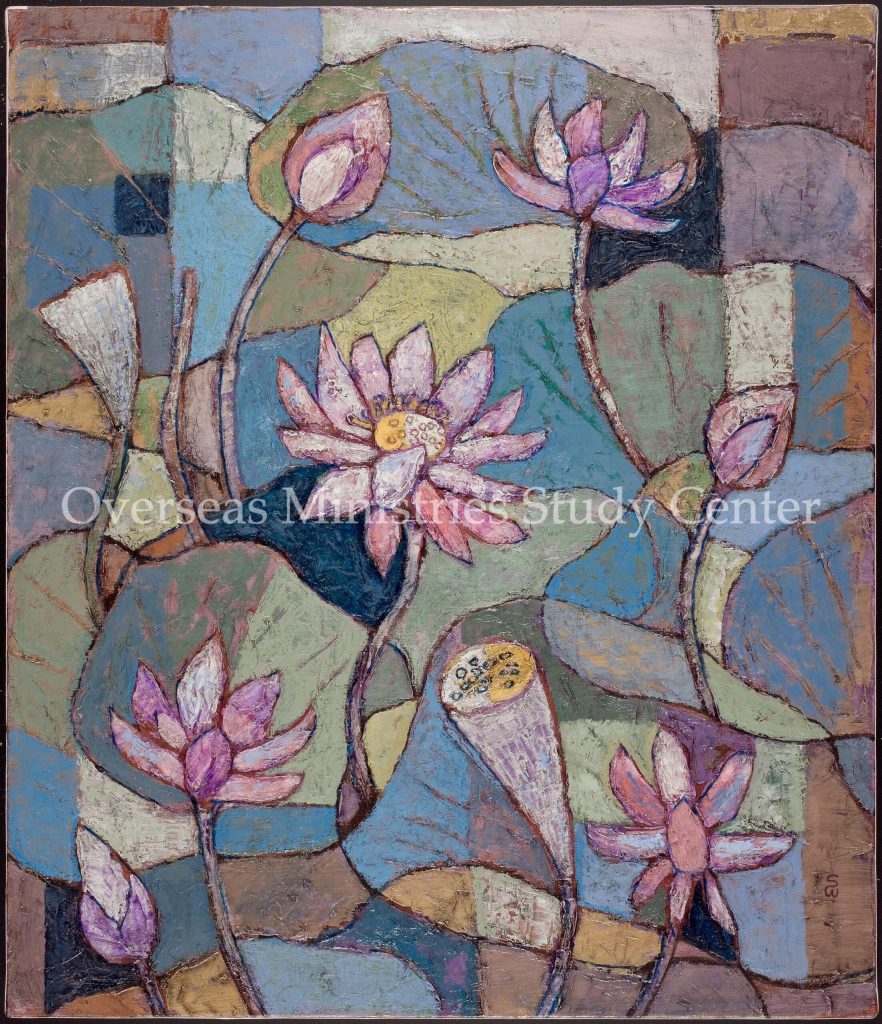
Painting by Soichi Watanabe, used with permission by the Overseas Ministries Study Center (OMSC) at Princeton Theological Seminary. You can purchase this and many other artworks by artists in residence at the OSMC in high resolution and without a watermark via the OSMC website .
“A resident of Koshigaya City, Saitama, Japan, Soichi Watanabe was the 2008-09 OMSC artist in residence. Watanabe graduated in 1982 from the Ochanomizu Art School in Tokyo after having earned, a decade earlier, an economics degree from Tohoku Gakuin University in Sendai. He teaches at a private art school that he started in 1982. Following his 1982 graduation, Soichi founded a private art school where he and his wife work together to help others experience the joy of art.
“Soichi was drawn to God as an undergraduate student during a home Bible study when he encountered Mark 8:35: ‘Whoever wants to save his life will lose it, but whoever loses his life for me and for the gospel will save it.’ Further study of the New Testament led him to realize that he was both ‘stubborn and self-centered.’ He recalls that ‘the richness of the biblical world overwhelmed me and at the same time tortured me.’
“Shortly thereafter he chose to submit his life to God at an evening worship service. ‘I really heard a voice telling me to accept the salvation of Jesus on the cross and to follow him,’ remembers Soichi. From that point on he has been determined to serve God through his abilities. As a follower of Jesus, Soichi points to his faith as the foundation from which he works as an artist. In his art book Jesus Walking With Us (2004), he writes, ‘I realize that [my works] are my own humble responses to God’s calling in my life… . The images are often given to me through the words of God at worship services on Sundays and during my daily devotion. I have the earnest hope that I will go on painting to praise the Lord.'” (Source )
About this image, Watanabe says: “Lotus icons are usually found in Buddhist temples. However, when I was making a sketch of a lotus flower in a pond, I became convinced that the flower was the ‘saint flower,’ because light shines out from the center of this flower. According to some books that have pictures of plants that are found in the Bible, the sculptures of lilies in Solomon’s temple were of water lilies [see Song of Songs 2:1], as the wild lotus plant can be found growing in Israel. I came to understand the deep biblical connection that exists with the lotus or the water lily.” (Source: OSMC 2010, p. 90)
“The Greek word charis, usually translated by English ‘grace,’ is one of the desperations of translators. The area of meaning is exceptionally extensive. Note the following possible meanings for this word in various contexts of the New Testament: ‘sweetness,’ ‘charm,’ ‘loveliness,’ ‘good-will,’ ‘loving-kindness,’ ‘favor,’ ‘merciful kindness,’ ‘benefit,’ ‘gift,’ ‘benefaction,’ ‘bounty,’ and ‘thanks.’ The theological definition of ‘unmerited favor’ (some translators have attempted to employ this throughout) is applicable to only certain contexts. Moreover, it is quite a task to find some native expression which will represent the meaning of ‘unmerited favor.’ In some languages it is impossible to differentiate between ‘grace’ and ‘kindness.’ In fact, the translation ‘kindness’ is in some cases quite applicable. In other languages, a translation of ‘grace’ is inseparable from ‘goodness.’ In San Miguel El Grande Mixtec a very remarkable word has been used for ‘grace.’ It is made up of three elements. The first of these is a prefixial abstractor. The second is the stem for ‘beauty.’ The third is a suffix which indicates that the preceding elements are psychologically significant. The resultant word may be approximately defined as ‘the abstract quality of beauty of personality.’” (Source: Nida 1947, p. 223)
Other translations include (click or tap here to see more):
Inuktitut: “God’s kindness that enables us” (source: Andrew Atagotaaluk)
Nukna: “God gave his insides to one.” (“The ‘insides’ are the seat of emotion in Nukna, like the heart in the English language. To give your insides to someone is to feel love toward them, to want what is best for them, and to do good things for them.” (Source: Matt Taylor in The PNG Experience )
Uma: “(God’s) white insides” (source: Uma Back Translation)
the Germandas Buch translation by Roland Werner (publ. 2009-2022) uses a large variety of translations, including “undeserved friendliness,” “wonderful work of God,” “loving attention,” “generous,” but also “undeserved grace” (using the traditional German term Gnade)
In Latvian the term žēlastība is used both for “grace” and steadfast love. It is also often used as a synonym for “mercy.” (Source: Katie Roth)
In the Contemporary Chichewa translation (2002/2016) and the Buku Lopatulika version (1922/2018) it is translated with chisomo. This word was earlier used to refer to a charm that people were using for others to like them. It meant that on his/her own, a person would not be qualified to be liked by people. But with this charm, people would look at that person more kindly. This is also used in a number of Old Testament passages for what is typically translated as “find favor” or “gracious” in English, including Exodus 33:12, Numbers 6:25, or Psalm 84:11. (Source: Mawu a Mulungu mu Chichewa Chalero Back Translation)
For Muna, René van den Berg explains the process how the translation team arrived at a satisfactory solution: “Initial translation drafts in Muna tended to (…) use the single word kadawu ‘part, (given) share, gift,’ but this word is really too generic. It lacks the meaning component of mercy and kindness and also seems to imply that the gift is part of a larger whole. Consequently we now [translate] according to context. In wishes and prayers such as ‘Grace to you and peace from God’ we translate ‘grace’ as kabarakati ‘blessing’ (e.g. Gal 1:3). In many places we use kataano lalo ‘goodness of heart’ (e.g. Gal 1:15 ‘because of the goodness of his heart God chose me’) as well as the loan rahamati ‘mercy’ (e.g. ‘you have-turned-your-backs-on the mercy of God’ for ‘you have fallen away from grace’; Gal 5:4). In one case where the unmerited nature of ‘grace’ is in focus, we have also employed katohai ‘a free gift’ (typically food offered to one’s neighbo-1urs) in the same verse. ‘The reason-you-have-been-saved is because of the goodness of God’s heart (Greek charis, Muna kataano lalo), going-through your belief in Kristus. That salvation is not the result of your own work, but really a free-gift (Greek dooron ‘gift’; Muna katohai) of God.’ (Eph 2:8).
In Burmese, it is translated with the Buddhist term kyeh’jooh’tau (ကျေးဇူးတော်). LaSeng Dingrin (in Missiology 37/4, 2009, p. 485ff.) explains: “As regards the Christian term ‘grace,’ Judson [the first translator of the Bible into Burmese] could not have brought the Burmese Buddhists the good news about the redeeming work of Jesus Christ and its benefits (i.e., forgiveness and salvation), without employing the Burmese Buddhist term kyeh’jooh’tau (‘grace’). Deriving from Palikataññuta (“gratefulness”), kyeh’jooh’tau denotes ‘good deeds for others or benefits,’ which occur among humans. (…) When Christianized, kyeh’jooh’tau also refers to the atoning work of Jesus and its benefits, and can occur between humans and God. The word kyeh’jooh’tau looks very Burmese Buddhist, but it is Christian, too, and conveys the core of the Christian proclamation. Furthermore, kyeh’jooh’tau itself shows that translatability of Christianity cannot be imagined without reliance on Buddhism.” (See also the Burmese entry for God)
In American Sign Language it is translated with a sign that combines “compassion” and “giving out.” (Source: Ruth Anna Spooner, Ron Lawer)
“Grace” in American Sign Language, source: Deaf Harbor
1:1-2 I am Paul. God chose me as his apostle under Jesus Christ who is God’s anointed.
I write this letter to the people of the church of Ephesus, who are Christians — believers and followers of Jesus Christ.
Peace and grace to you from God our Father and the Lord Jesus Christ.
1:3-4 Ah, look — long before the heavens and the earth were created God already knew us and chose us to be united with Christ. He chose us to be holy and without fault in his eyes. He embraces us with love as His holy people. Look — all the spiritual blessings that He has given us [love, peace, grace, patience] freely in abundance. Come, let us give praise to God, the Father of our Lord Jesus Christ.
1:5-8 This is all according to His plan — for us to be united with Jesus Christ, His beloved Son, through whom He has adopted us as His children, His sons and daughters. So we praise God for the wonderful grace that He has given us because we are united with Jesus Christ.
Long ago we were detached from Jesus Christ but He forgave us and united us. As Christians were saved by the blood of Jesus Christ. Amazing! His grace overflows, He has showered us with His kindness.
1:9-11 God’s plan is for everything in heaven and on earth to be united under Jesus Christ. He has revealed to us his mysterious plan in order that we may understand how everything connects to Jesus Christ. God is wise and everything is just according to His plan. When we are united to Jesus Christ He will reward us with His inheritance.
1:12-14 We Jews were the first to hope in Jesus Christ and we were chosen to bring praise and glory to God. Now you people of the church of Ephesus have been taught the truth of Jesus Christ which is salvation through unity with Christ. In Christ, God has given you the Holy Spirit which is His guarantee that we will get the things God promised and that he has purchased us to be his own people. We will bring praise and glory to Him.
1:15-18 I have heard of your faith in Jesus and your love for all Christians which has moved me to give God thanks for you. I pray for you constantly, I ask God, the glorious Father of our Lord Jesus Christ to give you spiritual wisdom so that you may grow in your knowledge of God. I pray that you will have greater understanding in your heart, then you will know the hope that God has chosen us to have. You will know that the blessings God has promised His holy people are rich and glorious.
1:19-20 I also pray that you will understand the incredible greatness of God’s power for us who believe in Him. This is the same power that God used to raise Jesus from the dead and seated Him in the place of honor at His right hand in heaven.
1:21-23 God has made Jesus more powerful than all rulers, authorities, powers and kings. He is more powerful than anything in this world or in the next world. God has put everything under Jesus’ authority and has made him ruler over all things for the church. The church is the body and Jesus is the head; he counsels us Christians and we are made full and complete by him, he makes everything complete in every way.
Back-translation by Amakedia Wallen, coordinated by Tashi Widmer
Many languages distinguish between inclusive and exclusive first-person plural pronouns (“we”). (Click or tap here to see more details)
The inclusive “we” specifically includes the addressee (“you and I and possibly others”), while the exclusive “we” specifically excludes the addressee (“he/she/they and I, but not you”). This grammatical distinction is called “clusivity.” While Semitic languages such as Hebrew or most Indo-European languages such as Greek or English do not make that distinction, translators of languages with that distinction have to make a choice every time they encounter “we” or a form thereof (in English: “we,” “our,” or “us”).
For this verse, translators typically select the inclusive form (including the addressee).
Source: Velma Pickett and Florence Cowan in Notes on Translation January 1962, p. 1ff.
Chicahuaxtla Triqui: “cover over” (a figure of speech which is also employed in Hebrew, but which in many languages is not acceptable, because it implies “hiding” or “concealment”)
Warao: “not being concerned with him clean your obonja.” Obonja is a term that “includes the concepts of consciousness, will, attitude, attention and a few other miscellaneous notions” (source: Henry Osborn in The Bible Translator 1969, p. 74ff. See other occurrences of Obojona in the Warao New Testament.)
Martu Wangka: “throw out badness” (source: Carl Gross)
Kyaka: “burn the jaw bones” — This goes back to the pre-Christian custom of hanging the jaw bones of murdered relatives on ones door frame until the time of revenge. Christians symbolically burned those bones to show forgiveness which in turn became the word for “forgiveness” (source: Eugene Nida, according to this blog )
Koonzime: “remove the bad deed-counters” (“The Koonzime lay out the deeds symbolically — usually strips of banana leaf — and rehearse their grievances with the person addressed.”) (Source: Keith and Mary Beavon in Notes on Translation 3/1996, p. 16)
Ngbaka: ele: “forgive and forget” (Margaret Hill [in Holzhausen & Ridere 2010, p. 8f.] recalls that originally there were two different words used in Ngbaka, one for God (ɛlɛ) and one for people (mbɔkɔ — excuse something) since it was felt that people might well forgive but, unlike God, can’t forget. See also this lectionary in The Christian Century.
Amahuaca: “erase” / “smooth over” (“It was an expression the people used for smoothing over dirt when marks or drawings had been made in it. It meant wiping off dust in which marks had been made, or wiping off writing on the blackboard. To wipe off the slate, to erase, to take completely away — it has a very wide meaning and applies very well to God’s wiping away sins, removing them from the record, taking them away.”) (Source: Robert Russel, quoted in Walls / Bennett 1959, p. 193)
Gonja / Dangme: “lend / loan” (in the words of one Dangme scholar: “When you sin and you are forgiven, you forget that you have been forgiven, and continue to sin. But when you see the forgiveness as a debt/loan which you will pay for, you do not continue to sin, else you have more debts to pay” — quoted in Jonathan E.T. Kuwornu-Adjaottor in Ibadan Journal of Religious Studies 17/2 2010, p. 67ff. )
Kwere: kulekelela, meaning literally “to allow for.” Derived from the root leka which means “to leave.” In other words, forgiveness is leaving behind the offense in relationship to the person. It is also used in contexts of setting someone free. (Source: Megan Barton)
Merina Malagasy: mamela or “leave / let go (of sin / mistakes)” (source: Brigitte Rabarijaona)
Mauwake: “take away one’s heaviness” (compare sin as “heavy”) (source: Kwan Poh San in this article )
Following are a number of back-translations of Ephesians 1:7:
Uma: “From the blood of the death of Yesus and from our connection with him, God redeemed us, he forgave our sins from his grace that is very big.” (Source: Uma Back Translation)
Yakan: “Because of the death of Almasi we (incl.) are set free, that means God has forgiven our (incl.) sins. Really very great is God’s love and mercy towards us (incl.).” (Source: Yakan Back Translation)
Western Bukidnon Manobo: “For because of the fact that His kindness to us is very great, He set us free from punishment by means of the shedding of blood when Christ allowed Himself to be killed. And He forgave our (incl.) sins.” (Source: Western Bukidnon Manobo Back Translation)
Kankanaey: “Because through the blood of that Child of his, we are set-free, it wants to say (henceforth meaning to say), our sins are forgiven. We enjoy/gain all these-things because of God’s exceeding mercy/grace” (Source: Kankanaey Back Translation)
Tagbanwa: “For because of the blood which this Jesus shed (lit.caused-to-drip), we are free now from the punishment by God because of our sins. They have now all been forgiven to us. There is really no comparison to this grace/mercy of his” (Source: Tagbanwa Back Translation)
Tenango Otomi: “Because of the grace of God, the Son of God died in order to save us and he forgave our sins.” (Source: Tenango Otomi Back Translation)
Bariai: “In our (incl.) joining together with him, he unbound us in order that we leave our bad life. And this action comes to us by his blood which spilled in the day that he died. And so he wiped away our bad deeds. And this action follows [from] his action of kindness which is extremely full (lit. greatly full and very greatly) and existing.” (Source: Bariai Back Translation)
Kupsabiny: “The Saviour redeemed/freed us with his blood which he poured and then/there/at that time he forgave us from our sins. How great his love is towards us!” (Source: Kupsabiny Back Translation)
Mairasi: “His good intestine [goodness/mercy/grace/generosity] is so great that He even gave us His riches/inheritance. That inheritance is like this: The first person was Great Above One’s very own possession. But he did wrong until finally we people became slaves of the malevolent Spirit [Satan]. Then Great Above One Himself bought us back [redeemed us], He bought us back, taking us into the palm of Yesus’ hands [in Yesus] with His blood, paying our price to become His children. That’s not all. He truly already completely wiped out/dismantled our wrongs [He forgave our wrongs].” (Source: Enggavoter 2004)
GermanGute Nachricht 2018: “Through his blood we are redeemed: all our sins are forgiven. This is how God showed us the riches of his grace.”

Leave a Reply
You must be logged in to post a comment.