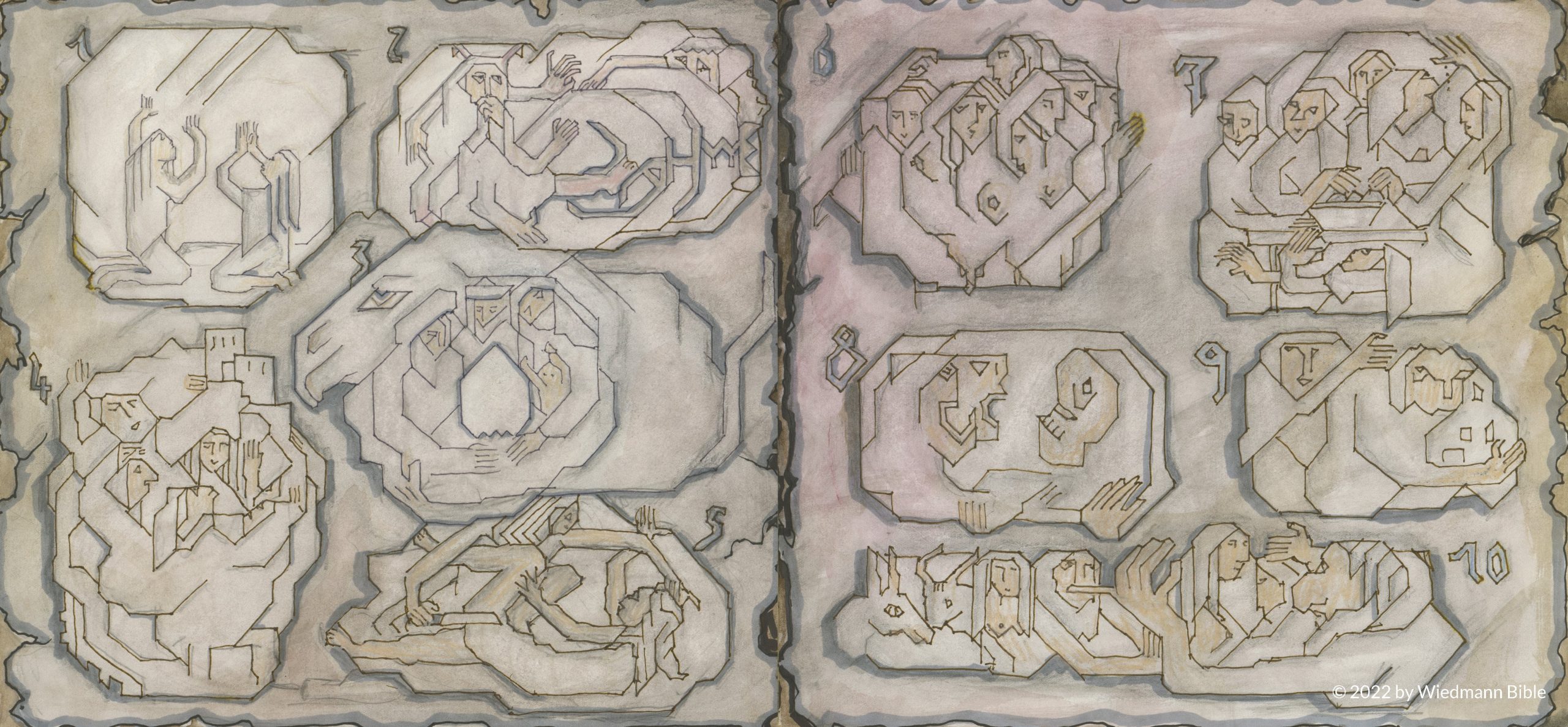
I the LORD your God am a jealous God

The Hebrew that is translated in English as “I, the Lord your God, am a jealous God” or similar is translated in Toraja-Sa’dan with an established figure of speech: “I am the Lord your God who will not that His face is drawn as water is drawn” (i.e “who will not that a person treats Him without respect, or refuses to figure with Him, or dishonors Him, or in passing Him by honors others above him.”) (Source: H. van der Veen in The Bible Translator 1950, p. 21 ff. ).

In Orma, the phrase is translated as “I, the Lord your God, will not tolerate if you bow down and worship them.” George Payton explains: “When we translated Exodus in Orma, we had difficulty translating ‘jealous’ in the Ten Commandments in Exodus 20. The first commandments in vv.3-5 read, ‘You shall have no other gods before me. 4 ‘You shall not make for yourself an image in the form of anything in heaven above or on the earth beneath or in the waters below. 5 You shall not bow down to them or worship them; for I, the Lord your God, am a jealous God, punishing the children for the sin of the parents…’

“Verse 5 says ‘I, the Lord your God, am a jealous God’ The word jealous/jealousy in Orma is hinaafa. This word brings two negative connotations. One is feeling envious of someone else’s property, or of the prosperity of their livestock or the produce of their farms. In other words, envy or coveting what someone else has but you do not. The word hinaafa can also refer to a jealous husband in a bad way. When a husband is always suspicious of his wife being unfaithful, he easily flies into a rage when she does something that triggers his suspicions, even if she is innocent. Sometimes the husband attacks her or someone else and harms them because of his jealousy. Hinaafa communicates that idea of blind rage, often unreasonable or irrational. We had to choose a different way to communicate God’s attitude. God promised to punish them if they worship any gods because He will not put up with them if they do. We ended up translating vv3-5: ‘Apart from me, you shall not worship any other gods. You shall not make a statue of anything in heaven or anything on earth or anything in the waters. I, the LORD your God, will not tolerate if you bow down and worship them. If you do, I will punish even the children for the sin of their parents…'”

In Chichewa “‘jealousy’ very commonly includes a prominent sexual component” so the solution there was to translated “(a God) who does not allow competition with me” (source: Wendland 1987, p. 127) and in Chamula Tzotzil it is not appropriate to use the usual word for jealousy of humans in relation to God when translating the Hebrew term that is translated as “jealous” in English versions. Here “I get angry with those who go with others” is used (source: Robert Bascom).

hate

The Greek and Hebrew that is translated in English as “hate” or a form thereof is translated in Tabasco Chontal as “don’t want to see [the person who is hated].” (Source: John Beekman & Harwood Hess in Notes on Translation, March 1963, p. 1ff.)

See also hate.

translations with a Hebraic voice (Exodus 20:2-14)

Some translations specifically reproduce the voice of the Hebrew text of the Old Testament / Hebrew Bible.

English:
I am Yhwh your God,
who brought you out
from the land of Egypt,
from a house of serfs.
You are not to have
any other gods
before my presence.
You are not to make yourself a carved-image
or any figure
that is in the heavens above, that is on the earth beneath, that is in the waters beneath the earth;
you are not to bow down to them,
you are not to serve them,
for I, Yhwh your God,
am a zealous God,
calling-to-account the iniquity of the fathers upon the sons, to the third and the fourth (generation)
of those that hate me,
but showing loyalty to the thousandth
of those that love me,
of those that keep my commandments.

You are not to take up
the name of Yhwh your God for emptiness,
for Yhwh will not clear him
that takes up his name for emptiness.

Remember
the Sabbath day, to hallow it.
For six days, you are to serve, and are to make all your work,
but the seventh day
is Sabbath for Yhwh your God:
you are not to make any kind of work,
(not) you, nor your son, nor your daughter,
(not) your servant, nor your maid, nor your beast,
nor your sojourner that is within your gates.
For in six days Yhwh made
the heavens and the earth,
the sea and all that is in it,
and he rested on the seventh day;
therefore Yhwh gave the Sabbath day his blessing, and he hallowed it.

Honor
your father and your mother,
in order that your days may be prolonged
on the soil that Yhwh your God is giving you.

You are not to murder.

You are not to adulter.

You are not to steal.

You are not to testify
against your fellow as a false witness.

You are not to desire
the house of your neighbor,
you are not to desire the wife of your neighbor,
or his servant, or his maid, or his ox, or his donkey,
or anything that is your neighbor’s.

Source: Everett Fox 1995

German:
Ich
bin dein Gott,
der ich dich führte aus dem Land Ägypten, aus dem Haus der Dienstbarkeit.
Nicht sei dir
andere Gottheit
mir ins Angesicht.
Nicht mache dir Schnitzgebild, —
und alle Gestalt,
die im Himmel oben, die auf Erden unten, die im Wasser unter der Erde ist,
neige dich ihnen nicht,
diene ihnen nicht,
denn Ich dein Gott
bin ein eifernder Gottherr,
zuordnend Fehl von Vätern ihnen an Söhnen, am dritten und vierten Glied,
denen die mich hassen,
aber Huld tuend ins tausendste
denen die mich lieben,
denen die meine Gebote wahren.

Trage nicht
Seinen deines Gottes Namen
auf das Wahnhafte,
denn nicht straffrei läßt Er ihn,
der seinen Namen auf das Wahnhafte trägt.

Gedenke
des Tags der Feier, ihn zu heiligen.
Ein Tagsechst diene und mache all deine Arbeit,
aber der siebente Tag
ist Feier Ihm, deinem Gott:
nicht mache allerart Arbeit,
du, dein Sohn, deine Tochter,
dein Dienstknecht, deine Magd, dein Tier,
und dein Gastsasse in deinen Toren.
Denn ein Tagsechst
machte Er
den Himmel und die Erde, das Meer und alles, was in ihnen ist,
am siebenten Tag aber ruhte er,
darum segnete Er den Tag der Feier, er hat ihn geheiligt.

Ehre
deinen Vater und deine Mutter,
damit sich längern deine Tage
auf dem Ackerboden, den Er dein Gott dir gibt.

Morde nicht.

Buhle nicht.

Stiehl nicht.

Aussage nicht
gegen deinen Genossen als Lügenzeuge.

Begehre nicht das Haus deines Genossen,
begehre nicht das Weib deines Genossen,
seinen Knecht, seine Magd, seinen Ochsen, seinen Esel,
noch allirgend was deines Genossen ist.

Source: Buber / Rosenzweig 1976

French:
« Moi-même, IHVH-Adonaï, ton Elohîms qui t’ai fait sortir
de la terre de Misraîm, de la maison des serfs,
il ne sera pas pour toi d’autres Elohîms contre mes faces.
Tu ne feras pour toi ni sculpture ni toute image
de ce qui est dans les ciels en haut, sur la terre en bas,
et dans les eaux sous terre.
Tu ne te prosterneras pas devant elles et ne les serviras pas.
Oui, moi-même, IHVH-Adonaï, ton Elohîms, Él ardent
je sanctionne le tort des pères sur les fils,
jusqu’au troisième et au quatrième cycle pour mes haineux,
Mais je fais chérissement jusqu’au millième à mes amants,
aux gardiens de mes ordres.
Tu ne porteras pas le nom de IHVH-Adonaï, ton Elohîms, en vain:
car, IHVH-Adonaï n’innocente pas qui porte son nom en vain.
Souviens-toi du jour du shabat pour le consacrer.
Tu travailleras six jours: fais tout ton ouvrage.
Le septième jour, shabat pour IHVH-Adonaï, ton Elohîms,
tu ne feras aucun ouvrage, toi, ton fils, ta fille,
ton serviteur, ta servante, ta bête,
ton métèque qui est en tes portes.
Oui, six jours, IHVH-Adonaï a fait les ciels et la terre,
la mer et tout ce qui y est,
puis il s’est reposé le septième jour,
sur quoi IHVH-Adonaï a béni le jour du shabat et il le consacre.
Glorifie ton père et ta mère, pour que se prolongent
tes jours sur la glèbe que IHVH-Adonaï, ton Elohîms, te donne.
Tu n’assassineras pas.
Tu n’adultéreras pas.
Tu ne voleras pas.
Tu ne répondras pas contre ton compagnon en témoin de mensonge.
Tu ne convoiteras pas la maison de ton compagnon,
tu ne convoiteras pas la femme de ton compagnon,
son serviteur, sa servante, son boeuf, son âne,
et tout ce qui est à ton compagnon. »
Et c’est au soir, la caille monte, elle couvre le camp,
et le matin, c’était une couche de rosée autour du camp.
La couche de rosée monte, et voici: sur les faces du désert,
une croûte fine, fine comme givre sur la terre.
Les Benéi Israël voient et disent, chaque homme à son frère:
« Mân hou ? Qu’est-ce ? » Non, ils ne savaient pas ce que c’était.
Moshè leur dit:
« C’est le pain que IHVH-Adonaï vous donne en nourriture. »

Source: Chouraqui 1985

For other verses or sections translated with a Hebraic voice, see here.

worship

The Hebrew, Aramaic, Ge’ez, and Greek terms that are often translated as “worship” (also, “kneel down” or “bow down”) are likewise translated in other languages in certain categories, including those based on physical activity, those which incorporate some element of “speaking” or “declaring,” and those which specify some type of mental activity.

Following is a list of (back-) translations (click or tap for details):

  • Javanese: “prostrate oneself before”
  • Malay: “kneel and bow the head”
  • Kaqchikel: “kneel before”
  • Loma (Liberia): “drop oneself beneath God’s foot”
  • Tepeuxila Cuicatec: “wag the tail before God” (using a verb which with an animal subject means “to wag the tail,” but with a human subject)
  • Tzotzil: “join to”
  • Kpelle: “raise up a blessing to God”
  • Kekchí: “praise as your God”
  • Cashibo-Cacataibo: “say one is important”
  • San Blas Kuna: “think of God with the heart”
  • Rincón Zapotec: “have one’s heart go out to God”
  • Tabasco Chontal: “holy-remember” (source of this and all above: Bratcher / Nida)
  • Bariai: “lift up God’s name” (source: Bariai Back Translation)
  • Q’anjob’al: “humble oneself before” (source: Newberry and Kittie Cox in The Bible Translator 1950, p. 91ff. )
  • Alur: rwo: “complete submission, adoration, consecration” (source: F. G. Lasse in The Bible Translator 1956, p. 22ff. )
  • Obolo: itọtọbọ ebum: “express reverence and devotion” (source: Enene Enene)
  • Ngäbere: “cut oneself down before” (“This figure of speech comes from the picture of towering mahoganies in the forest which, under the woodman’s ax, quiver, waver, and then in solemn, thunderous crashing bury their lofty heads in the upstretched arms of the surrounding forest. This is the experience of every true worshiper who sees ‘the Lord, high and lifted up.’ Our own unworthiness brings us low. As the Valientes say, ‘we cut ourselves down before’ His presence. Our heads, which have been carried high in self-confidence, sink lower and lower in worship.)
  • Tzeltal: “end oneself before God.” (“Only by coming to the end of oneself can one truly worship. The animist worships his deities in the hope of receiving corresponding benefits, and some pagans in Christendom think that church attendance is a guarantee of success in this life and good luck in the future. But God has never set a price on worship except the price that we must pay, namely, ‘coming to the end of ourselves.'”) (Source of this and the one above: Nida 1952, p. 163)
  • Folopa: “die under God” (“an idiom that roughly back-translates “dying under God” which means lifting up his name and praising him and to acknowledge by everything one does and thanks that God is superior.”) (Source: Anderson / Moore, p. 202)
  • Chokwe: kuivayila — “rub something on” (“When anyone goes into the presence of a king or other superior, according to native law and custom the inferior gets down on the ground, takes a little earth in the fingers of his right hand, rubs it on his own body, and then claps his hands in homage and the greeting of friendship. It is a token of veneration, of homage, of extreme gratitude for some favor received. It is also a recognition of kingship, lordship, and a prostrating of oneself in its presence. Yet it simply is the applicative form of ‘to rub something on oneself’, this form of the verb giving the value of ‘because of.’ Thus in God’s presence as king and Lord we metaphorically rub dirt on ourselves, thus acknowledging Him for what He really is and what He has done for us.”) (Source: D. B. Long in The Bible Translator 1952, p. 87ff. )
  • In the German New Testament translation Fridolin Stier (1989) it is consistently translated as “bow (to someone) deeply” (tief verneigen)

In Luang it is translated with different shades of meaning:

Source: Kathy Taber in Notes on Translation 1/1999, p. 9-16.

complete verse (Exodus 20:5)

Following are a number of back-translations as well as a sample translation for translators of Exodus 20:5:

  • Kupsabiny: “Don’t kneel to/worship those things, because I am your Creator/God, and I don’t want you to share me with anything else. I will punish those people who hate me, and I will extend that punishment to their grandchildren and it goes like that to great grandchildren.” (Source: Kupsabiny Back Translation)
  • Newari: “You are not to bow down to them and worship them because I, the Lord your God, am a jealous God, punishing the children for the sin of the father to the third and fourth generations of those who hate me.” (Source: Newari Back Translation)
  • Hiligaynon: “[You (plur.)] do- not ever -serve this and worship, for I, the LORD your (plur.) God, does- not -want that you (plur.) worship other-(gods). I punish the one who sins against me including their descendants until the third and the fourth generation that rejects me.” (Source: Hiligaynon Back Translation)
  • Bariai: “And you (sing.) can’t/mustn’t kneel down to other gods and lift up their names either. For I, your Chief God, am very insistent and so it isn’t possible for me to allow any other god to take my place. And whoever (pl.) feels ill-will toward me, they have a bad fault existing in my sight, and so I will punish them for their bad deeds and punish their children and grandchildren and their great-grandchildren also.” (Source: Bariai Back Translation)
  • Opo: “you not knee bow down before its face, you not it entreat, because I Yahweh who be God your, I be God who be jealous for my own (people). They who reject me, I punish them with children their, with children of children their, with children of children of children their together.” (Source: Opo Back Translation)
  • English: “You must not bow down to any idol and worship it, because I am Yahweh God, and I am very jealous/want you to worship me only. I will punish those who sin and hate me. I will punish not only them, but I will punish their descendants, down to the third and fourth generation/their children and grandchildren and great-grandchildren.” (Source: Translation for Translators)

1st person pronoun referring to God (Japanese)

Click or tap here to see the rest of this insight.

Like a number of other East Asian languages, Japanese uses a complex system of honorifics, i.e. a system where a number of different levels of politeness are expressed in language via words, word forms or grammatical constructs. These can range from addressing someone or referring to someone with contempt (very informal) to expressing the highest level of reference (as used in addressing or referring to God) or any number of levels in-between.

One way Japanese shows different degree of politeness is through the choice of a first person singular and plural pronoun (“I” and “we” and its various forms) as shown here in the widely-used Japanese Shinkaiyaku (新改訳) Bible of 2017. The most commonly used watashi/watakushi (私) is typically used when the speaker is humble and asking for help. In these verses, where God / Jesus is referring to himself, watashi is also used but instead of the kanji writing system (私) the syllabary hiragana (わたし) is used to distinguish God from others.

(Source: S. E. Doi, see also S. E. Doi in Journal of Translation, 18/2022, p. 37ff. )

See also pronoun for “God”.