The name that is transliterated as “Nazareth” in English is translated in Hungarian Sign Language with a sign that refers to blossoming and spring: it depicts the growth of young shoots. The word Nazareth is derived from the Hebrew word netzer, which means bud, blossom, sprout, or shoot. This linguistic connection is particularly significant for Messianic prophecies, such as in the Book of Isaiah: A shoot will come up from the stump of Jesse; from his roots a Branch (netzer) will bear fruit (Isaiah 11:1). Thus, the sign in sign language does not only identify a city, but also visually connects Nazareth with the prophetic title of Jesus. The translation highlights that the sign in sign language is essentially a visual exegesis: with a single motion, it teaches the profound etymological connection between the name of the city and the promise of the Savior. The sign is more than just a word, a label; it is simultaneously a commentary, an interpretation. (Source: Jenjelvi Biblia and HSL Bible Translation Group)
The Greek that is translated as “Pentecost” in English is translated in Huichol as “festival of the 7th week” It was rendered thus because the name of Pentecost would be equated with a sect only, and a harvest festival in late May would strain credibility. (Source: Viola Waterhouse in Notes on Translation August 1966, p. 86ff.)
In Hungarian Sign Language it is translated with a sign that refers to the fire of the Holy Spirit. (Source: Jenjelvi Biblia and HSL Bible Translation Group)
In the German New Testament translation by Berger / Nord (publ. 1999) it is translated as “the fiftieth day after Passover, on the Jewish Pentecost” (in Acts 2:1).
In Huichol, it is translated as “festival of the 7th week,” “because the name of ‘Pentecost’ would be equated only with [Pentecostal Christians], and a harvest festival in late May would strain credibility.” (Source: Viola Waterhouse in Notes on Translation August 1966, p. 86ff.)
The Aramaic, Hebrew, Latin, Ge’ez, and Greek that is translated as “fast” in English is translated in Isthmus Mixe as “going without food to worship God,” in Lacandon as “leaving eating in order to talk to God” (source: B. Moore / G. Turner in Notes on Translation 1967, p. 1ff.), in Vidunda as “resting to eat” (source: Pioneer Bible Translators, project-specific translation notes in Paratext), and in Kankanaey as “endure hunger” (source: Kankanaey Back Translation).
In Hungarian Sign Language it is translated with a sign referring to abstinence from food and drink. (Source: Jenjelvi Biblia and HSL Bible Translation Group)
The Hebrew, Latin, and Greek that is transliterated as “Joel” in English means “LORD of God,” “the LORD is God,” “the LORD is might.” (Source: Cornwall / Smith 1997 )
In Spanish Sign Language it is translated in two different ways. The first is with a sign depicting “Pentecost flame,” referring to Peter’s speech on Pentecost in which he quotes Joel in Acts 2:16 and following. (Source: Steve Parkhurst)
In Hungarian Sign Language it is translated with a sign that refers to the fact that God’s message, through the prophet, was perceived and proclaimed in the widest possible scope (see Joel 2:28). (Source: Jenjelvi Biblia and HSL Bible Translation Group)
“Joel” in Hungarian Sign Language — note that only the first part refers to “Joel,” the second and third parts refer to “prophet” and “book” (source )
Ixcatlán Mazatec: “with your best/biggest thinking” (source: Robert Bascom)
Noongar: dwangka-boola, lit. “ear much” (source: Portions of the Holy Bible in the Nyunga language of Australia, 2018 — see also remember)
Kwere “to know how to live well” (source: Pioneer Bible Translators, project-specific translation notes in Paratext)
Dobel: “their ear holes are long-lasting” (in Acts 6:3) (source: Jock Hughes)
Gbaya: iŋa-mgbara-mɔ or “knowing-about-things” (note that in comparison to that, “knowledge” is translated as iŋa-mɔ or “knowing things”) (source: Philip Noss in The Bible Translator 2001, p. 114ff. )
Chichewa: nzeru, meaning both “knowledge” and “wisdom” (source: Mawu a Mulungu mu Chichewa Chalero Back Translation)
Kako: “heart thinking” (source: Reyburn 2002, p. 190)
In Hungarian Sign Language it is translated with a hand gesture referring to God to indicate a human quality to communicate that wisdom does not originate from man but is linked to and connected with the fear of God (source: Jenjelvi Biblia and HSL Bible Translation Group):
The Aramaic or Syriac that is transliterated in English as “Golgotha” is translated in Hungarian Sign Language with a two-handed sign: the lower hand indicates the place of the skull (see Mark 15:22 et al.), while the other hand depicts the sign for the three crosses of Golgotha (see Mark 15:7 et al.). (Source: Jenjelvi Biblia and HSL Bible Translation Group)
The Hebrew and Latin that is transliterated as “Amos” in English is translated in Spanish Sign Language with the sign for “renovate / renew,” particularly referring to Amos 9:11. (Source: Steve Parkhurst)
In Swiss-German Sign Language it is translated with the sign that depicts Amos’ move from the Southern Kingdom of Judah into the Northern Kingdom of Israel to prophesy against it.
In Hungarian Sign Language it is translated with a sign reflecting the meaning and significance of the Hebrew name: burden-bearer or one who carries a load. While the biblical text does not explicitly define the name, its meaning indirectly alludes to the prophet’s ministry, as he proclaimed heavy judgments (burdens) against Israel. “I will crush you as a cart crushes, when loaded with grain.” (Amos 2:13). (Source: Jenjelvi Biblia and HSL Bible Translation Group)
“Amos” in Hungarian Sign Language — note that only the first part refers to “Amos,” the second and third parts refer to “prophet” and “book” (source )
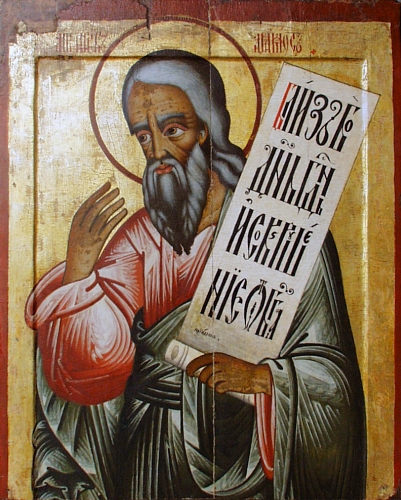
Following is a Russian Orthodox icon of Amos from the 18th century (found in the Transfiguration Church, Kizhi Monastery, Karelia, Russia). The words on the scroll are extracted from Isaiah 13:6: “For the day of the Lord is near; it will come like destruction from the Almighty!”
Orthodox Icons are not drawings or creations of imagination. They are in fact writings of things not of this world. Icons can represent our Lord Jesus Christ, the Virgin Mary, and the Saints. They can also represent the Holy Trinity, Angels, the Heavenly hosts, and even events. Orthodox icons, unlike Western pictures, change the perspective and form of the image so that it is not naturalistic. This is done so that we can look beyond appearances of the world, and instead look to the spiritual truth of the holy person or event. (Source )
The Hebrew and Latin that is transliterated as “Obadiah” in English means “a servant of the LORD,” “a worshiper of YHWH.” (Source: Cornwall / Smith 1997 )
In Hungarian Sign Language it is translated with a sign referring to the struggle between soul and body. The figure of Obadiah and his prophetic ministry exemplify faithfulness, courageous stance, and steadfastness. In the book of Obadiah, the struggle between soul and body appears as the contrast between pride and humility: “The pride of your heart has deceived you, you who live in the clefts of the rocks and make your home on the heights, you who say to yourself, ‘Who can bring me down to the ground?'” (Obadiah 1:3). The struggle between soul and body is also manifested in how we relate to those who suffer. The body would choose selfishness, while the soul chooses compassion: “You should not gloat over your brother in the day of his misfortune, nor rejoice over the people of Judah in the day of their destruction” (Obadiah 1:12). (Source: Jenjelvi Biblia and HSL Bible Translation Group)
“Obadiah” in Hungarian Sign Language — note that only the first part refers to “Obadiah,” the second and third parts refer to “prophet” and “book” (source )
In Swiss-German Sign Language it is translated with a sign that depicts the book of Obadiah as the shortest book in the Old Testament.