The Greek terms that are translated as “five thousand” and “four thousand” in these verses have to be translated descriptively in some languages, such as “ant heap” (Shona) or “large/uncountable number” (Chichewa, Yao).
See also numbers in Kombai.

ἦσαν γὰρ ὡσεὶ ἄνδρες πεντακισχίλιοι. εἶπεν δὲ πρὸς τοὺς μαθητὰς αὐτοῦ, Κατακλίνατε αὐτοὺς κλισίας [ὡσεὶ] ἀνὰ πεντήκοντα.
14For there were about five thousand men. And he said to his disciples, “Have them sit down in groups of about fifty each.”
The Greek terms that are translated as “five thousand” and “four thousand” in these verses have to be translated descriptively in some languages, such as “ant heap” (Shona) or “large/uncountable number” (Chichewa, Yao).
See also numbers in Kombai.
The Greek that is often translated as “disciple” in English typically follows three types of translation: (1) those which employ a verb ‘to learn’ or ‘to be taught’, (2) those which involve an additional factor of following, or accompaniment, often in the sense of apprenticeship, and (3) those which imply imitation of the teacher.
[Chouraqui] uses the noun “adept,” which is as uncommon in French as it is in English. It’s an evocative choice on several levels. First, linguistically, it derives — via the term adeptus — from the Latin verb adipiscor, “to arrive at; to reach; to attain something by effort or striving.” It suggests those who have successfully reached the goal of their searching, and implies a certain struggle or process of learning that has been gradually overcome. But it’s also a term with a very particular history: in the Middle Ages, “adept” was used in the world of alchemy, to describe those who, after years of labor and intensive study, claimed to have discovered the Great Secret (how to turn base metals like lead into gold); it thus had the somewhat softened meaning of “someone who is completely skilled in all the secrets of their field.”
Historians of religion often use the term adept with reference to the ancient mystery religions that were so prevalent in the Mediterranean in the centuries around the time of Jesus. An adept was someone who, through a series of initiatory stages, had penetrated into the inner, hidden mysteries of the religion, who understood its rituals, symbols, and their meaning. To be an adept implied a lengthy and intensive master-disciple relationship, gradually being led further and further into the secrets of the god or goddess (Isis-Osiris, Mithras, Serapis, Hermes, etc.) — secrets that were never to be revealed to an outsider.
Is “adept” a suitable category in which to consider discipleship as we see it described in the Gospels? On some levels, the link is an attractive one, drawing both upon the social-religious framework of the ancient Mediterranean, and upon certain aspects of intimacy and obscurity/secrecy that we see in the relationship of Jesus and those who followed him. The idea that disciples are “learners” — people who are “on the way” — and that Jesus is portrayed as (and addressed as) their Master/Teacher is accurate. But the comparison is unsatisfactory on several other levels.
First, the Gospels portray Jesus’s ministry as a largely public matter — there is relatively little of the secrecy and exclusiveness that is normally associated with both the mystery cults and medieval alchemy. Jesus’s primary message is not destined for a small, elite circle of “initiates” — although the Twelve are privy to explanations, experiences and teachings that are not provided to “the crowds.” For example, in Matthew 13:10-13:
Then the disciples came and asked him, “Why do you speak to [the crowds] in parables?” He answered, “To you it has been given to know the secrets of the kingdom of heaven, but to them it has not been given. For to those who have, more will be given, and they will have an abundance; but from those who have nothing, even what they have will be taken away. The reason I speak to them in parables is that ‘seeing they do not perceive, and hearing they do not listen, nor do they understand.’”
Etymologically, adeptus suggests someone who “has arrived,” who has attained a superior level of understanding reserved for very few. However, what we see in the Gospels, repeatedly, is a general lack of comprehension of many of Jesus’s key teachings by many of those who hear him. Many of his more cryptic sayings would have been virtually incomprehensible in their original context, and would only make sense in retrospect, in the wake of the events of Jesus’s passion, death, and resurrection. The intense master-student relationship is also lacking: the Gospels largely portray “the disciples” as a loose (and probably fluctuating) body of individuals, with minimal structure or cohesion. Finally, there seems to be little scholarly consensus about the degree to which the mystery cults had made inroads in Roman-ruled Palestine during the decades of Jesus’s life. According to Everett Ferguson in his Backgrounds of Early Christianity.
Although Christianity had points of contact with Stoicism, the mysteries, the Qumran community, and so on, the total worldview was often quite different….So far as we can tell, Christianity represented a new combination for its time…. At the beginning of the Christian era a number of local mysteries, some of great antiquity, flourished in Greece and Asia Minor. In the first century A.D. the vonly mysteries whose extension may be called universal were the mysteries of Dionysus and those of the eastern gods, especially Isis.
And Norman Perrin and Dennis C. Duling note, in their book The New Testament:
Examples of such mystery religions could be found in Greece… Asia Minor… Syria-Palestine… Persia… and Egypt. Though the mysteries had sacred shrines in these regions, many of them spread to other parts of the empire, including Rome. There is no clearly direct influence of the mysteries on early Christianity, but they shared a common environment and many non-Christians would have perceived Christians as members of an oriental Jewish mystery cult.56
Given the sparse archaeological and literary evidence from this period regarding mystery cults in Roman Palestine, and the apparent resistance of many Palestinian Jews to religious syncretism, Chouraqui’s use of the noun adept implies a comparison between the historical Jesus and mystery cults that is doubtful, on both the levels of chronology and religious culture. Personally, I believe this choice suggests a vision of Jesus that distances him from the religious world of ancient Judaism, thus creating a distorted view of what spiritually inspired him. But the idea of the disciples as “learners” on a journey (as the Greek term suggests) is a striking one to consider; certainly, the Gospels show us the Twelve as people who are growing, learning, and developing…but who have not yet “arrived” at the fullness of their vocation.
Scot McKnight (in The Second Testament, publ. 2023) translates it into English as apprentice.
In Luang several terms with different shades of meaning are being used.
Source: Kathy Taber in Notes on Translation 1/1999, p. 9-16.
In American Sign Language it is translated with a combination of the signs for “following” plus the sign for “group.” (Source: Ruth Anna Spooner, Ron Lawer)
“disciples” in American Sign Language, source: Deaf Harbor
In British Sign Language a sign is used that depicts a group of people following one person (the finger in the middle, signifying Jesus). Note that this sign is only used while Jesus is still physically present with his disciples. (Source: Anna Smith)
“Disciple in British Sign Language (source: Christian BSL, used with permission)
See also disciples (Japanese honorifics).
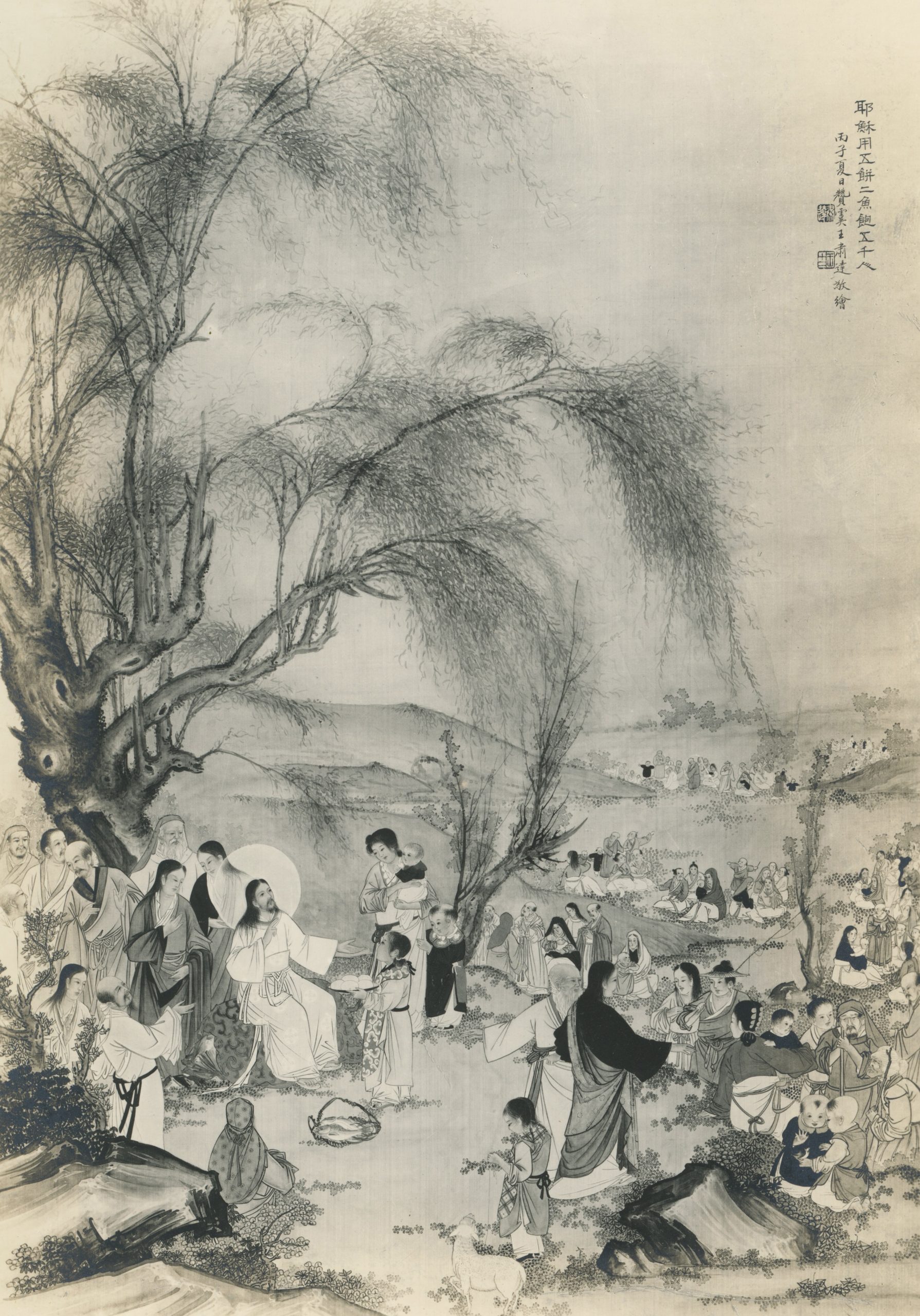
Image taken from Chinese Christian Posters . For more information on the “Ars Sacra Pekinensis” school of art, see this article , for other artworks of that school in TIPs, see here.
Following is a 1973 painting of the JESUS MAFA project, a response to New Testament readings from the Lectionary by a Christian community in Cameroon, Africa. Each of the readings was selected and adapted to dramatic interpretation by the community members. Photographs of their interpretations were made, and these were then transcribed to paintings:

Jesus stands in the center inspecting the baskets of leftover food the disciples are bringing to him. All around him are content crowds of people who have just been fed. The miracle of this story rests in Jesus’ taking the resources people shared and breaking (read dividing) them among all in attendance that day. Christians are called to live and follow Christ in his example—this means sharing what we have with those around us, especially those in need. In this world, there is plenty to go around. Rather than projecting a gospel of prosperity, we should radiate a gospel of giving.
From Art in the Christian Tradition , a project of the Vanderbilt Divinity Library, Nashville, TN. Image retrieved March 23, 2026. Original source: librairie-emmanuel.fr.
Following are a number of back-translations of Luke 9:14:
Many languages use a “body part tally system” where body parts function as numerals (see body part tally systems with a description). One such language is Angguruk Yali which uses a system that ends at the number 27. To circumvent this limitation, the Angguruk Yali translators adopted a strategy where a large number is first indicated with an approximation via the traditional system, followed by the exact number according to Arabic numerals. For example, where in 2 Samuel 6:1 it says “thirty thousand” in the English translation, the Angguruk Yali says teng-teng angge 30.000 or “so many rounds [following the body part tally system] 30,000,” likewise, in Acts 27:37 where the number “two hundred seventy-six” is used, the Angguruk Yali translation says teng-teng angge 276 or “so many rounds 276,” or in John 6:10 teng-teng angge 5.000 for “five thousand.”
This strategy is used in all the verses referenced here.
Source: Lourens de Vries in The Bible Translator 1998, p. 409ff.
See also numbers in Ngalum and numbers in Kombai.
Like a number of other East Asian languages, Japanese uses a complex system of honorifics, i.e. a system where a number of different levels of politeness are expressed in language via words, word forms or grammatical constructs. These can range from addressing someone or referring to someone with contempt (very informal) to expressing the highest level of reference (as used in addressing or referring to God) or any number of levels in-between.
One way Japanese shows different degree of politeness is through the usage of an honorific construction where the morpheme are (され) is affixed on the verb as shown here in the widely-used Japanese Shinkaiyaku (新改訳) Bible of 2017. This is particularly done with verbs that have God as the agent to show a deep sense of reverence. Here, iw-are-ru (言われる) or “say” is used.
(Source: S. E. Doi, see also S. E. Doi in Journal of Translation, 18/2022, p. 37ff. )
Exegesis:
ēsan gar hōsei andres pentakischilioi ‘for there were about five thousand men.’ The clause refers to panta ton laon touton in v. 13. The use of andres instead of anthrōpoi implies that women and children are not included in the number.
eipen de ‘then he said,’ rather than ‘but he said.’ de is continuative, not contrastive.
kataklinate autois klisias [hōsei] ana pentēkonta ‘make them sit down in groups of about fifty each.’ For kataklinō cf. on 7.36; here it is transitive. For hōsei cf. on 3.23; for ana cf. on v. 3.
klisia ‘group of people eating together.’ Here it is in the accusative plural, as an apposition which denotes the result of kataklinate.
Translation:
About. Approximation may be expressed variously, e.g. ‘perhaps’ (Toraja-Sa’dan), a term related to the word for ‘estimate’ (Bahasa Indonesia, Batak Toba), ‘more or less,’ or the indefinite article, cf. ‘a five thousand.’
Five thousand. Terms for 1000 may be basically descriptive, cf. e.g. ‘ant heap’ (Shona), ‘large/uncountable number’ (East Nyanja, Yao). In some cases the rendering must be built on smaller units, and/or be expressed by approximation, cf. e.g. ‘sixty sixties and more yet’ (Ekari, adding the last three words to distinguish the phrase from the one rendering “four thousand”, in Mk. 8.9), or, ‘very many.’ In the former case it may be possible to indicate the number indirectly, i.e. by using ‘in hundred companies, about fifty men each’ in the next clause.
Make them sit down, or, ‘tell them all to sit on the ground.’ The attitude may have to be specified.
In companies, about fifty each, or, ‘forming-groups about fifty one-group’ (Bahasa Indonesia), ‘about fifty-fifty one-group’ (Balinese, the repetition expressing the distributive use of the numeral). If the category numbered must be indicated one may hesitate here between ‘fifty male persons’ and ‘fifty persons (including men, women, and children),’ but ‘men/male persons’ seems to be preferable, because the correlation 5000-50 suggests that in both cases the same category is meant.
Quoted with permission from Reiling, J. and Swellengrebel, J.L. A Handbook on the Gospel of Luke. (UBS Handbook Series). New York: UBS, 1971. For this and other handbooks for translators see here . Make sure to also consult the Handbook on the Gospel of Mark for parallel or similar verses.
No comments yet.
Leave a Reply
You must be logged in to post a comment.