
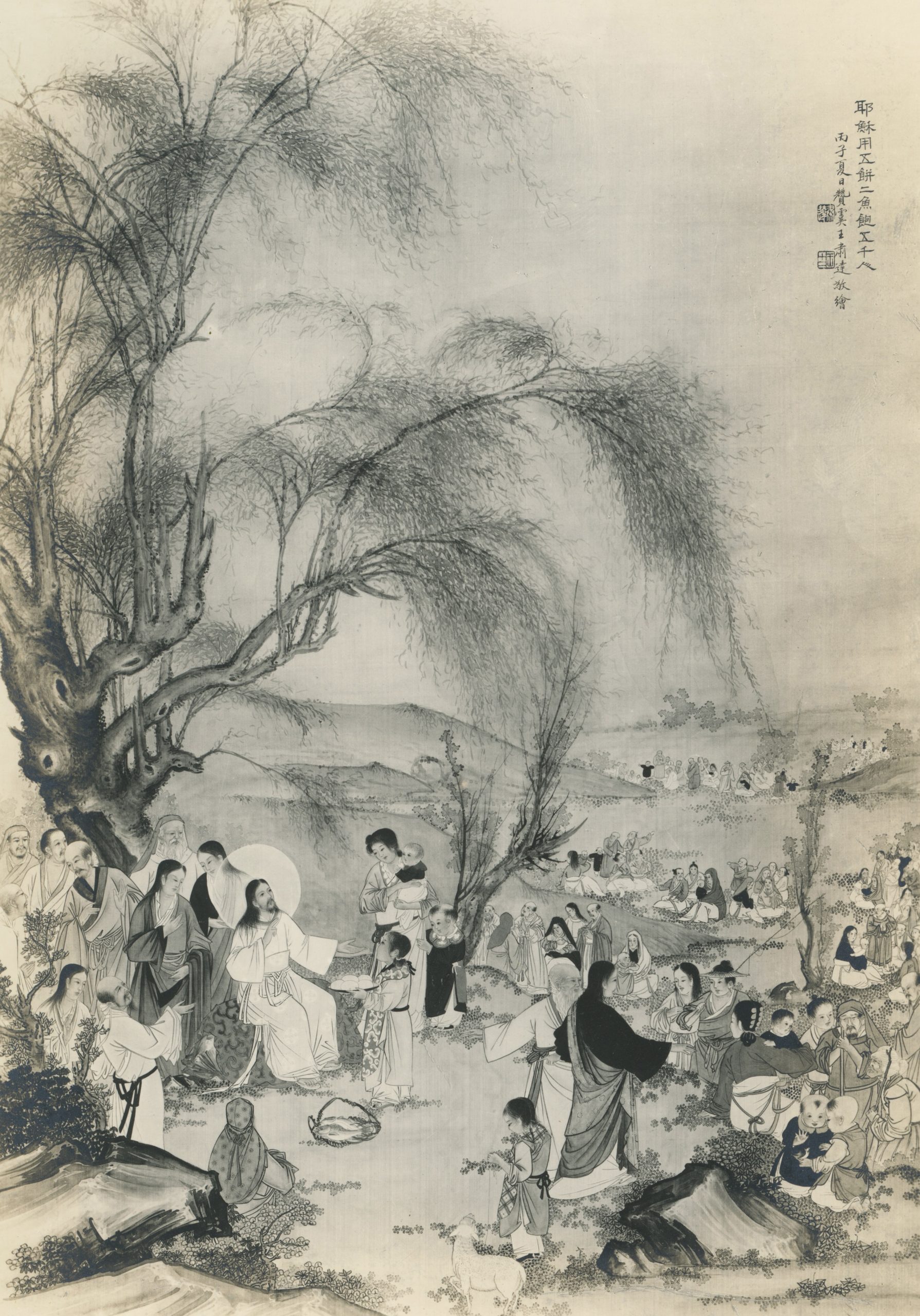
Feeding of the Five Thousand

1936 painting by Wang Suda 王肅達 (1910-1963),
Housed in the Société des Auxiliaires des Missions Collection – Whitworth University
(click image to enlarge)

Image taken from Chinese Christian Posters . For more information on the “Ars Sacra Pekinensis” school of art, see this article , for other artworks of that school in TIPs, see here.

Following is a 1973 painting of the JESUS MAFA project, a response to New Testament readings from the Lectionary by a Christian community in Cameroon, Africa. Each of the readings was selected and adapted to dramatic interpretation by the community members. Photographs of their interpretations were made, and these were then transcribed to paintings:

Jesus stands in the center inspecting the baskets of leftover food the disciples are bringing to him. All around him are content crowds of people who have just been fed. The miracle of this story rests in Jesus’ taking the resources people shared and breaking (read dividing) them among all in attendance that day. Christians are called to live and follow Christ in his example—this means sharing what we have with those around us, especially those in need. In this world, there is plenty to go around. Rather than projecting a gospel of prosperity, we should radiate a gospel of giving.

From Art in the Christian Tradition , a project of the Vanderbilt Divinity Library, Nashville, TN. Image retrieved March 23, 2026. Original source: librairie-emmanuel.fr.

complete verse (Luke 9:15)

Following are a number of back-translations of Luke 9:15:

  • Noongar: “After the disciples had done this,” (Source: Warda-Kwabba Luke-Ang)
  • Uma: “His disciples followed what Yesus commanded them.” (Source: Uma Back Translation)
  • Yakan: “They did what Isa had told them and they caused all the people to sit.” (Source: Yakan Back Translation)
  • Western Bukidnon Manobo: “And then they had all of the people sit down.” (Source: Western Bukidnon Manobo Back Translation)
  • Kankanaey: “And that’s what they did.” (Source: Kankanaey Back Translation)
  • Tagbanwa: “The disciples had all the people sit down like that.” (Source: Tagbanwa Back Translation)

Translation commentary on Luke 9:15

Exegesis:

kai epoiēsan houtōs kai kateklinan hapantas ‘and they did so, and made them all sit down.’ houtōs means here, ‘as they were told.’

Translation:

They may have to be specified, ‘the disciples.’

Did so, or, ‘behaved according-to his word’ (Balinese), ‘obeyed’ (Bible de Jérusalem), ‘complied’ (Javanese, Batak Toba).

Quoted with permission from Reiling, J. and Swellengrebel, J.L. A Handbook on the Gospel of Luke. (UBS Handbook Series). New York: UBS, 1971. For this and other handbooks for translators see here . Make sure to also consult the Handbook on the Gospel of Mark for parallel or similar verses.

SIL Translator’s Notes on Luke 9:15

Paragraph 9:15–17

9:15

They did so: The clause They did so indicates that the disciples did what Jesus had told them to do and seated the people. Some versions, such as the New International Version, repeat “the disciples” from 9:14b, but the Greek text has “they,” as in the Berean Standard Bible. Refer to the disciples here in a natural way in your language.

and everyone was seated: This clause tells the result of the disciples telling the people to sit down. For example:

So they did this. (God’s Word)

The word everyone refers primarily to the five thousand men, but it includes everyone who was there. For example:

and all the people sat down (Contemporary English Version)

General Comment on 9:15

In some languages it may be more natural to combine the two clauses of 9:15 into one clause. For example:

After the disciples had done so (Good News Translation)

© 2009, 2010, 2013 by SIL International®
Made available under the terms of a Creative Commons Attribution-ShareAlike 4.0 License (CC BY-SA) creativecommons.org/licenses/by-sa/4.0.
All Scripture quotations in this publication, unless otherwise indicated, are from The Holy Bible, Berean Standard Bible.
BSB is produced in cooperation with Bible Hub, Discovery Bible, OpenBible.com, and the Berean Bible Translation Committee.