18Those who believe in him are not condemned, but those who do not believe are condemned already because they have not believed in the name of the only Son of God.
The Greek and Latin that is translated as “Son of God” in English is translated in Shipibo-Conibo as “God’s Child” and in Garifuna as “God’s offspring.” (Source: M. Larson / B. Moore in Notes on Translation February 1970, p. 1-125.)
Nida (1984, p. 113) remarks on this “It was a common expression in Hebrew to say that someone was the ‘Son of…’ something to express that they shared characteristics with that thing etc. E.g. ‘son of peace’ ‘son of thunder.’ Therefore ‘Son of God’ meant that Jesus shared characteristics with God. This wasn’t carried over into Greek and was interpreted more biologically.”
In San Mateo Del Mar Huave it is translated as “Son of Father God,” where “Father” is a term of respect. (Source: B. Moore / G. Turner in Notes on Translation 1967, p. 1ff.)
Like a number of other East Asian languages, Japanese uses a complex system of honorifics, i.e. a system where a number of different levels of politeness are expressed in language via words, word forms or grammatical constructs. These can range from addressing someone or referring to someone with contempt (very informal) to expressing the highest level of reference (as used in addressing or referring to God) or any number of levels in-between. One way to do this is through the usage (or a lack) of an honorific prefix as shown here in the widely-used Japanese Shinkaiyaku (新改訳) Bible of 2017. When the referent is God, the “divine” honorific prefix mi- (御) is used as in mi-ko (御子) or “son (of God)” in the referenced verses. (Source: S. E. Doi, see also S. E. Doi in Journal of Translation, 18/2022, p. 37ff. )
The Greek terms krino and katakrino/katadikazo that are translated as “judge” and “condemn” respectively in English are translated with only one term in Kutu (tagusa). (Source: Pioneer Bible Translators, project-specific translation notes in Paratext)
Some of the Hebrew, Ge’ez, and Greek phrases that are translated in English in association with “name,” including “in the name of,” “in my name,” “in your name,” “on the account of my name,” “on the account of your name” (according to a classification by Robert Bratcher in The Bible Translator 1963, p. 72ff. , phrases that belong to the categories of “Agency or instrumentality” and “Representation”) present a number of challenges in other languages.
Click or tap here to see the rest of this insight
Eugene Nida (1947, p 178ff.) explains this way:
“The biblical attitudes toward human personality are of great theological importance. There is, however, only one word which produces any considerable difficulty in other languages. This is the word ‘name.’ The great difference attached to the significance of the name of a person in the Bible times in contrast with our own culture is very important. Note such phrases as ‘whatsoever ye shall ask in my name,’ John 14:13, ‘believed in the name of the only begotten Son of God,’ John 3:18, and ‘life through his name,’ John 20:31. These expressions are generally difficult for us to understand, for the word ‘name’ does not mean the same to us as it meant to those of Bible times. To them the name was the symbolization of the authority and personality of the individual who possessed the name. To us a name is far less important. It may be changed whenever one can convince a judge that another name might be more economically advantageous. The name is also a legal method of giving one’s written assent to certain business transactions, but to us it is not the symbol of the personality.”
The translation in Eastern Huasteca Nahuatl typically is “in someone’s authority” (for instance “I have come in my Father’s name” in John 5:43 becomes “I have come on my Father’s authority”) (source Nida 1947, p. 179), or in Highland Puebla Nahuatl with the more paraphrastic equivalent “as though on orders from you” or in Tzeltal as “by your authority, so he said” (both examples for Mark 9:38 and 39, see Bratcher / Nida).
In Guhu-Samane, Mark 11:9 (in English: “Blessed is he that comes in the name of the Lord”) is translated as “Blessed is the Lord’s namesake who comes.” “In the name of the Lord” caused “puzzlement [because] “has he just assumed the name of the Lord, valid or otherwise? [But] with ‘blessed is the Lord’s namesake who comes’ the strong bond between the namesake and the important ancestor for whom named entitles the namesake to the deference due the ancestor. Thought very proper in this context.” (Source: Ernest L. Richert in Notes on Translation December 1963: p. 4-7; reprinted in The Bible Translator 1965, p. 198ff. )
Barclay Newman (see The Bible Translator 1974, pp, 432ff. ) reports on different solutions for the translation of the Today’s Malay Version (Alkitab Berita Baik, 1987):
In Malay “the phrase ‘in my name’ is problematic (…) since it sounds like the use of magic. For this reason [the English] Today’s English Version (Good News Bible) was followed at such passages as John 5:43 and 10:25, where ‘in the name of my Father’ is translated as ‘with my Father’s authority’ and ‘by my Father’s authority’ [respectively]. In John 12:13 ‘in the name of the Lord’ has become ‘in his (the Lord’s) behalf,’ following the common language German translation Die Gute Nachricht. In John 14:13, ‘because you are my followers’ is used, in John in 15:16, 16:23 and 24 ‘as my followers,’ in John 17:11 ‘by your own power, the power you gave me,’ and in John 14:26 ‘in my place.'”
Other translations for “in the name of Jesus Christ” include “in the authority of Jesus Christ” (Isthmus Mixe), “calling on Jesus Christ” (Teutila Cuicatec), “calling the name of Jesus Christ over you” (Ayutla Mixtec), “because of Jesus” (Tepeuxila Cuicatec), “by the power of the name of Jesus Christ” (Chichimeca-Jonaz), “the word of Jesus Christ is strong” (Lalana Chinantec) (source for this and above: Viola Waterhouse in Notes on Translation August 1966, p. 86ff.), and “mentioning the name of Jesus” (Elhomwe — source: project-specific translation notes in Paratext).
“A particularly interesting development in the history of Christianity [related to translation] took place with respect to the Greek term monogenés, literally, ‘only, unique, one of kind.’ It was used of Isaac as the son of Abraham [see Gen. 22:2], though Isaac was not the only son of Abraham, for he had a son Ishmael, and with a later wife Keturah, several sons. But Isaac was the only son of a particular kind, that is to say, the unique son of the promise. The term monogenés was translated into the LatinVulgate as unigenitus, meaning literally ‘only begotten’ [in English — or likewise traditionally in Mandarin Chinese: “dúshēng 獨 生,” Italian: “unigenito,” Spanish “unigénito,” or German: “eingeboren”] but in Greek the equivalent of ‘only begotten’ would have two n’s and not just one (monogennes). Nevertheless, the Latin misinterpretation of monogenés has constituted such a long tradition that any attempt to speak of Jesus as the ‘unique son of God’ rather than the ‘only begotten son’ is often announced as a case of blatant heresy.” (Source: Nida 1984, p. 114.)
In Waiwai, the Greek that is translated as “only begotten Son” in English in John 3:16 is translated as cewnan tumumururosa okwe, where the “particle okwe indicates dearness, and it must be included in Waiwai for the expression ‘only begotten Son’ to mean anything like what it means to God or to us as Christians.” (Source: Robert Hawkins (in The Bible Translator 1962, pp. 164ff. )
“It is unusual for anyone to seek out another at night unless it is desired to be kept secret. Betel nut and condiments are laid out to welcome the guest even at the late hour. Nicodemus’s robe and bared shoulder show he is a religious devotee.”
For more images by Sawai Chinnawong in TIPs see here.
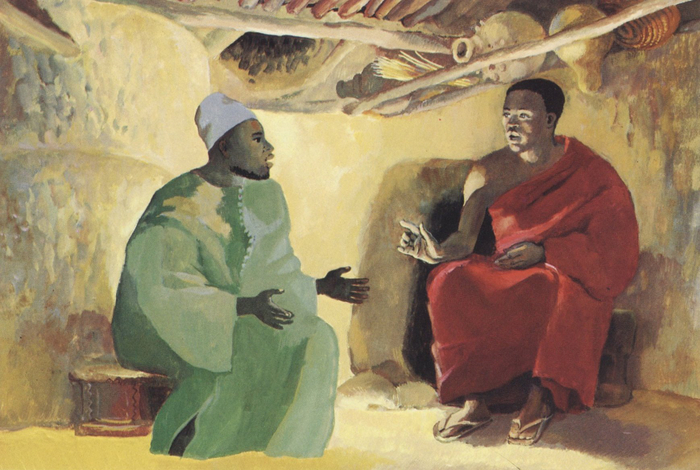
The following 1973 painting “Nicodemus” of the JESUS MAFA project is a response to New Testament readings from the Lectionary by a Christian community in Cameroon, Africa. Each of the readings was selected and adapted to dramatic interpretation by the community members. Photographs of their interpretations were made, and these were then transcribed to paintings:
Here we see Jesus patiently teaching about the kingdom of God to a perplexed Nicodemus, whose hands are in a gesture of questioning. Nicodemus has, like so many before and since, gotten caught up in the literal and limited understanding of the scriptures. Jesus attempted to explain the nature of reality in different terms that thereby he (and we) might be transformed. The boundaries we place on ourselves can be escaped if only we are brave enough to venture beyond them. Shall we remain in the cover of night with Nicodemus or step into the light that Jesus offers?
From Art in the Christian Tradition, a project of the Vanderbilt Divinity Library, Nashville, TN. Image retrieved March 23, 2026. Original source: librairie-emmanuel.fr.
Following are a number of back-translations of John 3:18:
Chol: “He who believes will not have to pay for his sins. He who does not believe, he is already beginning to pay for his sins because he does not believe on the name of the only Son of God.”
Yatzachi Zapotec: “The person who trusts in the Son of God, it is already determined about him that he does not have guilt, but the person who does not trust in him it is determined about him that he does have guilt. . .” (Source for this and above: M. Larson / B. Moore in Notes on Translation February 1970, p. 1-125.)
Uma: “People who believe in the Child of God, they are not punished/condemned. But people who do not believe, it is clear that they will be punished/condemned by God, because they do not want to believe in that Only Child of God.” (Source: Uma Back Translation)
Yakan: “Whoever trusts in the Son of God will not be hit by the judgment of God. Those who do not trust, have already been hit by the judgment of God because they do not trust in Isa, the only Son of God.” (Source: Yakan Back Translation)
Western Bukidnon Manobo: “Anyone who believes in me, he will not be punished by God, but those who do not believe in me, it is known beforehand that they will be punished. Because as for me, the only child of God, they have not believed in me.” (Source: Western Bukidnon Manobo Back Translation)
Kankanaey: “Therefore those who believe in him, they will emphatically not be punished. But those who don’t believe, they have already been sentenced/condemned to be punished, because of-course they didn’t believe in the only Child of God.” (Source: Kankanaey Back Translation)
Tagbanwa: “As many as will believe-in/obey and trust-in/rely-on him will really not be sentenced with a sentence of punishment. But those who don’t believe/obey, they have already been sentenced to be given punishment, because they are not believing-in/obeying this one-and-only Son of God.” (Source: Tagbanwa Back Translation)
Tenango Otomi: “He who believes the Son of God will not be sentenced. But he who does not believe, already is sentenced because he does not believe in the only Son of God.” (Source: Tenango Otomi Back Translation)
The Greek that is typically translated with a generic expressions such as “he who,” “whoever,” or “if anyone” in English is translated with the plural form (“they”) in Daga. “A literal translation of these conveys the idea that one specific unnamed individual is being discussed. Thus, for instance, in John 5:24 ‘he who hears my word and believes in him who sent me has eternal life’ meant in Daga that there was one fortunate individual to whom it applied.”
God transcends gender, but most languages are limited to grammatical gender expressed in pronouns. In the case of English, this is traditionally confined to “he” (or in the forms “his,” “him,” and “himself”), “she” (and “her,” “hers,” and “herself”), and “it” (and “its” and “itself”).
Modern Mandarin Chinese, however, offers another possibility. Here, the third-person singular pronoun is always pronounced the same (tā), but it is written differently according to its gender (他 is “he,” 她 is “she,” and 它/牠 is “it” and their respective derivative forms). In each of these characters, the first (or upper) part defines the gender (man, woman, or thing/animal), while the second element gives the clue to its pronunciation.
In 1930, after a full century with dozens of Chinese translations, Bible translator Wang Yuande (王元德) coined a new “godly” pronoun: 祂. Chinese readers immediately knew how to pronounce it: tā. But they also recognized that the first part of that character, signifying something spiritual, clarified that each person of the Trinity has no gender aside from being God.
While the most important Protestant and Catholic Chinese versions respectively have opted not to use 祂, some Bible translations do and it is widely used in hymnals and other Christian materials. Among the translations that use 祂 to refer to “God” were early versions of Lü Zhenzhong’s (呂振中) version (New Testament: 1946, complete Bible: 1970). R.P. Kramers (in The Bible Translator 1956, p. 152ff. ) explains why later versions of Lü’s translation did not continue with this practice: “This new way of writing ‘He,’ however, has created a minor problem of its own: must this polite form be used whenever Jesus is referred to? Lü follows the rule that, wherever Jesus is referred to as a human being, the normal tā (他) is written; where he is referred to as divine, especially after the ascension, the reverential tā (祂) is used.”
In that system, one kind of pronoun is used for humans (male and female alike) and others for natural elements, non-liquid masses, and some spiritual entities (one other is used for large animals and another one for miscellaneous items). While in these languages the pronoun for spiritual entities used to be employed when referring to God, this has changed into the use of the human pronoun.
Lynell Zogbo (in The Bible Translator 1989, p. 401ff. ) explains: “From informal discussions with young Christians especially, it would appear that, at least for some people, the experience and/or concepts of Christianity are affecting the choice of pronoun for God. Some people explain that God is no longer ‘far away,’ but is somehow tangible and personal. For these speakers God has shifted over into the human category.”
In Kouya, God (the Father) and Jesus are referred to with the human pronoun ɔ, whereas the Holy Spirit is referred to with a non-human pronoun. (Northern Grebo and Western Krahn make a similar distinction.)
Eddie Arthur, a former Kouya Bible translation consultant, says the following: “We tried to insist that this shouldn’t happen, but the Kouya team members were insistent that the human pronoun for the Spirit would not work.”
In Burmese, the pronoun ko taw (ကိုယ်တော်) is used either as 2nd person (you) or 3rd person (he, him, his) reference. “This term clearly has its root in the religious language in Burmese. No ordinary persons are addressed or known by this pronoun because it is reserved for Buddhist monks, famous religious teachers, and in the case of Christianity, the Trinity.” (Source: Gam Seng Shae in The Bible Translator 2002, p. 202ff. )
In Thai, the pronoun phra`ong (พระองค์) is used, a gender-neutral pronoun which must refer to a previously introduced royal or divine being. Similarly, in Northern Khmer, which is spoken in Thailand, “an honorific divine pronoun” is used for the pronoun referring to the persons of the Trinity (source: David Thomas in The Bible Translator 1993, p. 445 ). In Urak Lawoi’, another language spoken in Thailand, the translation often uses tuhat (ตูฮัด) — “God” — ”as a divine pronoun where Thai has phra’ong even though it’s actually a noun.” (Source for Thai and Urak Lawoi’: Stephen Pattemore)
The English “Contemporary Torah” addresses the question of God and gendered pronouns by mostly avoiding pronouns in the first five books of the Hebrew Bible/Old Testament (unless God is referred to as “lord,” “father,” “king,” or “warrior”). It does that by either using passive constructs (“He gave us” vs. “we were given”), by using the adjective “divine” or by using “God” rather than a pronoun.
Some Protestant and Orthodox English Bibles use a referential capitalized spelling when referring to the persons of the Trinity with “He,” “His,” “Him,” or “Himself.” This includes for instance the New American Standard Bible or The Orthodox New Testament, but most translations do not. Two other languages where this is also done (in most Bible translations) are Twents as well as the closely related Indonesian and Malay. In the latter two languages this follows the language usage according to the Qur’an, which in turn predicts that usage (see Soesilo in The Bible Translator 1991, p. 442ff. and The Bible Translator 1997, p. 433ff. ).
Leave a Reply
You must be logged in to post a comment.