The Greek that is translated as “world” in English is translated as “all the people who sleep in all the places of the earth” in Samo (source: Shaw / Van Engen 2003, p. 178) or “world people” in Lisu (source: Cooke 1947, p. 29).
The Greek that is often translated as “the light” in English is translated as “the one who teaches the right and straight, the one who, as you might say, illuminates people” in Ojitlán Chinantec and “who was like a light since he teaches what is truth” in Xicotepec De Juárez Totonac. (Source: M. Larson / B. Moore in Notes on Translation February 1970, p. 1-125)
“It is unusual for anyone to seek out another at night unless it is desired to be kept secret. Betel nut and condiments are laid out to welcome the guest even at the late hour. Nicodemus’s robe and bared shoulder show he is a religious devotee.”
For more images by Sawai Chinnawong in TIPs see here.
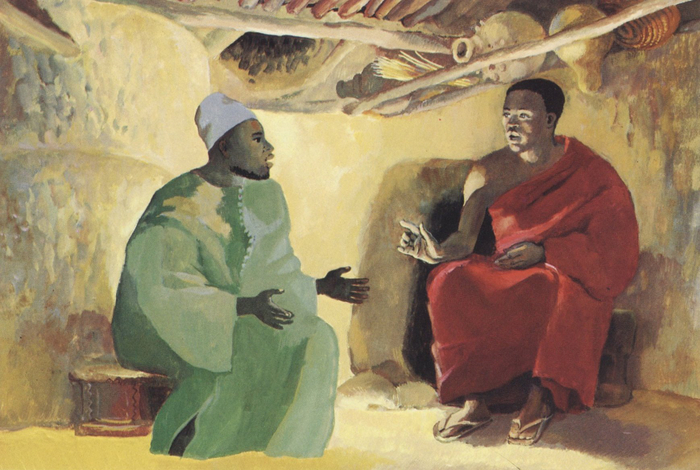
The following 1973 painting “Nicodemus” of the JESUS MAFA project is a response to New Testament readings from the Lectionary by a Christian community in Cameroon, Africa. Each of the readings was selected and adapted to dramatic interpretation by the community members. Photographs of their interpretations were made, and these were then transcribed to paintings:
Here we see Jesus patiently teaching about the kingdom of God to a perplexed Nicodemus, whose hands are in a gesture of questioning. Nicodemus has, like so many before and since, gotten caught up in the literal and limited understanding of the scriptures. Jesus attempted to explain the nature of reality in different terms that thereby he (and we) might be transformed. The boundaries we place on ourselves can be escaped if only we are brave enough to venture beyond them. Shall we remain in the cover of night with Nicodemus or step into the light that Jesus offers?
From Art in the Christian Tradition, a project of the Vanderbilt Divinity Library, Nashville, TN. Image retrieved March 23, 2026. Original source: librairie-emmanuel.fr.
Following are a number of back-translations of John 3:19:
Uma: “He arrived in the world carrying light to all people. But people prefer darkness to light, because their behavior is evil. That is why God punishes/condemns them.” (Source: Uma Back Translation)
Yakan: “This is the reason why they are hit by God’s judgment, because Isa has already come here to the world to enlighten the thoughts/minds of mankind but mankind does not want the light. They want the darkness because their doings are bad.” (Source: Yakan Back Translation)
Western Bukidnon Manobo: “The reason they will be punished is because when I, who am called the light came here in the world, they preferred darkness which is to say, transgression against God, rather than the light, because what they do is bad.” (Source: Western Bukidnon Manobo Back Translation)
Kankanaey: “This is the reason they were condemned. The light (silaw) which illuminates the minds of people came to this world, but they esteemed/valued the darkness more-than the light (mapat-a, as in daylight), because what they were doing was evil.” (Source: Kankanaey Back Translation)
Tagbanwa: “They will be sentenced like this because he who is meant by the light came here to the world, but what people preferred was darkness, not this light/enlightenment, because of their continued doing of evil.” (Source: Tagbanwa Back Translation)
Tenango Otomi: “And those who do not believe now will be sentenced because they do not believe in the Son of God who came here to earth. It is like a light reveals all things, in like manner he causes people to know they have sins. But the people do not look favorably upon one who says they have sin because they do evil.” (Source: Tenango Otomi Back Translation)
Illustration by Horst Lemke (1922-1985) for the GermanGute Nachricht für Sie – NT68, one of the first editions of the Good News Bible in German of 1968. Lemke was a well-known illustrator who illustrated books by Erich Kästner , Astrid Lindgren and many others.
This verse continues the theme of judgement introduced in the two preceding verses. If God sent his Son into the world to save the world, why then are some men still under God’s judgement? Verses 19 and 20 answer this question.
This is how the judgement works is literally “this is the judgement,” which Good News Translation takes to mean “This is how God judges the world,” and so it refers to the way in which God’s judgement is accomplished. That is, God sends his light … into the world, and the judgement is a natural outcome of man’s rejection of the light. New English Bible also takes this expression as a reference to the way God brings about his judgement, and so translates “Here lies the test.” Although condemnation is an inevitable outcome of the coming of the light into the world, the focus seems to be on the way God judges the world, rather than on the resulting condemnation. However, New American Bible makes the aspect of condemnation explicit: “The judgement of condemnation is this.” Jerusalem Bible reads “On these grounds is sentence pronounced,” laying stress on the manner in which the judgement is accomplished and suggesting the nature of the sentence.
The meaning of this is how the judgement works may be expressed in some languages as: “This is the basis on which God judges the world”; “This is how God decides whether people are guilty or innocent”; “This is how God counts things up when he judges people” or “This is just how God says you are innocent or you are condemned.” In some languages it may be necessary to be clear about distinctions in judging, and therefore a fuller expression may be required, for example, “This is how God says to some people, You are innocent, and how he says to other people, You are guilty.”
The light has come into the world refers to a past action that has a continuing effect in the present: the light has come and remains in the world. It may be meaningless to say the light has come into the world, for to some people it may mean merely that daybreak has come, or that the sun is shining. Since, as noted in 1.5, light refers to the truth about God, one can possibly say, “the light, as truth about God, has come into the world,” which would specify what is meant by light. When it is not possible to say “light as truth has come,” one may say that people themselves are aware of such truth, for example, “People in the world have become acquainted with the light from God” or “… the light about God.”
Love translates a Greek tense that would normally refer to an act in past time. This meaning is suggested by the past tense rendering of “love” (Revised Standard Version, New American Bible) and “preferred” (New English Bible). Or this same Greek tense can be used to describe events which habitually take place when people confront the light. This sense is conveyed by Good News Translation and by Jerusalem Bible “have shown they prefer” (see also Moffatt). Phillips has “have preferred,” and Goodspeed, “have loved.”
In some languages it is possible to preserve the figurative meaning of the clause but people love the darkness rather than the light by translating “but people love night rather than daylight.” However, only rarely can the contrast between night and day also suggest the difference between evil and righteousness. Light is more than mere truth about God; it is the kind of truth which leads to moral or righteous behavior. Similarly, darkness is not merely the absence of knowledge, but the sin which proceeds from the rejection of truth. The figurative meanings in this sentence may therefore be expressed in some languages as “but people love the darkness of their sins rather than the light of truth about God” or “… the light which comes from God.”
On the meaning of light and darkness, see 1.5. It is obvious that light here refers to God’s revelation of himself, while darkness suggests the opposite.
The Greek expression that Good News Translation renders rather than can also have the meaning “more than.” In the present context it is obvious that the meaning is rather than, and nearly all modern translators render the expression in this way. The fact is not that men love darkness “more than” light, but rather that they love darkness rather than light. According to John’s thinking, light and darkness are absolute categories, as are life and death.
Because their deeds are evil is similar in thought to 7.7. It may be both appropriate and necessary to introduce into the clause because their deeds are evil an expression indicating habitual action, roughly equivalent to “because they constantly do what is evil” or “since they habitually engage in evil actions.”
Quoted with permission from Newman, Barclay M. and Nida, Eugene A. A Handbook on the Gospel of John. (UBS Handbook Series). New York: UBS, 1980. For this and other handbooks for translators see here .
Jesus used the metaphors of light and darkness to describe the basis for God’s judgment. The basis is whether we love the darkness or love the light.
Jesus is represented as light. Light usually refers to that which is good. That is why those who love the darkness do evil deeds and hate the light. Those who love the darkness do not want their sins to be known. They also do not want to accept Jesus or allow him to shine truth in their lives. However, those who follow the truth come to Jesus. Jesus will then reveal that they did their good deeds only because of God.
3:19a
And: The Greek conjunction that the Berean Standard Bible translates as And here introduces an explanation. Jesus explains the basis of the judgment that he talked about in 3:17-18. Some English translations, such as the New International Version and Good News Translation, do not explicitly translate it. The NET Bible translates it as “Now” because that is a common way to introduce an explanation in English. It is not a time word in this context. You should introduce Jesus’ explanation in a way that is natural in your language.
this is the verdict: The Greek clause that the Berean Standard Bible translates as this is the verdict refers forward to 3:19b–d. It indicates that what follows is the ground or basis of God’s judgment on people. Here are other ways to translate this clause:
this is the basis for judging (NET Bible) -or-
the judgment is based on this fact (New Living Translation (2004)) -or-
This is how the judgment works (Good News Translation)
verdict: The word verdict refers to a judge deciding whether someone is guilty or innocent. In this case the judge is God himself. In some languages the noun verdict needs to be translated as a verb phrase. For example:
God is judging/declaring people ⌊guilty⌋ because… -or-
This is why people are condemned: (God’s Word) -or-
They are judged by this fact: (New Century Version)
3:19b
The Light has come into the world: The word Light here is a metaphor and refers to Jesus, the Son of God. Jesus was speaking, but he did not directly say that he was the light. So try to keep the reference to the light indirect, in the third person. Jesus was like a light because he was good. He also revealed the truth about things, both the good and the evil. If this metaphor is not understood in your language, you may need to follow one of these translation suggestions:
• Make explicit or explain the meaning of the metaphor. For example:
Light has come into the world ⌊through the one who reveals/shows the truth about everything⌋ .
• Change the metaphor to a simile and make it explicit that it refers to the Son of God. For example:
⌊The Son of God is like⌋ a light coming into the world.
See how you translated the metaphor Light in 1:4b.
3:19c
but: The Greek conjunction that the Berean Standard Bible translates as but here introduces something that is not expected. Instead of loving the light, which we might expect, people loved the darkness. So here is the basis for God’s judgment: although the light came into the world, they did not love the light. In some languages it may be natural to make it clearer that what is said next is not expected.
men loved the darkness: The Greek word that the Berean Standard Bible translates as men here means “people in general.” However, it does not mean all people without exception, because some people did trust Jesus. In some languages it is therefore more natural to say:
They wanted darkness (New Century Version) -or-
many people loved darkness
loved the darkness: This is a metaphor. It compares people who deliberately refuse to believe in Jesus to people who love darkness.
Darkness hides people who are doing evil. In the same way, people hoped that by staying far from Jesus (the light), they could hide their sin. They wanted to continue sinning. They also wanted to avoid God. So they did not come to hear and believe Jesus.
If this metaphor is not understood in your language, here are some other ways to translate it:
• Explain the meaning of the metaphor. For example:
loved the darkness ⌊of their sin⌋
• Change the metaphor to a simile and make the meaning explicit. For example:
loved ⌊their sins, which was like loving⌋ darkness
• State the meaning directly. For example:
loved ⌊sin⌋
the darkness: See how you translated the term darkness in 1:5a, and see the note there.
rather than the Light: There is an interpretation issue here. There are two ways to understand the Greek word that the Berean Standard Bible translates as rather :
(1) It means “rather” or “instead.” For example:
people loved darkness instead of light (New International Version)
(Berean Standard Bible, New International Version, NET Bible, King James Version, Good News Translation, Revised Standard Version, New Revised Standard Version, New American Standard Bible, English Standard Version, God’s Word, New Century Version)
(2) It means “more than.” For example:
they love the dark more than the light (Contemporary English Version)
(New Living Translation (2004), Contemporary English Version)
New Jerusalem Bible and Revised English Bible could be understood either way. It is recommended that you follow interpretation (1) and most English translations and Bible scholars. People loved and chose darkness instead of light.
Here again Light is a metaphor referring to Jesus. He is like a light in that he is good and reveals the truth about things to people. But people did not love him. Refer to your translation of 3:19b and the note there.
3:19d
because their deeds were evil: This is the reason why people loved darkness more than light. In some languages it is more natural to translate the noun deeds with a verb. For example:
because they were doing evil things (New Century Version)
General Comment on 3:19a–c
In some languages it may be more natural to reorder this verse. For example:
19b The light has come into the world, 19a, d and ⌊God⌋ judges the people who do evil things as guilty because 19c they love the dark rather than the light. -or-
19b He arrived among the people of the world bringing light ⌊from God⌋ . 19c But people wanted darkness and not light, 19d because their actions were evil. 19a That is why God judges/punishes them.



Leave a Reply
You must be logged in to post a comment.