The Greek in the Gospel of John and 1 John that is translated as “world” in English is translated as “all the people who sleep in all the places of the earth” in Samo (source: Shaw / Van Engen 2003, p. 178), as “world people” in Lisu (source: Cooke 1947, p. 29), and as “people (of the world)” (shìrén / 世人) in Protestant Mandarin Chinese Bible translations.
For the Chinese translation of “world” outside these two books see world (Chinese).
The Greek in John 3:17 that is often translated as “condemn the world” in English is translated as “to punish those of the world” in Xicotepec De Juárez Totonac and as “to condemn the people of the world because they had sinned” in Lalana Chinantec. (Source: M. Larson / B. Moore in Notes on Translation February 1970, p. 1-125)
The Greek terms krino and katakrino/katadikazo that are translated as “judge” and “condemn” respectively in English are translated with only one term in Kutu (tagusa). (Source: Pioneer Bible Translators, project-specific translation notes in Paratext)
“It is unusual for anyone to seek out another at night unless it is desired to be kept secret. Betel nut and condiments are laid out to welcome the guest even at the late hour. Nicodemus’s robe and bared shoulder show he is a religious devotee.”
For more images by Sawai Chinnawong in TIPs see here.
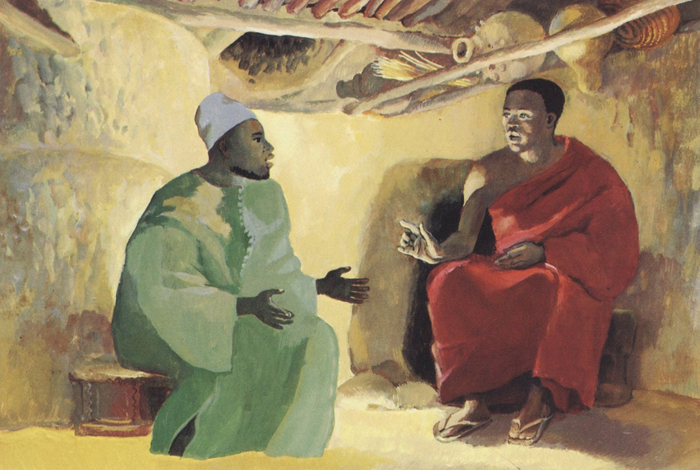
The following 1973 painting “Nicodemus” of the JESUS MAFA project is a response to New Testament readings from the Lectionary by a Christian community in Cameroon, Africa. Each of the readings was selected and adapted to dramatic interpretation by the community members. Photographs of their interpretations were made, and these were then transcribed to paintings:
Here we see Jesus patiently teaching about the kingdom of God to a perplexed Nicodemus, whose hands are in a gesture of questioning. Nicodemus has, like so many before and since, gotten caught up in the literal and limited understanding of the scriptures. Jesus attempted to explain the nature of reality in different terms that thereby he (and we) might be transformed. The boundaries we place on ourselves can be escaped if only we are brave enough to venture beyond them. Shall we remain in the cover of night with Nicodemus or step into the light that Jesus offers?
From Art in the Christian Tradition, a project of the Vanderbilt Divinity Library, Nashville, TN. Image retrieved March 23, 2026. Original source: librairie-emmanuel.fr.
The Greek, Hebrew, Aramaic, and Latin that is translated as a form of “save” in English is translated in Shipibo-Conibo with a phrase that means literally “make to live,” which combines the meaning of “to rescue” and “to deliver from danger,” but also the concept of “to heal” or “restore to health.”
Following are a number of back-translations of John 3:17:
Chol: “But God did not send his Son here to earth in order to cause the world to be punished; he sent him here in order that they might find their salvation from God’s Son.”
Yatzachi Zapotec: “God sent his Son to earth here not so that he would decide about humans that they are guilty, but rather so that he would save mankind out of evil.” (Source for this and above: M. Larson / B. Moore in Notes on Translation February 1970, p. 1-125.)
Uma: “It is not God’s purpose to send his Child here to the world in order to punish / condemn men. His intention in sending his Child here is in order to lift men from the punishment of their sins.” (Source: Uma Back Translation)
Yakan: “God sent his Son to the world not to drop judgment on mankind but to take away their sins.” (Source: Yakan Back Translation)
Western Bukidnon Manobo: “As for God, he did not send me, his child, here to earth to punish mankind, but rather so that by means of me mankind might be set free.” (Source: Western Bukidnon Manobo Back Translation)
Kankanaey: “Because God didn’t send his Child to this world to sentence/condemn people, but rather that they would be saved through him.” (Source: Kankanaey Back Translation)
Tagbanwa: “Because the reason why God caused his Son to come here was not that people be sentenced to punishement, but on the contrary so that he could free/save these people.” (Source: Tagbanwa Back Translation)
Tenango Otomi: “God did not send his son here to earth in order to sentence the people. Rather he sent him here to earth that he save the people.” (Source: Tenango Otomi Back Translation)
Click or tap here to see the rest of this insight.
Like a number of other East Asian languages, Japanese uses a complex system of honorifics, i.e. a system where a number of different levels of politeness are expressed in language via words, word forms or grammatical constructs. These can range from addressing someone or referring to someone with contempt (very informal) to expressing the highest level of reference (as used in addressing or referring to God) or any number of levels in-between.
One way Japanese shows different degree of politeness is through the usage of an honorific construction where the morpheme are (され) is affixed on the verb as shown here in the widely-used Japanese Shinkaiyaku (新改訳) Bible of 2017. This is particularly done with verbs that have God as the agent to show a deep sense of reverence. Here, tsukawas-are-ru (遣わされる) or “send” is used.
Illustration by Horst Lemke (1922-1985) for the GermanGute Nachricht für Sie – NT68, one of the first editions of the Good News Bible in German of 1968. Lemke was a well-known illustrator who illustrated books by Erich Kästner , Astrid Lindgren and many others.



Leave a Reply
You must be logged in to post a comment.