2He said, “Take your son, your only son Isaac, whom you love, and go to the land of Moriah and offer him there as a burnt offering on one of the mountains that I shall show you.”
The name that is transliterated as “Isaac” in English is signed in Spanish Sign Language and French Sign Language with a sign that is linked to his mother’s laughter when she hears that she will be pregnant with him (referring to Genesis 18:12 – 18:15) and also is the meaning of the Hebrew “Isaac” (Yitschaq — “he laughs”):
The Greek terms that are translated uniformly as “sacrifice” or “offering” in English have the option of various terms in Luang with different shades of meaning.
For Acts 24:17, himima-rere’a (“holding two hands out”). “The focus of this term is on the gift being given by a person of lower position to a person of higher position.”
For Acts 21:26, hniurliwtu-nwali odawa (“pour out sweat [and] turn into sweaty smell”). “The focus is on the personal cost of the sacrifice.”
For Gen. 22:2-8 and Gen. 22:13, hopopa-hegeuru (“peace sign”). “The focus is on the animal or object being sacrificed, as in the story of the sacrifice of Isaac. This term was used throughout that whole chapter. This term is also used in verses that speak of Jesus as the sacrifice for our sins.”
For Acts 15:29, hoi-tani (“serve with right hand – serve with left”). “This term is used in referring to sacrifices or worship offered to idols or pagan gods.”
Source: Kathy Taber in Notes on Translation 1/1999, p. 9-16.
Click or tap here to see the rest of this insight.
Like a number of other East Asian languages, Japanese uses a complex system of honorifics, i.e. a system where a number of different levels of politeness are expressed in language via words, word forms or grammatical constructs. These can range from addressing someone or referring to someone with contempt (very informal) to expressing the highest level of reference (as used in addressing or referring to God) or any number of levels in-between.
One way Japanese shows different degree of politeness is through the usage of an honorific construction where the morpheme rare (られ) is affixed on the verb as shown here in the widely-used Japanese Shinkaiyaku (新改訳) Bible of 2017. This is particularly done with verbs that have God as the agent to show a deep sense of reverence. Here, ko-rare-ru (来られる) or “come” is used.
“A particularly interesting development in the history of Christianity [related to translation] took place with respect to the Greek term monogenés, literally, ‘only, unique, one of kind.’ It was used of Isaac as the son of Abraham [see Gen. 22:2], though Isaac was not the only son of Abraham, for he had a son Ishmael, and with a later wife Keturah, several sons. But Isaac was the only son of a particular kind, that is to say, the unique son of the promise. The term monogenés was translated into the LatinVulgate as unigenitus, meaning literally ‘only begotten’ [in English — or likewise traditionally in Mandarin Chinese: “dúshēng 獨 生,” Italian: “unigenito,” Spanish “unigénito,” or German: “eingeboren”] but in Greek the equivalent of ‘only begotten’ would have two n’s and not just one (monogennes). Nevertheless, the Latin misinterpretation of monogenés has constituted such a long tradition that any attempt to speak of Jesus as the ‘unique son of God’ rather than the ‘only begotten son’ is often announced as a case of blatant heresy.” (Source: Nida 1984, p. 114.)
In Waiwai, the Greek that is translated as “only begotten Son” in English in John 3:16 is translated as cewnan tumumururosa okwe, where the “particle okwe indicates dearness, and it must be included in Waiwai for the expression ‘only begotten Son’ to mean anything like what it means to God or to us as Christians.” (Source: Robert Hawkins (in The Bible Translator 1962, pp. 164ff. )
The Hebrew olah (עֹלָה) originally means “that which goes up (in smoke).” English Bibles often translates it as “burnt-offering” or “whole burnt-offering,” focusing on the aspect of the complete burning of the offering.
The GreekSeptuagint and the LatinVulgate Bibles translate it as holokautōma / holocautōsis (ὁλοκαύτωμα / ὁλοκαύτωσις) and holocaustum, respectively, meaning “wholly burnt.” While a form of this term is widely used in many Romance languages (Spanish: holocaustos, French: holocaustes, Italian: olocausti, Portuguese: holocaustos) and originally also in the Catholic tradition of English Bible translations, it is largely not used in English anymore today (the preface of the revised edition of the Catholic New American Bible of 2011: “There have been changes in vocabulary; for example, the term ‘holocaust’ is now normally reserved for the sacrilegious attempt to destroy the Jewish people by the Third Reich.”)
Since translation into Georgian was traditionally done on the basis of the Greek Septuagint, a transliteration of holokautōma was used as well, which was changed to a translation with the meaning of “burnt offering” when the Old Testament was retranslated in the 1980’s on the basis of the Hebrew text.
In the Koongo (Ki-manianga) translation by the Alliance Biblique de la R.D. Congo (publ. in 2015) olah is translated as “kill and offer sacrifice” (source: Anicet Bassilua) and in Elhomwe as “fire offering.” (Source: project-specific translation notes in Paratext)
The English translation of Everett Fox uses offering-up (similarly, the German translation by Buber-Rosenzweig has Darhöhung and the French translation by Chouraqui montée).
Following are a number of back-translations as well as a sample translation for translators of Genesis 22:2:
Kankanaey: “Then God said, ‘Call that only-one child of yours (sing.), who is Isaac whom you (sing.) love, and go to the mountain that I will point-out to you (sing.) in the region of Moria so-that that’s where-you-(sing.)-will-kill and where-you-(sing.)-will-burn that child of yours (sing.) to offer him to me.'” (Source: Kankanaey Back Translation)
Newari: “God said — ‘Take your only son Isaac, whom you love very much, and go to the land of Moriah. I will show you a mountain there, right there, offer your son as a burnt offering for me.'” (Source: Newari Back Translation)
Hiligaynon: “Then he said, ‘Bring your (sing.) only and beloved child Isaac and [you (pl.)] go to the land of Moria. [You (pl.)] climb-up the mountain that I will-point-out to you (sing.) and [you (sing.)] sacrifice him there to me as a burnt offering.'” (Source: Hiligaynon Back Translation)
English: “God said, ‘Your son, Isaac, whom you love very much, is the only son who is still here with you. But take him and go together to the Moriah region. Offer him as a sacrifice like a burnt offering, on a hill that I will show you.'” (Source: Translation for Translators)
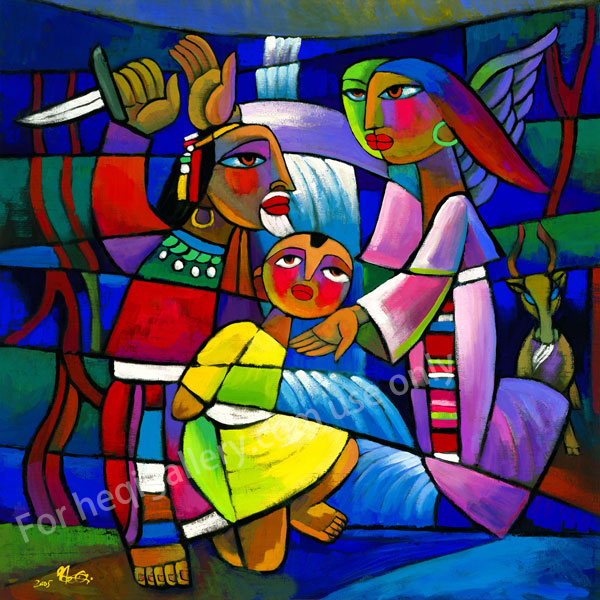
Image taken from He Qi Art . For purchasing prints of this and other artworks by He Qi go to heqiart.com . For other images of He Qi art works in TIPs, see here.
Following is an artwork by Sister Marie Claire , SMMI (1937–2018) from Bengaluru, India.
For more information about images by Sister Marie Claire and ways to purchase them as lithographs, see here . For other images of Sister Marie Claire paintings in TIPs, see here.
The following is a stained glass window from the Three choir windows in the Marienkirche, Frankfurt (Oder), Germany, of the 14th century:
Source: Der gläserne Schatz: Die Bilderbibel der St. Marienkirche in Frankfurt (Oder), Neuer Berlin Verlag, 2005, copyright for this image: Brandenburgisches Landesamt für Denkmalpflege und Archäologisches Landesmuseum
Stained glass is not just highly decorative, it’s a medium which has been used to express important religious messages for centuries. Literacy was not widespread in the medieval and Renaissance periods and the Church used stained glass and other artworks to teach the central beliefs of Christianity. In Gothic churches, the windows were filled with extensive narrative scenes in stained glass — like huge and colorful picture storybooks — in which worshipers could ‘read’ the stories of Christ and the saints and learn what was required for their religious salvation. (Source: Victoria and Albert Museum )
Click or tap here to see the rest of this insight.
Like a number of other East Asian languages, Japanese uses a complex system of honorifics, i.e. a system where a number of different levels of politeness are expressed in language via words, word forms or grammatical constructs. These can range from addressing someone or referring to someone with contempt (very informal) to expressing the highest level of reference (as used in addressing or referring to God) or any number of levels in-between.
One way Japanese shows different degree of politeness is through the choice of a first person singular and plural pronoun (“I” and “we” and its various forms) as shown here in the widely-used Japanese Shinkaiyaku (新改訳) Bible of 2017. The most commonly used watashi/watakushi (私) is typically used when the speaker is humble and asking for help. In these verses, where God / Jesus is referring to himself, watashi is also used but instead of the kanji writing system (私) the syllabary hiragana (わたし) is used to distinguish God from others.




Interesting, why would Jesus = “unique son of God” be heresy compared to “only begotten son”?