angel

The Greek, Hebrew, Ge’ez, and Aramaic that is translated as “angel” in English versions is translated in many ways:

  • Pintupi-Luritja: ngaṉka ngurrara: “one who belongs in the sky” (source: Ken Hansen quoted in Steven 1984a, p. 116.)
  • Tetela, Kpelle, Balinese, and Mandarin Chinese: “heavenly messenger”
  • Shilluk / Igede: “spirit messenger”
  • Mashco Piro: “messenger of God”
  • Batak Toba: “envoy, messenger”
  • Navajo (Dinė): “holy servant” (source for this and above: Bratcher / Nida 1961; Igede: Andy Warren-Rothlin)
  • Central Mazahua: “God’s worker” (source: Ronald D. Olson in Notes on Translation January, 1968, p. 15ff.)
  • Saramaccan: basia u Masa Gaangadu köndë or “messenger from God’s country” (source: Jabini 2015, p. 86)
  • Mairasi: atatnyev nyaa or “sent-one” (source: Enggavoter 2004)
  • Shipibo-Conibo: “word bringer” (source: James Lauriault in The Bible Translator 1951, p. 32ff. )
  • Apali: “God’s one with talk from the head” (“basically God’s messenger since head refers to any leader’s talk”) (source: Martha Wade)
  • Michoacán Nahuatl: “clean helper of God” (source: B. Moore / G. Turner in Notes on Translation 1967, p. 1ff.)
  • Noongar: Hdjin-djin-kwabba or “spirit good” (source: Warda-Kwabba Luke-Ang)
  • Wè Northern (Wɛɛ): Kea ‘a “sooa or “the Lord’s soldier” (also: “God’s soldier” or “his soldier”) (source: Drew Maust)
  • Iwaidja: “a man sent with a message” (Sam Freney explains the genesis of this term [in this article ): “For example, in Darwin last year, as we were working on a new translation of Luke 2:6–12 in Iwaidja, a Northern Territory language, the translators had written ‘angel’ as ‘a man with eagle wings’. Even before getting to the question of whether this was an accurate term (or one that imported some other information in), the word for ‘eagle’ started getting discussed. One of the translators had her teenage granddaughter with her, and this word didn’t mean anything to her at all. She’d never heard of it, as it was an archaic term that younger people didn’t use anymore. They ended up changing the translation of ‘angel’ to something like ‘a man sent with a message’, which is both more accurate and clear.”)

Like a number of other East Asian languages, Japanese uses a complex system of honorifics, i.e. a system where a number of different levels of politeness are expressed in language via words, word forms or grammatical constructs. These can range from addressing someone or referring to someone with contempt (very informal) to expressing the highest level of reference (as used in addressing or referring to God) or any number of levels in-between. One way to do this is through the usage (or a lack) of an honorific prefix as shown here in the widely-used Japanese Shinkaiyaku (新改訳) Bible of 2017. When the referent is God, the “divine” honorific prefix mi- (御 or み) is used as in mi-tsukai (御使い) or “messenger (of God).” (Source: S. E. Doi, see also S. E. Doi in Journal of Translation, 18/2022, p. 37ff. )

Bender / Belt (2025, p. 2f.) report about the translation of “angel” in Cherokee: “In John, the concept of angel is translated using a descriptive neologism rather than a semantic extension, suggesting the lack of a ready parallel. The plural is dmikahnawadidohi, ‘the law-givers’ or ‘those who go around looking after the medicine.’ Cherokee speakers argue that the Cherokee word for ‘law,’ dikahnawadvsdi, expresses the intent to maintain social, physical, and spiritual health and has at its core the word for ‘medicine,’ mwoli, which encompasses all aspects of social and spiritual well-being, including balance and order (Altman and Belt 2009), much more than the English word. Thus, the Cherokee word for ‘angel’ represents a new perspective on this category of spiritual beings named in the Bible. It does not derive from the concept of messenger present in both its Greek (angelos) and Hebrew (malak) antecedents perhaps because the Cherokee word for ‘messenger,’ atsinvsidasdi, is widely used to translate the foreign lexeme ‘servant.'”

See also angel (Acts 12:15) and this devotion on YouVersion .

Philip and the Ethiopian

Hand colored stencil print on momigami by Sadao Watanabe (1989).

Image taken with permission from the SadaoHanga Catalogue where you can find many more images and information about Sadao Watanabe. For other images of Sadao Watanabe art works in TIPs, see here.

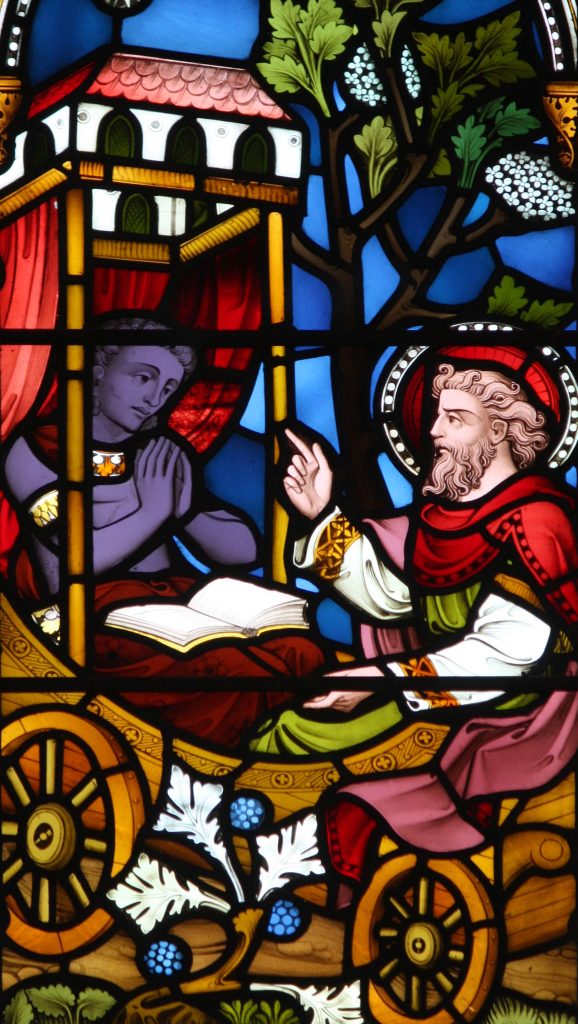
The following is a stained glass window from the Exeter College Chapel in Oxford:

Source: Art in the Christian Tradition , a project of the Vanderbilt University Divinity Library, Nashville, TN. Original source: photograph taken by Father Lawrence Lew, O.P., available on Flickr

Stained glass is not just highly decorative, it’s a medium which has been used to express important religious messages for centuries. Literacy was not widespread in the medieval and Renaissance periods and the Church used stained glass and other artworks to teach the central beliefs of Christianity. In Gothic churches, the windows were filled with extensive narrative scenes in stained glass — like huge and colorful picture storybooks — in which worshipers could ‘read’ the stories of Christ and the saints and learn what was required for their religious salvation. (Source: Victoria and Albert Museum )

complete verse (Acts 8:26)

Following are a number of back-translations of Acts 8:26:

  • Uma: “One time, an angel of God spoke to Filipus, he said: ‘Go to the south, to the road from Yerusalem arriving at Gaza.’ (That road is no longer traveled on very often.)” (Source: Uma Back Translation)
  • Yakan: “So-then, there was an angel of God who spoke to Pilip. He said, ‘Get ready. Go to the road from Awrusalam going towards Gasa.’ (This road is not much used now.)” (Source: Yakan Back Translation)
  • Western Bukidnon Manobo: “And there was an angel of God who said to Philip, he said, ‘Get going now and go downstream there to the road which leaves the town of Jerusalem going to the town of Gaza,’ he said. (Now this road is not often used.)” (Source: Western Bukidnon Manobo Back Translation)
  • Kankanaey: “When that was so, there was an angel of the Lord who went and said to Felipe, ‘Set-out and go-south on the road that comes-from Jerusalem going-to Gaza.’ This road, it passes-by the place with no inhabitants.” (Source: Kankanaey Back Translation)
  • Tagbanwa: “But as for Felipe, he was spoken to by an angel of the Lord. He said, ‘Today, you are to set out. Go toward the south, to/on the road which goes from Jerusalem to Gaza, which is there in the wilderness place.'” (Source: Tagbanwa Back Translation)

Jerusalem

The name that is transliterated as “Jerusalem” in English is signed in French Sign Language with a sign that depicts worshiping at the Western Wall in Jerusalem:


“Jerusalem” in French Sign Language (source: La Bible en langue des signes française )

While a similar sign is also used in British Sign Language, another, more neutral sign that combines the sign “J” and the signs for “place” is used as well. (Source: Anna Smith)


“Jerusalem” in British Sign Language (source: Christian BSL, used with permission)

Learn more on Bible Odyssey: Jerusalem .

cardinal directions

The cardinal directions “east” and “west” are easy to translate into Maan here since the language uses “where the sun comes up” and “where the sun goes down.” For “north” the translator had “facing toward the sun rising to the left,” and for “south” she had “facing toward the sun rising to the right.” So the listener had to think hard before knowing what direction was in view when translating “to the north and south, to the east and west.” So, in case all four directions are mentioned, it was shortened by saying simply “all directions.” Manya uses a similar nomenclature for the cardinal directions. (Source: Don Slager)

Likewise, Yakan has “from the four corners of the earth” (source: Yakan back-translation) or Western Bukidnon Manobo “from the four directions here on the earth” (source: Western Bukidnon Manobo back-translation).

Kankanaey is “from the coming-out and the going-away of the sun and the north and the south” (source: Kankanaey back-translation), Northern Emberá “from where the sun comes up, from where it falls, from the looking [left] hand, from the real [right] hand” (source: Charles Mortensen), Amele “from the direction of the sun going up, from the direction of the sun going down, from the north and from the south” (source: John Roberts), Ejamat “look up to see the side where the sun comes from, and the side where it sets, and look on your right side, and on your left” (source: David Frank in this blog post ).

In Lamba, only umutulesuŵa, “where the sun rises” and imbonsi, “where the sun sets” were available as cardinal directions that were not tied to the local area of language speakers (“north” is kumausi — “to the Aushi country” — and “south” kumalenje — “to the Lenje country”). So “north” and “south” were introduced as loanwords, nofu and saufu respectively. The whole phrase is kunofu nakusaufu nakumutulesuŵa nakumbonsi. (Source C. M. Doke in The Bible Translator 1958, p. 57ff. )

“West” is translated in Tzeltal as “where the sun pours-out” and in Kele as “down-river” (source: Reiling / Swellengrebel).

In Morelos Nahuatl, “north” is translated as “from above” and “south” as “from below.” (Source: Viola Waterhouse in Notes on Translation August 1966, p. 86ff.)

In Matumbi cardinal directions are defined as in relation to another place. “East” for instance typically is “toward the beach” since the coast is in the eastern direction in Matumbi-speaking areas. “North” and “south” can be defined as above or below another place. (Source: Pioneer Bible Translators, project-specific notes in Paratext)

The Hebrew text that gives instructions where to place items in the tabernacle with the help of cardinal directions (north and south) had to be approached in the Bambam translation specific to spacial concepts of that culture.

Phil Campbell explains: “There are no words in Bambam for north and south. In Exodus 26:35, God instructs that the table is to be placed on the north side and the lamp on the south side inside the tabernacle. The team wants to use right and left to tell where the lamp and table are located. In many languages we would say that the table is on the right and the lampstand is on the left based on the view of someone entering the tabernacle. However, that is not how Bambam people view it. They view the placement of things and rooms in a building according to the orientation of someone standing inside the building facing the front of the building. So that means the table is on the left side and the lampstand is on the right side.”

See also cardinal directions / left and right and people of the East.

Lord

The Hebrew adonai in the Old Testament typically refers to God. The shorter adon (and in two cases in the book of Daniel the Aramaic mare [מָרֵא]) is also used to refer to God but more often for concepts like “master,” “owner,” etc. In English Bible translations all of those are translated with “Lord” if they refer to God.

In English Old Testament translations, as in Old Testament translations in many other languages, the use of Lord (or an equivalent term in other languages) is not to be confused with Lord (or the equivalent term with a different typographical display for other languages). While the former translates adonai, adon and mare, the latter is a translation for the tetragrammaton (YHWH) or the Name of God. See tetragrammaton (YHWH) and the article by Andy Warren-Rothlin in Noss / Houser, p. 618ff. for more information.

In the New Testament, the Greek term kurios has at least four different kinds of use:

  • referring to “God,” especially in Old Testament quotations,
  • meaning “master” or “owner,” especially in parables, etc.,
  • as a form of address (see for instance John 4:11: “Sir, you have no bucket”),
  • or, most often, referring to Jesus

In the first and fourth case, it is also translated as “Lord” in English.

Most languages naturally don’t have one word that covers all these meanings. According to Bratcher / Nida, “the alternatives are usually (1) a term which is an honorific title of respect for a high-ranking person and (2) a word meaning ‘boss’, ‘master’, or ‘chief.’ (…) and on the whole it has generally seemed better to employ a word of the second category, in order to emphasize the immediate personal relationship, and then by context to build into the word the prestigeful character, since its very association with Jesus Christ will tend to accomplish this purpose.”

When looking at the following list of back-translations of the terms that translators in the different languages have used for both kurios and adonai to refer to God and Jesus respectively, it might be helpful for English readers to recall the etymology of the English “Lord.” While this term might have gained an exalted meaning in the understanding of many, it actually comes from hlaford or “loaf-ward,” referring to the lord of the castle who was the keeper of the bread (source: Rosin 1956, p. 121).

Click or tap here to see the rest of this insight

Following are some of the solutions that don’t rely on a different typographical display (see above):

  • Navajo (Dinė): “the one who has charge”
  • Mossi: “the one who has the head” (the leader)
  • Uduk: “chief”
  • Guerrero Amuzgo: “the one who commands”
  • Kpelle: “person-owner” (a term which may be applied to a chief)
  • Central Pame: “the one who owns us” (or “commands us”)
  • Piro: “the big one” (used commonly of one in authority)
  • San Blas Kuna: “the great one over all” (source for this and above: Bratcher / Nida)
  • Guhu-Samane: Soopara (“our Supervisor”) (source: Ellis Deibler in Notes on Translation July, 1967, p. 5ff.)
  • Balinese: “Venerated-one” (source: Reiling / Swellengrebel)
  • Yanesha’: “the one who carries us” (source: Nida 1952, p. 159)
  • Northern Emberá: Dadjirã Boro (“our Head”)
  • Rarotongan: Atu (“master or owner of a property”)
  • Gilbertese: Uea (“a person of high status invested with authority to rule the people”)
  • Rotuman: Gagaja (“village chief”)
  • Samoan: Ali’i (“an important word in the native culture, it derives from the Samoan understanding of lordship based on the local traditions”)
  • Tahitian: Fatu (“owner,” “master”)
  • Tuvalu: Te Aliki (“chief”)
  • Fijian: Liuliu (“leader”) (source for this and six above: Joseph Hong in The Bible Translator 1994, p. 329ff. )
  • Bacama: Həmə miye: “owner of people” (source: David Frank in this blog post )
  • Hopi: “Controller” (source: Walls 2000, p. 139)
  • Iyansi: Mwol. Mwol is traditionally used for the “chief of a group of communities and villages” with legal, temporal, and spiritual authority (versus the “mfum [the term used in other Bantu languages] which is used for the chief of one community of people in one village”). Mwol is also used for twins who are “treated as special children, highly honored, and taken care of like kings and queens.” (Source: Kividi Kikama in Greed / Kruger, p. 396ff.)
  • Ghomala’: Cyəpɔ (“he who is above everyone,” consisting of the verb cyə — to surpass or go beyond — and — referring to people. No human can claim this attribute, no matter what his or her social status or prestige.” (Source: Michel Kenmogne in Theologizing in Context: An Example from the Study of a Ghomala’ Christian Hymn )
  • Binumarien: Karaambaia: “fight-leader” (Source: Oates 1995, p. 255)
  • Warlpiri: Warlaljamarri (owner or possessor of something — for more information tap or click here)

    We have come to rely on another term which emphasizes God’s essential nature as YHWH, namely jukurrarnu (see tetragrammaton (YHWH)). This word is built on the same root jukurr– as is jukurrpa, ‘dreaming.’ Its basic meaning is ‘timelessness’ and it is used to describe physical features of the land which are viewed as always being there. Some speakers view jukurrarnu in terms of ‘history.’ In all Genesis references to YHWH we have used Kaatu Jukurrarnu. In all Mark passages where kurios refers to God and not specifically to Christ we have also used Kaatu Jukurrarnu.

    New Testament references to Christ as kurios are handled differently. At one stage we experimented with the term Watirirririrri which refers to a ceremonial boss of highest rank who has the authority to instigate ceremonies. While adequately conveying the sense of Christ’s authority, there remained potential negative connotations relating to Warlpiri ceremonial life of which we might be unaware.

    Here it is that the Holy Spirit led us to make a chance discovery. Transcribing the personal testimony of the local Warlpiri pastor, I noticed that he described how ‘my Warlaljamarri called and embraced me (to the faith)’. Warlaljamarri is based on the root warlalja which means variously ‘family, possessions, belongingness’. A warlaljamarri is the ‘owner’ or ‘possessor’ of something. While previously being aware of the ‘ownership’ aspect of warlaljamarri, this was the first time I had heard it applied spontaneously and naturally in a fashion which did justice to the entire concept of ‘Lordship’. Thus references to Christ as kurios are now being handled by Warlaljamarri.” (Source: Stephen Swartz, The Bible Translator 1985, p. 415ff. )

  • Mairasi: Onggoao Nem (“Throated One” — “Leader,” “Elder”) or Enggavot Nan (“Above-One”) (source: Enggavoter 2004)
  • Obolo: Okaan̄-ene (“Owner of person(s)”) (source: Enene Enene)
  • Angami Naga: Niepu (“master,” “owner”)
  • Lotha Naga: Opvui (“owner of house / field / cattle”) — since both “Lord” and YHWH are translated as Opvui there is an understanding that “Opvui Jesus is the same as the Opvui of the Old Testament”
  • Ao Naga: Kibuba (“human master,” “teacher,” “owner of property,” etc.) (source for this and two above: Nitoy Achumi in The Bible Translator 1992 p. 438ff. )
  • Seediq: Tholang, loan word from Min Nan Chinese (the majority language in Taiwan) thâu-lâng (頭儂): “Master” (source: Covell 1998, p. 248)
  • Thai: phra’ phu pen cao (พระผู้เป็นเจ้า) (divine person who is lord) or ong(kh) cao nay (องค์เจ้านาย) (<divine classifier>-lord-boss) (source: Stephen Pattemore)
  • Arabic often uses different terms for adonai or kurios referring to God (al-rabb الرب) and kurios referring to Jesus (al-sayyid الـسـيـد). Al-rabb is also the term traditionally used in Arabic Christian-idiom translations for YHWH, and al-sayyid is an honorary term, similar to English “lord” or “sir” (source: Andy Warren-Rothlin).
  • Tamil also uses different terms for adonai/kurios when referring to God and kurios when referring to Jesus. The former is Karttar கர்த்தர், a Sanskrit-derived term with the original meaning of “creator,” and the latter in Āṇṭavar ஆண்டவர், a Tamil term originally meaning “govern” or “reign” (source: Natarajan Subramani).
  • Burunge: Looimoo: “owner who owns everything” (in the Burunge Bible translation, this term is only used as a reference to Jesus and was originally used to refer to the traditional highest deity — source: Michael Endl in Holzhausen / Riderer 2010, p. 48)
  • Yagaria: Souve, originally “war lord” (source: Renck, p. 94)
  • Aguacateco: Ajcaw ske’j: “the one to whom we belong and who is above us” (source: Rita Peterson in Holzhausen / Riderer 2010, p. 49)
  • Konkomba: Tidindaan: “He who is the owner of the land and reigns over the people” (source: Lidorio 2007, p. 66)
  • Chichewa: Ambuye Ambuye comes from the singular form Mbuye which is used to refer to: (1) someone who is a guardian or protector of someone or group of people — a grandparent who has founded a community or village; (2) someone who is a boss or master over a group of people or servants and has absolute control over them; (3) owner of something, be it a property, animals and people who are bound under his/her rule — for people this was mostly commonly used in the context of slaves and their owner. In short, Mbuye is someone who has some authorities over those who call him/her their “Mbuye.” Now, when the form Ambuye is used it will either be for honorific when used for singular or plural when referring to more than one person. When this term is used in reference to God, it is for respect to God as he is acknowledged as a guardian, protector, and ruler of everything. (Source: Mawu a Mulungu mu Chichewa Chalero Back Translation).
  • Hdi uses rveri (“lion”) as a title of respect and as such it regularly translates adon in the Old Testament. As an address, it’s most often with a possessive pronoun as in rvera ɗa (“my lion” = “my lord” or “sir”). So, for example, Genesis 15:2 (“O Lord God”) is Rvera ɗa Yawe (“My lion Yahweh”) or Ruth to Boaz in Ruth 2:13: “May I find your grace [lit. good-stomach] my lion.” This ties in nicely with the imagery of the Lord roaring like a lion (Hosea 11:10; Amos 3:8; Joel 3:16). Better still, this makes passages like Revelation 5:5 even richer when we read about rveri ma taba məndəra la Yuda, “the Lion of the tribe of Judah”. In Revelation 19:16, Jesus is rveri ta ghəŋa rveriha “the lion above lions” (“lord of lords”). (Source: Drew Maust)

Law (2013, p. 97) writes about how the Ancient Greek Septuagint‘s translation of the Hebrew adonai was used by the New Testament writers as a bridge between the Old and New Testaments: “Another case is the use of kurios referring to Jesus. For Yahweh (in English Bibles: ‘the Lord‘), the Septuagint uses kurios. Although the term kurios usually has to do with one’s authority over others, when the New Testament authors use this word from the Septuagint to refer to Jesus, they are making an extraordinary claim: Jesus of Nazareth is to be identified with Yahweh.”

See also Father / Lord.

Translation commentary on Acts 8:26

Luke now directs his attention back to Philip. Get yourself ready (see Jerusalem Bible “be ready”) is the same verb which appears in 5.6 and indicates the initiation of action (New English Bible translates “start out”).

Though most translators and commentators understand that Philip was directed to go south, it is possible that this expression is intended to be taken in the sense of “at midday” (see Jerusalem Bible, Zürcher Bibel). This road is no longer used is generally understood to have been a parenthetical statement added by Luke for the benefit of his readers. The Good News Translation gives an alternative rendering of this passage (this is the desert road); and there is also the possibility that the adjective translated no longer used and desert may refer back to Gaza. If so, then the old Philistine city of Gaza, having been destroyed, is now distinguished from the new city of Gaza, built on the coast some two miles west of the old city. Although a number of commentators accept this viewpoint, only a few translators follow this interpretation (see An American Translation* “… from Jerusalem to Gaza. [The town is now deserted]”; and Knox).

Quoted with permission from Newman, Barclay M. and Nida, Eugene A. A Handbook on The Acts of the Apostles. (UBS Handbook Series). New York: UBS, 1972. For this and other handbooks for translators see here .