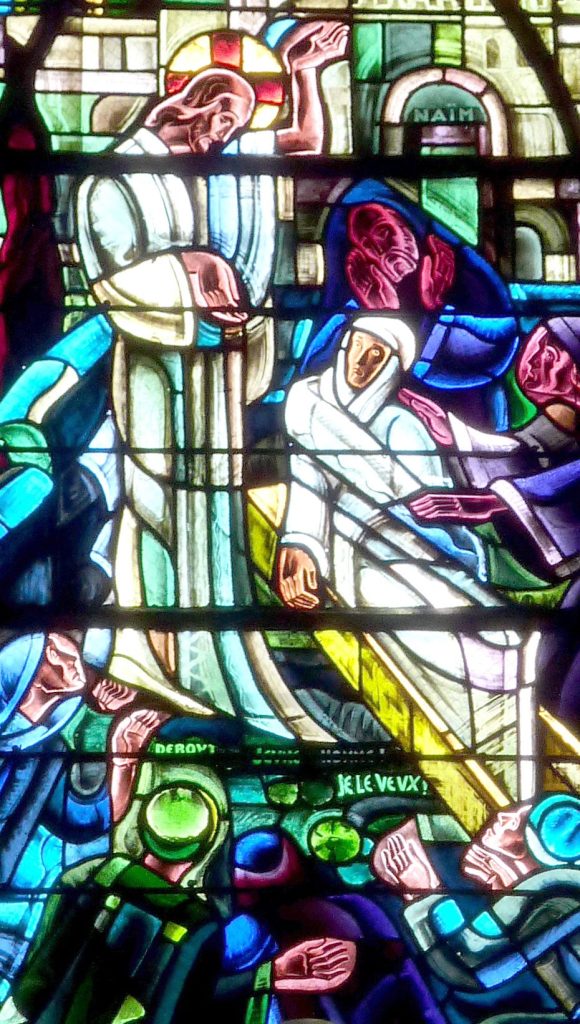
12As he approached the gate of the town, a man who had died was being carried out. He was his mother’s only son, and she was a widow, and with her was a large crowd from the town.
The Hebrew, Ge’ez, and Greek that is translated as “widow” in English is translated in West Kewa as ona wasa or “woman shadow” (source: Karl J. Franklin in Notes on Translation 70/1978, pp. 13ff.) and in Newari as “husband already died ones” or “ones who have no husband” (source: Newari Back Translation).
In Cherokee the term is gender neutral and translates to “one who has lost someone.” (Source: Bender / Belt 2025, p. 100)
The etymological meaning of the Hebrewalmanah (אַלְמָנָה) is likely “pain, ache,” the Greekchéra (χήρα) is likely “to leave behind,” “abandon,” and the Englishwidow (as well as related terms in languages such as Dutch, German, Sanskrit, Welsh, or Persian) is “to separate,” “divide” (source: Wiktionary).
Stained glass is not just highly decorative, it’s a medium which has been used to express important religious messages for centuries. Literacy was not widespread in the medieval and Renaissance periods and the Church used stained glass and other artworks to teach the central beliefs of Christianity. In Gothic churches, the windows were filled with extensive narrative scenes in stained glass — like huge and colorful picture storybooks — in which worshipers could ‘read’ the stories of Christ and the saints and learn what was required for their religious salvation. (Source: Victoria and Albert Museum )
The Greek that is translated as “Son of Man” is mostly used by Jesus to refer to himself as well as in the prophecies of Daniel and Enoch (see Enoch 17:34 et al). It is translated in the following languages as (click or tap for details):
Tzotzil: “I who am equal with men” or “The Older Brother of Everybody” (“expressing the dignity and authority of the Messiah and the universality of his work”)
Tenango Otomi: “The Man Appointed” (i.e. the man to whom authority has been delegated) (source for this and preceding: Beekman, p. 189-190, see also Ralph Hill in Notes on Translation February 1983, p. 35-50)
Aguaruna: “One who was born becoming a person” (source for this and two above: M. Larson / B. Moore in Notes on Translation February 1970, p. 1-125.)
Western Bukidnon Manobo: “Older Sibling of Mankind” (source: Western Bukidnon Manobo Back Translation)
Kankanaey: “Child of a Person” (source: Kankanaey Back Translation)
Tagbanwa: “One From Heaven Born of Man/human?” (source: Tagbanwa Back Translation)
Tenango Otomi: “Man who came from heaven” (source: Tenango Otomi Back Translation)
Yatzachi Zapotec: “One who God sent, who was born a human” (a direct translation would have suggested “that the father is unknown due to the indiscretions of the mother” and where “he is the son of people” is used when one wants to disclaim responsibility for or relationship with a child caught in some mischief — source: Reiling / Swellengrebel)
Kâte: Ŋic Fâri Wâtuŋne or “the man who is a true support” (source: Renck, p. 106)
Mezquital Otomi: “The son who became a person” (Source: B. Moore / G. Turner in Notes on Translation 1967, p. 1ff.)
Alekano: “The true man who descended from heaven” (source: Ellis Deibler in Notes on Translation June 1986, p. 36ff.)
Central Tarahumara: “One who has been stood up to help” (“This suggests that Christ has been given authority to some appointed task. A very generic word, help, was selected to fill in the lexically obligatory purpose required by the word which means to appoint or commission. Usually this word is used of menial tasks but not exclusively. The choice of this generic term retains the veiled reference to the character of Christ’s work which He intended in using the ‘Son of Man’ title.”)
Chicahuaxtla Triqui: “He who is relative of all people.” (“The Triqui word for relative is a rather generic term and in its extended sense sometimes is diluted to neighbor and friend. But the primary meaning is relative.”)
Tepeuxila Cuicatec: “The Person who Accompanies All People” (“The literal equivalents ‘son of man’ and ‘son of people’ were both rejected because of the false inference of natural birth involving a human father. Furthermore, it was necessary to expand any translation of the Bible by the addition of the pronoun ‘I’ so as to clarify the fact that Jesus is using the third person in referring to Himself. A common expression used by the Cuicatecos when difficulties befall someone, is to say to that one, ‘don’t worry, we are accompanying you.’ By this they mean they share that person’s sorrow. When wedding guests arrive at the home of a son who has just been married, they say to the father, ‘We have come to accompany you.’ By this they mean that they have come to share the father’s joy. These expressions do not refer to ordinary physical accompaniment, which is expressed by a set of different verbs. For example, visits are always announced by some such greeting as, “I have come to visit you,’ ‘I have come to see you,’ or ‘I have come to ask you something.’ The desire to accompany a friend on a journey is expressed by saying, ‘I will go with you.’ Translation helpers used the verb ‘accompany’ in constructing the phrase ‘I, the Person who Accompanies All People.'(…) It reflects the fact that Jesus closely identified Himself with all of us, understands our weaknesses, shares our burdens, rejoices with us in times of gladness, etc.”) (source for this and the three preceding: Beekman in Notes on Translation January 1963, p. 1-10)
Guhu-Samane: “Elder-brother-man” (“Since the term denotes an elder brother in every way such as honor, power, leadership, representation of the younger, etc. it is a meaningful and fitting — though not ostentatious — title.” Source: Ernest Richert in The Bible Translator 1965, p. 198ff. )
Navajo (Dinė): Diné Silíi’ii — “Man he-became-the-one-who” (“This terra presented a difficulty not only in Navajo but also one peculiar to all the Athapaskan languages. It lies in the fact that all these languages, so far as we know, have a word phonetically similar to the Navajo diné which has three meanings: ‘man, people in general,’ ‘a man,’ ‘The People’ which is the name the Navajos use for themselves. (The name Navajo was first used by the Spanish explorers.) Although it seemed natural to say diné biye’ ‘a-man his-son,’ this could also mean ‘The-People their-son’ or ‘a-Navajo his-son,’ in contrast to the son of a white man or of another Indian tribe. Since the concept of the humanity of Christ is so important, we felt that diné biye’ with its three possible meanings should not be used. The term finally decided on was Diné Silíi’ii ‘Man he-became-the-one-who.’ This could be interpreted to mean ‘the one who became a Navajo,’ but since it still would impart the idea of Christ’s becoming man, it was deemed adequate, and it has proven acceptable to the Navajos.”) (Source: Faye Edgerton in The Bible Translator 1962, p. 25ff. )
Toraja-Sa’dan: “Child descended in the world” (“using a poetic verb, often found in songs that [deal with] the contacts between heaven and earth”) (source: Reiling / Swellengrebel)
Obolo: Gwun̄ Ebilene: “Child of Human” (source: Enene Enene).
Mairasi: Jaanoug Tat: “Person Child” (source: Enggavoter 2004)
Costa Rican Sign Language: “It was impossible to translate the expression ‘Son of Man.’ The son-man sign simply means ‘male child.’ The Costa Rican Sign Language (LESCO) team opted for an interpretation of the term and translated it ‘Jesus.'” (Source: Elsa Tamez (in The Bible Translator 2008, p. 59ff. )
Lokạạ: wẹẹn wạ ọnẹn or “son of a person.” “This translation is symbolic in that it uses indigenous Lokạạ words. However, since the publication of the New Testament in 2006, this phrase has gained popularity within contemporary Lokạạ society as an expression to describe an important person whose career is going well. In the New Testament, the phrase ‘son of man’ is used to describe Jesus as prototypically human, but the Lokạạ phrase is now being used to describe an exceptional person in Lokạạ society.” (Source: J.A. Naudé, C.L. Miller Naudé, J.O. Obono in Acta Theologica 43/2, 2023, p. 129ff. )
In many West African languages, using a third person reference as a first person indicator is common practice with a large range of semantic effects. Languages that use the exact expression “son of man” as a self-reference or reference to another person include Lukpa, Baatonum, Mossi (“son of Adam”), Yoruba (“son of person”), Guiberoua Béte, or Samo. (Source: Lynell Zogbo in: Omanson 2000, p. 167-188.)
In Swahili the expression Mwana wa Mtu or mwana wa mtu or “son/daughter of human person,” which is used by several Bible translations, also has “the idiomatic meaning of ‘a human being’” (source: Jean-Claude Loba-Mkole in An Intercultural Criticism of New Testament Translations 2013, see here). The same is true for the Lingala expression Mwana na Moto — “son/daughter of human person.” (Ibid.)
In Balinese “we are again bordering on theological questions when we inquire as to which vocabulary shall be used to translate the texts where Jesus speaks of himself as ‘the Son of man.’ One of the fixed rules governing the use of these special vocabularies is that one may never use the deferential terms in speaking of oneself. This would be the extreme of arrogance. Now if one considers the expression ‘Son of man’ primarily as a description of ‘I,’ then one must continually indicate the possessions or actions of the Son of man by Low Balinese words. In doing this the mystery of the expression is largely lost. In any case the vocabulary used in most of the contexts would betray that Jesus means the title for himself.
“However, a distinction can actually be made in Balinese between the person and the exalted position he occupies. For example, the chairman of a judicial body may employ deferential terms when referring to this body and its chairman, without this being taken as an expression of arrogance. Considered from this standpoint, one may translate in such a way that Jesus is understood as using such deferential words and phrases in speaking of himself. The danger is, however, that the unity between his person and the figure of “the Son of man” is blurred by such usage.
“On request, the New Testament committee of the Netherlands Bible Society advised that ‘the sublimity of this mysterious term be considered the most important point and thus High Balinese be used.'”
“One of the first things that we did in working through the earlier part of the New Testament was to decide on how we would translate some of the more difficult technical terms. It was immediately obvious that something must be done with the translation of ‘the Son of Man,’ since the literal rendering anak manusia (literally ‘child of a man’) held absolutely no meaning for Malay readers. We felt that the title should emphasize the divine origin and authority of the one who used this title, and at the same time, since it was a title, we decided that it should not be too long a phrase. Finally, a phrase meaning ‘the One whom God has ordained’ was chosen (yang dilantik Allah). It is interesting to note that the newly-begun Common Indonesian (Alkitab Kabar Baik, published in 1985) has followed a similar route by translating ‘the One whom God has chosen’ (yang depilih Allah).”
Following are a number of back-translations of Luke 7:12:
Noongar: “Now he came to the gate of the town. Many people were coming out. They were weeping and carrying a dead man, the only son of a woman. She was a widow. Many people of the town walked with her.” (Source: Warda-Kwabba Luke-Ang)
Uma: “They were close to the gate at the end of the town, they saw many people appear from inside the town, carrying a dead person. That dead person was a young man, an only child, his mother was a widow. Many townspeople accompanied his mother going to the graves.” (Source: Uma Back Translation)
Yakan: “When they arrived at the gate for entering that town, there were people carrying a dead person bringing him outside to the graveyard. The dead man/male was an only child and his mother was a widow already. Many people from the town went along with the widow to bury her son.” (Source: Yakan Back Translation)
Western Bukidnon Manobo: “And when they arrived there to the gate going to the town, they met some people coming from the town who were carrying a dead person in order to bury him. That dead person was a man who was the only child of an old widow-woman. There were very many people there in that town who were coming with the woman to go out and bury him.” (Source: Western Bukidnon Manobo Back Translation)
Kankanaey: “When they approached the boundary of the town, they met many inhabitants going-as-a-group to go bury a dead man/boy. That dead-one was the only child of a widow.” (Source: Kankanaey Back Translation)
Tagbanwa: “When they were near to the gate of that town, they happened-to-meet those going to bury a man/male who had died, the only-child of a widow woman. Many were the people who were accompanying those going burying.” (Source: Tagbanwa Back Translation)
Click or tap here to see the rest of this insight.
Like a number of other East Asian languages, Japanese uses a complex system of honorifics, i.e. a system where a number of different levels of politeness are expressed in language via words, word forms or grammatical constructs. These can range from addressing someone or referring to someone with contempt (very informal) to expressing the highest level of reference (as used in addressing or referring to God) or any number of levels in-between.
One way Japanese shows different degree of politeness is through the usage of an honorific construction where the morpheme are (され) is affixed on the verb as shown here in the widely-used Japanese Shinkaiyaku (新改訳) Bible of 2017. This is particularly done with verbs that have God as the agent to show a deep sense of reverence. Here, chikazuk-are-ru (近づかれる) or “come close” is used.
Barclay Newman, a translator on the teams for both the Good News Bible and the Contemporary English Version, translated passages of the New Testament into English and published them in 2014, “in a publication brief enough to be non-threatening, yet long enough to be taken seriously, and interesting enough to appeal to believers and un-believers alike.” The following is the translation of Luke 7:11-17:
Jesus and his followers were on the way to the village of Nain,
with a big crowd surrounding them.
As they approached the town gate,
they saw a funeral procession —
a widow’s only son was being carried out for burial,
and many of the village people were with her.
When Jesus saw the woman, he felt sorry for her and said,
“You can stop crying now.”
Then he went over and touched the stretcher
on which the dead boy was lying.
The funeral procession came to a halt,
and Jesus said, “Young man, sit up!”
The boy sat up and started speaking.
“Here’s your son!” Jesus said to the widow.
Though everyone was frightened,
they praised God and exclaimed,
“A great prophet has now arrived!
God has come to save us all!”
hōs de ēggisen tē pulē tēs poleōs ‘and as he approached the gate of the town.’ pulē.
eggizō with following dative ‘to approach,’ ‘to come near.’
kai idou exekomizeto tethnēkōs ‘(and) behold a dead man was being carried out.’ For kai idou cf. on 1.20.
ekkomizō ‘to carry out,’ often used as here for the taking of a corpse to a burial-place outside.
tethnēka (also 8.49) lit. ‘to have died,’ hence ‘to be dead.’ Here the participle tethnēkōs is used as an indefinite substantive.
monogenēs huios tē mētri autou ‘an only son of (lit. for) his mother,’ apposition to tethnēkōs.
monogenēs, adjective, ‘only,’ in Luke always of an only child.
kai ochlos tēs poleōs hikanos ēn sun autē ‘and a large crowd of the townspeople (lit. of the town) was with her.’ Hikanos means ‘considerable’ with reference to quantity.
Translation:
As he drew near…, behold, a man …, or, ‘just as (or, at the moment) he drew near, a man…’; cf. also on 1.20. To draw near with local object may be rendered, ‘to come close to,’ ‘to come in the neighbourhood of,’ ‘to have nearly reached’ (Javanese in 15.25).
Gate of the city, or, ‘gate in the wall of the city’ (Trukese). Gate can sometimes be rendered by the term for the entrance in an earthen wall, wooden palisade, or hedge of a settlement, which can be barricaded at night, e.g. in Marathi, East and Toraja-Sa’dan. Elsewhere a more generic word is used, e.g. ‘entrance’ (Kekchi), or, ‘exit’ (Balinese).
A man who had died was being carried out, or, ‘people were/came carrying out a dead one’ (cf. Trukese); or, introducing a technical term, “a funeral procession was coming out” (Good News Translation). For a man who had died, or, ‘a dead man/one,’ ‘a corpse.’ In the receptor language ‘a dead man’ may be thought of as a person or as an object, which will influence the selection of terms (cf. on 16.22), or of categories (e.g. personal: non-personal, animate: inanimate). For to die (also in 16.22; 20.28f, 31f, 36). — To carry out. Renderings may have to be specific as to the way of carrying (cf. on “bringing” in 5.18), or the occasion, i.e. the burial.
The only son of his mother, and she was a widow. Often such a long apposition is better rendered as a new sentence, ‘he/the dead man was the only son….’ More radical changes may be needed, e.g. ‘an only son, his mother a widow’ (Javanese), “the only son of a woman who was a widow” (Good News Translation), ‘the son of a widow, her only child’ (Tzeltal), ‘the child of a woman whose husband had died; this woman had no other sons’ (Kituba), ‘the mother of the dead man was a widow, having (as) son only him’ (Balinese), ‘he was the only one his mother had, and the mother was a widow’ (Zarma); Tboli has a euphemistic expression, ‘he was the only child his father left his mother, a boy child.’ For widow see above on 2.37.
A large crowd from the city was with her, or, ‘very many people … accompanied/followed her, or, thronged-after her’ (Batak Toba); ‘a large crowd also from-with the woman in the-city (i.e. accompanied the woman as they came from within the city)’ (Pohnpeian).
Quoted with permission from Reiling, J. and Swellengrebel, J.L. A Handbook on the Gospel of Luke. (UBS Handbook Series). New York: UBS, 1971. For this and other handbooks for translators see here . Make sure to also consult the Handbook on the Gospel of Mark for parallel or similar verses.



Leave a Reply
You must be logged in to post a comment.