The Greek terms krino and katakrino/katadikazo that are translated as “judge” and “condemn” respectively in English are translated with only one term in Kutu (tagusa). (Source: Pioneer Bible Translators, project-specific translation notes in Paratext)
Image taken from He Qi Art . For purchasing prints of this and other artworks by He Qi go to heqiart.com . For other images of He Qi art works in TIPs, see here.
Following is a painting by Kim Ki-chang (1913-2001):
Kim Ki-chang (pen name: Unbo) had been deaf and partially mute since the age of 7. He painted a series of 30 paintings for the “Life of Christ” cycle in 1952 during the Korean War. Kim portrayed Jesus as a seonbi / 선비, or a Joseon Period (1392-1910) gentleman scholar, wearing a gat / 갓 (hat) and dopo / 도포 (robe). For other images of Kim Ki-chang art works in TIPs, see here.
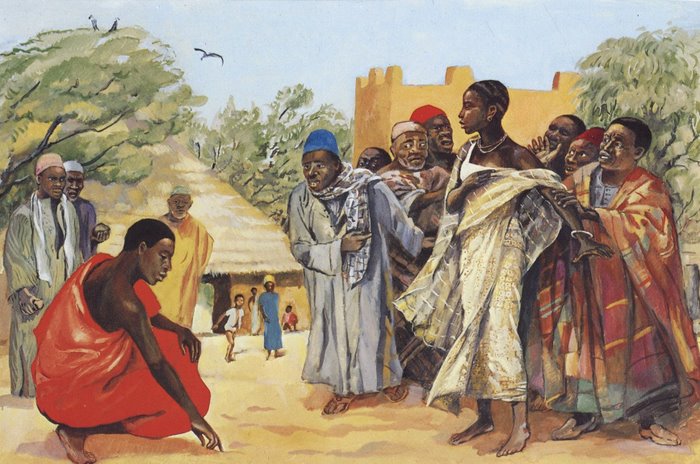
Following is a 1973 painting of the JESUS MAFA project, a response to New Testament readings from the Lectionary by a Christian community in Cameroon, Africa. Each of the readings was selected and adapted to dramatic interpretation by the community members. Photographs of their interpretations were made, and these were then transcribed to paintings:
From Art in the Christian Tradition, a project of the Vanderbilt Divinity Library, Nashville, TN. Image retrieved March 23, 2026. Original source: librairie-emmanuel.fr.
Following are a number of back-translations of John 8:11:
Uma: “The woman answered: ‘There is no-one, Lord.’ Yesus said: ‘I also do not condemn you. Thus, go, and stop [lit., let go] doing sin.’]]” (Source: Uma Back Translation)
Yakan: “‘There is none, Sir,’ said the woman. Isa said, ‘Even I do not judge you to be killed. Go home now but do not sin again.'” (Source: Yakan Back Translation)
Western Bukidnon Manobo: “And the woman answered, ‘No more. Because they are all gone.’ And Jesus said again to her, ‘As for me, I also do not condemn you to death. Go home and never again do wrong.'” (Source: Western Bukidnon Manobo Back Translation)
Kankanaey: “‘No one, Sir,’ she answered. Jesus then said, ‘Neither do I condemn you (sing.) to die. You (sing.) go now, but don’t sin again (lit. repeat to sin).'” (Source: Kankanaey Back Translation)
Tagbanwa: “That woman replied, saying, ‘Well no, Master.”Well even I,’ said Jesus, ‘I will not punish you. Go now and cease the doing of sin.'” (Source: Tagbanwa Back Translation)
Tenango Otomi: “The woman said, ‘Not now, Lord.’ Jesus again spoke to her, ‘And neither do I sentence you. Go now. Never again commit sin.'” (Source: Tenango Otomi Back Translation)
The Hebrew, Ge’ez, and Greek that is typically translated as “sin” in English has a wide variety of translations.
The Greek ἁμαρτάνω (hamartanō) carries the original verbatim meaning of “miss the mark” and likewise, many translations contain the “connotation of moral responsibility.”
Loma: “leaving the road” (which “implies a definite standard, the transgression of which is sin”)
Navajo (Dinė): “that which is off to the side” (source for this and above: Bratcher / Nida)
Toraja-Sa’dan: kasalan, originally meaning “transgression of a religious or moral rule” and in the context of the Bible “transgression of God’s commandments” (source: H. van der Veen in The Bible Translator 1950, p. 21ff. )
Bariai: “bad behavior” (source: Bariai Back Translation)
Sandawe: “miss the mark” (like the original meaning of the Greek term) (source for this and above: Ursula Wiesemann in Holzhausen / Riderer 2010, p. 36ff., 43)
Nias: horö, originally a term primarily used for sexual sin. (Source: Hummel / Telaumbanua 2007, p. 256)
In Shipibo-Conibo the term is hocha. Nida (1952, p. 149) tells the story of its choosing: “In some instances a native expression for sin includes many connotations, and its full meaning must be completely understood before one ever attempts to use it. This was true, for example, of the term hocha first proposed by Shipibo-Conibo natives as an equivalent for ‘sin.’ The term seemed quite all right until one day the translator heard a girl say after having broken a little pottery jar that she was guilty of ‘hocha.’ Breaking such a little jar scarcely seemed to be sin. However, the Shipibos insisted that hocha was really sin, and they explained more fully the meaning of the word. It could be used of breaking a jar, but only if the jar belonged to someone else. Hocha was nothing more nor less than destroying the possessions of another, but the meaning did not stop with purely material possessions. In their belief God owns the world and all that is in it. Anyone who destroys the work and plan of God is guilty of hocha. Hence the murderer is of all men most guilty of hocha, for he has destroyed God’s most important possession in the world, namely, man. Any destructive and malevolent spirit is hocha, for it is antagonistic and harmful to God’s creation. Rather than being a feeble word for some accidental event, this word for sin turned out to be exceedingly rich in meaning and laid a foundation for the full presentation of the redemptive act of God.”
Martin Ehrensvärd, one of the translators for the DanishBibelen 2020, comments on the translation of this term: “We would explain terms, such that e.g. sin often became ‘doing what God does not want’ or ‘breaking God’s law’, ‘letting God down’, ‘disrespecting God’, ‘doing evil’, ‘acting stupidly’, ‘becoming guilty’. Now why couldn’t we just use the word sin? Well, sin in contemporary Danish, outside of the church, is mostly used about things such as delicious but unhealthy foods. Exquisite cakes and chocolates are what a sin is today.” (Source: Ehrensvärd in HIPHIL Novum 8/2023, p. 81ff. )
The Hebrew adonai in the Old Testament typically refers to God. The shorter adon (and in two cases in the book of Daniel the Aramaic mare [מָרֵא]) is also used to refer to God but more often for concepts like “master,” “owner,” etc. In English Bible translations all of those are translated with “Lord” if they refer to God.
In English Old Testament translations, as in Old Testament translations in many other languages, the use of Lord (or an equivalent term in other languages) is not to be confused with Lord (or the equivalent term with a different typographical display for other languages). While the former translates adonai, adon and mare, the latter is a translation for the tetragrammaton (YHWH) or the Name of God. See tetragrammaton (YHWH) and the article by Andy Warren-Rothlin in Noss / Houser, p. 618ff. for more information.
In the New Testament, the Greek term kurios has at least four different kinds of use:
referring to “God,” especially in Old Testament quotations,
meaning “master” or “owner,” especially in parables, etc.,
as a form of address (see for instance John 4:11: “Sir, you have no bucket”),
or, most often, referring to Jesus
In the first and fourth case, it is also translated as “Lord” in English.
Most languages naturally don’t have one word that covers all these meanings. According to Bratcher / Nida, “the alternatives are usually (1) a term which is an honorific title of respect for a high-ranking person and (2) a word meaning ‘boss’, ‘master’, or ‘chief.’ (…) and on the whole it has generally seemed better to employ a word of the second category, in order to emphasize the immediate personal relationship, and then by context to build into the word the prestigeful character, since its very association with Jesus Christ will tend to accomplish this purpose.”
When looking at the following list of back-translations of the terms that translators in the different languages have used for both kurios and adonai to refer to God and Jesus respectively, it might be helpful for English readers to recall the etymology of the English “Lord.” While this term might have gained an exalted meaning in the understanding of many, it actually comes from hlaford or “loaf-ward,” referring to the lord of the castle who was the keeper of the bread (source: Rosin 1956, p. 121).
Click or tap here to see the rest of this insight
Following are some of the solutions that don’t rely on a different typographical display (see above):
Iyansi: Mwol. Mwol is traditionally used for the “chief of a group of communities and villages” with legal, temporal, and spiritual authority (versus the “mfum [the term used in other Bantu languages] which is used for the chief of one community of people in one village”). Mwol is also used for twins who are “treated as special children, highly honored, and taken care of like kings and queens.” (Source: Kividi Kikama in Greed / Kruger, p. 396ff.)
Binumarien: Karaambaia: “fight-leader” (Source: Oates 1995, p. 255)
Warlpiri: Warlaljamarri (owner or possessor of something — for more information tap or click here)
We have come to rely on another term which emphasizes God’s essential nature as YHWH, namely jukurrarnu (see tetragrammaton (YHWH)). This word is built on the same root jukurr– as is jukurrpa, ‘dreaming.’ Its basic meaning is ‘timelessness’ and it is used to describe physical features of the land which are viewed as always being there. Some speakers view jukurrarnu in terms of ‘history.’ In all Genesis references to YHWH we have used Kaatu Jukurrarnu. In all Mark passages where kurios refers to God and not specifically to Christ we have also used Kaatu Jukurrarnu.
New Testament references to Christ as kurios are handled differently. At one stage we experimented with the term Watirirririrri which refers to a ceremonial boss of highest rank who has the authority to instigate ceremonies. While adequately conveying the sense of Christ’s authority, there remained potential negative connotations relating to Warlpiri ceremonial life of which we might be unaware.
Here it is that the Holy Spirit led us to make a chance discovery. Transcribing the personal testimony of the local Warlpiri pastor, I noticed that he described how ‘my Warlaljamarri called and embraced me (to the faith)’. Warlaljamarri is based on the root warlalja which means variously ‘family, possessions, belongingness’. A warlaljamarri is the ‘owner’ or ‘possessor’ of something. While previously being aware of the ‘ownership’ aspect of warlaljamarri, this was the first time I had heard it applied spontaneously and naturally in a fashion which did justice to the entire concept of ‘Lordship’. Thus references to Christ as kurios are now being handled by Warlaljamarri.” (Source: Stephen Swartz, The Bible Translator 1985, p. 415ff. )
Mairasi: Onggoao Nem (“Throated One” — “Leader,” “Elder”) or Enggavot Nan (“Above-One”) (source: Enggavoter 2004)
Obolo: Okaan̄-ene (“Owner of person(s)”) (source: Enene Enene)
Lotha Naga: Opvui (“owner of house / field / cattle”) — since both “Lord” and YHWH are translated as Opvui there is an understanding that “Opvui Jesus is the same as the Opvui of the Old Testament”
Seediq: Tholang, loan word from Min Nan Chinese (the majority language in Taiwan) thâu-lâng (頭儂): “Master” (source: Covell 1998, p. 248)
Thai: phra’ phu pen cao (พระผู้เป็นเจ้า) (divine person who is lord) or ong(kh) cao nay (องค์เจ้านาย) (<divine classifier>-lord-boss) (source: Stephen Pattemore)
Arabic often uses different terms for adonai or kurios referring to God (al-rabb الرب) and kurios referring to Jesus (al-sayyid الـسـيـد). Al-rabb is also the term traditionally used in Arabic Christian-idiom translations for YHWH, and al-sayyid is an honorary term, similar to English “lord” or “sir” (source: Andy Warren-Rothlin).
Tamil also uses different terms for adonai/kurios when referring to God and kurios when referring to Jesus. The former is Karttar கர்த்தர், a Sanskrit-derived term with the original meaning of “creator,” and the latter in Āṇṭavar ஆண்டவர், a Tamil term originally meaning “govern” or “reign” (source: Natarajan Subramani).
Burunge: Looimoo: “owner who owns everything” (in the Burunge Bible translation, this term is only used as a reference to Jesus and was originally used to refer to the traditional highest deity — source: Michael Endl in Holzhausen / Riderer 2010, p. 48)
Yagaria: Souve, originally “war lord” (source: Renck, p. 94)
Aguacateco: Ajcaw ske’j: “the one to whom we belong and who is above us” (source: Rita Peterson in Holzhausen / Riderer 2010, p. 49)
Konkomba: Tidindaan: “He who is the owner of the land and reigns over the people” (source: Lidorio 2007, p. 66)
Chichewa: AmbuyeAmbuye comes from the singular form Mbuye which is used to refer to: (1) someone who is a guardian or protector of someone or group of people — a grandparent who has founded a community or village; (2) someone who is a boss or master over a group of people or servants and has absolute control over them; (3) owner of something, be it a property, animals and people who are bound under his/her rule — for people this was mostly commonly used in the context of slaves and their owner. In short, Mbuye is someone who has some authorities over those who call him/her their “Mbuye.” Now, when the form Ambuye is used it will either be for honorific when used for singular or plural when referring to more than one person. When this term is used in reference to God, it is for respect to God as he is acknowledged as a guardian, protector, and ruler of everything. (Source: Mawu a Mulungu mu Chichewa Chalero Back Translation).
Hdi uses rveri (“lion”) as a title of respect and as such it regularly translates adon in the Old Testament. As an address, it’s most often with a possessive pronoun as in rvera ɗa (“my lion” = “my lord” or “sir”). So, for example, Genesis 15:2 (“O Lord God”) is Rvera ɗa Yawe (“My lion Yahweh”) or Ruth to Boaz in Ruth 2:13: “May I find your grace [lit. good-stomach] my lion.” This ties in nicely with the imagery of the Lord roaring like a lion (Hosea 11:10; Amos 3:8; Joel 3:16). Better still, this makes passages like Revelation 5:5 even richer when we read about rveri ma taba məndəra la Yuda, “the Lion of the tribe of Judah”. In Revelation 19:16, Jesus is rveri ta ghəŋa rveriha “the lion above lions” (“lord of lords”). (Source: Drew Maust)
Law (2013, p. 97) writes about how the Ancient GreekSeptuagint‘s translation of the Hebrew adonai was used by the New Testament writers as a bridge between the Old and New Testaments: “Another case is the use of kurios referring to Jesus. For Yahweh (in English Bibles: ‘the Lord‘), the Septuagint uses kurios. Although the term kurios usually has to do with one’s authority over others, when the New Testament authors use this word from the Septuagint to refer to Jesus, they are making an extraordinary claim: Jesus of Nazareth is to be identified with Yahweh.”
Click or tap here to see the rest of this insight.
Like a number of other East Asian languages, Japanese uses a complex system of honorifics, i.e. a system where a number of different levels of politeness are expressed in language via words, word forms or grammatical constructs. These can range from addressing someone or referring to someone with contempt (very informal) to expressing the highest level of reference (as used in addressing or referring to God) or any number of levels in-between.
One way Japanese shows different degree of politeness is through the choice of a first person singular and plural pronoun (“I” and “we” and its various forms) as shown here in the widely-used Japanese Shinkaiyaku (新改訳) Bible of 2017. The most commonly used watashi/watakushi (私) is typically used when the speaker is humble and asking for help. In these verses, where God / Jesus is referring to himself, watashi is also used but instead of the kanji writing system (私) the syllabary hiragana (わたし) is used to distinguish God from others.
Click or tap here to see the rest of this insight.
Like a number of other East Asian languages, Japanese uses a complex system of honorifics, i.e. a system where a number of different levels of politeness are expressed in language via words, word forms or grammatical constructs. These can range from addressing someone or referring to someone with contempt (very informal) to expressing the highest level of reference (as used in addressing or referring to God) or any number of levels in-between.
One way Japanese shows different degree of politeness is through the usage of an honorific construction where the morpheme are (され) is affixed on the verb as shown here in the widely-used Japanese Shinkaiyaku (新改訳) Bible of 2017. This is particularly done with verbs that have God as the agent to show a deep sense of reverence. Here, iw-are-ru (言われる) or “say” is used.
The Greek Iēsous is “only” a proper name but one with great importance. The following quote by John Ellington (in The Bible Translator1993, p. 401ff. ) illustrates this:
“In Matthew’s account of the birth of Jesus Christ, Joseph is told that when Mary gives birth to a son ‘you will name him Jesus, because he will save his people from their sins’ (1:21). This name is a Greek transliteration of the Hebrew name [Yeshua (יֵשׁוּעַ) which is a short form of a name meaning] ‘the Lord [Yahweh] saves.’ The name is very significant and is in itself especially dear to Christians around the world. (…) Unquestionably great importance is attached to the name of Jesus by Christians of all persuasions and backgrounds.”
While Iēsous (pronounced: /i.ɛː.suːs/) is transliterated as “Jesus” (pronounced /ˈdʒiːzəs/) in English (but was translated as “Hælend” [the “healing one”] in Old English — see Swain 2019) it is transliterated and pronounced in a large variety of other ways as well, following the different rules of different languages’ orthographies, writing systems and rules of pronunciation. The following is a (partial) list of forms of Jesus in Latin characters: aYeso, Azezi, Boiyesuq, Cecoc, Chesús, Chi̍i̍sū, Chisɔsi, Ciisahs, Ciise, Ciisusu, Djesu, Ɛisa, Ƹisa, Eyesu, Gesù, Gesû, Gesü, Ġesù, Ghjesù, Giêsu, ꞌGiê‑ꞌsu, Giê-xu, Gyisɛse, Hesu, Hesús, Hisus, Hisuw, Ià-sŭ, Iesen, Ié:sos, Iesu, Iesui, Iesusɨn, Iesusiva, Ié:sos, Ihu, Īhu, Iisus, Iisussa, Ijeesu, iJisọsị, Iji̍sɔ̄ɔsi, Iosa, Íosa, Ìosa, İsa, I’sa, Isiso, Isõs, Ísu, Isus, Isusa, Iisussa, Isuthi, Itota, Îtu, Isuva, Izesu, Izesuq, Jasus, Jeeju, Jeesus, Jeesuse, Jeezas, Jehu, Jeisu, Jeju, Jejus, Jesesi, Jeshu, Jeso, Jesoe, Jesosa, Jesoshi, Jesosi, Jesosy, Jesu, Jesû, Jesua, Jesuh, Jesuhs, Jesuo, Jesús, Jésus, Jesúsu, Jethu, Jetsóó, Jezed, Jezi, Jézi, Ježiš, Jezu, Jezus, Jézus, Jėzus, Jēzus, Jezusi, Jėzus, Jezuz, Jiijajju, Jíísas, Jiisusi, Jiizas, Jíìzọ̀s, Jisas, Jisase, Jisasi, Jisasɨ, Jisaso, Jisesi, Jisɛ̀, Jisos, Jisọs, Jisɔs, Jisu, Jiszs, Jizọs, Jizɔs, Jizọsi, Jizọsu, Jòso, Jusu, Jweesus, Ketsutsi, Njises, ọYẹsọ, Sesi, Sisa, Sísa, Sisas, Sises, Sīsū, Sizi, Txesusu, uJesu, Ujísɔ̄si, ŵaYesu, Xesosi, ´Xesús, Xesús, Yasu, Ya:su, yasuɛ, Yasuuⓐ, Ɣaysa, Yecu, Yeeb Sub, Yeeh Suh, Yeesey, Yeeso, Yeesso, Yēēsu, Yehsu, Yëësu, Yeiqsul, Yeisu, Yeisuw, Yeshu, Yē shú, Yeso, Yéso, Yesò, Yëso, Yɛso, ye-su, Yésu, Yêsu, Yẹ́sụ̃, Yěsù, Yésʉs, Yeswa, Yet Sut, Yetut, Yexus, Yezo, Yezu, Yiesu, Yiisa, Yiisu, Yiitju, Yis, Yisɔs, Yisufa, Yitati, Yusu, ‑Yusu, :Yusu’, Zeezi, Zezi, Zezì, Zezuz, Zezwii, Ziizɛ, Zisas, Zîsɛ, Zjezus, Zozi, Zozii, and this (much more incomplete) list with other writings systems: ᔩᓱᓯ, ᒋᓴᔅ, Հիսուս, ᏥᏌ, ኢየሱስ, ያሱስ, ܝܫܘܥ, Ісус, Їисъ, 耶稣, იესო, ईसा, イエス, イイスス, イエスス, 예수, येशू, येशो, ਈਸਾ, ພຣະເຢຊູ, ජේසුස්, যীশু, ଯୀଶୁ, ཡེ་ཤུ་, ‘ঈছা, இயேசு, ಯೇಸು, ພຣະເຢຊູ, ယေရှု, ઇસુ, जेजू, येसु, เยซู, យេស៊ូ, ᱡᱤᱥᱩ, ယေသှု, యేసు, ᤕᤧᤛᤢ᤺ᤴ, އީސާގެފާނު, ਯਿਸੂ, ꕉꖷ ꔤꕢ ꕞ, ⵏ⵿ⵗⵢⵙⴰ, ଜୀସୁ, يَسُوعَ,ㄧㄝㄙㄨ, YE-SU, ꓬꓰ꓿ꓢꓴ, 𖽃𖽡𖾐𖼺𖽹𖾏𖼽𖽔𖾏, ꑳꌠ, ᠶᠡᠰᠦᠰ (note that some of these might not display correctly if your device does not have the correct fonts installed).
Click or tap here to read more.
In some languages the different confessions have selected different transliterations, such as in Belarusian with Isus (Ісус) by the Orthodox and Protestant churches and Yezus (Езус) by the Catholic church, Bulgarian with Iisus (Иисус) by the Orthodox and Isus (Исус) by the Protestant church, Japanese with Iesu (イエス) (Protestant and Catholic) and Iisusu (イイスス) (Orthodox), or Lingala with Yesu (Protestant) or Yezu (Catholic). These differences have come to the forefront especially during the work on interconfessional translations such as one in Lingala where “many hours were spent on a single letter difference” (source: Ellington, p. 401).
In Literary and Mandarin Chinese where transliterations of proper names between the Catholic and Protestant versions typically differ vastly, the Chinese name of Jesus (Yēsū 耶稣) remarkably was never brought into question between and by those two confessions, likely due to its ingenious choice. (Click or tap here to see more).
The proper name of God in the Old Testament, Yahweh (YHWH), is rendered in most Chinese Bible translations as Yēhéhuá 耶和華 — Jehovah. According to Chinese naming conventions, Yēhéhuá could be interpreted as Yē Héhuá, in which Yē would be the family name and Héhuá — “harmonic and radiant” — the given name. In the same manner, Yē 耶 would be the family name of Jesus and Sū 稣 would be his given name. Because in China the children inherit the family name from the father, the sonship of Jesus to God the Father, Jehovah, would be illustrated through this. Though this line of argumentation sounds theologically unsound, it is indeed used effectively in the Chinese church (see Wright 1953, p. 298).
Moreover, the “given name” of Sū 稣 carries the meaning ‘to revive, to rise again’ and seems to point to the resurrected Jesus. (Source: J. Zetzsche in Malek 2002, p. 141ff., see also tetragrammaton (YHWH))
There are different ways that Bible translators have chosen historically and today in how to translate the name of Jesus in predominantly Muslim areas: with a form of the Arabic Isa (عيسى) (which is used for “Jesus” in the Qur’an), the Greek Iēsous, or, like major 20th century Bible translations into Standard Arabic, the Aramaic Yēšūaʿ: Yasua (يَسُوعَ). (Click or tap here to see more.)
Following are languages and language groups that use a form of Isa include the following (note that this list is not complete):
In Indonesian, while most Bible translations had already used Yesus Kristus rather than Isa al Masih, three public holidays used to be described using the term Isa Al Masih. From 2024 on the government is using Yesus Kristus in those holiday names instead (see this article in Christianity Today ).
Some languages have additional “TAZI” editions (TAZI stands for “Tawrat, Anbiya, Zabur, and Injil” the “Torah, Prophets, Psalms and Gospel”) of the New Testament that are geared towards Muslim readers where there is also a translation in the same language for non-Muslims. In those editions, Isa is typically used as well (for example, the Khmer TAZI edition uses Isa (អ៊ីសា) rather than the commonly used Yesaou (យេស៊ូ), the Thai edition uses Isa (อีซา) rather than Yesu (เยซู), the Chinese edition uses Ěrsā (尔撒) vs. Yēsū (耶稣), and the English edition also has Isa rather than Jesus.)
In German the name Jesus (pronounced: /ˈjeːzʊs/) is distinguished by its grammatical forms. Into the 20th century the grammatical rules prescribed a unique Greek-Latin declination: Jesus (nominative), Jesu (genitive, dative, vocative), Jesum (accusative), from which today only the genitive case “Jesu” is still in active use. Likewise, in Seediq (Taroko), the morphological treatment of “Jesus” also occupies a special category by not falling under the normal rule of experiencing a vowel reduction when the object-specific suffix an is added “since it was felt that the readers might resent that the name has been changed that drastically.” (Compare Msian for “Moses” (Mosi) as an object, but Yisuan for “Jesus” (Yisu).) (Source: Covell 1998. p. 249)
In Lamba the name ŵaYesu consists of a transliteration Yesu and the prefix ŵa, a plural form for “proper names when addressing and referring to persons in any position of seniority or honor.” While this was avoided in early translations to avoid possible misunderstandings of more than one Jesus, once the church was established it was felt that it was both “safe” and respectful to use the honorific (pl.) prefix. (Source C. M. Doke in The Bible Translator 1958, p. 57ff. )
In virtually all sign languages, “Jesus” is signed with the middle finger of each hand pointing to the palm (or wrist) of the other in succession (signing the nails of the cross). In the context of Bible translation this has been pointed out as theologically problematic since the “semantic connections of the original name Jesus do point towards ‘salvation,’ they do not naturally lead to crucifixion.” (Source: Phil King in Journal of Translation 1 (2020), p. 33ff.)
Following is the oldest remaining Ethiopian Orthodox icon of Jesus from the 14th or possibly 13th century (found in the Church of the Saviour of the World in Gurji, Ethiopia). As in many Orthodox icons, Jesus’ right hand forms the Greek letters I-C-X-C for IHCOYCXPICTOC or “Jesus Christ.” Another interpretation of the right hand is that it shows three fingers pointing to the Trinity, while the two other fingers point to Jesus’ two natures.
Orthodox icons are not drawings or creations of imagination. They are in fact writings of things not of this world. Icons can represent our Lord Jesus Christ, the Virgin Mary, and the Saints. They can also represent the Holy Trinity, Angels, the Heavenly hosts, and even events. Orthodox icons, unlike Western pictures, change the perspective and form of the image so that it is not naturalistic. This is done so that we can look beyond appearances of the world, and instead look to the spiritual truth of the holy person or event. (Source )
The following is the so-called “Wales Window for Alabama.” It is a stained-glass window by the artist John Petts from Carmarthenshire, Wales, created in response to the 16th Street Baptist Church bombing which took place in 1963:
Stained glass is not just highly decorative, it’s a medium which has been used to express important religious messages for centuries. Literacy was not widespread in the medieval and Renaissance periods and the Church used stained glass and other artworks to teach the central beliefs of Christianity. In Gothic churches, the windows were filled with extensive narrative scenes in stained glass — like huge and colorful picture storybooks — in which worshipers could ‘read’ the stories of Christ and the saints and learn what was required for their religious salvation. (Source: Victoria and Albert Museum )
The style of the following drawing of Jesus by Annie Vallotton is described by the artist as this: “By using few lines the readers fill in the outlines with their imagination and freedom. That is when the drawings begin to communicate.” (see here ; see also We All are One in Christ)
Illustration by Annie Vallotton, copyright by Donald and Patricia Griggs of Griggs Educational Service.