In Gbaya, the notion of a burning desire (as in a craving, exceeding love, greed, zeal, or longing) is emphasized in the referenced verses with lɛk-lɛk, an ideophone that refers to someone burning with desire.
Ideophones are a class of sound symbolic words expressing human sensation that are used as literary devices in many Central African languages. (Source: Philip Noss)
The Greek (and Hebrew) that is translated on many English versions as “Zeal for your house will consume me” is translated in various ways in other languages:
Yanesha’: “My protectiveness for your house completely possesses me.”
Xicotepec De Juárez Totonac: “So very much I want the house of God to be honored. And because of this I am treated with contempt.”
Tenango Otomi: “I look with respect on your house, even though I lose my life.”
Lalana Chinantec: “I cannot stand it, so much do I value the house where they worship You.”
(Source: M. Larson / B. Moore in Notes on Translation February 1970, p. 1-125.)
In Gbaya, the notion of “consume” (or “burn like a fire” in the Good News Translation) is emphasized with lɛk-lɛk, an ideophone “that is often used to describe the flames of a fire.”
Philip Noss (in The Bible Translator 1976, p. 100ff. ) explains: “A descriptive device common to Gbaya oral literature that is often found in translations of the Psalms is the ideophone. The ideophone may be identified with onomatopoeia and other sound words frequently seen in French and English comic strips, but in Gbaya and other African languages it comprises a class of words with a very wide range of meaning and usage. They may function verbally, substantively, or in a modifying role similar to adverbs and adjectives. They describe anything that may be experienced: action, sound, color, quality, smell, or emotion. In oral literature they are used not only with great frequency but also with great creativity.
Conforming to Gbaya literary style, the team used ideophones in its translation of the Psalms, although an average of less than two per psalm is a considerably lower rate of occurrence than in Gbaya narrative. There were two reasons for this limited usage. The first was that the Psalms are poetry rather than action narrative where their occurrence would be more common. The second was that in a tale being performed for artistic reasons, the ideophone may predominate over the action, whereas in the psalm the ideophone must complement without dominating or overshadowing the message. However, since the ideophone is an integral part of Gbaya literary expression, it could not be omitted. To do so would have rendered the translation colorless and unliterary.”
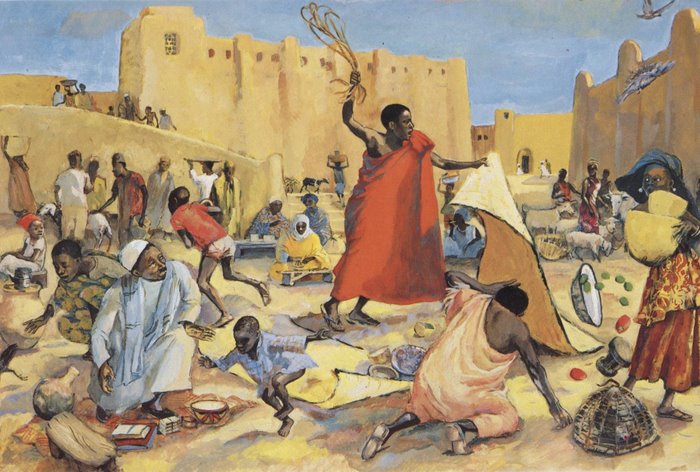
Painting by Lino Pontebon, “an artist from the Negros island of the Philippines. The area in which he lives has been the scene of considerable military action and this has added to the already hard life of the peasants. His painting of the angry Christ captures a mood in the Philippines and reflects the prevailing anger of the people at being manipulated by forces beyond their control.
The painting became popular in many parts of the world, especially among the young. It counteracts the image of ‘gentle Jesus meek and mild’ with the reminder that Jesus also became angry at injustice.”
(Source for this and the image: The Bible Through Asian Eyes by Masao Takenaka and Ron O’Grady 1991)
“Jesus is doing something extremely dangerous here. The Thai temple is a place in which it is considered by religious people inappropriate to show any anger or strong emotions. It has to be an extremely urgent reason for someone to do something as violent as this in such a sacred space.”
The Greek that is often translated as “disciple” in English typically follows three types of translation: (1) those which employ a verb ‘to learn’ or ‘to be taught’, (2) those which involve an additional factor of following, or accompaniment, often in the sense of apprenticeship, and (3) those which imply imitation of the teacher.
Following are some examples (click or tap for details):
Toraja-Sa’dan: “child (i.e., follower) of the master”
Indonesian: “pupil” (also used in many Slavic languages, including Russian [ученик], Bulgarian [учени́к], Ukrainian [учень], or Polish [uczeń] — source: Paul Amara)
Waorani: “one who lives following Jesus” (source: Wallis 1973, p. 39)
Ojitlán Chinantec: “learner” (Source: M. Larson / B. Moore in Notes on Translation February 1970, p. 1-125.)
Javanese: “pupil” or “companion” (“a borrowing from Arabic that is a technical term for Mohammed’s close associates”)
German: Jünger or “younger one” (source for this and one above: Reiling / Swellengrebel)
German New Testament translation by Berger / Nord (publ. 1999): Jüngerinnen und Jünger or “female and male disciples.” Note that Berger/Nord only use that translation in many cases in the gospel of Luke, “because especially according to Luke (see 8:1–3), women were part of the extended circle of disciples” (see p. 452 and looked up at his disciples).
Noongar: ngooldjara-kambarna or “friend-follow” (source: Warda-Kwabba Luke-Ang)
French 1985 translation by Chouraqui: adept or “adept” (as in a person who is skilled or proficient at something). Watson (2023, p. 48ff.) explains (click or tap here to see more):
[Chouraqui] uses the noun “adept,” which is as uncommon in French as it is in English. It’s an evocative choice on several levels. First, linguistically, it derives — via the term adeptus — from the Latin verb adipiscor, “to arrive at; to reach; to attain something by effort or striving.” It suggests those who have successfully reached the goal of their searching, and implies a certain struggle or process of learning that has been gradually overcome. But it’s also a term with a very particular history: in the Middle Ages, “adept” was used in the world of alchemy, to describe those who, after years of labor and intensive study, claimed to have discovered the Great Secret (how to turn base metals like lead into gold); it thus had the somewhat softened meaning of “someone who is completely skilled in all the secrets of their field.”
Historians of religion often use the term adept with reference to the ancient mystery religions that were so prevalent in the Mediterranean in the centuries around the time of Jesus. An adept was someone who, through a series of initiatory stages, had penetrated into the inner, hidden mysteries of the religion, who understood its rituals, symbols, and their meaning. To be an adept implied a lengthy and intensive master-disciple relationship, gradually being led further and further into the secrets of the god or goddess (Isis-Osiris, Mithras, Serapis, Hermes, etc.) — secrets that were never to be revealed to an outsider.
Is “adept” a suitable category in which to consider discipleship as we see it described in the Gospels? On some levels, the link is an attractive one, drawing both upon the social-religious framework of the ancient Mediterranean, and upon certain aspects of intimacy and obscurity/secrecy that we see in the relationship of Jesus and those who followed him. The idea that disciples are “learners” — people who are “on the way” — and that Jesus is portrayed as (and addressed as) their Master/Teacher is accurate. But the comparison is unsatisfactory on several other levels.
First, the Gospels portray Jesus’s ministry as a largely public matter — there is relatively little of the secrecy and exclusiveness that is normally associated with both the mystery cults and medieval alchemy. Jesus’s primary message is not destined for a small, elite circle of “initiates” — although the Twelve are privy to explanations, experiences and teachings that are not provided to “the crowds.” For example, in Matthew 13:10-13:
Then the disciples came and asked him, “Why do you speak to [the crowds] in parables?” He answered, “To you it has been given to know the secrets of the kingdom of heaven, but to them it has not been given. For to those who have, more will be given, and they will have an abundance; but from those who have nothing, even what they have will be taken away. The reason I speak to them in parables is that ‘seeing they do not perceive, and hearing they do not listen, nor do they understand.’”
Etymologically, adeptus suggests someone who “has arrived,” who has attained a superior level of understanding reserved for very few. However, what we see in the Gospels, repeatedly, is a general lack of comprehension of many of Jesus’s key teachings by many of those who hear him. Many of his more cryptic sayings would have been virtually incomprehensible in their original context, and would only make sense in retrospect, in the wake of the events of Jesus’s passion, death, and resurrection. The intense master-student relationship is also lacking: the Gospels largely portray “the disciples” as a loose (and probably fluctuating) body of individuals, with minimal structure or cohesion. Finally, there seems to be little scholarly consensus about the degree to which the mystery cults had made inroads in Roman-ruled Palestine during the decades of Jesus’s life. According to Everett Ferguson in his Backgrounds of Early Christianity.
Although Christianity had points of contact with Stoicism, the mysteries, the Qumran community, and so on, the total worldview was often quite different….So far as we can tell, Christianity represented a new combination for its time…. At the beginning of the Christian era a number of local mysteries, some of great antiquity, flourished in Greece and Asia Minor. In the first century A.D. the vonly mysteries whose extension may be called universal were the mysteries of Dionysus and those of the eastern gods, especially Isis.
And Norman Perrin and Dennis C. Duling note, in their book The New Testament:
Examples of such mystery religions could be found in Greece… Asia Minor… Syria-Palestine… Persia… and Egypt. Though the mysteries had sacred shrines in these regions, many of them spread to other parts of the empire, including Rome. There is no clearly direct influence of the mysteries on early Christianity, but they shared a common environment and many non-Christians would have perceived Christians as members of an oriental Jewish mystery cult.56
Given the sparse archaeological and literary evidence from this period regarding mystery cults in Roman Palestine, and the apparent resistance of many Palestinian Jews to religious syncretism, Chouraqui’s use of the noun adept implies a comparison between the historical Jesus and mystery cults that is doubtful, on both the levels of chronology and religious culture. Personally, I believe this choice suggests a vision of Jesus that distances him from the religious world of ancient Judaism, thus creating a distorted view of what spiritually inspired him. But the idea of the disciples as “learners” on a journey (as the Greek term suggests) is a striking one to consider; certainly, the Gospels show us the Twelve as people who are growing, learning, and developing…but who have not yet “arrived” at the fullness of their vocation.

Scot McKnight (in The Second Testament, publ. 2023) translates it into English as apprentice.
In Luang several terms with different shades of meaning are being used.
For Mark 2:23 and 3:7: maka nwatutu-nwaye’a re — “those that are taught” (“This is the term used for ‘disciples’ before the resurrection, while Jesus was still on earth teaching them.”)
For Acts 9:1 and 9:10: makpesiay — “those who believe.” (“This is the term used for believers and occasionally for the church, but also for referring to the disciples when tracking participants with a view to keeping them clear for the Luang readers. Although Greek has different terms for ‘believers’, ‘brothers’, and ‘church’, only one Luang word can be used in a given episode to avoid confusion. Using three different terms would imply three different sets of participants.”)
For Acts 6:1: mak lernohora Yesus wniatutunu-wniaye’eni — “those who follow Jesus’ teaching.” (“This is the term used for ‘disciples’ after Jesus returned to heaven.”)
Source: Kathy Taber in Notes on Translation 1/1999, p. 9-16.
In American Sign Language it is translated with a combination of the signs for “following” plus the sign for “group.” (Source: Ruth Anna Spooner, Ron Lawer)
“disciples” in American Sign Language, source: Deaf Harbor
In British Sign Language a sign is used that depicts a group of people following one person (the finger in the middle, signifying Jesus). Note that this sign is only used while Jesus is still physically present with his disciples. (Source: Anna Smith)
“Disciple in British Sign Language (source: Christian BSL, used with permission)
In the Yatzachi Zapotec translation of the Gospel of John, any reference to the evangelist and presumed narrator is done in the first person.
The translator Inez Butler explains (in: Notes on Translation, September 1967, pp. 10ff.):
“In revising the Gospel of John in Yatzachi Zapotec we realized from the start that the third person references of Jesus to himself as Son of Man had to be converted into first person references, but only more recently have we decided that similar change is necessary in John’s references to himself as ‘the disciple whom Jesus loved.’ As I worked on those changes and questioned the informant about his understanding of other passages in the Gospel, I discovered that the reader misses the whole focus of the book as an eyewitness account unless every reference to the disciples indicates the writer’s membership in the group. In view of that we went back through the entire book looking for ways to cue in the reader to the fact that John was an eyewitness and a participant in a many of the events, as well as the historian.
“When the disciples were participants in events along with Jesus, it was necessary to make explicit the fact that they accompanied him, although in the source language that is left implicit, since otherwise our rendering would imply that they were not present.”
In this verse, the Yatzachi Zapotec says: “Then we his disciples remembered . . .”
Following are a number of back-translations of John 2:17:
Uma: “His disciple remembered the words of the Holy Book that said like this: ‘My heart boiled, because I love your (sing.) House, Lord.'” (Source: Uma Back Translation)
Yakan: “When the disciples saw this his doing, they remembered that it is written in the holy-book, it says there, ‘My love for your house o God, is like a fire in my liver which is destroying me.'” (Source: Yakan Back Translation)
Western Bukidnon Manobo: “The disciples remembered the prophesy which was written long ago which says, ‘Very great is my cherishing of your house, God, and that’s why it has become a reason for giving me a very painful breath.'” (Source: Western Bukidnon Manobo Back Translation)
Kankanaey: “And then his disciples remembered that which God caused-to-be-written that says, ‘My extreme concern-for (lit. hurting-for) your (sing.) house, that will be my death.'” (Source: Kankanaey Back Translation)
Tagbanwa: “When his disciples had seen, they remembered what is in the writing which says, ‘I really uphold/stand-up-for very much your house where you are worshipped even if it will cause my life/breath to be severed.'” (Source: Tagbanwa Back Translation)
Tenango Otomi: “The learners then remembered what is written in the Holy Book. It says, ‘I look with respect on your house, even though I lose my life.'” (Source: Tenango Otomi Back Translation)
God transcends gender, but most languages are limited to grammatical gender expressed in pronouns. In the case of English, this is traditionally confined to “he” (or in the forms “his,” “him,” and “himself”), “she” (and “her,” “hers,” and “herself”), and “it” (and “its” and “itself”).
Modern Mandarin Chinese, however, offers another possibility. Here, the third-person singular pronoun is always pronounced the same (tā), but it is written differently according to its gender (他 is “he,” 她 is “she,” and 它/牠 is “it” and their respective derivative forms). In each of these characters, the first (or upper) part defines the gender (man, woman, or thing/animal), while the second element gives the clue to its pronunciation.
In 1930, after a full century with dozens of Chinese translations, Bible translator Wang Yuande (王元德) coined a new “godly” pronoun: 祂. Chinese readers immediately knew how to pronounce it: tā. But they also recognized that the first part of that character, signifying something spiritual, clarified that each person of the Trinity has no gender aside from being God.
While the most important Protestant and Catholic Chinese versions respectively have opted not to use 祂, some Bible translations do and it is widely used in hymnals and other Christian materials. Among the translations that use 祂 to refer to “God” were early versions of Lü Zhenzhong’s (呂振中) version (New Testament: 1946, complete Bible: 1970). R.P. Kramers (in The Bible Translator 1956, p. 152ff. ) explains why later versions of Lü’s translation did not continue with this practice: “This new way of writing ‘He,’ however, has created a minor problem of its own: must this polite form be used whenever Jesus is referred to? Lü follows the rule that, wherever Jesus is referred to as a human being, the normal tā (他) is written; where he is referred to as divine, especially after the ascension, the reverential tā (祂) is used.”
In that system one kind of pronoun is used for humans (male and female alike) and one for natural elements, non-liquid masses, and some spiritual entities (one other is used for large animals and another one for miscellaneous items). While in these languages the pronoun for spiritual entities used to be employed when referring to God, this has changed into the use of the human pronoun.
Lynell Zogbo (in The Bible Translator 1989, p. 401ff. ) explains in the following way: “From informal discussions with young Christians especially, it would appear that, at least for some people, the experience and/or concepts of Christianity are affecting the choice of pronoun for God. Some people explain that God is no longer ‘far away,’ but is somehow tangible and personal. For these speakers God has shifted over into the human category.”
In Kouya, God (the Father) and Jesus are referred to with the human pronoun ɔ, whereas the Holy Spirit is referred to with a non-human pronoun. (Northern Grebo and Western Krahn make a similar distinction.)
Eddie Arthur, a former Kouya Bible translation consultant, says the following: “We tried to insist that this shouldn’t happen, but the Kouya team members were insistent that the human pronoun for the Spirit would not work.”
In Burmese, the pronoun ko taw (ကိုယ်တော်) is used either as 2nd person (you) or 3rd person (he, him, his) reference. “This term clearly has its root in the religious language in Burmese. No ordinary persons are addressed or known by this pronoun because it is reserved for Buddhist monks, famous religious teachers, and in the case of Christianity, the Trinity.” (Source: Gam Seng Shae in The Bible Translator 2002, p. 202ff. )
In Thai, the pronoun phra`ong (พระองค์) is used, a gender-neutral pronoun which must refer to a previously introduced royal or divine being. Similarly, in Northern Khmer, which is spoken in Thailand, “an honorific divine pronoun” is used for the pronoun referring to the persons of the Trinity (source: David Thomas in The Bible Translator 1993, p. 445 ). In Urak Lawoi’, another language spoken in Thailand, the translation often uses tuhat (ตูฮัด) — “God” — ”as a divine pronoun where Thai has phra’ong even though it’s actually a noun.” (Source for Thai and Urak Lawoi’: Stephen Pattemore)
The English “Contemporary Torah” addresses the question of God and gendered pronouns by mostly avoiding pronouns in the first five books of the Hebrew Bible/Old Testament (unless God is referred to as “lord,” “father,” “king,” or “warrior”). It does that by either using passive constructs (“He gave us” vs. “we were given”), by using the adjective “divine” or by using “God” rather than a pronoun.
Some Protestant and Orthodox English Bibles use a referential capitalized spelling when referring to the persons of the Trinity with “He,” “His,” “Him,” or “Himself.” This includes for instance the New American Standard Bible or The Orthodox New Testament, but most translations do not. Two other languages where this is also done (in most Bible translations) are Twents as well as the closely related Indonesian and Malay. In both languages this follows the language usage according to the Qur’an, which in turn predicts that usage (see Soesilo in The Bible Translator 1991, p. 442ff. and The Bible Translator 1997, p. 433ff. ).
Leave a Reply
You must be logged in to post a comment.