fall to the ground

The Greek in Matthew 17:6 that is translated as “fell to the ground” or similar in English is translated in Elhomwe with yaamora ekhove or “fell on their faces,” the same expression that is used in Numbers 14:5 and Numbers 16:45. (Source: project-specific translation notes in Paratext)

In Gbaya, the ideophone hirr is used to emphasize this expression. Hirr denotes a tight fit — such as the one of the disciples’ faces to the ground. Ideophones are a class of sound symbolic words expressing human sensation that are used as literary devices in many African languages. (Source: Philip Noss)

See also fell to the ground and fell on their faces.

Transfiguration (icon)

Following is a Ukrainian Orthodox icon of the Transfiguration by Ivan Rutkovych (c. 1650 – c. 1708) (for the Church of Christ’s Nativity in Zhovkva, Ukraine, today in the Lviv National Museum).

Orthodox Icons are not drawings or creations of imagination. They are in fact writings of things not of this world. Icons can represent our Lord Jesus Christ, the Virgin Mary, and the Saints. They can also represent the Holy Trinity, Angels, the Heavenly hosts, and even events. Orthodox icons, unlike Western pictures, change the perspective and form of the image so that it is not naturalistic. This is done so that we can look beyond appearances of the world, and instead look to the spiritual truth of the holy person or event. (Source )

very afraid

The Greek that is translated as “to be very afraid” or similar in English is translated in Ashe as iwei idur iyee or “fear caught him/her.” (Source: David Rowbory)

See also fear / afraid and terrified / afraid.

disciple

The Greek that is often translated as “disciple” in English typically follows three types of translation: (1) those which employ a verb ‘to learn’ or ‘to be taught’, (2) those which involve an additional factor of following, or accompaniment, often in the sense of apprenticeship, and (3) those which imply imitation of the teacher.

Following are some examples (click or tap for details):

  • Ngäbere: “word searcher”
  • Yaka: “one who learned from Jesus”
  • Navajo (Dinė), Western Highland Purepecha, Tepeuxila Cuicatec, Lacandon: “one who learned”
  • San Miguel El Grande Mixtec: “one who studied with Jesus”
  • Northern Grebo: “one Jesus taught”
  • Toraja-Sa’dan: “child (i.e., follower) of the master”
  • Indonesian: “pupil” (also used in many Slavic languages, including Russian [ученик], Bulgarian [учени́к], Ukrainian [учень], or Polish [uczeń] — source: Paul Amara)
  • Central Mazahua: “companion whom Jesus taught”
  • Kipsigis, Loma, Copainalá Zoque: “apprentice” (implying continued association and learning)
  • Cashibo-Cacataibo: “one who followed Jesus”
  • Huautla Mazatec: “his people” (essentially his followers and is the political adherents of a leader)
  • Highland Puebla Nahuatl: based on the root of “to imitate” (source for this and all above: Bratcher / Nida)
  • Chol: “learner” (source: Larson 1998, p. 107)
  • Waorani: “one who lives following Jesus” (source: Wallis 1973, p. 39)
  • Ojitlán Chinantec: “learner” (Source: M. Larson / B. Moore in Notes on Translation February 1970, p. 1-125.)
  • Javanese: “pupil” or “companion” (“a borrowing from Arabic that is a technical term for Mohammed’s close associates”)
  • German: Jünger or “younger one” (source for this and one above: Reiling / Swellengrebel)
  • German New Testament translation by Berger / Nord (publ. 1999): Jüngerinnen und Jünger or “female and male disciples.” Note that Berger/Nord only use that translation in many cases in the gospel of Luke, “because especially according to Luke (see 8:13), women were part of the extended circle of disciples” (see p. 452 and looked up at his disciples).
  • Noongar: ngooldjara-kambarna or “friend-follow” (source: Warda-Kwabba Luke-Ang)
  • French 1985 translation by Chouraqui: adept or “adept” (as in a person who is skilled or proficient at something). Watson (2023, p. 48ff.) explains (click or tap here to see more):

    [Chouraqui] uses the noun “adept,” which is as uncommon in French as it is in English. It’s an evocative choice on several levels. First, linguistically, it derives — via the term adeptus — from the Latin verb adipiscor, “to arrive at; to reach; to attain something by effort or striving.” It suggests those who have successfully reached the goal of their searching, and implies a certain struggle or process of learning that has been gradually overcome. But it’s also a term with a very particular history: in the Middle Ages, “adept” was used in the world of alchemy, to describe those who, after years of labor and intensive study, claimed to have discovered the Great Secret (how to turn base metals like lead into gold); it thus had the somewhat softened meaning of “someone who is completely skilled in all the secrets of their field.”

    Historians of religion often use the term adept with reference to the ancient mystery religions that were so prevalent in the Mediterranean in the centuries around the time of Jesus. An adept was someone who, through a series of initiatory stages, had penetrated into the inner, hidden mysteries of the religion, who understood its rituals, symbols, and their meaning. To be an adept implied a lengthy and intensive master-disciple relationship, gradually being led further and further into the secrets of the god or goddess (Isis-Osiris, Mithras, Serapis, Hermes, etc.) — secrets that were never to be revealed to an outsider.

    Is “adept” a suitable category in which to consider discipleship as we see it described in the Gospels? On some levels, the link is an attractive one, drawing both upon the social-religious framework of the ancient Mediterranean, and upon certain aspects of intimacy and obscurity/secrecy that we see in the relationship of Jesus and those who followed him. The idea that disciples are “learners” — people who are “on the way” — and that Jesus is portrayed as (and addressed as) their Master/Teacher is accurate. But the comparison is unsatisfactory on several other levels.

    First, the Gospels portray Jesus’s ministry as a largely public matter — there is relatively little of the secrecy and exclusiveness that is normally associated with both the mystery cults and medieval alchemy. Jesus’s primary message is not destined for a small, elite circle of “initiates” — although the Twelve are privy to explanations, experiences and teachings that are not provided to “the crowds.” For example, in Matthew 13:10-13:

    Then the disciples came and asked him, “Why do you speak to [the crowds] in parables?” He answered, “To you it has been given to know the secrets of the kingdom of heaven, but to them it has not been given. For to those who have, more will be given, and they will have an abundance; but from those who have nothing, even what they have will be taken away. The reason I speak to them in parables is that ‘seeing they do not perceive, and hearing they do not listen, nor do they understand.’”

    Etymologically, adeptus suggests someone who “has arrived,” who has attained a superior level of understanding reserved for very few. However, what we see in the Gospels, repeatedly, is a general lack of comprehension of many of Jesus’s key teachings by many of those who hear him. Many of his more cryptic sayings would have been virtually incomprehensible in their original context, and would only make sense in retrospect, in the wake of the events of Jesus’s passion, death, and resurrection. The intense master-student relationship is also lacking: the Gospels largely portray “the disciples” as a loose (and probably fluctuating) body of individuals, with minimal structure or cohesion. Finally, there seems to be little scholarly consensus about the degree to which the mystery cults had made inroads in Roman-ruled Palestine during the decades of Jesus’s life. According to Everett Ferguson in his Backgrounds of Early Christianity.

    Although Christianity had points of contact with Stoicism, the mysteries, the Qumran community, and so on, the total worldview was often quite different….So far as we can tell, Christianity represented a new combination for its time…. At the beginning of the Christian era a number of local mysteries, some of great antiquity, flourished in Greece and Asia Minor. In the first century A.D. the vonly mysteries whose extension may be called universal were the mysteries of Dionysus and those of the eastern gods, especially Isis.

    And Norman Perrin and Dennis C. Duling note, in their book The New Testament:

    Examples of such mystery religions could be found in Greece… Asia Minor… Syria-Palestine… Persia… and Egypt. Though the mysteries had sacred shrines in these regions, many of them spread to other parts of the empire, including Rome. There is no clearly direct influence of the mysteries on early Christianity, but they shared a common environment and many non-Christians would have perceived Christians as members of an oriental Jewish mystery cult.56

    Given the sparse archaeological and literary evidence from this period regarding mystery cults in Roman Palestine, and the apparent resistance of many Palestinian Jews to religious syncretism, Chouraqui’s use of the noun adept implies a comparison between the historical Jesus and mystery cults that is doubtful, on both the levels of chronology and religious culture. Personally, I believe this choice suggests a vision of Jesus that distances him from the religious world of ancient Judaism, thus creating a distorted view of what spiritually inspired him. But the idea of the disciples as “learners” on a journey (as the Greek term suggests) is a striking one to consider; certainly, the Gospels show us the Twelve as people who are growing, learning, and developing…but who have not yet “arrived” at the fullness of their vocation.

Scot McKnight (in The Second Testament, publ. 2023) translates it into English as apprentice.

In Luang several terms with different shades of meaning are being used.

  • For Mark 2:23 and 3:7: maka nwatutu-nwaye’a re — “those that are taught” (“This is the term used for ‘disciples’ before the resurrection, while Jesus was still on earth teaching them.”)
  • For Acts 9:1 and 9:10: makpesiay — “those who believe.” (“This is the term used for believers and occasionally for the church, but also for referring to the disciples when tracking participants with a view to keeping them clear for the Luang readers. Although Greek has different terms for ‘believers’, ‘brothers’, and ‘church’, only one Luang word can be used in a given episode to avoid confusion. Using three different terms would imply three different sets of participants.”)
  • For Acts 6:1: mak lernohora Yesus wniatutunu-wniaye’eni — “those who follow Jesus’ teaching.” (“This is the term used for ‘disciples’ after Jesus returned to heaven.”)

Source: Kathy Taber in Notes on Translation 1/1999, p. 9-16.

In American Sign Language it is translated with a combination of the signs for “following” plus the sign for “group.” (Source: Ruth Anna Spooner, Ron Lawer)


“disciples” in American Sign Language, source: Deaf Harbor

In British Sign Language a sign is used that depicts a group of people following one person (the finger in the middle, signifying Jesus). Note that this sign is only used while Jesus is still physically present with his disciples. (Source: Anna Smith)


“Disciple in British Sign Language (source: Christian BSL, used with permission)

See also disciples (Japanese honorifics).

complete verse (Matthew 17:6)

Following are a number of back-translations of Matthew 17:6:

  • Uma: “As soon as the disciples heard those words, they fell-face-down to the ground because they were very frightened.” (Source: Uma Back Translation)
  • Yakan: “When his disciples heard that voice, they were very frightened and immediately they threw-themselves-face-downwards on the ground.” (Source: Yakan Back Translation)
  • Western Bukidnon Manobo: “And when the disciples of Jesus heard this, they got down on their faces because they were very afraid.” (Source: Western Bukidnon Manobo Back Translation)
  • Kankanaey: “When Jesus’ disciples heard this voice, they immediately-kneeled face-down from their extreme fear.” (Source: Kankanaey Back Translation)
  • Tagbanwa: “Those disciples really became very scared when they heard those words. They at once went down with their faces to the ground” (Source: Tagbanwa Back Translation)
  • Tenango Otomi: “When they heard the words God spoke, they fell face down on the ground, for they were extremely afraid.” (Source: Tenango Otomi Back Translation)

The Transfiguration

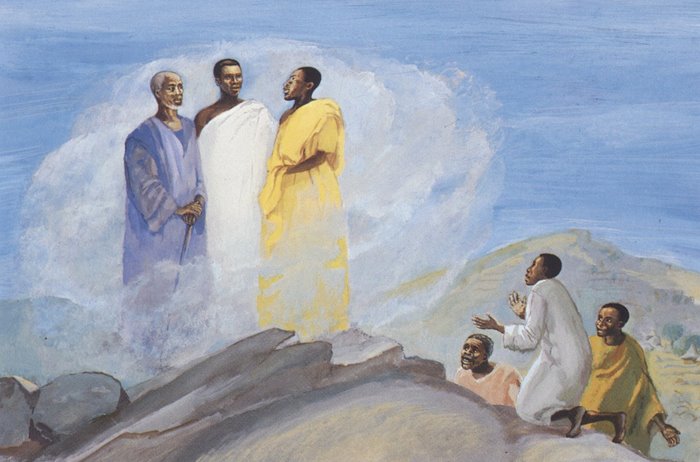
Following is a 1973 painting of the JESUS MAFA project, a response to New Testament readings from the Lectionary by a Christian community in Cameroon, Africa. Each of the readings was selected and adapted to dramatic interpretation by the community members. Photographs of their interpretations were made, and these were then transcribed to paintings:

In this theatrical representation of Jesus’ transfiguration, Jesus is robed in a dazzling white garment, as the story in the gospels describes. He appears to be greeting Moses and Elijah like old friends as they are surrounded by a cloud that makes the whole scene feel ethereal. Peter, James, and John look on with flabbergasted and fearful expressions, bewildered at what they should do. This painting invites the viewer to imagine what it would be like to have seen such amazing things. Undoubtedly, it would inspire one to follow and obey Jesus, just as God commands in the story: “This is my son, the beloved. Listen to him!”

From Art in the Christian Tradition , a project of the Vanderbilt Divinity Library, Nashville, TN. Image retrieved March 23, 2026. Original source: librairie-emmanuel.fr.

Translation commentary on Matthew 17:6

The effect of this experience on the disciples (verses 6-7) is without parallel in either Mark or Luke.

Some translators have found that the disciples needs to be rendered as “the three disciples,” although the context makes this clear enough for most readers.

In the Greek text the verb heard is a participle in Greek and does not have an expressed object. But in English an object is obligatory, and most translations supply this (Revised Standard Version, New Jerusalem Bible, New American Bible, New International Version); An American Translation has “it.” On the other hand Moffatt (“the voice”), Phillips (“this voice”), and New English Bible (“At the sound of the voice”), together with Good News Translation, provide “voice” as the object. Die Bibel im heutigen Deutsch translates “When the disciples heard these words.” One may even need to translate “When the disciples heard the voice from heaven say these words.”

They fell on their faces, and were filled with awe: Good News Translation both reverses the order of the two clauses and shifts from a coordinate connection (and) to a causative one: “they were so terrified that they threw themselves downward on the ground.” It is typical of the biblical languages that they will utilize coordinate structures for what would be more naturally expressed by a different construction in other languages. Here it is obvious that they fell on their faces is a result of being filled with awe, and Good News Translation has merely made the relation explicit. New English Bible retains the original sequence but shifts from a coordinate structure: “the disciples fell on their faces in terror.” The same is true of Phillips and New Jerusalem Bible: “the disciples fell on their faces, overcome with fear.” Barclay has “they flung themselves face down on the ground, for they were terrified.”

Fell on their faces is normally not translated literally. Fell does not mean they fell accidentally (after stumbling, perhaps), and to fall literally on their faces would be quite painful. Most languages will have an idiomatic way of expressing the idea that they deliberately lay down on the ground, possibly with their faces touching the ground, as an act of reverence or great respect.

As can be seen from the examples in the paragraphs above, filled with awe does not really reflect the idea of the text. “Terrified” is much more accurate.

Quoted with permission from Newman, Barclay M. and Stine, Philip C. A Handbook on the Gospel of Matthew. (UBS Handbook Series). New York: UBS, 1988. For this and other handbooks for translators see here .