Click or tap here to see the rest of this insight.
Like a number of other East Asian languages, Japanese uses a complex system of honorifics, i.e. a system where a number of different levels of politeness are expressed in language via words, word forms or grammatical constructs. These can range from addressing someone or referring to someone with contempt (very informal) to expressing the highest level of reference (as used in addressing or referring to God) or any number of levels in-between. One way to do this is through the usage (or a lack) of an honorific prefix as shown here in the widely-used Japanese Shinkaiyaku (新改訳) Bible of 2017.
The Greek that is translated as “see” or “understand” or similar in English is translated in the Shinkaiyaku Bible as o-miuke (お#見受け), combining “perceive” (miuke) with the respectful prefix o-. (Source: S. E. Doi, see also S. E. Doi in Journal of Translation, 18/2022, p. 37ff. )
Like many languages (but unlike Greek or Hebrew or English), Tuvan uses a formal vs. informal 2nd person pronoun (a familiar vs. a respectful “you”). Unlike other languages that have this feature, however, the translators of the Tuvan Bible have attempted to be very consistent in using the different forms of address in every case a 2nd person pronoun has to be used in the translation of the biblical text.
As Voinov shows in Pronominal Theology in Translating the Gospels (in The Bible Translator2002, p. 210ff. ), the choice to use either of the pronouns many times involved theological judgment. While the formal pronoun can signal personal distance or a social/power distance between the speaker and addressee, the informal pronoun can indicate familiarity or social/power equality between speaker and addressee.
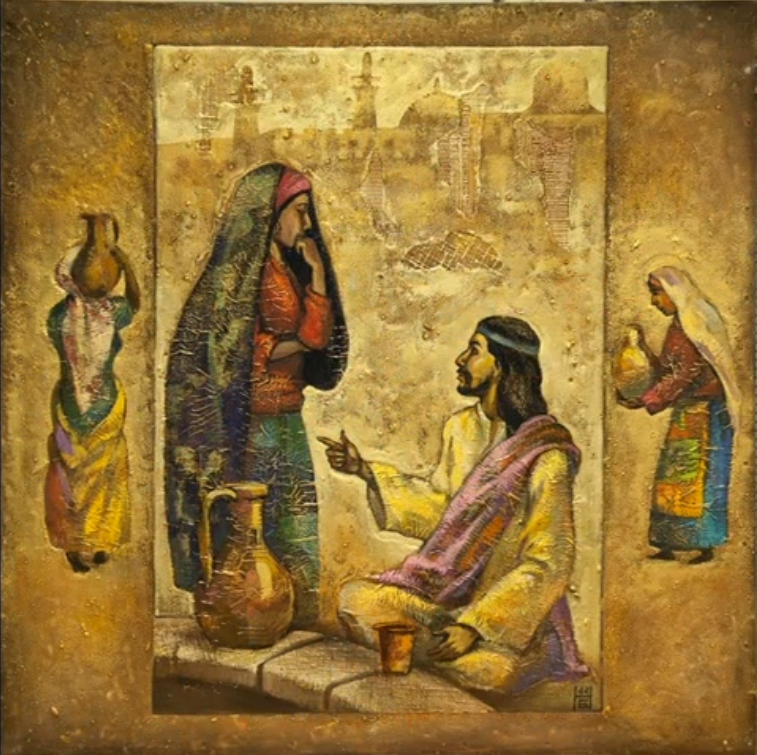
Here, Jesus is addressing the woman with an informal pronoun whereas she addresses him with a formal pronoun, showing respect.
In Gbaya, where God is always addressed with the second person plural pronoun ɛ́nɛ́, the common way to address superiors, the woman addresses him with the less courteous nɛ́ in verse 4:9 but then switches to the courteous plural form ɛ́nɛ́. (Source Philip Noss)
Likewise in Burmese where in the Common Language Version (publ. 2005) the Samaritan woman changes her language level from the Common to the Royal and Religious as she discovers the real nature of Jesus. Jesus appears here as a divine revealer. (Source: Gam Seng Shae in The Bible Translator 2002, p. 202ff. )
In most Dutch translations, both Jesus and the woman use the formal pronoun, whereas in Afrikaans and Western Frisian Jesus addresses the woman informally and she addresses him with the formal pronoun.
Following are a number of back-translations of John 4:19:
Uma: “That woman said: ‘Ei’, you (sing.) must be a prophet!” (Source: Uma Back Translation)
Yakan: “The woman said to Isa, ‘Sir, now I know that you are a prophet, surprise.” (Source: Yakan Back Translation)
Western Bukidnon Manobo: “Then the woman said again, ‘You must be a prophet of God.” (Source: Western Bukidnon Manobo Back Translation)
Kankanaey: “Then the woman said, ‘Sir, I-now-realize you (sing.) are a prophet! I have something to say to you (sing.).” (Source: Kankanaey Back Translation)
Tagbanwa: “The woman said, ‘Master, apparently you are a prophet!” (Source: Tagbanwa Back Translation)
Tenango Otomi: “After hearing this the woman said, ‘Sir, I think that you must be a prophet of God.” (Source: Tenango Otomi Back Translation)
“Jesus is dressed in a different style of clothing than the style of the woman who is shown as a Lanna Thai northerner. It is unusual for him to talk to a person from a different region, especially a woman. The clothes, the roof of the house in the background, and the dipper for water all indicate that this is in northern Thailand.”
Ketut Lasia is one of the last traditional Balinese painters in the Ubud style. As an adult, Lasia converted from Hinduism to Christianity, and he paints primarily biblical scenes. You can find artwork from Ketut Lasia in a variety of formats for sale at Fine Art America .
Eugene Nida wrote the following about the translation of the Hebrew, Aramaic, Ge’ez, and Greek terms that are typically translated with “prophet” in English:
“The tendency in many translations is to use ‘to foretell the future’ for ‘prophesy,’ and ‘one who foretells the future’ for ‘prophet.’ This is not always a recommended usage, particularly if such expressions denote certain special native practices of spirit contact and control. It is true, of course, that prophets of the Bible did foretell the future, but this was not always their principal function. One essential significance of the Greek word prophētēs is ‘one who speaks forth,’ principally, of course, as a forth-teller of the Divine will. A translation such as ‘spokesman for God’ may often be employed profitably.” (1947, p. 234f.)
Following is a list of (back-) translations from other languages (click or tap for details):
Ayutla Mixtec: “one who talks as God’s representative”
Isthmus Mixe: “speaker for God” (source for this and two above: Viola Waterhouse in Notes on Translation August 1966, p. 86ff.)
Mezquital Otomi / Paasaal: “God’s messenger” (source: Waterhouse / Parrott in Notes on Translation October 1967, p. 1ff. and Fabian N. Dapila in The Bible Translator 2024, p. 415ff.)
Noongar: Warda Marridjiny or “News Traveling” (source: Warda-Kwabba Luke-Ang)
Kutu: mtula ndagu or “one who gives the prediction of the past and the future” (Source: Pioneer Bible Translators, project-specific translation notes in Paratext)
Ebira: ọnịsẹ, a neologism that combines the prefix ọn for “a person” with ịsẹ for “prediction” (source: Scholz /Scholz 2015, p. 49)
French 1985 translation by Chouraqui: inspiré or “inspired one” (“someone in whom God has breathed [Latin: in + spiro]) (source: Watson 2023, p. 45)
Cherokee: adolehosgi (ᎠᏙᎴᎰᏍᎩ) or “discoverer of things,” a “term that was was traditionally applied to Cherokee medicine men or women who used divining.” (Source: Bender / Belt 2025, p. 49)
In Ixcatlán Mazatec a term is used that specifically includes women. (Source: Robert Bascom)
“In some instances these spiritual terms result from adaptations reflecting the native life and culture. Among the Northern Grebo people of Liberia, a missionary wanted some adequate term for ‘prophet,’ and she was fully aware that the native word for ‘soothsayer’ or ‘diviner’ was no equivalent for the Biblical prophet who spoke forth for God. Of course, much of what the prophets said referred to the future, and though this was an essential part of much of their ministry, it was by no means all. The right word for the Gbeapo people would have to include something which would not only mean the foretelling of important events but the proclamation of truth as God’s representative among the people. At last the right word came; it was ‘God’s town-crier.’ Every morning and evening the official representative of the chief goes through the village crying out the news, delivering the orders of the chief, and announcing important coming events. ‘God’s town-crier’ would be the official representative of God, announcing to the people God’s doings, His commands, and His pronouncements for their salvation and well-being. For the Northern Grebo people the prophet is no weird person from forgotten times; he is as real as the human, moving message of the plowman Amos, who became God’s town-crier to a calloused people.” (source: Nida 1952, p. 20)
In British Sign Language it is is translated with a sign that depicts a message coming from God to a person (the upright finger) and then being passed on to others. (Source: Anna Smith)
“Prophet” in British Sign Language (source: Christian BSL, used with permission)
On the basis of Jesus’ insight into her situation, the woman judges that he is a prophet. She does not refer to him as “the prophet,” as though she had a specific reference in mind (as in Deut 18.15, 18), but simply as a prophet. It does seem, however, that she assumes that a prophet might have authority to settle legal questions, as implied in the next verse.
The term prophet must be expressed in several different ways, depending on the context in the Scriptures. In some instances the meaning certainly is “one who foretells the future,” in others the emphasis is upon “one who makes inspired utterances.” In some languages the tendency has been to translate prophet by a term meaning “diviner” or “one who foretells the future,” but it is increasingly common to render prophet as “one who speaks for God” or “a messenger from God.” This type of expression fits well in the present context.
The woman addresses Jesus by the same word that she used in verses 11 and 15. Most translators and commentators understand sir here as a simple address; a few see a transition to the meaning of “Lord.” For a discussion of the translational difficulties involved in rendering sir, see under verse 11.
Quoted with permission from Newman, Barclay M. and Nida, Eugene A. A Handbook on the Gospel of John. (UBS Handbook Series). New York: UBS, 1980. For this and other handbooks for translators see here .
The woman next asked Jesus about where people should worship God. The Samaritans said it was right to worship on Mount Gerizim, but the Jews worshiped in Jerusalem. Jesus said that where people worship is not important. It is how they worship that is important.
Jesus also said that the Samaritans really did not know whom they worshiped. The Jewish people knew whom they worshiped, and it was through them that all people will be saved. The woman mentioned the Messiah or Chosen Savior who was coming. Jesus told her that he was the Messiah. This is a very important part of the story.
4:19a
Sir: The Greek word that the Berean Standard Bible translates as Sir is more literally “lord.” It is a polite form of address for an important person. See 4:11a.
the woman said: The Greek contains a phrase that the New Revised Standard Version translates literally as “to him” in order to indicate that Jesus was the one whom the woman was talking to. In some languages it may be natural to that this explicitly. For example:
The woman said to him (New Revised Standard Version)
4:19b
I see that You are a prophet: The woman realized that Jesus was someone important. She thought he was a prophet because he knew things about her that she had not told him.
I see: The word see here means “understand” or “recognize.” The woman realized that Jesus’ knowledge was greater than that of an ordinary human. She believed that God had revealed to Jesus about her five husbands.
Here is another way to translate this clause:
You must be a prophet. (New Living Translation (2004))
prophet: A prophet is a person who speaks as God’s representative. He receives messages from God for people. In this way he may know things that people cannot know naturally.
Here are some ways to translate prophet :
a messenger/representative for God -or-
a man who speaks God’s words -or-
God’s message-speaker
Consider how you will translate words that are similar in meaning, such as “angel,” “apostle,” and “preacher.”
See how you translated this word in 1:21d. See also prophet 1(a) in Key Biblical Terms.
General Comment on 4:19a–b
Place the quote introducer where it is natural in your language. For example:
‘Sir,’ replied the woman, ‘I can see you are a prophet.’ (Revised English Bible) -or-
“I see you are a prophet, sir,” the woman said. (Good News Translation)



Leave a Reply
You must be logged in to post a comment.