
The Greek in Acts 8:34 that is translated as “great grace” or similar in English is translated in the German New Testament translation by Berger / Nord (publ. 1999) with reicher Segen or “great (or: “rich”) blessing.” They explain: “Literally: ‘great grace.’ According to the context, however, it is not about justification, but a description of the ‘happiness’ of the church in Jerusalem. The word ‘grace’ in this context can then mean either: reputation, goodwill (among outsiders) — or God’s gracious blessing, which may well include prosperity. This is precisely this aspect that is described in verses 34-36.”
ask / inquire (Japanese honorifics)
Click or tap here to see the rest of this insight.
Like a number of other East Asian languages, Japanese uses a complex system of honorifics, i.e. a system where a number of different levels of politeness are expressed in language via words, word forms or grammatical constructs. These can range from addressing someone or referring to someone with contempt (very informal) to expressing the highest level of reference (as used in addressing or referring to God) or any number of levels in-between. One way to do this is through the usage (or a lack) of an honorific prefix as shown here in the widely-used Japanese Shinkaiyaku (新改訳) Bible of 2017.
The Hebrew and Greek that is translated as “ask” in English is translated in the Shinkaiyaku Bible as o-tazune (お尋ね), combining “inquire” (tazune) with the respectful prefix o-. (Source: S. E. Doi, see also S. E. Doi in Journal of Translation, 18/2022, p. 37ff. )
See also ask / request (Japanese honorifics) and humble form of “ask” (ukagau).
eunuch
The Hebrew and Greek that is translated as “eunuch” in English is translated in Low German as “man (or: person) who does not have male strength” (Minsch, de ehr Mannskraft nicht hebt) (translation by Johannes Jessen, publ. 1933, republ. 2006). Similarly, in the German Luther Bible it is translated as Entmannter or “de-masculated.” (Source: Jost Zetzsche)
In Bislama it is “a person who has been castrated” (source: Bill Camden in The Bible Translator 1995, p. 240ff. ) and in Tok Pisin “a man whose testicles they had removed” (source: Martha Wade in The Bible Translator 2012, p. 81ff. )
When the mentioning of “eunuch” does not play an important part of the story, such as in Esther 2:3 or Esther 1:15, the Elhomwe translation uses “servant or “someone working at the palace” “because otherwise element of being castrated too much emphasis.” (Source: project-specific translation notes in Paratext)
Philip and the Ethiopian

Hand colored stencil print on momigami by Sadao Watanabe (1989).
Image taken with permission from the SadaoHanga Catalogue where you can find many more images and information about Sadao Watanabe. For other images of Sadao Watanabe art works in TIPs, see here.
The following is a stained glass window from the Exeter College Chapel in Oxford:
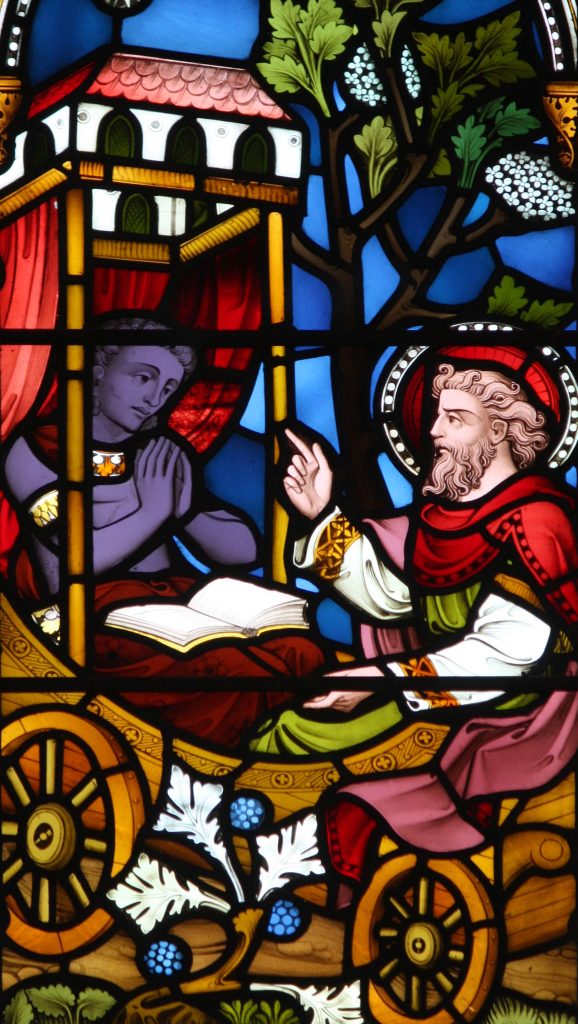
Source: Art in the Christian Tradition , a project of the Vanderbilt University Divinity Library, Nashville, TN. Original source: photograph taken by Father Lawrence Lew, O.P., available on Flickr
Stained glass is not just highly decorative, it’s a medium which has been used to express important religious messages for centuries. Literacy was not widespread in the medieval and Renaissance periods and the Church used stained glass and other artworks to teach the central beliefs of Christianity. In Gothic churches, the windows were filled with extensive narrative scenes in stained glass — like huge and colorful picture storybooks — in which worshipers could ‘read’ the stories of Christ and the saints and learn what was required for their religious salvation. (Source: Victoria and Albert Museum )
complete verse (Acts 8:34)
Following are a number of back-translations of Acts 8:34:
- Uma: “From there, the Ethiopia person said to Filipus: ‘Tell me who the prophet was aiming-at, whether his own self/body or another person.'” (Source: Uma Back Translation)
- Yakan: “Then the official said to Pilip, ‘Tell me. About whom is this prophet speaking? Is it about himself or about another person?'” (Source: Yakan Back Translation)
- Western Bukidnon Manobo: “And the official said to Philip, ‘Who perhaps is this inspired one of God talking about? Is it he himself or is it some other person?'” (Source: Western Bukidnon Manobo Back Translation)
- Kankanaey: “Upon his reading that, he said to Felipe, ‘Please tell who the prophet was talking-about. Was it himself or a different person?'” (Source: Kankanaey Back Translation)
- Tagbanwa: “When Felipe had climbed-aboard, that official of the king said, ‘Hopefully, if it’s all right with you, you will explain to me who this prophet meant by this. Was it himself of someone else?'” (Source: Tagbanwa Back Translation)
prophet
Eugene Nida wrote the following about the translation of the Hebrew, Aramaic, Ge’ez, and Greek terms that are typically translated with “prophet” in English:
“The tendency in many translations is to use ‘to foretell the future’ for ‘prophesy,’ and ‘one who foretells the future’ for ‘prophet.’ This is not always a recommended usage, particularly if such expressions denote certain special native practices of spirit contact and control. It is true, of course, that prophets of the Bible did foretell the future, but this was not always their principal function. One essential significance of the Greek word prophētēs is ‘one who speaks forth,’ principally, of course, as a forth-teller of the Divine will. A translation such as ‘spokesman for God’ may often be employed profitably.” (1947, p. 234f.)
Following is a list of (back-) translations from other languages (click or tap for details):
- San Blas Kuna: “one who speaks the voice of God”
- Central Pame and Vai: “interpreter for God”
- Kaqchikel, Navajo (Dinė), Yaka: “one who speaks for God”
- Northern Grebo: “God’s town crier” (see more about this below)
- Sapo: “God’s sent-word person”
- Shipibo-Conibo, Ngäbere: “one who speaks God’s word”
- Copainalá Zoque: “one who speaks-opens” (a compound meaning “one who discloses or reveals”)
- Sierra Totonac: “one who causes them to know” (in the sense of “revealer”)
- Batak Toba: “foreteller” (this and all the above acc. to Nida 1961, p. 7)
- Western Bukidnon Manobo: “one who is inspired of God” (Source: Western Bukidnon Manobo Back Translation)
- Alekano: “the true man who descended from heaven” (source: Ellis Deibler in Notes on Translation June 1986, p. 36ff.)
- Aguaruna: “teller of God’s word” (source: M. Larson / B. Moore in Notes on Translation February 1970, p. 1-125)
- Ekari: “person who speaks under divine impulse”
- Mandarin Chinese: 先知 xiānzhī — “one who foreknows” (or the 1946/1970 translation by Lü Zhenzhong: 神言人 shényánrén — “divine-word-man”)
- Uab Meto: “holy spokesman” (source for this and two above: Reiling / Swellengrebel)
- Kouya: Lagɔɔ gbʋgbanyɔ — “the one who seeks God’s affairs” (source: Saunders, p. 269)
- Kafa: “decide for God only” (source: Loren Bliese)
- Martu Wangka: “sit true to God’s talk” (source: Carl Gross)
- Eastern Highland Otomi: “word passer” (source: John Beekman in Notes on Translation November 1964, p. 1-22)
- Obolo: ebi nriran: “one with power of divine revelation” (source: Enene Enene)
- Mairasi: nonondoai nyan: “message proclaimer” (source: Enggavoter 2004)
- Highland Totonac: “speaker on God’s behalf”
- Central Tarahumara: “God’s preacher” (source for this and above: Waterhouse / Parrott in Notes on Translation October 1967, p. 1ff.)
- Coatlán Mixe: “God’s word-thrower”
- Ayutla Mixtec: “one who talks as God’s representative”
- Isthmus Mixe: “speaker for God” (source for this and two above: Viola Waterhouse in Notes on Translation August 1966, p. 86ff.)
- Mezquital Otomi / Paasaal: “God’s messenger” (source: Waterhouse / Parrott in Notes on Translation October 1967, p. 1ff. and Fabian N. Dapila in The Bible Translator 2024, p. 415ff.)
- Noongar: Warda Marridjiny or “News Traveling” (source: Warda-Kwabba Luke-Ang)
- Kutu: mtula ndagu or “one who gives the prediction of the past and the future” (Source: Pioneer Bible Translators, project-specific translation notes in Paratext)
- Ebira: ọnịsẹ, a neologism that combines the prefix ọn for “a person” with ịsẹ for “prediction” (source: Scholz /Scholz 2015, p. 49)
- French 1985 translation by Chouraqui: inspiré or “inspired one” (“someone in whom God has breathed [Latin: in + spiro]) (source: Watson 2023, p. 45)
- Cherokee: adolehosgi (ᎠᏙᎴᎰᏍᎩ) or “discoverer of things,” a “term that was was traditionally applied to Cherokee medicine men or women who used divining.” (Source: Bender / Belt 2025, p. 49)
In Ixcatlán Mazatec a term is used that specifically includes women. (Source: Robert Bascom)
About the translation into Northern Grebo:
“In some instances these spiritual terms result from adaptations reflecting the native life and culture. Among the Northern Grebo people of Liberia, a missionary wanted some adequate term for ‘prophet,’ and she was fully aware that the native word for ‘soothsayer’ or ‘diviner’ was no equivalent for the Biblical prophet who spoke forth for God. Of course, much of what the prophets said referred to the future, and though this was an essential part of much of their ministry, it was by no means all. The right word for the Gbeapo people would have to include something which would not only mean the foretelling of important events but the proclamation of truth as God’s representative among the people. At last the right word came; it was ‘God’s town-crier.’ Every morning and evening the official representative of the chief goes through the village crying out the news, delivering the orders of the chief, and announcing important coming events. ‘God’s town-crier’ would be the official representative of God, announcing to the people God’s doings, His commands, and His pronouncements for their salvation and well-being. For the Northern Grebo people the prophet is no weird person from forgotten times; he is as real as the human, moving message of the plowman Amos, who became God’s town-crier to a calloused people.” (source: Nida 1952, p. 20)
In American Sign Language it is a person who sees into the future:
“Prophet” in American Sign Language (source )
In British Sign Language it is is translated with a sign that depicts a message coming from God to a person (the upright finger) and then being passed on to others. (Source: Anna Smith)
“Prophet” in British Sign Language (source: Christian BSL, used with permission)
See also prophesy and prophesy / prophetic frenzy.
Learn more on Bible Odyssey: How to Recognize a Biblical Prophet .
See also seer.
One Can't Do it Alone (Acts 8:26-40)

Illustration by Horst Lemke (1922-1985) for the German Gute Nachricht für Sie – NT68, one of the first editions of the Good News Bible in German of 1968. Lemke was a well-known illustrator who illustrated books by Erich Kästner , Astrid Lindgren and many others.
Translation commentary on Acts 8:34
The supplementary question, Of himself or of someone else?, must frequently be filled out, for the ellipsis which is perfectly appropriate in English may not be satisfactory in other languages. Therefore, one may translate: “Was he talking about himself or was he talking about someone else?”
Quoted with permission from Newman, Barclay M. and Nida, Eugene A. A Handbook on The Acts of the Apostles. (UBS Handbook Series). New York: UBS, 1972. For this and other handbooks for translators see here .
Leave a Reply
You must be logged in to post a comment.