
amazed / astonished / marvel

The Greek that is translated as “astonished” or “amazed” or “marvel” in English is translated in Pwo Karen as “stand up very tall.” (In John 5:20, source: David Clark)

Elsewhere it is translated as “confusing the inside of the head” (Mende), “shiver in the liver” (Uduk, Laka), “to lose one’s heart” (Mískito, Tzotzil), “to shake” (Southern Bobo Madaré), “to be with mouth open” (Panao Huánuco Quechua) (source: Bratcher / Nida), “to stand with your mouth open” (Citak) (source: Stringer 2007, p. 120), “ceasing to think with the heart” (Bulu), “surprise in the heart” (Yamba) (source for this and one above: W. Reyburn in The Bible Translator 1959, p. 1ff. ), or “have one’s mouth full” (Maan (source: Don Slager).

In Mark 5:20 and elsewhere where the astonishment is a response to listening to Jesus, the translation is “listen quietly” in Central Tarahumara, “forget listening” (because they were so absorbed in what they heard that they forgot everything else) in San Miguel El Grande Mixtec, “it was considered very strange by them” in Tzeltal (source: Bratcher / Nida), “in glad amazement” (to distinguish it from other kinds of amazement) (Quetzaltepec Mixe) (source: Robert Bascom), or “breath evaporated (or “escaped”)” (Mairasi) (source: Enngavoter 2004).

In Western Dani astonishment is emphasized with direct speech. In Mark 1:22, for instance, it says: “Wi!” yinuk, pi wareegwaarak — “They were all amazed, saying ‘Oh'” (source: Lourens De Vries in The Bible Translator 1992, p. 333ff. )

In Low German it is translated as grote Oken maken or “make big eyes” (sometime followed by: un kreegn dat Stillswiegen: “and became silent”) (translation by Johannes Jessen, publ. 1933, republ. 2006).

In the Kölsch translation (Boch 2017) it is translated as brummte de Lück de Kopp or “the heads of the people buzzed,” Bauklötz jestaunt, lit. “marvel toy blocks,” and vür Staune de Muhl nit mieh zojekräch or “so full of marvel that they couldn’t close their mouths again.”

In the Pfälzisch translation by Walter Sauer (publ. 2012) it is often translated as baff vor staune or “speechless because of their marvel.” (Source: Jost Zetzsche)

See also amazed and astonished, astonished (Mark 6:51), and I’m astonished.

angel

The Greek, Hebrew, Ge’ez, and Aramaic that is translated as “angel” in English versions is translated in many ways:

  • Pintupi-Luritja: ngaṉka ngurrara: “one who belongs in the sky” (source: Ken Hansen quoted in Steven 1984a, p. 116.)
  • Tetela, Kpelle, Balinese, and Mandarin Chinese: “heavenly messenger”
  • Shilluk / Igede: “spirit messenger”
  • Mashco Piro: “messenger of God”
  • Batak Toba: “envoy, messenger”
  • Navajo (Dinė): “holy servant” (source for this and above: Bratcher / Nida 1961; Igede: Andy Warren-Rothlin)
  • Central Mazahua: “God’s worker” (source: Ronald D. Olson in Notes on Translation January, 1968, p. 15ff.)
  • Saramaccan: basia u Masa Gaangadu köndë or “messenger from God’s country” (source: Jabini 2015, p. 86)
  • Mairasi: atatnyev nyaa or “sent-one” (source: Enggavoter 2004)
  • Shipibo-Conibo: “word bringer” (source: James Lauriault in The Bible Translator 1951, p. 32ff. )
  • Apali: “God’s one with talk from the head” (“basically God’s messenger since head refers to any leader’s talk”) (source: Martha Wade)
  • Michoacán Nahuatl: “clean helper of God” (source: B. Moore / G. Turner in Notes on Translation 1967, p. 1ff.)
  • Noongar: Hdjin-djin-kwabba or “spirit good” (source: Warda-Kwabba Luke-Ang)
  • Wè Northern (Wɛɛ): Kea ‘a “sooa or “the Lord’s soldier” (also: “God’s soldier” or “his soldier”) (source: Drew Maust)
  • Iwaidja: “a man sent with a message” (Sam Freney explains the genesis of this term [in this article ): “For example, in Darwin last year, as we were working on a new translation of Luke 2:6–12 in Iwaidja, a Northern Territory language, the translators had written ‘angel’ as ‘a man with eagle wings’. Even before getting to the question of whether this was an accurate term (or one that imported some other information in), the word for ‘eagle’ started getting discussed. One of the translators had her teenage granddaughter with her, and this word didn’t mean anything to her at all. She’d never heard of it, as it was an archaic term that younger people didn’t use anymore. They ended up changing the translation of ‘angel’ to something like ‘a man sent with a message’, which is both more accurate and clear.”)

Like a number of other East Asian languages, Japanese uses a complex system of honorifics, i.e. a system where a number of different levels of politeness are expressed in language via words, word forms or grammatical constructs. These can range from addressing someone or referring to someone with contempt (very informal) to expressing the highest level of reference (as used in addressing or referring to God) or any number of levels in-between. One way to do this is through the usage (or a lack) of an honorific prefix as shown here in the widely-used Japanese Shinkaiyaku (新改訳) Bible of 2017. When the referent is God, the “divine” honorific prefix mi- (御 or み) is used as in mi-tsukai (御使い) or “messenger (of God).” (Source: S. E. Doi, see also S. E. Doi in Journal of Translation, 18/2022, p. 37ff. )

See also angel (Acts 12:15) and this devotion on YouVersion .
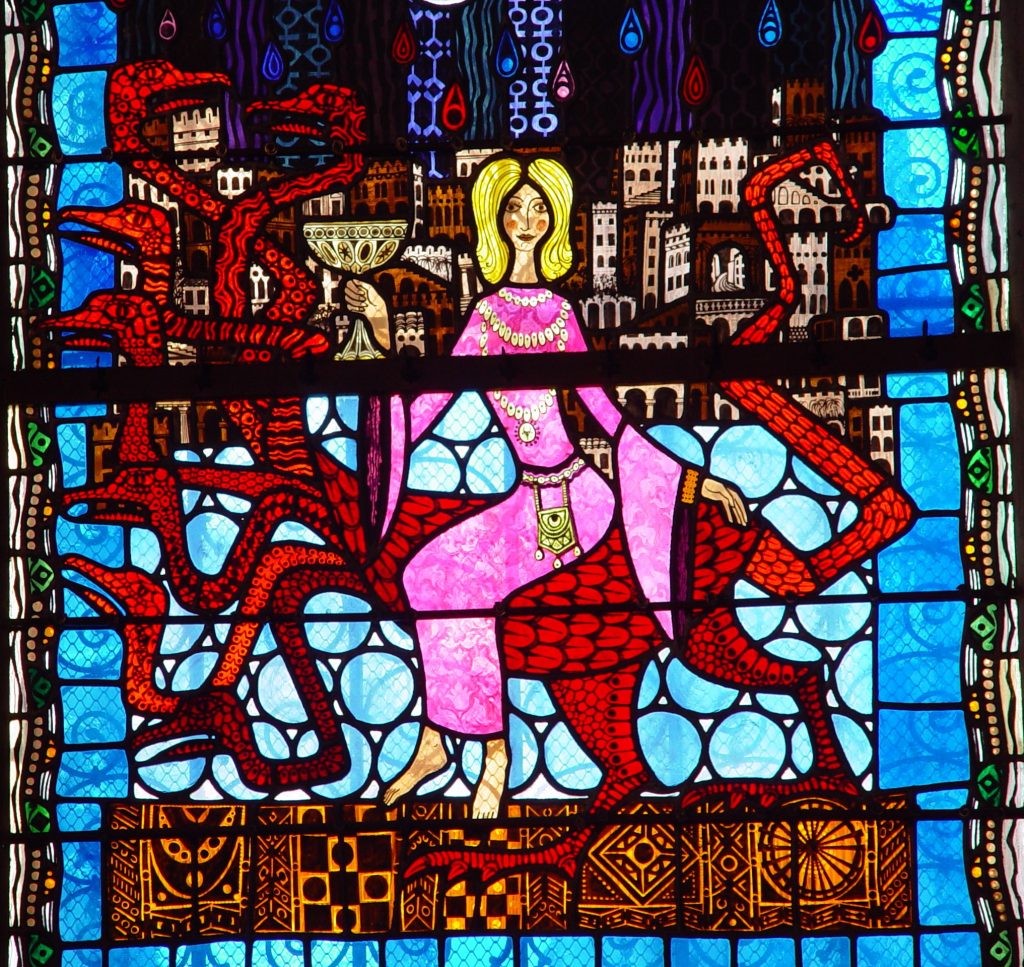
complete verse (Revelation 17:7)

Following are a number of back-translations of Revelation 17:7:

  • Uma: “After that, the angel who took me said to me: ‘Why are you (sing.) so surprised? Apparently you (sing.) do not yet understand the meaning of that woman and the animal she rides. In that case, I will make clear to you (sing.) its meaning. That animal has seven heads and ten horns.” (Source: Uma Back Translation)
  • Yakan: “‘Why are you wondering,’ said the angel. ‘I will tell you now what the meaning of that woman is and the meaning of the creature she is riding on, the one that has seven heads and ten horns.” (Source: Yakan Back Translation)
  • Western Bukidnon Manobo: “However, the angel said to me, ‘Why are you amazed? I will explain to you the secret meaning of that woman and of that beast with seven heads and ten horns that the woman rides on.” (Source: Western Bukidnon Manobo Back Translation)
  • Kankanaey: “but the angel said to me, ‘Why are you (sing.) amazed? I will tell you (sing.) the meaning of that woman and the fearsome animal upon-which-she-is-riding which has seven heads and ten horns.” (Source: Kankanaey Back Translation)
  • Tagbanwa: “But I was questioned by that angel, saying, ‘Why are you amazed? Now I will explain to you the meaning of that woman and that monster she is riding which has seven heads branching out and ten horns.” (Source: Tagbanwa Back Translation)
  • Tenango Otomi: “The angel said to me: ‘How come you are surprised? I will tell you the meaning of what you saw, in regard to the woman who sits on the terrible animal, this one who has seven heads and ten horns.” (Source: Tenango Otomi Back Translation)

Translation commentary on Revelation 17:7

Why marvel?: “Why are you surprised (or, astonished)?” The question implies that John should have understood what he was seeing. It prepares the way for the explanation that follows. Marvel is expressed idiomatically in many languages; for example, “shiver in the heart (or, liver),” “be with mouth open,” or “feel strange in the heart.”

I will tell you the mystery: for the first time in the book, an angel interpreter appears. “I will explain the mystery to you,” “I will reveal to you the secret meaning.”

Quoted with permission from Bratcher, Robert G. and Hatton, Howard A. A Handbook on The Revelation to John. (UBS Handbook Series). New York: UBS, 1993. For this and other handbooks for translators see here .

SIL Translator’s Notes on Revelation 17:7

17:7a

“Why are you so amazed?”: This is a rhetorical question. It emphasizes that John did not need to be surprised at seeing the woman. The rhetorical question may also be a slight rebuke. Translate this clause in a way that emphasizes that John did not need to be surprised. Some ways are:

Use a rhetorical question. For example:

Why are you surprised? (God’s Word)
-or-
How is it that you are so amazed?

Use a statement. For example:

You should not be surprised.

17:7b

I will tell you the mystery of the woman: The word mystery indicates that the angel would reveal something to John. He told John the secret meaning of the symbol of the prostitute. See how you translated the word mystery in 17:5, where the Berean Standard Bible translates it as “mysterious.” You may want to translate it the same way here. For example:

I will interpret for you the mystery of the woman (NET Bible)
-or-
I will tell you the secret of this woman (New Century Version)
-or-
I will tell you the secret meaning of the woman (Good News Translation)

17:7c

and of the beast that carries her: The angel would also explain the mystery of the beast. This implies that the beast also had a secret or hidden meaning.

carries: Here the word carries refers to the woman sitting on the back of the beast.

which has the seven heads and ten horns: The information from 17:3d is repeated here in order to make clear which beast was meant.

© 2020 by SIL International®
Made available under the terms of a Creative Commons Attribution-ShareAlike 4.0 License (CC BY-SA) creativecommons.org/licenses/by-sa/4.0.
All Scripture quotations in this publication, unless otherwise indicated, are from The Holy Bible, Berean Standard Bible.
BSB is produced in cooperation with Bible Hub, Discovery Bible, OpenBible.com, and the Berean Bible Translation Committee.