2with whom the kings of the earth have engaged in sexual immorality and with the wine of whose prostitution the inhabitants of the earth have become drunk.”
The Greek and Ge’ez that is translated as “sexual immorality” or “fornication” or similar is translated much more specifically in some languages. Morelos Nahuatl has “let a man not yield himself to another woman except only to his wife. Also let a woman not yield herself to another man except only to her husband” or in Lalana Chinantec as “not proper for them to mix themselves with other women. The same is true of women for other men also.” (Source: Viola Waterhouse in Notes on Translation August 1966, p. 86ff.)
In Low German as Hurenkram or “things related to prostitution (and/or sleeping around)” (translation by Johannes Jessen, publ. 1933, republ. 2006) and in the German New Testament translation by Berger / Nord (publ. 1999) typically as Sexgier or “sex cravings” (exceptions: Acts 15:10 and 15:29).
The Hebrew, Aramaic, Ge’ez, and Greek that are translated as “wine” in English is translated into Pass Valley Yali as “grape juice pressed long ago (= fermented)” or “strong water” (source: Daud Soesilo). In Guhu-Samane it is also translated as “strong water” (source: Ernest L. Richert in The Bible Translator 1965, p. 198ff. ), in Noongar as “liquor” (verbatim: “strong water”) (source: Warda-Kwabba Luke-Ang), in Hausa as ruwan inabi or “water of grapes” (with no indication whether it’s alcoholic or not — source: Mark A. Gaddis), in sar as kasə nduú or “grape drink” (source: Andy Warren-Rothlin), or in Papantla Totonac and Coyutla Totonac as “a drink like Pulque” (for “Pulque,” see here ) (source: Jacob Loewen in The Bible Translator 1971, p. 169ff. ).
In Swahili, Bible translations try to avoid local words for alcoholic drinks, because “drinking of any alcohol at all was one of the sins most denounced by early missionaries. Hence translators are uncomfortable by the occurrences of wine in the Bible. Some of the established churches which use wine prefer to see church wine as holy, and would not refer to it by the local names used for alcoholic drinks. Instead church wine is often referred to by terms borrowed from other languages, divai (from German, der Wein) or vini/mvinyo (from ltalian/Latin vino/vinum). Several translations done by Protestants have adapted the Swahili divai for ‘wine,’ while those done by Catholics use vini or mvinyo.” (Source: Rachel Konyoro in The Bible Translator 1985, p. 221ff. )
The Swahili divai was in turn borrowed by Sabaot and was turned into tifaayiik and is used as such in the Bible. Kupsabiny, on the other hand, borrowed mvinyo from Swahili and turned it into Finyonik. (Source: Iver Larsen)
In Nyamwezi, two terms are used. Malwa ga muzabibu is a kind of alcohol that people specifically use to get drunk (such as in Genesis 9:21) and ki’neneko is used for a wine made from grapes (source: Pioneer Bible Translators, project-specific translation notes in Paratext).
In some Hindi translations (such as the Common Language version, publ. 2015 ), one term (dākharasa दाखरस — grape juice) is used when that particular drink is in the focus (such as in John 2) and another term (madirā मदिरा — “alcohol” or “liquor”) when drunkenness is in the focus (such as in Eph. 5:18).
In Mandarin Chinese, the generic term jiǔ (酒) or “alcohol(ic drink)” is typically used. Exceptions are Leviticus 10:9, Numbers 6:3, Deuteronomy 29:6, Judges 13:4 et al., 1 Samuel 1:15, and Luke 1:15 where a differentiation between weak and strong alcohol is needed. The Mandarin Chinese Union Version (2010) translates that as qīngjiǔ lièjiǔ (清酒烈酒) and dànjiǔ lièjiǔ (淡酒烈酒), both in the form of a Chinese proverb and meaning “light alcohol and strong drink.” (Source: Zetzsche)
Click or tap here to see a short video clip about wine in biblical times (source: Bible Lands 2012)
Following are a number of back-translations of Revelation 17:2:
Uma: “The kings of the world do [sexual] wrong with her, and she makes all the people who live in the world drink a drink that is intoxicating, its meaning: she encourages them to follow her deeds that are not fitting.'” (Source: Uma Back Translation)
Yakan: “The leaders in the world have practised illicit sex with this famous bad woman. And all the people in the world have been influenced also by her doings, figuratively like people caused to be drunk by grape juice who are no longer ashamed to do bad.'” (Source: Yakan Back Translation)
Western Bukidnon Manobo: “The kings of the earth have had sexual relations with her. And her wine, which is to say, her worship of idols has made the people on the earth drunk.'” (Source: Western Bukidnon Manobo Back Translation)
Kankanaey: “Those who rule on the earth, they have slept-with her, and even also the people on the earth, it’s as if they are drunk with her alcoholic-beverage which is her filthy behavior that they have followed.'” (Source: Kankanaey Back Translation)
Tagbanwa: “Really the kings and the people here under the heavens have become very much involved in this disgusting habit of hers.'” (Source: Tagbanwa Back Translation)
Tenango Otomi: “The rulers who live all over the world all have committed fornication with this woman. The people all over the world have been made drunk by drinking the liquor of fornication,’ he told me.” (Source: Tenango Otomi Back Translation)
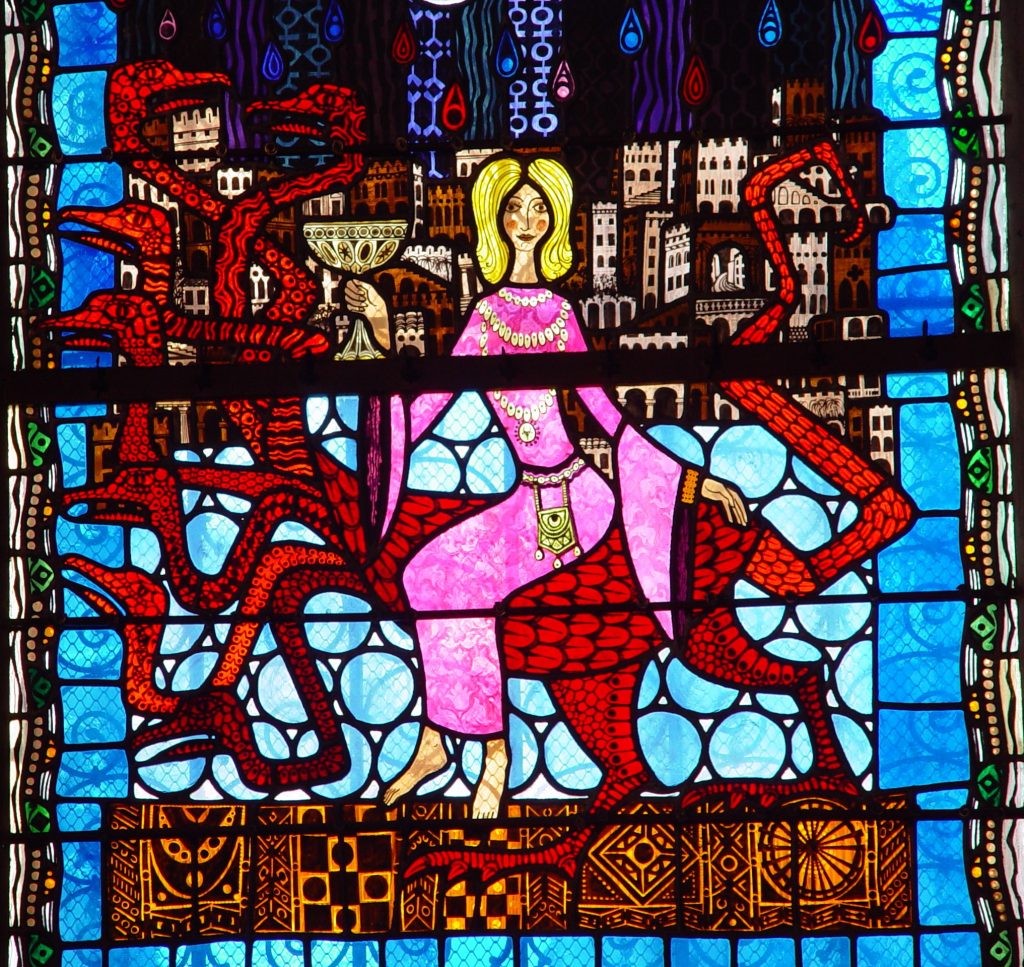
The following is a stained glass window by William Wailes from the Cathédrale Notre-Dame in Clermont-Ferrand, France:
Source: Art in the Christian Tradition , a project of the Vanderbilt University Divinity Library, Nashville, TN. Original source: image donated by Jim Womack and Anne Richardson
Stained glass is not just highly decorative, it’s a medium which has been used to express important religious messages for centuries. Literacy was not widespread in the medieval and Renaissance periods and the Church used stained glass and other artworks to teach the central beliefs of Christianity. In Gothic churches, the windows were filled with extensive narrative scenes in stained glass — like huge and colorful picture storybooks — in which worshipers could ‘read’ the stories of Christ and the saints and learn what was required for their religious salvation. (Source: Victoria and Albert Museum )
Some languages do not have a concept of kingship and therefore no immediate equivalent for the Greek, Hebrew, Ge’ez, Aramaic, and Latin that is translated as “king” in English. Here are some (back-) translations:
Ninia Yali: “big brother with the uplifted name” (source: Daud Soesilio in Noss 2007, p. 175)
Nyamwezi: mutemi: generic word for ruler, by specifying the city or nation it becomes clear what kind of ruler (source: Pioneer Bible Translators, project-specific translation notes in Paratext)
Ghomála’: Fo (“The word Fo refers to the paramount ruler in the kingdoms of West Cameroon. He holds administrative, political, and religious power over his own people, who are divided into two categories: princes (descendants of royalty) and servants (everyone else).” (Source: Michel Kenmogne in Theologizing in Context: An Example from the Study of a Ghomala’ Christian Hymn))
Faye Edgerton retells how the term in Navajo (Dinė) was determined:
“[This term was] easily expressed in the language of Biblical culture, which had kings and noblemen with their brilliant trappings and their position of honor and praise. But leadership among the Navajos is not accompanied by any such titles or distinctions of dress. Those most respected, especially in earlier days, were their headmen, who were the leaders in raids, and the shaman, who was able to serve the people by appealing for them to the gods, or by exorcising evil spirits. Neither of these made any outward show. Neither held his position by political intrigue or heredity. If the headman failed consistently in raids, he was superceded by a better warrior. If the shaman failed many times in his healing ceremonies, it was considered that he was making mistakes in the chants, or had lost favor with the gods, and another was sought. The term Navajos use for headman is derived from a verb meaning ‘to move the head from side to side as in making an oration.’ The headman must be a good orator, able to move the people to go to war, or to follow him in any important decision. This word is naat’áanii which now means ‘one who rules or bosses.’ It is employed now for a foreman or boss of any kind of labor, as well as for the chairman of the tribal council. So in order to show that the king is not just a common boss but the highest ruler, the word ‘aláahgo, which expresses the superlative degree, was put before naat’áanii, and so ‘aláahgo naat’áanii ‘anyone-more-than-being around-he-moves-his-head-the-one-who’ means ‘the highest ruler.’ Naat’áanii was used for governor as the context usually shows that the person was a ruler of a country or associated with kings.”
Revised Standard Version follows the form of the Greek text and continues the sentence to the end of verse 2. It is better in most instances to put a full stop at the end of verse 1 and begin a new sentence at verse 2, as Good News Translation has done.
With whom the kings of the earth have committed fornication: in English fornication (as contrasted with adultery) implies that the woman is unmarried. Something like “sexual immorality,” “immoral sexual intercourse,” or even “filthy sexual practices” will be more suitable for this context. For the verb see “practice immorality,” 2.14. This is a figure of idolatry, as elsewhere in the book. An alternative translation model for this sentence is “The kings (or, high chiefs) of the world committed evil (or, filthy) sexual practices with her.”
With the wine of whose fornication: here the sexual immorality of the infamous prostitute is called wine, and the effect of her immorality (idolatry) on her partners is called drunkenness. In some languages it may be advisable not to follow literally the Greek text. A translator may follow the point of view of one commentator, that the wine was the prostitute’s way of seducing her partners: “the people of the world got drunk on the wine she gave them and had sexual intercourse with her.” For the noun translated fornication see “immorality” and comments at 2.21; 14.8.
The dwellers on earth: see 3.10.
Have become drunk: the term occurs also in 17.6. Most languages have a number of words to describe drunkenness, but few will match the English language. One word collector (Paul Dickson) turned up 2,231 words and phrases for “drunk.” However, the metaphor here refers to drunkenness from drinking wine. So translators should pick a word or phrase that means that type of drunkenness.
Quoted with permission from Bratcher, Robert G. and Hatton, Howard A. A Handbook on The Revelation to John. (UBS Handbook Series). New York: UBS, 1993. For this and other handbooks for translators see here .
The kings of the earth were immoral with her: The Greek phrase that the Berean Standard Bible translates as with her is literally “with whom” (as in the Revised Standard Version), connecting to “the great prostitute” in 17:1. It is emphasized in the Greek by putting it at the beginning of the sentence. For example:
With her the kings of the earth committed adultery (New International Version (2011))
Some languages must put the phrase with her after the verb, as the Berean Standard Bible does.
The kings of the earth: This phrase refers to the leaders of nations around the world.
were immoral: The Greek word that the Berean Standard Bible translates as were immoral refers generally to having sexual relations with someone who is not one’s spouse. It refers to both married and unmarried people.
In your culture, you may use a euphemism for this Greek word. For example:
slept with women who was not their spouses -or-
did wrong with women who were not their wives
The word or phrase you use should be acceptable for reading aloud in public. See how you translated this phrase in 2:14 (“commit sexual immorality”).
This metaphor refers to the shameful deeds and greed of these kings. They were happy to be seduced by this woman. She lured them through offers of riches and power.
In some languages a literal translation would not indicate the figurative meaning of were immoral. If that is true in your language, you may want to:
• Translate the meaning without the figure of speech. For example:
The kings of the earth did shameful things/deeds with ⌊the people of⌋ this city
• Explain its figurative meaning in a footnote. For example:
This word/phrase indicates that the kings joined with the people of this city and did shameful things/deeds in the same way that someone commits adultery with a prostitute.
17:2b
those who dwell on the earth were intoxicated with the wine of her immorality: This clause symbolically indicates that the woman’s activities caused people to lose self-control and right thinking, just as wine does.
In some languages it is more natural to translate this clause with her immorality as the subject. You may compare them to wine in a simile. For example:
Her adulteries, like wine, made the people of the earth drunk
It is also possible to leave the wine implicit, because it is implied by the word intoxicated. For example:
Her immoral ways have intoxicated the earth’s inhabitants
were intoxicated: This phrase refers to being drunk, in this case from wine. A person who drinks too much wine is unable to think, speak, or act normally. Use the word or phrase that is natural in your language to describe being intoxicated.
the wine of her immorality: This phrase compares the woman’s immorality to wine. This is a figure of speech referring to the idolatry and excessive pleasures of the great city. Another way to translate this is:
her immoral ways, just like wine
wine: Wine is an alcoholic beverage made from the juice of grapes. In some languages people are not familiar with wine. If that is true in your language, you may want to:
• Explain the meaning in your translation. For example:
alcoholic grape juice/drink
• Use the word for the common alcoholic beverage in your area. You may then want a footnote to explain the literal word. You may have to use the major language word for wine. For example:
Literally: “wine.”
See how you translated this word in 14:8 or 16:19.
General Comment on 17:2b
17:2b uses the metaphor of being drunk with wine to refer to a state of spiritual folly. The people worshiped the false gods of Babylon and shared in her excessive luxury. This caused them to become incapable of understanding spiritual things, which is like being drunk. In some languages a literal translation would not indicate the correct figurative meaning. If that is true in your language, you may want to:
• Translate literally and explain its meaning in a footnote. For example:
The phrase “intoxicated with the wine of her immorality” indicates that people participated in idolatry and excessive luxuries with the evil city. That caused them to become spiritually foolish.
• Explain its meaning in your translation. For example:
and the inhabitants of the earth became ⌊spiritually like a⌋ drunk person from sharing in her idolatry and her excessive luxuries

Leave a Reply
You must be logged in to post a comment.