
The Greek that is translated as “buying” and “selling” in English is both translated in Ulithian as “exchange.” Stephen Hre Kio (in The Bible Translator 1987, p. 246f. ) explains: “There are buyers and sellers in the Temple whom Jesus drove away. But Ulithians do not buy or sell; they only exchange. And so we have ‘exchange’ for both buying and selling.”
In righteous anger he attacked hypocrisy (image)

“Jesus is doing something extremely dangerous here. The Thai temple is a place in which it is considered by religious people inappropriate to show any anger or strong emotions. It has to be an extremely urgent reason for someone to do something as violent as this in such a sacred space.”
Drawing by Sawai Chinnawong who employs northern and central Thailand’s popular distinctive artistic style originally used to depict Buddhist moral principles and other religious themes; explanation by Paul DeNeui. From That Man Who Came to Save Us by Sawai Chinnawong and Paul H. DeNeui, William Carey Library, 2010.
For more images by Sawai Chinnawong in TIPs see here.
sell
The Hebrew and Greek that is translated as “sell” in English is translated in Noongar as wort-bangal or “away-barter.” Note that “buy” is translated as bangal-barranga or “get-barter.” (Source: Bardip Ruth-Ang 2020)
See also buy and buying / selling.
Jesus Drives Out the Merchants
Following is a 1973 painting of the JESUS MAFA project, a response to New Testament readings from the Lectionary by a Christian community in Cameroon, Africa. Each of the readings was selected and adapted to dramatic interpretation by the community members. Photographs of their interpretations were made, and these were then transcribed to paintings:
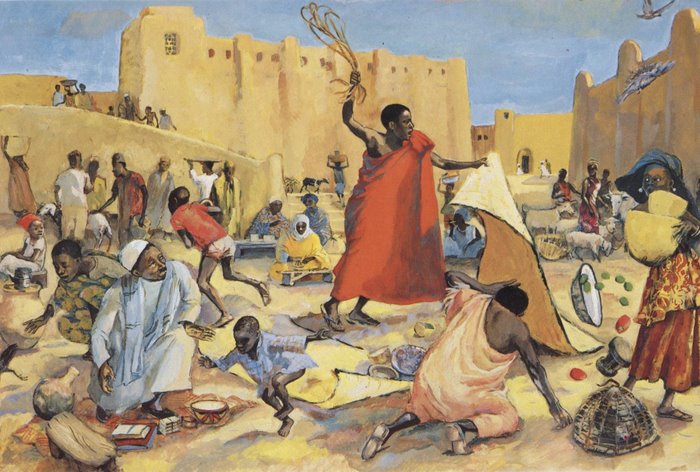
From Art in the Christian Tradition , a project of the Vanderbilt Divinity Library, Nashville, TN. Image retrieved March 23, 2026. Original source: librairie-emmanuel.fr.
synagogue, temple (inner), temple (outer)
In many English translations the Greek terms “hieron” (the whole “temple” in Jerusalem or specifically the outer courts open to worshippers) and “naos” (the inner “shrine” or “sanctuary”) are translated with only one word: “temple” (see also for instance “Tempel” in German [for exception see below] and “tempel” in Dutch, Danish, or Afrikaans).
Other languages make a distinction: (Click or tap here to see more)
- Navajo (Dinė): “house in which worship is carried out” (for naos)
- Balinese: “inner part of the Great Temple” (“the term ‘inner part’ denoting the hindmost and holiest of the two or three courts that temples on Bali usually possess”) vs. “Great Temple”
- Telugu: “womb (i.e. interior)-of-the-abode” vs. “abode”
- Thai: a term denoting the main audience hall of a Buddhist temple compound vs. “environs-of-the-main-audience-hall”
- Kituba: “place of holiness of house-God Lord” vs. “house-God Lord”
- Shipibo-Conibo: “deep in God’s house” vs. “God’s house” (source: Reiling / Swellengrebel)
- German das Buch translation by Roland Werner (publ. 2009-2022): “inner court of the temple” (Tempelinnenhof) vs. “temple”
Languages that, like English, German, Dutch, Danish, or Afrikaans, don’t make that distinction include:
- Mandarin Chinese: “聖殿 Shèng diàn” (“holy palace”)
- Loma: “the holy place”
- Pular: “the sacred house” (source for this and the one above: Bratcher / Nida)
- Zarma: “God’s compound”
- Eastern Highland Otomi: “big church of the Jews”
- Yatzachi Zapotec: “big house on top (i.e. most important)”
- Toraja-Sa’dan: “house that is looked upon as holy, that is sacred, that is taboo and where one may not set foot” (lit. “house where-the-belly-gets-swollen” — because taboo is violated — using a term that is also applied to a Muslim mosque) (source for this and the three above: Reiling / Swellengrebel)
- Mairasi: Janav Enggwarjer Weso: “Great Above One’s (God’s) House” (source: Enggavoter 2004)
- Noongar: Maya-maya-Kooranyi: “Sacred House” (source: Warda-Kwabba Luke-Ang)
- Huehuetla Tepehua: “the big church of the Israelites”
- Aguaruna: “the house for talking to God” (source for this and above: M. Larson / B. Moore in Notes on Translation February 1970, p. 1-125.)
- Guhu-Samane: “festival longhouse of God” (“The biiri, ‘festival longhouse’, being the religious and social center of the community, is a possible term for ‘temple’. It is not the ‘poro house’ as such. That would be too closely identified with the cult of poro. The physical features of the building, huge and sub-divided, lend it further favor for this consideration. By qualifying it as ‘God’s biiri’ the term has become meaningful and appropriate in the context of the Scriptures.”) (Source: Ernest Richert in The Bible Translator, 1965, p. 81ff. )
- Enga: “God’s restricted access house” (source: Adam Boyd on his blog )
Another distinction that tends to be overlooked in translations is that between hieron (“temple” in English) and sunagógé (“synagogue” in English). Euan Fry (in The Bible Translator 1987, p. 213ff. ) reports on this:
“Many older translations have simply used transliterations of ‘temple’ and ‘synagogue’ rather than trying to find equivalent terms or meaningful expressions in their own languages. This approach does keep the two terms separate; but it makes the readers depend on explanations given by pastors or teachers for their understanding of the text.
“Translators who have tried to find meaningful equivalents, for the two terms ‘temple’ and ‘synagogue’ have usually made a distinction between them in one of two ways (which focus on the contrasting components of meaning). One way takes the size and importance of the Temple to make a contrast, so that expressions such as ‘sacred meeting/ worship house of the Jews’ and ‘big sacred meeting/worship house of the Jews’ are used. The other way focuses on the different nature of the religious activity at each of the places, so that expressions such as ‘meeting/worship house of the Jews’ and ‘sacrifice/ceremony place of the Jews’ are used.
“It is not my purpose in this article to discuss how to arrive at the most precise equivalent to cover all the components of meaning of ‘temple’. That is something that each translator really has to work through for himself in the light of the present usage and possibilities in his own language. My chief concern here is that the basic term or terms chosen for ‘temple’ should give the reader of a translation a clear and correct picture of the location referred to in each passage. And I am afraid that in many cases where an equivalent like ‘house of God’ or ‘worship house’ has been chosen, the readers have quite the wrong picture of what going to the Temple or being in the Temple means. (This may be the case for the word ‘temple’ in English too, for many readers.)”
Here are some examples:
- Bambara: “house of God” (or: “big house of worship”) vs. “worship house” (or: “small houses of worship”)
- Toraja-Sa’dan: “house where-the-belly-gets-swollen” (see above) vs. “meeting house for discussing matters concerning religious customs” (and “church” is “house where one meets on Sunday”)
- Navajo (Dinė): “house in which worship is carried out” vs. “house of gathering” (source for all above: Bratcher / Nida)
Bangandu: “the great house of God” vs. “house of prayer” (Source: Ervais Fotso Noumsi in Le Sycomore, 16/1, 2022 )
Click or tap here to see a short video clip about Herod’s temple (source: Bible Lands 2012)
Click or tap here to see a short video clip showing synagogues in New Testament times (source: Bible Lands 2012)
See also this devotion on YouVersion .
complete verse (Matthew 21:12)
Following are a number of back-translations of Matthew 21:12:
- Uma: “After that, Yesus entered into the yard of the House of God, and he expelled [caused-to-leave] all the people who were selling there. He tipped over the tables where they exchanged money, and also tipped over the seats of the pigeon sellers.” (Source: Uma Back Translation)
- Yakan: “So-then Isa entered the great prayer-house and he chased out all the people who traded/sold and those who bought in the house of God. He overturned the tables of the people who changed money. He also overturned the seats of the people who sold pigeons for sacrifices.” (Source: Yakan Back Translation)
- Western Bukidnon Manobo: “And Jesus went into the House of God, and he drove out the cheating people there who were buying and selling. He tipped over the tables of the people who exchanged money and the seats of those who were selling doves.” (Source: Western Bukidnon Manobo Back Translation)
- Kankanaey: “Then Jesus entered the Temple and he drove-out the sellers and buyers of things-for-sacrifice to God. He also tipped-over the tables of the money changers and the seats of the sellers of doves/pigeons,” (Source: Kankanaey Back Translation)
- Tagbanwa: “Jesus entered the Templo. He drove out the sellers and buyers there in its like-a-yard. And he turned over the tables of the money exchangers and the seats of the sellers of doves.” (Source: Tagbanwa Back Translation)
- Tenango Otomi: “Jesus went to the church of God. All the people who sold there in the church yard and those who bought, he ejected. He turned over the tables of the people who changed the money of people who came from far away. He also turned over the stools of those who sold pigeons.” (Source: Tenango Otomi Back Translation)
dove / pigeon
The Hebrew, Latin and Greek that is translated as “dove” or “pigeon” in English is translated in Pijin with the onomatopoeia kurrukurru. (Source: Bob Carter)
In Matumbi is is translated as ngunda, a kind of dove that has the reputation to be monogamous. (Source: Pioneer Bible Translators, project-specific notes in Paratext)
In the fifteenth century the English word “pigeon” meant a young dove, the word “dove” being reserved for the adult birds. In modern English the words are used almost interchangeably. As a general rule, “pigeon” is used for domesticated forms of these birds, and for the larger variety of wild forms, while “dove” is used mainly for wild varieties. However, there are many exceptions to this general rule.
Pigeons and doves are both included in a bird family known scientifically as the Colombidae, consisting of well over two hundred species. In Israel and the Middle East are found the true Colombidae, which are easily distinguished from the genus Stretopelia, that is, the turtle doves.
The most common of the true Colombidae in the Middle East is most certainly the Asiatic Rock Dove Columba livia. This bird was first domesticated around 4500 B.C. in Mesopotamia. By 2500 B.C. it was kept as a domestic bird in Egypt, and by 1200 B.C. there is evidence that its homing abilities were already well known. It is this bird that is the ancestor of the domestic homing pigeons that people keep, some of which have escaped, returned to the wild, and now populate city streets all over the world. The ledges of modern buildings are a good substitute for the rock ledges that were its original nesting sites. It is likely that the Canaanites and the Israelites also kept these birds for both food and sacrifice. It is this bird that is called yonah in the Hebrew Bible and peristera in the Greek New Testament.
There are also three types of turtledove found in the land of Israel, two of which are resident species; the third is a migrant that arrives in spring and spends the summer in Israel. This migrant, the true Turtle Dove Streptopelia turtur, and one of the species now resident, the Collared Dove Streptopelia decaocto, are what the Bible writers called tor in Hebrew and trugōn in Greek. (Both the Hebrew and Greek names are based on the sound the turtledove makes.)
In biblical Hebrew the word gozal generally refers to a nestling of any bird species. In Genesis 15:9 it obviously refers specifically to a young pigeon. Nestling rock pigeons were collected from the rock ledges. Pigeons and doves were kept in cages and dovecotes, and wild ones were trapped in nets. This enabled the Jews to have a handy stock of birds for sacrificial purposes.
The rock pigeon is a blue-gray color with a pinkish sheen to the neck feathers. It has a black tip on its tail. Its call is a repeated moaning oom (the Hebrew name yonah is related to a verb meaning “to moan”) or a rapid cooing coo-ROO-coo-coo, usually repeated two or three times. The call is uttered with the beak closed, into the chest. The male’s sexual display starts with flying wing claps, and then when it lands next to the female, it begins bowing and turning with chest puffed and tail spread.
This type of pigeon lives in large colonies, and when a group is in flight, they maneuver as a single unit, often gliding short distances together with their wings held in a V shape.
The turtledove is a smaller blue-gray bird with a pinkish chest. It arrives in Israel in April, and its rhythmic call yoo-ROO-coo, yoo-ROO-coo, yoo-ROO-coo, repeated for two or three minutes at a time on sunny days, can be heard all over.
Doves are seed eaters, and this fact may be significant in the Flood narrative. The raven, a carrion eater, does not return to the ark, since food is available. The dove returns at first, and when it finally stays away, this is an indication that seeds of some sort are once again available to it, and the earth is again dry.
As seed-eaters, doves and pigeons are ritually clean birds for Jews. Their swift flight means that they are symbolic of speed in some biblical contexts, especially in Psalms. The fact that these birds court, mate, and nest repeatedly throughout the year resulted in their being a symbol of affection, sexuality, and fertility in the ancient Egyptian, Canaanite, and Hebrew cultures. This symbolism is important in the Song of Solomon.
A very ancient belief that the dove has no bile and is therefore devoid of anger led to its becoming a symbol of peace and gentleness. (In actual fact doves and pigeons are aggressive, often attacking other birds, especially at food sources.)
The name yonah for the pigeon and dove is associated with moaning and groaning in pain or sorrow. This is often the symbolism in prophetic poetry.
Pigeons and doves are found worldwide, except in some snow-bound regions and on some remote islands. Almost everywhere they live there is more than one species, and in almost all locations the domestic pigeon is one of these species. As a general rule, the word for the smaller wild dove should be used wherever possible, but in those contexts where both pigeons and doves are mentioned in connection with sacrifices, the word for the domestic pigeon can be used as well as the one for the wild dove.
In 2 Kings 6:25 there is a Hebrew expression that literally means “dove’s dung”. This seems to be a reference to some kind of food that is eaten only in emergencies. Suggestions about what this may refer to have varied from “chickpeas” (which do look somewhat like a dove’s droppings) to “locust-beans”, “wild onions”, and the roots of certain wild flowers. In view of the lack of certainty, it is probably best to translate it literally as “dove’s dung” and include the footnote, “This is probably some kind of wild food eaten only in emergencies.”
Source: All Creatures Great and Small: Living things in the Bible (UBS Helps for Translators)
Jesus
The Greek Iēsous is “only” a proper name but one with great importance. The following quote by John Ellington (in The Bible Translator 1993, p. 401ff. ) illustrates this:
“In Matthew’s account of the birth of Jesus Christ, Joseph is told that when Mary gives birth to a son ‘you will name him Jesus, because he will save his people from their sins’ (1:21). This name is a Greek transliteration of the Hebrew name [Yeshua (יֵשׁוּעַ) which is a short form of a name meaning] ‘the Lord [Yahweh] saves.’ The name is very significant and is in itself especially dear to Christians around the world. (…) Unquestionably great importance is attached to the name of Jesus by Christians of all persuasions and backgrounds.”
While Iēsous (pronounced: /i.ɛː.suːs/) is transliterated as “Jesus” (pronounced /ˈdʒiːzəs/) in English (but was translated as “Hælend” [the “healing one”] in Old English — see Swain 2019) it is transliterated and pronounced in a large variety of other ways as well, following the different rules of different languages’ orthographies, writing systems and rules of pronunciation. The following is a (partial) list of forms of Jesus in Latin characters: aYeso, Azezi, Boiyesuq, Cecoc, Chesús, Chi̍i̍sū, Chisɔsi, Ciisahs, Ciise, Ciisusu, Djesu, Ɛisa, Ƹisa, Eyesu, Gesù, Gesû, Gesü, Ġesù, Ghjesù, Giêsu, ꞌGiê‑ꞌsu, Giê-xu, Gyisɛse, Hesu, Hesús, Hisus, Hisuw, Ià-sŭ, Iesen, Ié:sos, Iesu, Iesui, Iesusɨn, Iesusiva, Ié:sos, Ihu, Īhu, Iisus, Iisussa, Ijeesu, iJisọsị, Iji̍sɔ̄ɔsi, Iosa, Íosa, Ìosa, İsa, I’sa, Isiso, Isõs, Ísu, Isus, Isusa, Iisussa, Isuthi, Itota, Îtu, Isuva, Izesu, Izesuq, Jasus, Jeeju, Jeesus, Jeesuse, Jeezas, Jehu, Jeisu, Jeju, Jejus, Jesesi, Jeshu, Jeso, Jesoe, Jesosa, Jesoshi, Jesosi, Jesosy, Jesu, Jesû, Jesua, Jesuh, Jesuhs, Jesuo, Jesús, Jésus, Jesúsu, Jethu, Jezed, Jezi, Jézi, Ježiš, Jezu, Jezus, Jézus, Jėzus, Jēzus, Jezusi, Jėzus, Jezuz, Jiijajju, Jíísas, Jiisusi, Jiizas, Jíìzọ̀s, Jisas, Jisase, Jisasi, Jisasɨ, Jisaso, Jisesi, Jisɛ̀, Jisos, Jisọs, Jisɔs, Jisu, Jiszs, Jizọs, Jizɔs, Jizọsi, Jizọsu, Jòso, Jusu, Jweesus, Ketsutsi, Njises, ọYẹsọ, Sesi, Sisa, Sísa, Sisas, Sises, Sīsū, Sizi, Txesusu, uJesu, Ujísɔ̄si, ŵaYesu, Xesosi, ´Xesús, Xesús, Yasu, Ya:su, yasuɛ, Yasuuⓐ, Ɣaysa, Yecu, Yeeb Sub, Yeeh Suh, Yeesey, Yeeso, Yeesso, Yēēsu, Yehsu, Yëësu, Yeiqsul, Yeisu, Yeisuw, Yeshu, Yē shú, Yeso, Yéso, Yesò, Yëso, Yɛso, ye-su, Yésu, Yêsu, Yẹ́sụ̃, Yěsù, Yésʉs, Yeswa, Yet Sut, Yetut, Yexus, Yezo, Yezu, Yiesu, Yiisa, Yiisu, Yiitju, Yis, Yisɔs, Yisufa, Yitati, Yusu, ‑Yusu, :Yusu’, Zeezi, Zezi, Zezì, Zezuz, Zezwii, Ziizɛ, Zisas, Zîsɛ, Zjezus, Zozi, Zozii, and this (much more incomplete) list with other writings systems: ᔩᓱᓯ, ᒋᓴᔅ, Հիսուս, ᏥᏌ, ኢየሱስ, ያሱስ, ܝܫܘܥ, Ісус, Їисъ, 耶稣, იესო, ईसा, イエス, イイスス, イエスス, 예수, येशू, येशो, ਈਸਾ, ພຣະເຢຊູ, ජේසුස්, যীশু, ଯୀଶୁ, ཡེ་ཤུ་, ‘ঈছা, இயேசு, ಯೇಸು, ພຣະເຢຊູ, ယေရှု, ઇસુ, जेजू, येसु, เยซู, យេស៊ូ, ᱡᱤᱥᱩ, ယေသှု, యేసు, ᤕᤧᤛᤢ᤺ᤴ, އީސާގެފާނު, ਯਿਸੂ, ꕉꖷ ꔤꕢ ꕞ, ⵏ⵿ⵗⵢⵙⴰ, ଜୀସୁ, يَسُوعَ,ㄧㄝㄙㄨ, YE-SU, ꓬꓰ꓿ꓢꓴ, 𖽃𖽡𖾐𖼺𖽹𖾏𖼽𖽔𖾏, ꑳꌠ, ᠶᠡᠰᠦᠰ (note that some of these might not display correctly if your device does not have the correct fonts installed).
Click or tap here to read more.
In some languages the different confessions have selected different transliterations, such as in Belarusian with Isus (Ісус) by the Orthodox and Protestant churches and Yezus (Езус) by the Catholic church, Bulgarian with Iisus (Иисус) by the Orthodox and Isus (Исус) by the Protestant church, Japanese with Iesu (イエス) (Protestant and Catholic) and Iisusu (イイスス) (Orthodox), or Lingala with Yesu (Protestant) or Yezu (Catholic). These differences have come to the forefront especially during the work on interconfessional translations such as one in Lingala where “many hours were spent on a single letter difference” (source: Ellington, p. 401).
In Literary and Mandarin Chinese where transliterations of proper names between the Catholic and Protestant versions typically differ vastly, the Chinese name of Jesus (Yēsū 耶稣) remarkably was never brought into question between and by those two confessions, likely due to its ingenious choice. (Click or tap here to see more).
The proper name of God in the Old Testament, Yahweh (YHWH), is rendered in most Chinese Bible translations as Yēhéhuá 耶和華 — Jehovah. According to Chinese naming conventions, Yēhéhuá could be interpreted as Yē Héhuá, in which Yē would be the family name and Héhuá — “harmonic and radiant” — the given name. In the same manner, Yē 耶 would be the family name of Jesus and Sū 稣 would be his given name. Because in China the children inherit the family name from the father, the sonship of Jesus to God the Father, Jehovah, would be illustrated through this. Though this line of argumentation sounds theologically unsound, it is indeed used effectively in the Chinese church (see Wright 1953, p. 298).
Moreover, the “given name” of Sū 稣 carries the meaning ‘to revive, to rise again’ and seems to point to the resurrected Jesus. (Source: J. Zetzsche in Malek 2002, p. 141ff., see also tetragrammaton (YHWH))
There are different ways that Bible translators have chosen historically and today in how to translate the name of Jesus in predominantly Muslim areas: with a form of the Arabic Isa (عيسى) (which is used for “Jesus” in the Qur’an), the Greek Iēsous, or, like major 20th century Bible translations into Standard Arabic, the Aramaic Yēšūaʿ: Yasua (يَسُوعَ). (Click or tap here to see more.)
Following are languages and language groups that use a form of Isa include the following (note that this list is not complete):
- Indo-Iranian languages: Persian, Dari, Central Pashto, Southern Pashto all use Eysa (عيسی or عيسىٰ for Southern Pashto), Sindhi uses Eysey (عيسيٰ), Southern Balochi Issa (ایسّا), Central Kurdish (Sorani) and Northern Kurdish (Kurmanji) use Îsa (عیسای and Иса respectively), Turkmen has Isa, and Tajik Isoi (Исои — compare Iso/Исо in the Tajik Qur’an)
- Turkic languages: Turkish uses İsa, Kazakh, Kumyk, Nogai, Crimean Tatar all have Isa (Иса), Kirghiz has Iysa (Ыйса), Uzbek has Iso (Исо — compare Iiso/Ийсо in the Uzbek Qur’an), Bashkir uses Aaisa (Ғайса), North Azerbaijani İsa, Uighur uses Eysa (ئەيسا), and Kara-Kalpak İysa (Ийса)
- Caucasian languages: Bezhta and Lezghian use Isa (Иса), Avaric has Aisa (ГІиса), and Chechen Iza (Иза)
- Various African languages: Somali, a Cushitic language, has Ciise, Kabyle has Ɛisa and Tahaggart Tamahaq has Yeswa (both Berber languages), the Saharan languages Central Kanuri, Manga Kanuri have Isa, the Atlantic-Congo languages Dagbani, Mampruli, and Bimoba use Yisa, and the Chadian Arabic Bible has Isa (عِيسَى)
- In Indonesian, while most Bible translations had already used Yesus Kristus rather than Isa al Masih, three public holidays used to be described using the term Isa Al Masih. From 2024 on the government is using Yesus Kristus in those holiday names instead (see this article in Christianity Today ).
- Some languages have additional “TAZI” editions (TAZI stands for “Tawrat, Anbiya, Zabur, and Injil” the “Torah, Prophets, Psalms and Gospel”) of the New Testament that are geared towards Muslim readers where there is also a translation in the same language for non-Muslims. In those editions, Isa is typically used as well (for example, the Khmer TAZI edition uses Isa (អ៊ីសា) rather than the commonly used Yesaou (យេស៊ូ), the Thai edition uses Isa (อีซา) rather than Yesu (เยซู), the Chinese edition uses Ěrsā (尔撒) vs. Yēsū (耶稣), and the English edition also has Isa rather than Jesus.)
In German the name Jesus (pronounced: /ˈjeːzʊs/) is distinguished by its grammatical forms. Into the 20th century the grammatical rules prescribed a unique Greek-Latin declination: Jesus (nominative), Jesu (genitive, dative, vocative), Jesum (accusative), from which today only the genitive case “Jesu” is still in active use. Likewise, in Seediq (Taroko), the morphological treatment of “Jesus” also occupies a special category by not falling under the normal rule of experiencing a vowel reduction when the object-specific suffix an is added “since it was felt that the readers might resent that the name has been changed that drastically.” (Compare Msian for “Moses” (Mosi) as an object, but Yisuan for “Jesus” (Yisu).) (Source: Covell 1998. p. 249)
In Lamba the name ŵaYesu consists of a transliteration Yesu and the prefix ŵa, a plural form for “proper names when addressing and referring to persons in any position of seniority or honor.” While this was avoided in early translations to avoid possible misunderstandings of more than one Jesus, once the church was established it was felt that it was both “safe” and respectful to use the honorific (pl.) prefix. (Source C. M. Doke in The Bible Translator 1958, p. 57ff. )
In virtually all sign languages, “Jesus” is signed with the middle finger of each hand pointing to the palm (or wrist) of the other in succession (signing the nails of the cross). In the context of Bible translation this has been pointed out as theologically problematic since the “semantic connections of the original name Jesus do point towards ‘salvation,’ they do not naturally lead to crucifixion.” (Source: Phil King in Journal of Translation 1 (2020), p. 33ff.)
“Jesus” in German Sign Language (source )
Following is the oldest remaining Ethiopian Orthodox icon of Jesus from the 14th or possibly 13th century (found in the Church of the Saviour of the World in Gurji, Ethiopia). As in many Orthodox icons, Jesus’ right hand forms the Greek letters I-C-X-C for IHCOYC XPICTOC or “Jesus Christ.” Another interpretation of the right hand is that it shows three fingers pointing to the Trinity, while the two other fingers point to Jesus’ two natures.

source (c) Jacques Mercier and Alain Mathieu
Orthodox icons are not drawings or creations of imagination. They are in fact writings of things not of this world. Icons can represent our Lord Jesus Christ, the Virgin Mary, and the Saints. They can also represent the Holy Trinity, Angels, the Heavenly hosts, and even events. Orthodox icons, unlike Western pictures, change the perspective and form of the image so that it is not naturalistic. This is done so that we can look beyond appearances of the world, and instead look to the spiritual truth of the holy person or event. (Source )
The following is the so-called “Wales Window for Alabama.” It is a stained-glass window by the artist John Petts from Carmarthenshire, Wales, created in response to the 16th Street Baptist Church bombing which took place in 1963:

Stained glass is not just highly decorative, it’s a medium which has been used to express important religious messages for centuries. Literacy was not widespread in the medieval and Renaissance periods and the Church used stained glass and other artworks to teach the central beliefs of Christianity. In Gothic churches, the windows were filled with extensive narrative scenes in stained glass — like huge and colorful picture storybooks — in which worshipers could ‘read’ the stories of Christ and the saints and learn what was required for their religious salvation. (Source: Victoria and Albert Museum )
The style of the following drawing of Jesus by Annie Vallotton is described by the artist as this: “By using few lines the readers fill in the outlines with their imagination and freedom. That is when the drawings begin to communicate.” (see here ; see also We All are One in Christ)

Illustration by Annie Vallotton, copyright by Donald and Patricia Griggs of Griggs Educational Service.
Other visual representation of Jesus in TIPs include several non-Western styles of art: traditional Korean art, traditional Chinese art, modern Chinese abstract art, northern and central Thailand’s popular art, Indian Hamzanama style, traditional Vietnamese art, or Japanese prints.
See also this devotion on YouVersion .