LORD God / Lord God

The Hebrew, Latin and Greek that is translated in English as “Lord God” or “Lord God” encountered an issue in Tok Pisin. Norm Mundhenk explains why (in The Bible Translator 1985, p. 442ff. ):

“I am not aware of any serious objections to either the word God [for “God”] or Bikpela [for YHWH] alone. However, when trying to translate the expression ‘the Lord God,’ the translators first tried to use Bikpela God. But Bikpela is also an adjective meaning ‘big’ and in the expression Bikpela God, it would usually be understood as “Big God,’ as though there were other smaller gods around also.

“In the Old Testament, as the recent articles have clearly pointed out, the English word ‘Lord‘ often stands for the Hebrew name of God, YHWH, which is usually spelled these days as Yahweh. With this in mind, the name Yawe was tried in Tok Pisin, but it was felt that most readers did not connect this strange name with God. Eventually, we decided to keep Bikpela, but to translate ‘Lord God’ as God, Bikpela, literally ‘God, the Lord.’

“The reason for this decision was really only that the words could be used naturally in this order, without the problem of giving a wrong meaning which we had when putting Bikpela first. It was not until some people asked if it was right to ‘turn around’ the name and the title in this way that we realized that there was really a deeper reason for doing what we did. In fact, for most speakers of Tok Pisin, God is the only God they know, and it seems likely that God is understood as the personal name of God, rather than as a class name. Bikpela, on the other hand, is a class name — there can be more than one Bikpela, though it is recognized that God is the greatest of them and there is no confusion when he is referred to simply as Bikpela. Thus, in Hebrew an expression like ‘YHWH, the God of Israel,’ has the personal name first, followed by the class name explaining who he is. And we have exactly the same situation in Tok Pisin when we say God, Bikpela bilong Isrel. I suspect that in many other languages which have borrowed the word ‘God,’ we might find that it has been borrowed basically as a personal name, rather than as a class name.”

Annunciation to Mary (icon)

Following is a Serbian Orthodox icon of the Annunciation to Mary from the 14th century (found in the Church of Theotokos the Perivleptos, Ohrid, today in the National Museum of Serbia).


Orthodox Icons are not drawings or creations of imagination. They are in fact writings of things not of this world. Icons can represent our Lord Jesus Christ, the Virgin Mary, and the Saints. They can also represent the Holy Trinity, Angels, the Heavenly hosts, and even events. Orthodox icons, unlike Western pictures, change the perspective and form of the image so that it is not naturalistic. This is done so that we can look beyond appearances of the world, and instead look to the spiritual truth of the holy person or event. (Source )

Tibbs (2025, p. 51ff.) writes about the annunciation icon: “The archangel is seen entering from the left, moving toward the right, which is the typical direction of narrative action in icons. One reason for this is that the icon is read similarly to the Greek text in the New Testament, from left to right.

“The are no walls in the icon to suggest that Gabriel had entered an indoor space, as would have been presser in naturalistic art. The absence of enclosing walls in iconography is also intentional since the icon has no dimension or physical boundaries. There is no light source, and therefore, there are no shadows. The absence of both walls and light sources serves to convey that the event itself expands beyond its natural earthbound limits. Evdokimov writes that the icon is ‘never a window on nature,’ not even on a specific place, ‘but rather an opening onto the beyond.’

“It is the red drape that sets the scriptural event within its actual indoor historical setting, with the color red representing the earthly setting of this event. The red drape affirms that this event took place at a specific moment in history, in a specific indoor space in Nazareth, between a specific angel, Gabriel, and a specific young woman, Mary, in the ‘sixth month’ after Elizabeth conceived (Luke 1:26-27, 36). Yet the icon goes beyond the historical setting to encompass the cosmic significance of this event: the eternal God enters human history.”

throne

The Greek that is translated into English versions as “throne” is translated into Naro as ntcõó-q’oo: “he will rule.” The figure of the “throne” cannot be translated in the egalitarian Naro culture, so the idea had to be expressed more explicitly. (Source: Gerrit van Steenbergen)

In other languages it is translated as “stool/seat of the king” (Marathi), “seat of commanding/chieftainship” (Highland Totonac, Kituba), “seat of the Supreme one (lit. of-him-who-has-the umbrella)” (Toraja-Sa’dan — the umbrella being a well-known symbol of power in various parts of South and South-East Asia), “glorious place to sit” (Ekari) (source: Reiling / Swellengrebel), “where God sits and rules” (Estado de México Otomi), “where God reigns” (Central Mazahua) (source: John Beekman in Notes on Translation, March 1965, p. 2ff.), or “bed of kingship” (Kafa) (source: Loren Bliese).

In Elhomwe it is translated as “seat of the king,” unless it refers to the throne of God (such as in Matthew 19:28. Then the translation is the “seat of God.”) (Source: project-specific translation notes in Paratext)

Most High

The Hebrew, Aramaic, Latin, Ge’ez, or Greek that is translated as “(God) the Most High” or “Most High God” in English is translated in various way:

  • Eastern Highland Otomi: “he, the completely glorified God”
  • San Mateo del Mar Huave: “Father God who is high in heaven”
  • Teutila Cuicatec: “God who has such tremendous authority”
  • Chichimeca-Jonaz: “he who is the native of the highest place”
  • Palantla Chinantec: “the Big God Himself”
  • Xicotepec De Juárez Totonac: “God who has authority over all”
  • Estado de México Otomi: “most exalted God”
  • Isthmus Mixe: “God who is in heaven”
  • Teutila Cuicatec: “God who has a great rule” (source for this and above: Viola Waterhouse in Notes on Translation August 1966, p. 86ff.)
  • Sa’a: “God, the Surpassing One” (source: Carl Gross)
  • Elhomwe: Mulluku Muullupalli or “God the Great” (source: project-specific translation notes in Paratext)
  • Chichewa: Wammwambamwamba: A name of God. While this word is difficult to translate into English, its sense implies that God is highly above everything in his power and greatness. (Source: Mawu a Mulungu mu Chichewa Chalero Back Translation)

sinner

The Greek and Ge’ez that is translated as “sinner” in English is translated in various ways:

  • “people with bad hearts” (“it is not enough to call them ‘people who do bad things,’ for though actions do reflect the heart, yet it is the hearts with which God is primarily concerned — see Matt. 15:19“) in Western Kanjobal
  • “people who are doing wrong things in their hearts” in San Blas Kuna (source for this and above: Nida 1952, p. 148)
  • “people with bad stomachs” in Q’anjob’al (source: Newberry and Kittie Cox in The Bible Translator 1950, p. 91ff. )
  • “those others who don’t fully obey our laws” in Tagbanwa (source: Tagbanwa Back Translation)
  • “people with dirty hearts” or “people who are called ‘bad'” in Mairasi (source: Enggavoter 2004).
  • “those who owe sin” in Central Mazahua and Teutila Cuicatec (source: Waterhouse / Parrott in Notes on Translation October 1967, p. 1ff.)
  • “those without (or: “who don’t know”) God” (Gottlose) in the German New Testament translation by Berger / Nord (publ. 1999)
  • “people of bad deeds” in Bariai (source: Bariai Back Translation)
  • “rejected/despised people” in Kupsabiny (source: Kupsabiny Back Translation)

Annunciation

Image taken from the Wiedmann Bible. For more information about the images and ways to adopt them, see here . For other images of Willy Wiedmann paintings in TIPs, see here.

Following is a contemporary tempera / gouache on leather painting by an unknown Ethiopian artist:

Source: Sacred Art Pilgrim website .

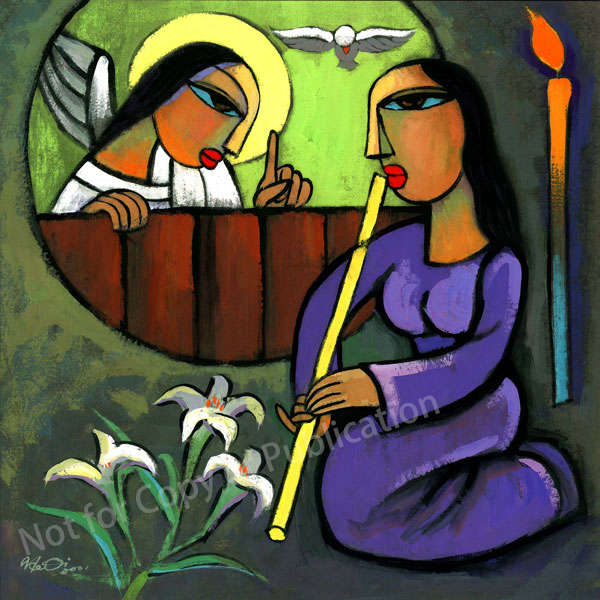
Following is a painting (“Annunciation”) by He Qi:

He Qi © 2021 All Rights Reserved.

Image taken from He Qi Art . For purchasing prints of this and other artworks by He Qi go to heqiart.com . For other images of He Qi art works in TIPs, see here.

Following is an artwork by Sister Marie Claire , SMMI (1937–2018) from Bengaluru, India:

(Note that supernatural beings are always portrayed with this type of upraised scarf and white circle.)

For more information about images by Sister Marie Claire and ways to purchase them as lithographs, see here . For other images of Sister Marie Claire paintings in TIPs, see here.

The following is a contemporary stained glass window from Our Lady of Pity in Swaffham, United Kingdom:

Source: Art in the Christian Tradition , a project of the Vanderbilt University Divinity Library, Nashville, TN. Original source: Wikimedia

Stained glass is not just highly decorative, it’s a medium which has been used to express important religious messages for centuries. Literacy was not widespread in the medieval and Renaissance periods and the Church used stained glass and other artworks to teach the central beliefs of Christianity. In Gothic churches, the windows were filled with extensive narrative scenes in stained glass — like huge and colorful picture storybooks — in which worshipers could ‘read’ the stories of Christ and the saints and learn what was required for their religious salvation. (Source: Victoria and Albert Museum )

complete verse (Luke 1:32)

Following are a number of back-translations of Luke 1:32:

  • Noongar: “He will be great. He will be called the ‘Son of God’. God says this. He will stand up as King, like his ancestor David.” (Source: Warda-Kwabba Luke-Ang)
  • Uma: “He will become an important person [lit., big life], and he is called the Son of God that is in heaven. And the Lord God lifts him to become a King like King Daud, his ancestor long ago.” (Source: Uma Back Translation)
  • Yakan: “He will be really great and he will be called the Child/Son of God the Most High. And God will make him king like his forefather King Da’ud ley.” (Source: Yakan Back Translation)
  • Western Bukidnon Manobo: “His rank will be very great, and he will be called the Son of the Very Highest God, and the Lord God will make it be that this one you will give birth to will rule just like his ancestor long ago David ruled.” (Source: Western Bukidnon Manobo Back Translation)
  • Kankanaey: “He will be great and will be called the Child of the Highest God. God will moreover make-him -king like his ancestor King David long ago,” (Source: Kankanaey Back Translation)
  • Tagbanwa: “He is really great/important, and is called the Son of God who is Exceedingly the Greatest/Most-important. God will give to him the kingship which is like that of his ancestor David.” (Source: Tagbanwa Back Translation)

give (Japanese honorifics)

Click or tap here to see the rest of this insight.

Like a number of other East Asian languages, Japanese uses a complex system of honorifics, i.e. a system where a number of different levels of politeness are expressed in language via words, word forms or grammatical constructs. These can range from addressing someone or referring to someone with contempt (very informal) to expressing the highest level of reference (as used in addressing or referring to God) or any number of levels in-between. One way to do this is through the usage (or a lack) of an honorific prefix as shown here in the widely-used Japanese Shinkaiyaku (新改訳) Bible of 2017.

In these verses, the verb that is translated as “give” in English is translated in the Shinkaiyaku Bible as o-atae (お与え), combining “to give” (atae) with the respectful prefix o-. (Source: S. E. Doi, see also S. E. Doi in Journal of Translation, 18/2022, p. 37ff. )

See also respectful form of “give” (kudasaru), respectful form of “give” (tamawaru).