go in peace

The Hebrew, Ge’ez, and Greek that is translated as “go in peace” into English is an idiomatic expression of farewell which is translatable in other languages as an idiomatic expression as well:

  • “go with sweet insides” (Shilluk)
  • “rejoice as you go” (Central Mazahua)
  • “go in quietness of heart” (Chol)
  • “go happy” (Highland Puebla Nahuatl)
  • “being happy, go” (Central Tarahumara)
  • “go and sit down in your heart” (Tzeltal) (source for this and five above: Bratcher / Nida)
  • “have a smooth interior and go” (Bariai) (source: Bariai Back Translation)
  • “Go with-your-liver-good” (Mairasi) (source Enggavoter 2004)
  • “Go home with goodness of your life” (Uma (source: Uma Back Translation)
  • “Go home now, and may your situation be good.” (Western Bukidnon Manobo) (source: Western Bukidnon Manobo Back Translation)
  • “Go with your mind at-peace” (tip_language language=”3135″]Kankanaey[/tip_language]) (source: Kankanaey Back Translation)

See also in peace and go in peace (2Sam. 15:9).

in peace

The Hebrew and Greek that is translated as some form of “in peace” in these verses in English is translated in the widely-used Mandarin Chinese Union Version with a historical 4-character Chinese idiom: píngpíng ān’ān (平平安安) or “peace (and peace).”

See also go in peace.

peace (inner peace)

The Hebrew, Ge’ez, and Greek that is usually translated into English as “peace,” when referring to one’s inner peace, is (back-) translated with a variety of idioms and phrases:

In American Sign Language it is signed with a compound sign consisting of “become” and “silent.” (Source: Yates 2011, p. 52)


“Peace” in American Sign Language (source )

See also peace (absence of strife) and this devotion on YouVersion and this one on Bible Gateway .

Saul

The name that is transliterated as “Saul” in English means “asked for,” “demanded,” “required.” (Source: Cornwall / Smith 1997 )

It is translated in Spanish Sign Language with the sign that depicts “sword in chest” (referring to 1 Samuel 31:4 and 1 Chronicles 10:4) and also “self-centered.” (Source: Steve Parkhurst)


“Saul” in Spanish Sign Language, source: Sociedad Bíblica de España

For more information on translations of proper names with sign language see Sign Language Bible Translations Have Something to Say to Hearing Christians .

Click or tap here to see a short video clip about King Saul (source: Bible Lands 2012)

Learn more on Bible Odyssey: Saul .

Samuel

The name that is transliterated as “Samuel” in English means “heard of God,” “asked of God,” “offering of God,” “appointed by God.” (Source: Cornwall / Smith 1997 )

It is translated in Spanish Sign Language with the sign for “listen” referring to 1 Samuel 3:10. (Source: Steve Parkhurst)


“Samuel” in Spanish Sign Language, source: Sociedad Bíblica de España

For more information on translations of proper names with sign language see Sign Language Bible Translations Have Something to Say to Hearing Christians .

Learn more on Bible Odyssey: Samuel .

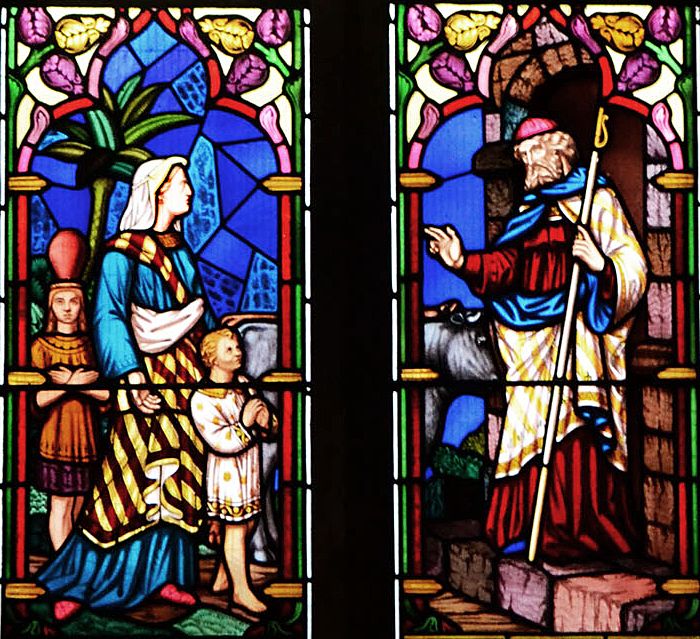
A Mother in Israel: Hannah, Samuel and Eli

The following is an 1862 stained glass window by William Wailes from the Church of St. Mary the Virgin in Ambleside, United Kingdom:

Source: Art in the Christian Tradition , a project of the Vanderbilt University Divinity Library, Nashville, TN. Original source: Flickr

Stained glass is not just highly decorative, it’s a medium which has been used to express important religious messages for centuries. Literacy was not widespread in the medieval and Renaissance periods and the Church used stained glass and other artworks to teach the central beliefs of Christianity. In Gothic churches, the windows were filled with extensive narrative scenes in stained glass — like huge and colorful picture storybooks — in which worshipers could ‘read’ the stories of Christ and the saints and learn what was required for their religious salvation. (Source: Victoria and Albert Museum )

Eli

The name that is transliterated as “Eli” in English is translated means “YHWH is high,” “my God,” “adopted of the LORD,” “elevated.” (Source: Cornwall / Smith 1997 )

In Spanish Sign Language it is translated with the sign for “falling back” referring to 1 Samuel 4:18. (Source: Steve Parkhurst)


“Eli” in Spanish Sign Language, source: Sociedad Bíblica de España

For more information on translations of proper names with sign language see Sign Language Bible Translations Have Something to Say to Hearing Christians .

More information on Eli .

complete verse (1 Samuel 1:17)

Following are a number of back-translations as well as a sample translation for translators of 1 Samuel 1:17:

  • Kupsabiny: “When Eli heard those words, he said that, ‘Sorry, my dear! Go in peace and may the God of Israel give you what you want!’” (Source: Kupsabiny Back Translation)
  • Newari: “Eli answered, "Go in peace, and may the God of Israel give you what you asked Him for."” (Source: Newari Back Translation)
  • Hiligaynon: “Eli answered/replied, ‘Go, and [you (sing.)] do- not -worry anymore. May-it-be that the God of Israel give what you (sing.) have-asked of him.’” (Source: Hiligaynon Back Translation)
  • English: “Eli replied, ‘I wish/desire that things will go well for you. I desire that God, the one we Israeli people worship, will give you what you requested from him.’” (Source: Translation for Translators)