
sea monster

The Hebrew in Genesis 1:21 that is translated as “sea monster” in English is translated in Elhomwe as “big fish.” (Source: project-specific translation notes in Paratext)

In Cherokee it is translated as dakwa (ᏓᏆ), a term from Cherokee mythology that denotes “an aquatic (riverine) monster (…) that is considered the father of all fish tribe.” (Source: Bender / Belt 2025, p. 48)

See also Nephilim.

Genesis 1 in Jamaican Sign Language

Following is the translation of Genesis 1 into Jamaican Sign Language:


Source: Jamaican Sign Language Bible Translation

1:1 A very, very long time ago, God created the heavens and the earth.

1:2 The earth was not yet formed and contained nothing, it was completely void. Water flowed endlessly and the entire earth was completely dark. God looked over all this. The Spirit of God, [like a bird], hovered over the water.

1:3 God spoke, saying, “Let there be light.” And the darkness became light.

1:4 God looked at the darkness and the light and saw that it was good.

1:5 God called the light ‘Day’ and the darkness ‘Night.’ Evening passed and morning came and that was day one.

1:6 Then God said, “Let there be a great dome to separate the waters above from the waters below.”

1:7 So God made a great dome to keep the waters above separate from the waters below.

1:8 God called the dome above ‘Heaven.’ Evening passed and morning came and that was day two.

1:9 God said, “Let there be dry land.” And the water gathered and dry land appeared.

1:10 God called the dry land ‘earth’ and the waters He called ‘seas.’ God looked at the earth and seas and saw that it was good.

1:11 God said “Let the earth produce plants of every kind. Let the earth grow grass, plants that make grain, and fruit trees. The fruit trees will make fruit with seeds in it. Let these plants grow on the earth.”

1:12 And it happened; the earth produced plants of all different kinds. Grass sprang up abundantly across the land, stalks with grains of all types [corn, rice, wheat, oat], trees of all varieties sprang up yielding fruits of all different kinds [orange, mango, banana, plums, guavas, guinep] everywhere [tomatoes, pineapple, strawberries, watermelon] [of all different sizes and shapes]. These plants sprang over all across the land, reproducing themselves through seeds. God looked over this and saw that it was good.

1:13 Evening passed and morning came and that was day three.

1:14 God spoke to the heavens, “Let there be lights in the sky to separate the day from the night. These lights will indicate the seasons, days and years.

1:15 The lights from heaven will give light to the earth.”

1:16 God made two great lights: the greater [brighter] light to rule the day, and the lesser [dimmed] light to rule the night, along with the stars.

1:17 God placed these lights in the sky to give light to the earth.

1:18 The greater [brighter] light ruled over the day and the lesser [dimmed] light ruled over the night and separated light and darkness. God looked at this and saw that it was good.

1:19 Evening passed and morning came and that was day four.

1:20 God spoke to the waters below and the heavens above, “Let the seas be filled with living creatures and let birds fly above in the heavens.”

1:21 God created huge sea creatures and many different animals swarmed the waters [shrimp, lobster, octopus, turtles, crocodile, whales] the sky was filled with different winged animals of its own kind [great and small- dove, crow, eagle, parrot, hummingbird]. God looked at this and saw that it was good.

1:22 God looked at the heavens and the earth and blessed them, “Be fruitful and multiply and fill the seas, let the birds multiply across the earth.”

1:23 Evening passed and morning came and that was day five.

1:24 God spoke to the earth “Let there be living creatures of different kinds: farm animals [cows, sheep, goat], crawling insects [bugs, worms, snakes], and wild animals of different kind [lion, leopard, elephant, ostrich, kangaroo, alligator]

1:25 So God created all these different types of animals. God looked at this and saw that it was good.

1:26 Then God thought of creating man [human]. Why? To be stewards [responsible] for the earth. To take care of birds in the sky, the animals in the sea and the creatures all over the earth.

1:27 God created man and woman in His own image and likeness.

1:28 God blessed them saying, “Be fruitful and multiply, fill the earth. Let man and woman rule over the earth, over the fishes in the sea and the birds in the sky, and the animals on the land. Be stewards of the earth.”

1:29 God said to the man and the woman, “Look at all the plants and trees, I give you all the plants that bear fruits and grains to eat freely.

1:30 All green grass, grains and fruit trees I give to all the animals, every bird and crawling insect, to eat from freely. Every plant is theirs because they have the breath of life which I have given them.” And they all went ahead and ate freely.

1:31 God looked at all He created and saw that it was good. Evening passed and morning came and that was day six.

Back-translation by Amakedia Wallen, coordinated by Tashi Widmer
And God saw it was good

The Hebrew that is typically translated in English as “And God saw it was good” is translated in Newari as “This seemed good to God.”

The first part of Genesis 1:31, which is translated in English as “God saw everything that he had made, and indeed, it was very good” or similar is translated in Newari as “God saw everything that He made. This seemed very good to Him.”

(Source: Newari Back Translation)

Abram

The term that is transliterated as “Abram” in English is translated in American Sign Language with the sign signifying sojourning with a staff, clearly differentiating it from Abraham. (Source: Ruth Anna Spooner, Ron Lawer)


“Abram” in American Sign Language, source: Deaf Harbor

Similarly, in Vietnamese (Hanoi) Sign Language it is translated with a sign that demonstrates that he has to wander from his home. (Source: The Vietnamese Sign Language translation team, VSLBT)


“Abram” in Vietnamese Sign Language, source: SooSL

See also Abraham.

For more information on translations of proper names with sign language see Sign Language Bible Translations Have Something to Say to Hearing Christians .

Creation Story Overview in Israeli Sign Language

The following is an overview of the creation story in Israeli Sign Language and its back-translation into English.

Genesis chapter 1 tells us how God created the world in the beginning.

In the beginning of all things there was deep water without boundaries. Darkness was everywhere. The Spirit of God moved over the waters.

On the first day God made light. God saw the light: it was good! God divided the light from the darkness.

The second day.

On the second day there was endless water everywhere. What did God do? He divided the waters up and down and put a strong arch in the middle. What did God call this arch? The sky. The waters are deep below, under the arch, and the waters are deep above, above the arch.

The third day.

What was the world like on the third day? Here is the firmament. Below it is the great expanse of water. What did God do? He gathered the waters together in one place. The place without water was dry land. God called the dry land ‘earth’. In sign language we make the gesture ‘EARTH’. God called the collection of water ‘seas’. In sign language we make the gesture ‘sea’.

And God made different plants grow from the dry land — herbs, flowers, fruit trees.

The fourth day.

On the fourth day, God made the sun, the moon and the stars. God put the sun and the moon on the firmament. And he put the stars all around the firmament. What are the sun, moon and stars for? They shine down on the earth. Because of the sun, moon and stars, we know when the days and nights are; the months and seasons change.

The fifth day.

On the fifth day, in the depths of the water, God made various sea creatures, large and small, and various fish. And on the earth God made all kinds of birds. The birds fly between the earth and the sky. God blessed the birds and the sea creatures and told them, “Be fruitful and multiply”.

The sixth day.

On the sixth day, God made various land animals on the earth — large animals, small animals, domestic animals, wild animals, reptiles and insects.

And on the sixth day God made man — male and female. God gave them His face. God blessed man and woman equally. God gave all animals to man. Man is God’s last and most important creation.

Video by Whole Word Institute , originally posted here . Back-translation by Luke Manevich.

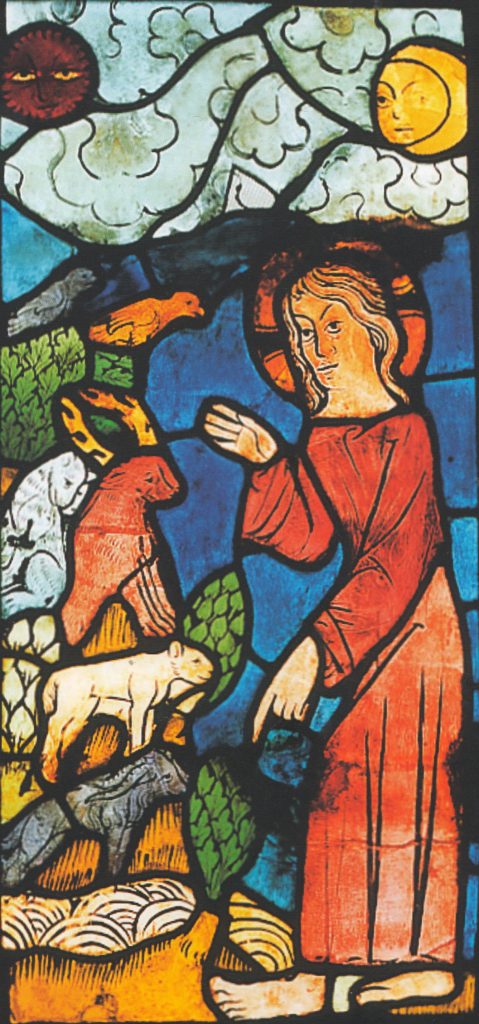
God Creates the Animals

The following is a stained glass window from the Three choir windows in the Marienkirche, Frankfurt (Oder), Germany, of the 14th century, depicting God creating the animals:

Source: Der gläserne Schatz: Die Bilderbibel der St. Marienkirche in Frankfurt (Oder), Neuer Berlin Verlag, 2005, copyright for this image: Brandenburgisches Landesamt für Denkmalpflege und Archäologisches Landesmuseum

Stained glass is not just highly decorative, it’s a medium which has been used to express important religious messages for centuries. Literacy was not widespread in the medieval and Renaissance periods and the Church used stained glass and other artworks to teach the central beliefs of Christianity. In Gothic churches, the windows were filled with extensive narrative scenes in stained glass — like huge and colorful picture storybooks — in which worshipers could ‘read’ the stories of Christ and the saints and learn what was required for their religious salvation. (Source: Victoria and Albert Museum )

See also other stained glass windows from the Marienkirche in Frankfurt.

complete verse (Genesis 1:21)

Following are a number of back-translations as well as a sample translation for translators of Genesis 1:21:

  • Kankanaey: “And that’s when- God -created all the kinds of fish and others that make-their-home in the ocean, including the large and frightening/dangerous, and also all the kinds of birds in the sky. When he saw those-things that he had created, he was content/satisfied.” (Source: Kankanaey Back Translation)
  • Newari: “And God made water monsters [lit.: huge animals that live in water], as well as all kinds of animals who live both in water and on the earth, as well as all kinds of winged birds. This seemed good to God.” (Source: Newari Back Translation)
  • Hiligaynon: “So God made big animals/creatures in the water, and all kinds of animals/creatures that live in the water, and all kinds of animals/creatures that fly. God was-pleased of what he saw.” (Source: Hiligaynon Back Translation)
  • English: “So God created huge sea creatures and every other kind of creature that moves in the water, and caused them to live in all the oceans. He also created many kinds of birds. God was pleased with all those creatures.” (Source: Translation for Translators)

Honorary "rare" construct denoting God ("see")

Click or tap here to see the rest of this insight.

Like a number of other East Asian languages, Japanese uses a complex system of honorifics, i.e. a system where a number of different levels of politeness are expressed in language via words, word forms or grammatical constructs. These can range from addressing someone or referring to someone with contempt (very informal) to expressing the highest level of reference (as used in addressing or referring to God) or any number of levels in-between.

One way Japanese shows different degree of politeness is through the usage of an honorific construction where the morpheme rare (られ) is affixed on the verb as shown here in the widely-used Japanese Shinkaiyaku (新改訳) Bible of 2017. This is particularly done with verbs that have God as the agent to show a deep sense of reverence. Here, mi-rare-ru (見られる) or “see” is used.

(Source: S. E. Doi, see also S. E. Doi in Journal of Translation, 18/2022, p. 37ff. )