The Hebrew and Greek that is translated as “bed” or similar in English is translated in Noongar as maya-ngwoorndiny or “bark sleeping” (source: Warda-Kwabba Luke-Ang).
See also mat, bed.

καὶ ἰδοὺ ἄνδρες φέροντες ἐπὶ κλίνης ἄνθρωπον ὃς ἦν παραλελυμένος καὶ ἐζήτουν αὐτὸν εἰσενεγκεῖν καὶ θεῖναι [αὐτὸν] ἐνώπιον αὐτοῦ.
18Just then some men came carrying a paralyzed man on a stretcher. They were trying to bring him in and lay him before Jesus,
The Greek that is translated as “paralyzed” in English is translated in the following ways:
See also paralyzed / withered.
Following is a 1973 painting of the JESUS MAFA project, a response to New Testament readings from the Lectionary by a Christian community in Cameroon, Africa. Each of the readings was selected and adapted to dramatic interpretation by the community members. Photographs of their interpretations were made, and these were then transcribed to paintings:
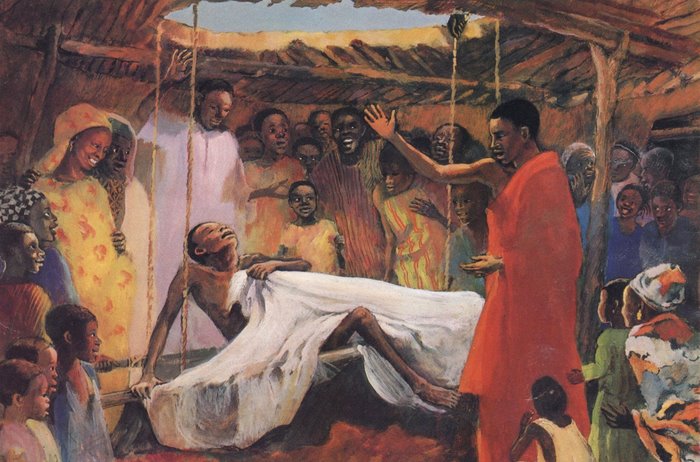
From Art in the Christian Tradition , a project of the Vanderbilt Divinity Library, Nashville, TN. Image retrieved March 23, 2026. Original source: librairie-emmanuel.fr.
Following are a number of back-translations of Luke 5:18:
The Greek Iēsous is “only” a proper name but one with great importance. The following quote by John Ellington (in The Bible Translator 1993, p. 401ff. ) illustrates this:
“In Matthew’s account of the birth of Jesus Christ, Joseph is told that when Mary gives birth to a son ‘you will name him Jesus, because he will save his people from their sins’ (1:21). This name is a Greek transliteration of the Hebrew name [Yeshua (יֵשׁוּעַ) which is a short form of a name meaning] ‘the Lord [Yahweh] saves.’ The name is very significant and is in itself especially dear to Christians around the world. (…) Unquestionably great importance is attached to the name of Jesus by Christians of all persuasions and backgrounds.”
While Iēsous (pronounced: /i.ɛː.suːs/) is transliterated as “Jesus” (pronounced /ˈdʒiːzəs/) in English (but was translated as “Hælend” [the “healing one”] in Old English — see Swain 2019) it is transliterated and pronounced in a large variety of other ways as well, following the different rules of different languages’ orthographies, writing systems and rules of pronunciation. The following is a (partial) list of forms of Jesus in Latin characters: aYeso, Azezi, Boiyesuq, Cecoc, Chesús, Chi̍i̍sū, Chisɔsi, Ciisahs, Ciise, Ciisusu, Djesu, Ɛisa, Ƹisa, Eyesu, Gesù, Gesû, Gesü, Ġesù, Ghjesù, Giêsu, ꞌGiê‑ꞌsu, Giê-xu, Gyisɛse, Hesu, Hesús, Hisus, Hisuw, Ià-sŭ, Iesen, Ié:sos, Iesu, Iesui, Iesusɨn, Iesusiva, Ié:sos, Ihu, Īhu, Iisus, Iisussa, Ijeesu, iJisọsị, Iji̍sɔ̄ɔsi, Iosa, Íosa, Ìosa, İsa, I’sa, Isiso, Isõs, Ísu, Isus, Isusa, Iisussa, Isuthi, Itota, Îtu, Isuva, Izesu, Izesuq, Jasus, Jeeju, Jeesus, Jeesuse, Jeezas, Jehu, Jeisu, Jeju, Jejus, Jesesi, Jeshu, Jeso, Jesoe, Jesosa, Jesoshi, Jesosi, Jesosy, Jesu, Jesû, Jesua, Jesuh, Jesuhs, Jesuo, Jesús, Jésus, Jesúsu, Jethu, Jetsóó, Jezed, Jezi, Jézi, Ježiš, Jezu, Jezus, Jézus, Jėzus, Jēzus, Jezusi, Jėzus, Jezuz, Jiijajju, Jíísas, Jiisusi, Jiizas, Jíìzọ̀s, Jisas, Jisase, Jisasi, Jisasɨ, Jisaso, Jisesi, Jisɛ̀, Jisos, Jisọs, Jisɔs, Jisu, Jiszs, Jizọs, Jizɔs, Jizọsi, Jizọsu, Jòso, Jusu, Jweesus, Ketsutsi, Njises, ọYẹsọ, Sesi, Sisa, Sísa, Sisas, Sises, Sīsū, Sizi, Txesusu, uJesu, Ujísɔ̄si, ŵaYesu, Xesosi, ´Xesús, Xesús, Yasu, Ya:su, yasuɛ, Yasuuⓐ, Ɣaysa, Yecu, Yeeb Sub, Yeeh Suh, Yeesey, Yeeso, Yeesso, Yēēsu, Yehsu, Yëësu, Yeiqsul, Yeisu, Yeisuw, Yeshu, Yē shú, Yeso, Yéso, Yesò, Yëso, Yɛso, ye-su, Yésu, Yêsu, Yẹ́sụ̃, Yěsù, Yésʉs, Yeswa, Yet Sut, Yetut, Yexus, Yezo, Yezu, Yiesu, Yiisa, Yiisu, Yiitju, Yis, Yisɔs, Yisufa, Yitati, Yusu, ‑Yusu, :Yusu’, Zeezi, Zezi, Zezì, Zezuz, Zezwii, Ziizɛ, Zisas, Zîsɛ, Zjezus, Zozi, Zozii, and this (much more incomplete) list with other writings systems: ᔩᓱᓯ, ᒋᓴᔅ, Հիսուս, ᏥᏌ, ኢየሱስ, ያሱስ, ܝܫܘܥ, Ісус, Їисъ, 耶稣, იესო, ईसा, イエス, イイスス, イエスス, 예수, येशू, येशो, ਈਸਾ, ພຣະເຢຊູ, ජේසුස්, যীশু, ଯୀଶୁ, ཡེ་ཤུ་, ‘ঈছা, இயேசு, ಯೇಸು, ພຣະເຢຊູ, ယေရှု, ઇસુ, जेजू, येसु, เยซู, យេស៊ូ, ᱡᱤᱥᱩ, ယေသှု, యేసు, ᤕᤧᤛᤢ᤺ᤴ, އީސާގެފާނު, ਯਿਸੂ, ꕉꖷ ꔤꕢ ꕞ, ⵏ⵿ⵗⵢⵙⴰ, ଜୀସୁ, يَسُوعَ,ㄧㄝㄙㄨ, YE-SU, ꓬꓰ꓿ꓢꓴ, 𖽃𖽡𖾐𖼺𖽹𖾏𖼽𖽔𖾏, ꑳꌠ, ᠶᠡᠰᠦᠰ (note that some of these might not display correctly if your device does not have the correct fonts installed).
In some languages the different confessions have selected different transliterations, such as in Belarusian with Isus (Ісус) by the Orthodox and Protestant churches and Yezus (Езус) by the Catholic church, Bulgarian with Iisus (Иисус) by the Orthodox and Isus (Исус) by the Protestant church, Japanese with Iesu (イエス) (Protestant and Catholic) and Iisusu (イイスス) (Orthodox), or Lingala with Yesu (Protestant) or Yezu (Catholic). These differences have come to the forefront especially during the work on interconfessional translations such as one in Lingala where “many hours were spent on a single letter difference” (source: Ellington, p. 401).
The proper name of God in the Old Testament, Yahweh (YHWH), is rendered in most Chinese Bible translations as Yēhéhuá 耶和華 — Jehovah. According to Chinese naming conventions, Yēhéhuá could be interpreted as Yē Héhuá, in which Yē would be the family name and Héhuá — “harmonic and radiant” — the given name. In the same manner, Yē 耶 would be the family name of Jesus and Sū 稣 would be his given name. Because in China the children inherit the family name from the father, the sonship of Jesus to God the Father, Jehovah, would be illustrated through this. Though this line of argumentation sounds theologically unsound, it is indeed used effectively in the Chinese church (see Wright 1953, p. 298).
Moreover, the “given name” of Sū 稣 carries the meaning ‘to revive, to rise again’ and seems to point to the resurrected Jesus. (Source: J. Zetzsche in Malek 2002, p. 141ff., see also tetragrammaton (YHWH))
Following are languages and language groups that use a form of Isa include the following (note that this list is not complete):
In German the name Jesus (pronounced: /ˈjeːzʊs/) is distinguished by its grammatical forms. Into the 20th century the grammatical rules prescribed a unique Greek-Latin declination: Jesus (nominative), Jesu (genitive, dative, vocative), Jesum (accusative), from which today only the genitive case “Jesu” is still in active use. Likewise, in Seediq (Taroko), the morphological treatment of “Jesus” also occupies a special category by not falling under the normal rule of experiencing a vowel reduction when the object-specific suffix an is added “since it was felt that the readers might resent that the name has been changed that drastically.” (Compare Msian for “Moses” (Mosi) as an object, but Yisuan for “Jesus” (Yisu).) (Source: Covell 1998. p. 249)
In Lamba the name ŵaYesu consists of a transliteration Yesu and the prefix ŵa, a plural form for “proper names when addressing and referring to persons in any position of seniority or honor.” While this was avoided in early translations to avoid possible misunderstandings of more than one Jesus, once the church was established it was felt that it was both “safe” and respectful to use the honorific (pl.) prefix. (Source C. M. Doke in The Bible Translator 1958, p. 57ff. )
In virtually all sign languages, “Jesus” is signed with the middle finger of each hand pointing to the palm (or wrist) of the other in succession (signing the nails of the cross). In the context of Bible translation this has been pointed out as theologically problematic since the “semantic connections of the original name Jesus do point towards ‘salvation,’ they do not naturally lead to crucifixion.” (Source: Phil King in Journal of Translation 1 (2020), p. 33ff.)
“Jesus” in German Sign Language (source )
Following is the oldest remaining Ethiopian Orthodox icon of Jesus from the 14th or possibly 13th century (found in the Church of the Saviour of the World in Gurji, Ethiopia). As in many Orthodox icons, Jesus’ right hand forms the Greek letters I-C-X-C for IHCOYC XPICTOC or “Jesus Christ.” Another interpretation of the right hand is that it shows three fingers pointing to the Trinity, while the two other fingers point to Jesus’ two natures.

Orthodox icons are not drawings or creations of imagination. They are in fact writings of things not of this world. Icons can represent our Lord Jesus Christ, the Virgin Mary, and the Saints. They can also represent the Holy Trinity, Angels, the Heavenly hosts, and even events. Orthodox icons, unlike Western pictures, change the perspective and form of the image so that it is not naturalistic. This is done so that we can look beyond appearances of the world, and instead look to the spiritual truth of the holy person or event. (Source )
The following is the so-called “Wales Window for Alabama.” It is a stained-glass window by the artist John Petts from Carmarthenshire, Wales, created in response to the 16th Street Baptist Church bombing which took place in 1963:

Stained glass is not just highly decorative, it’s a medium which has been used to express important religious messages for centuries. Literacy was not widespread in the medieval and Renaissance periods and the Church used stained glass and other artworks to teach the central beliefs of Christianity. In Gothic churches, the windows were filled with extensive narrative scenes in stained glass — like huge and colorful picture storybooks — in which worshipers could ‘read’ the stories of Christ and the saints and learn what was required for their religious salvation. (Source: Victoria and Albert Museum )
The style of the following drawing of Jesus by Annie Vallotton is described by the artist as this: “By using few lines the readers fill in the outlines with their imagination and freedom. That is when the drawings begin to communicate.” (see here ; see also We All are One in Christ)

Illustration by Annie Vallotton, copyright by Donald and Patricia Griggs of Griggs Educational Service.
Other visual representation of Jesus in TIPs include several non-Western styles of art: traditional Korean art, traditional Chinese art, modern Chinese abstract art, northern and central Thailand’s popular art, Indian Hamzanama style, traditional Vietnamese art, or Japanese prints.
See also this devotion on YouVersion .
Exegesis:
kai idou andres pherontes ‘and behold, there were, or appeared, or came, men, carrying…,’ or, ‘and behold, men were bringing’ (cf. Revised Standard Version); the former rendering which treats andres as a nominal clause after idou and assigns to pherontes the role of a relative clause is preferable.
epi klinēs ‘on a bed,’ ‘on a stretcher.’
anthrōpon hos ēn paralelumenos (also v. 24) ‘a man who was paralysed.’ The past participle paralelumenos points to a permanent situation.
kai ezētoun lit. ‘and they sought,’ hence ‘they tried.’ The imperfect tense stresses the conative meaning of the verb.
auton eisenegkein kai theinai [auton] enōpion autou ‘to bring him in (scil. into the house) and to lay (him) before him (i.e. Jesus).’ enōpion (cf. on 1.15) here an indication of place.
eispherō ‘to bring, or, to carry in.’
Translation:
Bringing on a bed, or, ‘carrying on a bed.’ The language may possess a more specific verb which has to be used here, e.g. ‘to carry-suspended-from-a-pole-on-the-shoulders’ (Bahasa Indonesia, Balinese), ‘to carry-with-some-people-together’ (Javanese), ‘to carry-on-a-stretcher’ (Tae,’ thus dispensing with the prepositional phrase). Bed is sometimes rendered by a locative derivation, ‘what-one-lies/sleeps-on’; here, since the context points to something light and easily transportable, it is also possible to say, ‘mattress,’ ‘mat,’ ‘stretcher,’ ‘litter.’
They sought, or, ‘they tried (hard),’ ‘they aimed-at’ (Javanese in 19.47), ‘they tried to find a way/means/an opportunity/a possibility.’
To bring him in, or ‘to take him in (or, into the house),’ ‘to cause-him-to-enter the house’ (Sundanese, Tae’).
Quoted with permission from Reiling, J. and Swellengrebel, J.L. A Handbook on the Gospel of Luke. (UBS Handbook Series). New York: UBS, 1971. For this and other handbooks for translators see here . Make sure to also consult the Handbook on the Gospel of Mark for parallel or similar verses.
5:18a
Just then: The Greek phrase that the Berean Standard Bible translates here as Just then is literally “And behold,” as in the Revised Standard Version. Luke used these words to introduce the action of the event. He also wanted to draw attention to the action. Some ways to translate this phrase in this context are:
Then
-or-
And while he was teaching
Some English versions, such as the New International Version and New Living Translation (2004), do not translate this phrase. Connect 5:18a to 5:17b in a way that is natural in your language.
some men came carrying a paralyzed man on a mat: The Greek phrase that the Berean Standard Bible translates as some men came carrying a paralyzed man on a mat is literally “men carrying on a pallet a man who was paralyzed.” The phrase introduces the paralyzed man and his friends. Introduce the friends and the paralyzed man in a way that is natural in your language. For example:
some men were carrying on a mat a man who was paralyzed (New Century Version)
-or-
Some men brought a paralyzed man on a stretcher. (God’s Word)
paralyzed man: A paralyzed man is a person who is unable to move some part or all of his body. In this context the paralytic could not walk. His legs were paralyzed.
mat: The Greek word that the Berean Standard Bible translates as mat means “bed, couch, cot, or stretcher.” It can refer to any piece of furniture that is used for reclining or lying on. In this context it refers to something light that could be used to carry someone. Since most people in Israel who were not rich slept on woven mats, it could have been a woven mat.
Be careful not to translate the word mat with a word that would imply something heavy and not easily carried.
5:18b
They tried to bring him inside: The Greek phrase that the Berean Standard Bible translates as tried to bring him inside is literally “were seeking to carry him in.” The men wanted to carry the paralyzed man through the door into the house. They attempted to do this but could not. Verse 5:19a explains that they could not do this because there were too many people in the house or around the door to the house.
The tense of the Greek verb for tried indicates that they tried to do this more than once. Some ways to express this in English are:
were trying to bring him in (NET Bible)
-or-
kept trying to carry him in (Phillips’ New Testament in Modern English)
to set him before Jesus: The men wanted to take the man into the house and lay him in front of Jesus so that Jesus would heal him. Be sure that the readers of your translation understand this. If the reason for taking this man to Jesus is unclear, you may have to make this explicit. For example:
in order to lay him before Jesus ⌊so that Jesus would heal him⌋
© 2009, 2010, 2013 by SIL International®
Made available under the terms of a Creative Commons Attribution-ShareAlike 4.0 License (CC BY-SA) creativecommons.org/licenses/by-sa/4.0.
All Scripture quotations in this publication, unless otherwise indicated, are from The Holy Bible, Berean Standard Bible.
BSB is produced in cooperation with Bible Hub, Discovery Bible, OpenBible.com, and the Berean Bible Translation Committee.
No comments yet.
Leave a Reply
You must be logged in to post a comment.