17One day while he was teaching, Pharisees and teachers of the law who had come from every village of Galilee and Judea and from Jerusalem were sitting nearby, and the power of the Lord was with him to heal.
The Greek that is translated as a form of “teach” is translated with some figurative phrases such as “to engrave the mind” (Ngäbere) or “to cause others to imitate” (Huichol). (Source: Bratcher / Nida)
In Noongar it is translated as karni-waangki or “truth saying” (source: Warda-Kwabba Luke-Ang).
The Hebrew and Greek that is translated as “village” or “town” in English is translated in Noongar as karlamaya or “fire (used for “home“) + houses” (source: Warda-Kwabba Luke-Ang).
In Elhomwe it is typically translated as “place.” “Here in Malawi, villages very small, so changed to ‘places,’ since not sure whether biblical reference just to small villages or also to bigger towns. (Source: project-specific translation notes in Paratext)
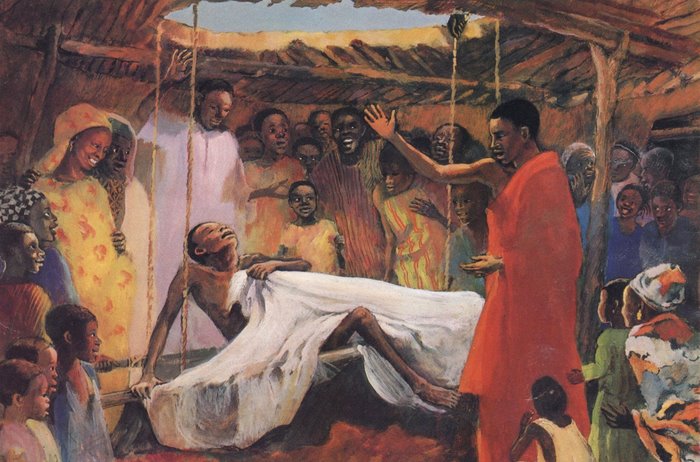
Following is a 1973 painting of the JESUS MAFA project, a response to New Testament readings from the Lectionary by a Christian community in Cameroon, Africa. Each of the readings was selected and adapted to dramatic interpretation by the community members. Photographs of their interpretations were made, and these were then transcribed to paintings:
From Art in the Christian Tradition, a project of the Vanderbilt Divinity Library, Nashville, TN. Image retrieved March 23, 2026. Original source: librairie-emmanuel.fr.
Following are a number of back-translations of Luke 5:17:
Noongar: “Another day, Jesus was teaching. Pharisees and Law Men, they were sitting there. They came from everywhere in Galilee and Judea and Jerusalem. The power of God was within Jesus and he healed sick people.” (Source: Warda-Kwabba Luke-Ang)
Uma: “One day while Yesus was teaching, there were several Parisi people and religion teachers sitting there. They were from towns in the lands of Galilea, Yudea and from the town of Yerusalem also. Power from the Lord God was in Yesus so that he could heal.” (Source: Uma Back Translation)
Yakan: “One day while Isa was teaching some Pariseo and teachers of the Yahudi religious law were sitting beside him. These people were from the town Awrusalam and from the villages in the places Jalil and Yahudiya. God’s power was there with him, therefore he was able to heal the sick.” (Source: Yakan Back Translation)
Western Bukidnon Manobo: “Another day, Jesus was teaching and many Pharisee people and teachers of the law came to greet him. They had come from all the towns in Galilee and in Judea. There were also companions of theirs who had come from the town of Jerusalem. The power of God was there to Jesus, that he might heal the people.” (Source: Western Bukidnon Manobo Back Translation)
Kankanaey: “On one-occasion, Jesus was in a house teaching, and there were also Fafariseo (Pharisees) and teachers of God’s law sitting-with (the others) who had come-from the-collective-towns in Galilea and Judea and from Jerusalem also. And there was with/in Jesus the power of the Lord God to heal anyone who had a sickness.” (Source: Kankanaey Back Translation)
Tagbanwa: “Once when Jesus was teaching, there were some Pariseo and explainers of the laws of God there. There were some who came from the towns in the district of Galilea and the district of Judea, and from the city of Jerusalem too. The supernatural-power of God was really there with Jesus with which he could heal whatever kind of illness.” (Source: Tagbanwa Back Translation)
The name that is transliterated as “Judah” or “Judea” in English (referring to the son of Jacob, the tribe, and the territory) is translated in Spanish Sign Language as “lion” (referring to Genesis 49:9 and Revelation 5:5). This sign for lion is reserved for regions and kingdoms. (Source: John Elwode in The Bible Translator 2008, p. 78ff. and Steve Parkhurst)
The name that is transliterated as “Jerusalem” in English is signed in French Sign Language with a sign that depicts worshiping at the Western Wall in Jerusalem:
While a similar sign is also used in British Sign Language, another, more neutral sign that combines the sign “J” and the signs for “place” is used as well. (Source: Anna Smith)
“Jerusalem” in British Sign Language (source: Christian BSL, used with permission)
The Greek that is a transliteration of the Hebrew Pərūšīm and is typically transliterated into English as “Pharisee” is transliterated in Mandarin Chinese as Fǎlìsài (法利賽 / 法利赛) (Protestant) or Fǎlìsāi (法利塞) (Catholic). In Chinese, transliterations can typically be done with a great number of different and identical-sounding characters. Often the meaning of the characters are not relevant, unless they are chosen carefully as in these cases. The Protestant Fǎlìsài can mean something like “Competition for the profit of the law” and the Catholic Fǎlìsāi “Stuffed by/with the profit of the law.” (Source: Zetzsche 1996, p. 51)
In Finnish Sign Language it is translated with the sign signifying “prayer shawl”. (Source: Tarja Sandholm)
Scot McKnight (in The Second Testament, publ. 2023) translates it into English as Observant. He explains (p. 302): “Pharisee has become a public, universal pejorative term for a hypocrite. Pharisees were observant of the interpretation of the Covenant Code called the ‘tradition of the elders.’ They conformed their behaviors to the interpretation. Among the various groups of Jews at the time of Jesus, they were perhaps closest to Jesus in their overall concern to make a radical commitment to the will of God (as they understood it).”
Like a number of other East Asian languages, Japanese uses a complex system of honorifics, i.e. a system where a number of different levels of politeness are expressed in language via words, word forms or grammatical constructs. These can range from addressing someone or referring to someone with contempt (very informal) to expressing the highest level of reference (as used in addressing or referring to God) or any number of levels in-between.
One way Japanese shows different degree of politeness is through the usage of an honorific construction where the morpheme rare (られ) or are (され) are affixed on the verb as shown here in the widely-used Japanese Shinkaiyaku (新改訳) Bible of 2017. This is particularly done with verbs that have God as the agent to show a deep sense of reverence. Here, naoshiteo-rare-ru (治しておられる) or “healing” oshieteo-rare-ru (教えておられる) or “teaching” are used.
Also, when the referent is God, the “divine” honorific prefix mi- (御 or み) can be used, as here in mi-chikara (御力) or “power (of God).”.

Leave a Reply
You must be logged in to post a comment.