Compare Isaiah 19:2, Matthew 24:7, Mark 13:8, Luke 24:10f., and 1 Meqabyan 34:4f. (Ethiopian Maccabees).
See also kingdom against kingdom.

ἦσαν δὲ ἡ Μαγδαληνὴ Μαρία καὶ Ἰωάννα καὶ Μαρία ἡ Ἰακώβου καὶ αἱ λοιπαὶ σὺν αὐταῖς. ἔλεγον πρὸς τοὺς ἀποστόλους ταῦτα,
10Now it was Mary Magdalene, Joanna, Mary the mother of James, and the other women with them who told this to the apostles.
Compare Isaiah 19:2, Matthew 24:7, Mark 13:8, Luke 24:10f., and 1 Meqabyan 34:4f. (Ethiopian Maccabees).
See also kingdom against kingdom.
The Greek term that means “one who is sent off” in its singular form and is usually transliterated as “apostle(s)” in English is (back-) translated in the following ways:
Scot McKnight (in The Second Testament, publ. 2023) translates it into English as commissioner.
In American Sign Language it is translated with a combination of the signs for “following” plus the sign for “authority” to differentiate it from disciple. (Source: Ruth Anna Spooner, Ron Lawer)
“apostles” in American Sign Language, source: Deaf Harbor
In Hungarian Sign Language it is translated with a sign that shows the shape of the beard, based on the common and general visual representation of the apostles. This sign differs from the sign for a beard as used in colloquial language. The sign of the apostle does not originate from a specific biblical verse, but rather from the cultural context and later ecclesiastical tradition. “Do not cut the hair at the sides of your head or clip off the edges of your beard.” Lev 19:27. In the biblical era, wearing a beard was the default social and religious norm among Jewish men. The Apostle Peter is generally depicted with a short, curly, white beard. The Apostle Paul appears with a longer, pointed beard. The Apostle John is an exception, as he was the youngest disciple. In iconography, he is often the only one painted without a beard (as a youth) to emphasize his purity and age (see for instance at Transfiguration (icon)). (Source: Jenjelvi Biblia and HSL Bible Translation Group)
“Apostle” in Hungarian Sign Language (source )
Learn more on Bible Odyssey: The Apostles in Christian Art .
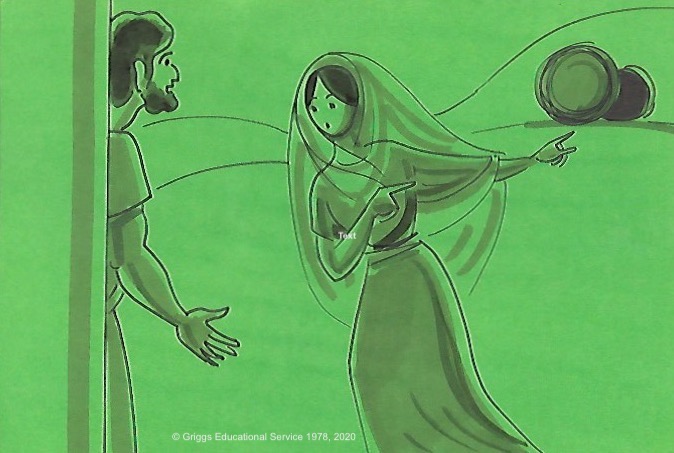
Illustration by Annie Vallotton, copyright by Donald and Patricia Griggs of Griggs Educational Service. More images can be viewed at rotation.org .
For other images by Annie Vallotton on Translation Insights & Perspectives, see here.
The term that is transliterated as “Mary Magdalene” in English is translated in American Sign Language with a sign signifying 7 demons having gone out, referring to Luke 8:2. (Source: Ruth Anna Spooner, Ron Lawer)
“Mary Magdalene” in American Sign Language, source: Deaf Harbor
For more information on translations of proper names with sign language see Sign Language Bible Translations Have Something to Say to Hearing Christians .
The following is a stained glass window in the All Saints’ Church, Highgate, London, of the late 19thy century:

Photo by John Salmon, hosted by Wikimedia Common under the Creative Commons Attribution-Share Alike 2.0 Generic license
Stained glass is not just highly decorative, it’s a medium which has been used to express important religious messages for centuries. Literacy was not widespread in the medieval and Renaissance periods and the Church used stained glass and other artworks to teach the central beliefs of Christianity. In Gothic churches, the windows were filled with extensive narrative scenes in stained glass — like huge and colorful picture storybooks — in which worshipers could ‘read’ the stories of Christ and the saints and learn what was required for their religious salvation. (Source: Victoria and Albert Museum )
Learn more on Bible Odyssey: Mary Magdalene and Mary Magdalene in Popular Culture .
See also Mary Magdalene and Mary Magdalene (icon).
Following is a contemporary Ukrainian Orthodox icon of Mary Magdalene by Kateryna Shadrina.

Orthodox Icons are not drawings or creations of imagination. They are in fact writings of things not of this world. Icons can represent our Lord Jesus Christ, the Virgin Mary, and the Saints. They can also represent the Holy Trinity, Angels, the Heavenly hosts, and even events. Orthodox icons, unlike Western pictures, change the perspective and form of the image so that it is not naturalistic. This is done so that we can look beyond appearances of the world, and instead look to the spiritual truth of the holy person or event. (Source )
For purchasing artworks by Kateryna Shadrina go to IconArt Gallery .
The following is a stained glass window from the Chartres Cathedral in Chartres, France, ca. 1150:
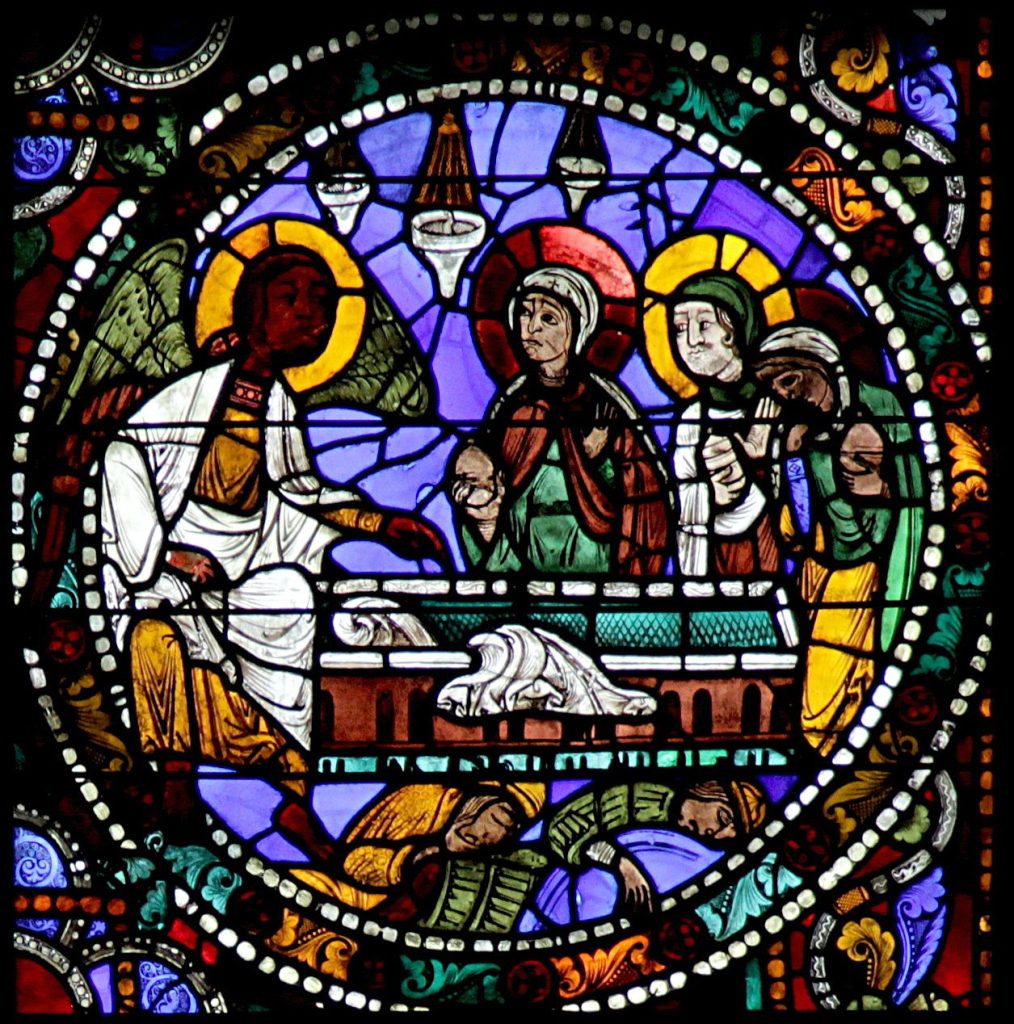
Source: Art in the Christian Tradition , a project of the Vanderbilt University Divinity Library, Nashville, TN. Original source: Wikimedia
Stained glass is not just highly decorative, it’s a medium which has been used to express important religious messages for centuries. Literacy was not widespread in the medieval and Renaissance periods and the Church used stained glass and other artworks to teach the central beliefs of Christianity. In Gothic churches, the windows were filled with extensive narrative scenes in stained glass — like huge and colorful picture storybooks — in which worshipers could ‘read’ the stories of Christ and the saints and learn what was required for their religious salvation. (Source: Victoria and Albert Museum )
Following are a number of back-translations of Luke 24:10:
The name that is transliterated as “Joanna” in English is translated in Libras (Brazilian Sign Language) with a combinations of the signs for “God is gracious” (the meaning of the name) and a reference to her visiting Jesus’ tomb (see Luke 24:10). (Source: Missão Kophós )
“Joanna” in Libras (source )
For more information on translations of proper names with sign language see Sign Language Bible Translations Have Something to Say to Hearing Christians .
No comments yet.


Leave a Reply
You must be logged in to post a comment.