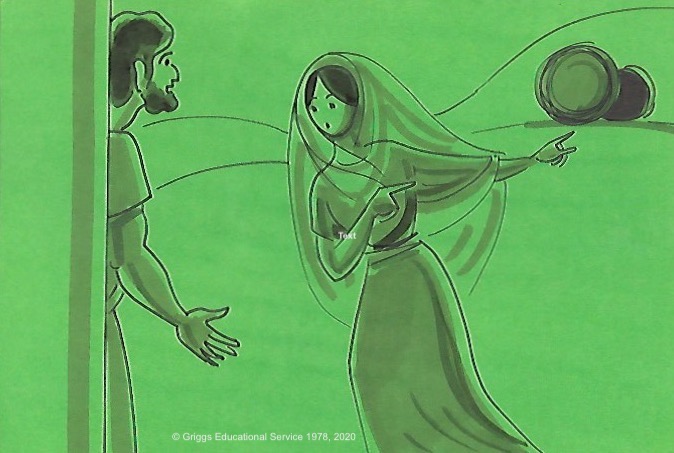
Illustration by Annie Vallotton, copyright by Donald and Patricia Griggs of Griggs Educational Service. More images can be viewed at rotation.org .
For other images by Annie Vallotton on Translation Insights & Perspectives, see here.

καὶ ὑποστρέψασαι ἀπὸ τοῦ μνημείου ἀπήγγειλαν ταῦτα πάντα τοῖς ἕνδεκα καὶ πᾶσιν τοῖς λοιποῖς.
9and returning from the tomb they told all this to the eleven and to all the rest.
Illustration by Annie Vallotton, copyright by Donald and Patricia Griggs of Griggs Educational Service. More images can be viewed at rotation.org .
For other images by Annie Vallotton on Translation Insights & Perspectives, see here.
Following are a number of back-translations of Luke 24:9:
The following is a stained glass window from the Chartres Cathedral in Chartres, France, ca. 1150:
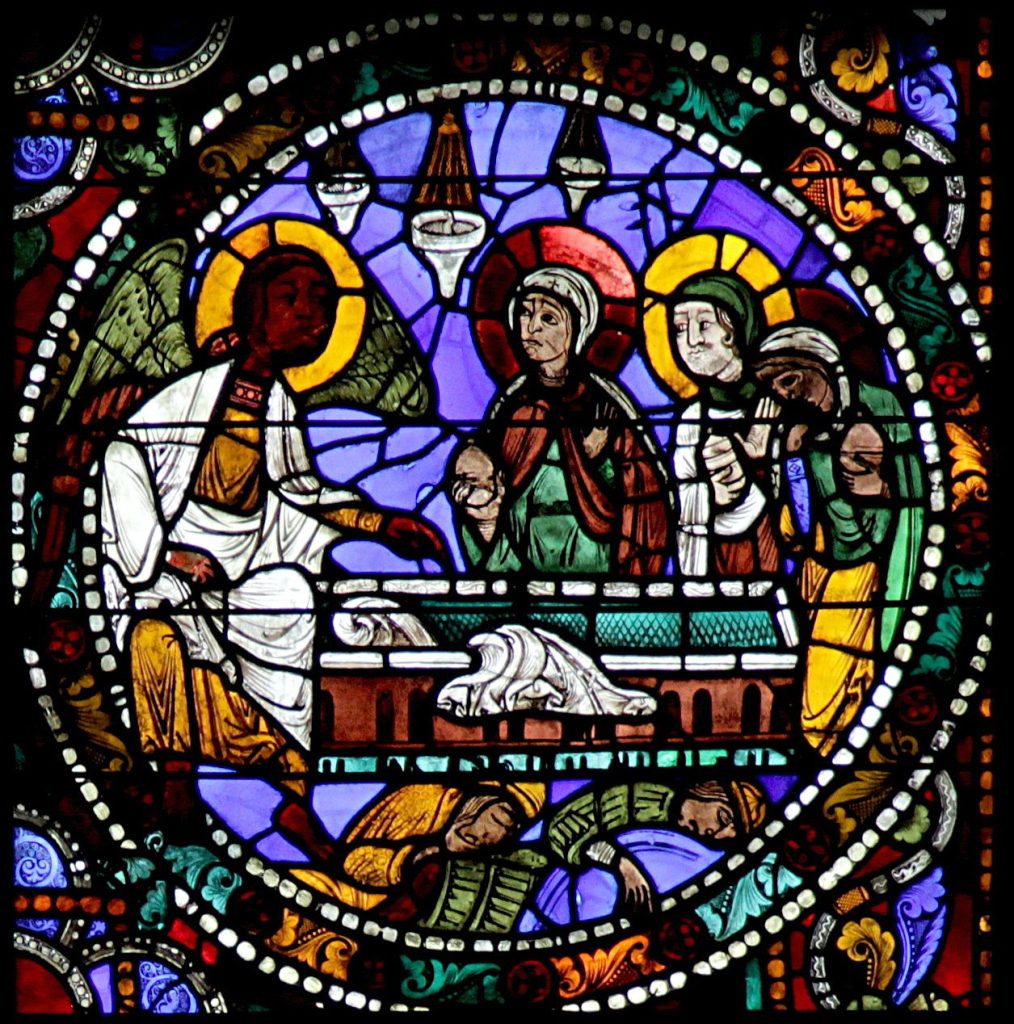
Source: Art in the Christian Tradition , a project of the Vanderbilt University Divinity Library, Nashville, TN. Original source: Wikimedia
Stained glass is not just highly decorative, it’s a medium which has been used to express important religious messages for centuries. Literacy was not widespread in the medieval and Renaissance periods and the Church used stained glass and other artworks to teach the central beliefs of Christianity. In Gothic churches, the windows were filled with extensive narrative scenes in stained glass — like huge and colorful picture storybooks — in which worshipers could ‘read’ the stories of Christ and the saints and learn what was required for their religious salvation. (Source: Victoria and Albert Museum )
Barclay Newman, a translator on the teams for both the Good News Bible and the Contemporary English Version, translated passages of the New Testament into English and published them in 2014, “in a publication brief enough to be non-threatening, yet long enough to be taken seriously, and interesting enough to appeal to believers and un-believers alike.” The following is the translation of Luke 24:1-12:
Before Sunday dawned, the women rushed to the tomb,
carrying spices they had prepared.
The stone had been rolled away from the entrance,
and they rushed right in.
Where was the body of the Lord Jesus?
It was nowhere to be seen,
and they didn’t know what to think.
Two men there in shining white garments!
Where did they come from?
Shocked, the women fell to the ground, but the men said:
“The living don’t dwell in tombs of the dead!
Jesus has been raised to life,
and now he’s long gone.
While you were still in Galilee, don’t you remember
he told you he’d be arrested, then executed on a cross,
but three days later he’d rise to life?”
At that very moment, the women recalled
what Jesus had said to them.
Quite a crowd of women had gone to the tomb,
among them: Mary Magdalene, Joanna,
and Mary the mother of James.
They hurried off and informed others,
including the closest followers of Jesus,
who refused to believe such nonsense.
However, Peter raced to the tomb,
but after stooping and looking carefully inside,
he saw only burial clothes.
Still confused, he returned to the others.
24:9a
And when they returned from the tomb: In Greek, this part of the verse is more literally “and having returned from the tomb.” It introduces what the women did after they heard what the angels said in 24:8. The women left the tomb and returned to the city of Jerusalem to tell Jesus’ apostles.
Some other ways to translate 24:9a are:
The women left the tomb and went back to the city. (God’s Word)
-or-
So they rushed back from the tomb… (New Living Translation (2004))
-or-
Then the women returned from the tomb.
Some English versions include 24:9–10 in the preceding paragraph. Some even connect 24:9 to 24:8, as the Berean Standard Bible does. For example:
and when they returned from the tomb (NET Bible)
Connect this information to 24:8 and 24:9b in a natural way in your language.
they: The pronoun they refers to the women who went to the tomb and saw the angels in 24:1–8. Some of their names are mentioned in 24:10a. In some languages it may be helpful to put their names here in 24:9a. See the General Comment on 24:9–10 at the end of 24:10c for a suggestion on reordering information in these verses.
24:9b
they reported all these things to the Eleven and to all the others: The phrase all these things refers to everything that the women saw and heard when they went to the tomb. It does not refer only to what the angels told them. Some other ways to translate the clause are:
they told all this to Jesus’ eleven apostles and to all the others
-or-
they went to Jesus’ eleven apostles and the others and told them all that had happened
the Eleven: The phrase the Eleven refers to Jesus’ apostles. There were now only eleven apostles instead of twelve, because Judas Iscariot was no longer among them. After he betrayed Jesus, he did not continue as an apostle. In some languages it may be necessary to supply the word “apostles” here, as some English versions do. For example:
the eleven apostles (God’s Word)
all the others: The phrase all the others refers to other people who followed Jesus. The phrase does not specify exactly which people are included. The text may refer to those who were gathered with the apostles at that time, or it may include other followers in Jerusalem. Other Scriptures indicate that many of Jesus’ followers and family members stayed together in Jerusalem after he died.
Some other ways to translate the phrase are:
all his other followers
-or-
all the rest (Revised Standard Version)
© 2009, 2010, 2013 by SIL International®
Made available under the terms of a Creative Commons Attribution-ShareAlike 4.0 License (CC BY-SA) creativecommons.org/licenses/by-sa/4.0.
All Scripture quotations in this publication, unless otherwise indicated, are from The Holy Bible, Berean Standard Bible.
BSB is produced in cooperation with Bible Hub, Discovery Bible, OpenBible.com, and the Berean Bible Translation Committee.
No comments yet.

Leave a Reply
You must be logged in to post a comment.