The term that is translated as “resurrect” or “rise again” as referring to Jesus in English is translated in British Sign Language with a sign that combines the signs for “Jesus” and “standing on feet again.” (Source: Anna Smith)
“Resurrect” or “rise again” in British Sign Language (source: Christian BSL, used with permission)
The Christian BSL website notes: “A British Sign Language (BSL) translation of Resurrection / Rise Again / Rose Again (Jesus). Jesus’ return to life three days after his death on the cross. In the translation of Rise Again or Rose Again the word AGAIN isn’t signed; signing the word AGAIN in BSL in this context would erroneously indicate that Jesus was resurrected more than once.” (see here )
“Jesus is doing something extremely dangerous here. The Thai temple is a place in which it is considered by religious people inappropriate to show any anger or strong emotions. It has to be an extremely urgent reason for someone to do something as violent as this in such a sacred space.”
In the EnglishGood News Bible (2nd edition of 1992), this occurrence of the Greek hoi Ioudaioi, traditionally “the Jews” in English, is translated with “the authorities (in Jerusalem)” in contexts that imply that the referred groups are hostile to Jesus For an explanation of the differentiated translation in English as well as translation choices in a number of languages, see the Jews.
Following are a number of back-translations of John 2:20:
Uma: “The Yahudi rulers were surprised, they said: ‘How’s-that!? This House of God was built in forty-six years, and you (sing.) say you (sing.) will build it back in just three days?'” (Source: Uma Back Translation)
Yakan: “‘Uy,’ said the leaders, ‘this temple took forty six years to be built. You are able to erect it in just three days?'” (Source: Yakan Back Translation)
Western Bukidnon Manobo: “And they answered, ‘Forty and six years was the making of this house and are you able to build it up in just three days?'” (Source: Western Bukidnon Manobo Back Translation)
Kankanaey: “Whereupon they said, ‘Forty six years (argumentative particle) was the time-required-for-making this Temple, then you (sing.) say that you (sing.) will build it again in three days?'” (Source: Kankanaey Back Translation)
Tagbanwa: “‘What,’ said those Judio, ‘you will restore it in only three days when it took some forty-six years to build before this building which is a worship-place was finished?'” (Source: Tagbanwa Back Translation)
Tenango Otomi: “The Jews who were leaders said to him, ‘It took forty-six years to build up this church and you say that in only three days you will build it up!'” (Source: Tenango Otomi Back Translation)
Mairasi: “Then they themselves said to Him: ‘They were making this Great Above One’s House [Temple] for the number of years equivalent to all the digits on two people [fingers & toes] and one hand and one [46 years]. Will You finish making it again in three days?’ they said.” (See also body part tally systems) (Source: Enggavoter 2004)
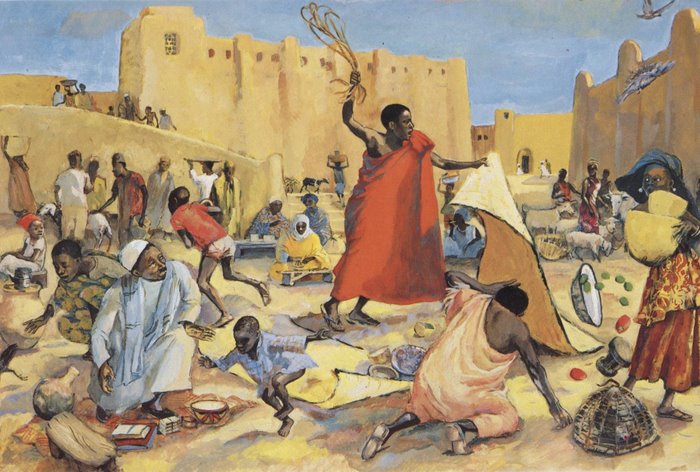
Following is a 1973 painting of the JESUS MAFA project, a response to New Testament readings from the Lectionary by a Christian community in Cameroon, Africa. Each of the readings was selected and adapted to dramatic interpretation by the community members. Photographs of their interpretations were made, and these were then transcribed to paintings:
From Art in the Christian Tradition, a project of the Vanderbilt Divinity Library, Nashville, TN. Image retrieved March 23, 2026. Original source: librairie-emmanuel.fr.
In many English translations the Greek terms “hieron” (the whole “temple” in Jerusalem or specifically the outer courts open to worshippers) and “naos” (the inner “shrine” or “sanctuary”) are translated with only one word: “temple” (see also for instance “Tempel” in German [for exception see below] and “tempel” in Dutch, Danish, or Afrikaans).
Other languages make a distinction: (Click or tap here to see more)
Navajo (Dinė): “house in which worship is carried out” (for naos)
Balinese: “inner part of the Great Temple” (“the term ‘inner part’ denoting the hindmost and holiest of the two or three courts that temples on Bali usually possess”) vs. “Great Temple”
Telugu: “womb (i.e. interior)-of-the-abode” vs. “abode”
Thai: a term denoting the main audience hall of a Buddhist temple compound vs. “environs-of-the-main-audience-hall”
Kituba: “place of holiness of house-God Lord” vs. “house-God Lord”
Shipibo-Conibo: “deep in God’s house” vs. “God’s house” (source: Reiling / Swellengrebel)
Germandas Buch translation by Roland Werner (publ. 2009-2022): “inner court of the temple” (Tempelinnenhof) vs. “temple”
Languages that, like English, German, Dutch, Danish, or Afrikaans, don’t make that distinction include:
Toraja-Sa’dan: “house that is looked upon as holy, that is sacred, that is taboo and where one may not set foot” (lit. “house where-the-belly-gets-swollen” — because taboo is violated — using a term that is also applied to a Muslim mosque) (source for this and the three above: Reiling / Swellengrebel)
Aguaruna: “the house for talking to God” (source for this and above: M. Larson / B. Moore in Notes on Translation February 1970, p. 1-125.)
Guhu-Samane: “festival longhouse of God” (“The biiri, ‘festival longhouse’, being the religious and social center of the community, is a possible term for ‘temple’. It is not the ‘poro house’ as such. That would be too closely identified with the cult of poro. The physical features of the building, huge and sub-divided, lend it further favor for this consideration. By qualifying it as ‘God’s biiri’ the term has become meaningful and appropriate in the context of the Scriptures.”) (Source: Ernest Richert in The Bible Translator, 1965, p. 81ff. )
Enga: “God’s restricted access house” (source: Adam Boyd on his blog )
Another distinction that tends to be overlooked in translations is that between hieron (“temple” in English) and sunagógé (“synagogue” in English). Euan Fry (in The Bible Translator 1987, p. 213ff. ) reports on this:
“Many older translations have simply used transliterations of ‘temple’ and ‘synagogue’ rather than trying to find equivalent terms or meaningful expressions in their own languages. This approach does keep the two terms separate; but it makes the readers depend on explanations given by pastors or teachers for their understanding of the text.
“Translators who have tried to find meaningful equivalents, for the two terms ‘temple’ and ‘synagogue’ have usually made a distinction between them in one of two ways (which focus on the contrasting components of meaning). One way takes the size and importance of the Temple to make a contrast, so that expressions such as ‘sacred meeting/ worship house of the Jews’ and ‘big sacred meeting/worship house of the Jews’ are used. The other way focuses on the different nature of the religious activity at each of the places, so that expressions such as ‘meeting/worship house of the Jews’ and ‘sacrifice/ceremony place of the Jews’ are used.
“It is not my purpose in this article to discuss how to arrive at the most precise equivalent to cover all the components of meaning of ‘temple’. That is something that each translator really has to work through for himself in the light of the present usage and possibilities in his own language. My chief concern here is that the basic term or terms chosen for ‘temple’ should give the reader of a translation a clear and correct picture of the location referred to in each passage. And I am afraid that in many cases where an equivalent like ‘house of God’ or ‘worship house’ has been chosen, the readers have quite the wrong picture of what going to the Temple or being in the Temple means. (This may be the case for the word ‘temple’ in English too, for many readers.)”
Here are some examples:
Bambara: “house of God” (or: “big house of worship”) vs. “worship house” (or: “small houses of worship”)
Toraja-Sa’dan: “house where-the-belly-gets-swollen” (see above) vs. “meeting house for discussing matters concerning religious customs” (and “church” is “house where one meets on Sunday”)
Navajo (Dinė): “house in which worship is carried out” vs. “house of gathering” (source for all above: Bratcher / Nida)
Click or tap here to see a short video clip about Herod’s temple (source: Bible Lands 2012)Click or tap here to see a short video clip showing synagogues in New Testament times (source: Bible Lands 2012)
Living Water is produced for the Bible translation movement in association with Lutheran Bible Translators. Lyrics derived from the ESV® Bible (The Holy Bible, English Standard Version®).
Good News Translation reorders the response of the Jewish authorities to Jesus. In Greek the mention of the forty-six years that it took to build the Temple comes before the question, Are you going to build it again in three days? But for the purposes of English style the present order is more forceful, since, in responding to the shocking statement or command, it is more natural in conversational English to use a question first, and then to expand its implication by a statement.
In some languages it is appropriate to introduce the question in verse 20 as being the idea of someone; for example, “Do you think that you are going to build it again in three days?” or “How do you imagine that you are going to build it again in three days?” In this way some of the irony and surprise can be brought out.
It has taken forty-six years to build this Temple may be more literally rendered “this Temple was built in forty-six years.” The verb “was built” is aorist, and so focuses attention on the completion of the act of building, rather than on the process. Actually, the Temple was not completed until A.D. 63. Some scholars believe that John made a chronological error here, assuming that the Temple was completed at the same time as Jesus’ ministry, when actually it was not. However, it is natural to take “was built” as a summary of the whole process of building without necessarily implying that the building was completed at the time the statement was made. It is interesting that in the Septuagint of Ezra 5.16 the same aorist form of the verb is used of the building of the Temple, and there also the Temple was not yet completed.
It is possible to transform the passive expression It has taken forty-six years to build this Temple into an active one by introducing an indefinite subject, such as “men” or a more definite subject such as “builders,” for example, “Men worked forty-six years to build this Temple” or “Builders have worked forty-six years to complete this Temple.”
As in many other contexts, the term Temple must be translated as simply “the house of God,” as it is called in many Old Testament texts. This same type of expression occurs also in the New Testament. Such a phrase, however, must not be confused with a term for heaven, which in some languages is “the place where God dwells” or “the place where God is.”
Quoted with permission from Newman, Barclay M. and Nida, Eugene A. A Handbook on the Gospel of John. (UBS Handbook Series). New York: UBS, 1980. For this and other handbooks for translators see here .


Leave a Reply
You must be logged in to post a comment.