39And going a little farther, he threw himself on the ground and prayed, “My Father, if it is possible, let this cup pass from me, yet not what I want but what you want.”
In Hindi a differentiation is made between the way that the different persons of the Trinity are addressed by a regular person or by another person of the Trinity. When Jesus addresses God the Father or when God the Father addresses Jesus, a familiar form of address is used, unlike the way that any of them would be addressed with a honorific (pl.) form by anyone else.
The Greek that is translated as “cup” in English is translated in Chol as vaso i yejtal bʌ wocol: “glass which is the picture of affliction.”
Wilbur Aulie (in The Bible Translator 1957, p. 109ff. ) explains: “Whatever the precise meaning of ‘cup’ may be in these verses may never be agreed upon, but in the Septuagint it is used metaphorically of adversity and divine punishment. In these verses we used a Spanish borrowing vaso ‘glass’ and added the explanatory phrase, ‘which is the picture of wocol‘. Wocol has a rather wide range of meaning, including affliction, trial, punishment, and retribution. The term vaso was preferred to copa, which is regularly used by Spanish-speaking Christians, since Chol Christians understand copa to be a small glass of intoxicating drink.”
The Hebrew, Greek, and Latin that is translated as “cup” in English is translated in Sar with “calabash” (see here ) (source: Ngarbolnan Riminan in Le Sycomore 2000, p. 20ff. ) and in Bariai with “coconut shell” (source: Bariai Back Translation)
The Greek that is translated as “my Father” in English is translated in Matumbi as Tati’ bangu’ or “my fathers.” “Our Father” is translated as “our Fathers” (and likewise “our ancestor” as “our ancestors”). Matumbi uses a majestic plural as an honorific when addressing parents. (Source: Tim Macsaveny)
The now commonly-used German idiom dieser Kelch gehe an jemandem vorüber (literally “may this chalice pass by someone”), which today is primarily means “hoping that fate will not go this but another way for someone,” was made popular in 1522 in the German New Testament translation by Martin Luther. (Source: Redewendungen aus der Bibel )
For other idioms or terms in German that were coined by Bible translation, see here.
Translators of different languages have found different ways with what kind of formality God is addressed.
Like many languages (but unlike Greek or Hebrew or modern English), Tuvan uses a formal vs. informal 2nd person pronoun (a familiar vs. a respectful “you”). Unlike other languages that have this feature, however, the translators of the Tuvan Bible have attempted to be very consistent in using the different forms of address in every case a 2nd person pronoun has to be used in the translation of the biblical text.
As Voinov shows in Pronominal Theology in Translating the Gospels (in: The Bible Translator2002, p. 210ff. ), the choice to use either of the pronouns many times involved theological judgment. While the formal pronoun can signal personal distance or a social/power distance between the speaker and addressee, the informal pronoun can indicate familiarity or social/power equality between speaker and addressee.
In these verses, in which humans address God, the informal, familiar pronoun is used that communicates closeness.
Voinov notes that “in the Tuvan Bible, God is only addressed with the informal pronoun. No exceptions. An interesting thing about this is that I’ve heard new Tuvan believers praying with the formal form to God until they are corrected by other Christians who tell them that God is close to us so we should address him with the informal pronoun. As a result, the informal pronoun is the only one that is used in praying to God among the Tuvan church.”
In Gbaya, “a superior, whether father, uncle, or older brother, mother, aunt, or older sister, president, governor, or chief, is never addressed in the singular unless the speaker intends a deliberate insult. When addressing the superior face to face, the second person plural pronoun ɛ́nɛ́ or ‘you (pl.)’ is used, similar to the French usage of vous.
Accordingly, the translators of the current version of the Gbaya Bible chose to use the plural ɛ́nɛ́ to address God. There are a few exceptions. In Psalms 86:8, 97:9, and 138:1, God is addressed alongside other “gods,” and here the third person pronoun o is used to avoid confusion about who is being addressed. In several New Testament passages (Matthew 21:23, 26:68, 27:40, Mark 11:28, Luke 20:2, 23:37, as well as in Jesus’ interaction with Pilate and Jesus’ interaction with the Samaritan woman at the well) the less courteous form for Jesus is used to indicate ignorance of his position or mocking.” (Source Philip Noss)
In the most recent Manchu translation of 1835 (a revision of an earlier edition from 1822), God is never addressed with a pronoun but with “father” (ama /ᠠᠮᠠ) instead. Chengcheng Liu (in this post on the Cambridge Centre for Chinese Theology blog ) explains: “In Manchu tradition, as in Chinese etiquette, second-person pronouns could be considered disrespectful when speaking to superiors or spiritual beings. Manchu Shamanist prayers avoided si [‘you’] and sini [‘your’] for this very reason. To use them for God would be, in Lipovzoff’s [one of the two translators] words, ‘the most uncouth and indecent way to speak to the Almighty — as if He were a servant or slave.’ There was also a grammatical problem. In Manchu, si and sini could refer to both singular and plural subjects. For a faith that insisted on the singularity of God, this was potentially confusing. By contrast, repeating ama removed any ambiguity.”
Hand colored stencil print on momigami by Sadao Watanabe (1962). Image taken with permission from the SadaoHanga Catalogue where you can find many more images and information about Sadao Watanabe. For other images of Sadao Watanabe art works in TIPs, see here.
Following is a painting (“Jesus’ agony in the garden of Gethsemane”) by Kim Ki-chang (1913-2001):
Kim Ki-chang (pen name: Unbo) had been deaf and partially mute since the age of 7. He painted a series of 30 paintings for the “Life of Christ” cycle in 1952 during the Korean War. Kim portrayed Jesus as a seonbi / 선비, or a Joseon Period (1392-1910) gentleman scholar, wearing a gat / 갓 (hat) and dopo / 도포 (robe). For other images of Kim Ki-chang art works in TIPs, see here.
Following is a painting (“Prayer at Gethsemane”) by He Qi:
Image taken from He Qi Art . For purchasing prints of this and other artworks by He Qi go to heqiart.com . For other images of He Qi art works in TIPs, see here
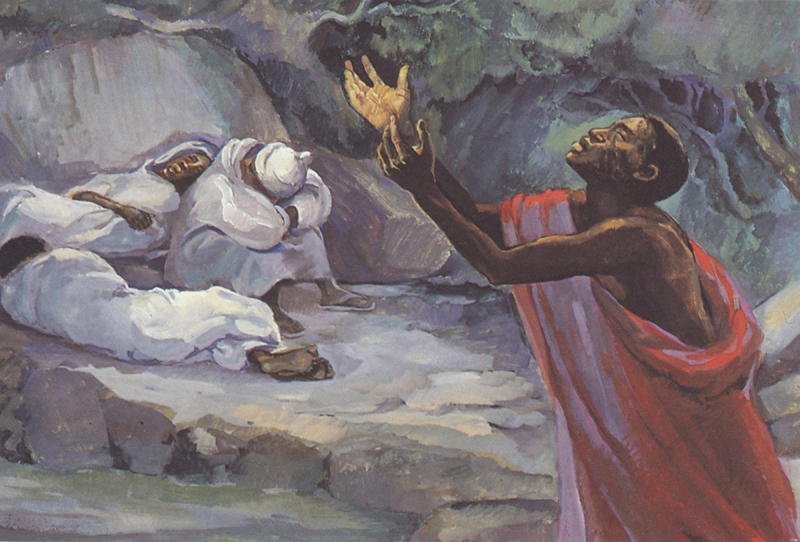
Following is a 1973 painting of the JESUS MAFA project, a response to New Testament readings from the Lectionary by a Christian community in Cameroon, Africa. Each of the readings was selected and adapted to dramatic interpretation by the community members. Photographs of their interpretations were made, and these were then transcribed to paintings:
From Art in the Christian Tradition, a project of the Vanderbilt Divinity Library, Nashville, TN. Image retrieved March 23, 2026. Original source: librairie-emmanuel.fr.
Photo by NateBergin, hosted by Wikimedia Commons under a Creative Commons Attribution 4.0 International license
Stained glass is not just highly decorative, it’s a medium which has been used to express important religious messages for centuries. Literacy was not widespread in the medieval and Renaissance periods and the Church used stained glass and other artworks to teach the central beliefs of Christianity. In Gothic churches, the windows were filled with extensive narrative scenes in stained glass — like huge and colorful picture storybooks — in which worshipers could ‘read’ the stories of Christ and the saints and learn what was required for their religious salvation. (Source: Victoria and Albert Museum )
“beg” or “ask,” (full expression: “ask with one’s heart coming out,” which leaves out selfish praying, for asking with the heart out leaves no place for self to hide) (Tzotzil)
“raise up one’s words to God” (implying an element of worship, as well as communication) (Miskito, Lacandon) (source of this and all above: Bratcher / Nida)
“speak to God” (Shilluk) (source: Nida 1964, p. 237)
“talk together with Great Above One (=God)” (Mairasi) (source: Enggavoter, 2004)
“beg” (waan) (Ik). Terrill Schrock (in Wycliffe Bible Translators 2016, p. 93) explains (click or tap here to read more):
What do begging and praying have to do with each other? Do you beg when you pray? Do I?
“The Ik word for ‘visitor’ is waanam, which means ‘begging person.’ Do you beg when you go visiting? The Ik do. Maybe you don’t beg, but maybe when you visit someone, you are looking for something. Maybe it’s just a listening ear.
When the Ik hear that [my wife] Amber and I are planning trip to this or that place for a certain amount of time, the letters and lists start coming. As the days dwindle before our departure, the little stack of guests grows. ‘Please, sir, remember me for the allowing: shoes, jacket (rainproof), watch, box, trousers, pens, and money for the children. Thank you, sir, for your assistance.’
“A few people come by just to greet us or spend bit of time with us. Another precious few will occasionally confide in us about their problems without asking for anything more than a listening ear. I love that.
“The other day I was in our spare bedroom praying my list of requests to God — a nice list covering most areas of my life, certainly all the points of anxiety. Then it hit me: Does God want my list, or does he want my relationship?
“I decided to try something. Instead of reading off my list of requests to God, I just talk to him about my issues without any expectation of how he should respond. I make it more about our relationship than my list, because if our personhood is like God’s personhood, then maybe God prefers our confidence and time to our lists, letters, and enumerations.”
In Luang it is translated with different shades of meaning (click or tap here to read more):
For Acts 1:14, 20:36, 21:5: kola ttieru-yawur nehla — “hold the waist and hug the neck.” (“This is the more general term for prayer and often refers to worship in prayer as opposed to petition. The Luang people spend the majority of their prayers worshiping rather than petitioning, which explains why this term often is used generically for prayer.”)
For Acts 28:9: sumbiani — “pray.” (“This term is also used generically for ‘prayer’. When praying is referred to several times in close proximity, it serves as a variation for kola ttieru-yawur nehla, in keeping with Luang discourse style. It is also used when a prayer is made up of many requests.”)
For Acts 8:15, 12:5: polu-waka — “call-ask.” (“This is a term for petition that is used especially when the need is very intense.”)
Source: Kathy Taber in Notes on Translation 1/1999, p. 9-16.







Leave a Reply
You must be logged in to post a comment.