
The Greek in Matthew 26:38 that is translated as “my soul is deeply grieved, even to death” or similar in English is translated in the German New Testament translation by Berger / Nord (publ. 1999) with ich habe große Angst vor dem Sterben or “I am very afraid of dying.”
soul
The Hebrew, Greek, Ge’ez, and Latin that is translated as “soul” in English is translated in Chol with a term that refers to the invisible aspects of human beings (source: Robert Bascom), in Yagaria with oune or “shadow, reflection” (source: Renck, p. 81), and in Elhomwe as “heart” (source: project-specific translation notes in Paratext).
The Mandarin Chinese línghún (靈魂 / 灵魂), literally “spirit-soul,” is often used for “soul” (along with xīn [心] or “heart”). This is a term that was adopted from Buddhist sources into early Catholic writings and later also by Protestant translators. (Source: Zetzsche 1996, p. 32, see also Clara Ho-yan Chan in this article )
In Chichewa, moyo means both “soul” and “life.” (Source: Mawu a Mulungu mu Chichewa Chalero Back Translation)
See also heart, soul, mind.
Gethsemane

Hand colored stencil print on momigami by Sadao Watanabe (1962). Image taken with permission from the SadaoHanga Catalogue where you can find many more images and information about Sadao Watanabe. For other images of Sadao Watanabe art works in TIPs, see here.
Following is a painting (“Jesus’ agony in the garden of Gethsemane”) by Kim Ki-chang (1913-2001):

Kim Ki-chang (pen name: Unbo) had been deaf and partially mute since the age of 7. He painted a series of 30 paintings for the “Life of Christ” cycle in 1952 during the Korean War. Kim portrayed Jesus as a seonbi / 선비, or a Joseon Period (1392-1910) gentleman scholar, wearing a gat / 갓 (hat) and dopo / 도포 (robe). For other images of Kim Ki-chang art works in TIPs, see here.
Following is a painting (“Prayer at Gethsemane”) by He Qi:
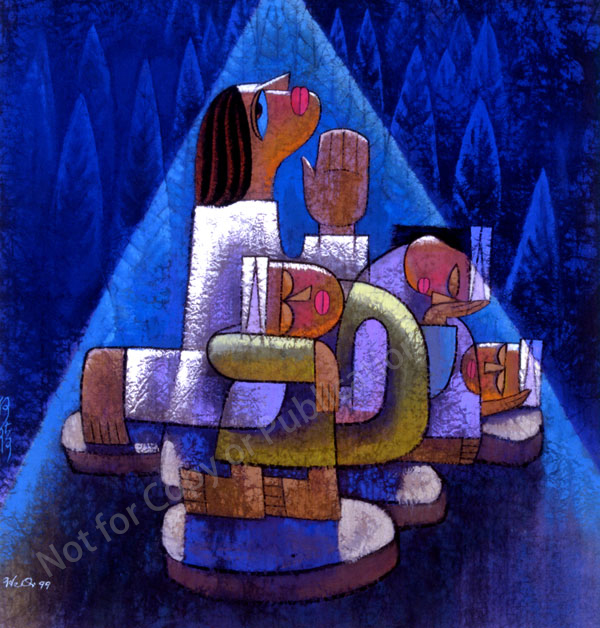
He Qi © 2021 All Rights Reserved.
Image taken from He Qi Art . For purchasing prints of this and other artworks by He Qi go to heqiart.com . For other images of He Qi art works in TIPs, see here
Following is a painting in the Hamzanama style:

Prayer at Gethsemane, 2017-2018, Paul Abraham with Manish Soni, Opaque watercolour and natural pigments on hand-made paper, © Sarmaya Arts Foundation. (2018.33.12)
Following is a 1973 painting of the JESUS MAFA project, a response to New Testament readings from the Lectionary by a Christian community in Cameroon, Africa. Each of the readings was selected and adapted to dramatic interpretation by the community members. Photographs of their interpretations were made, and these were then transcribed to paintings:
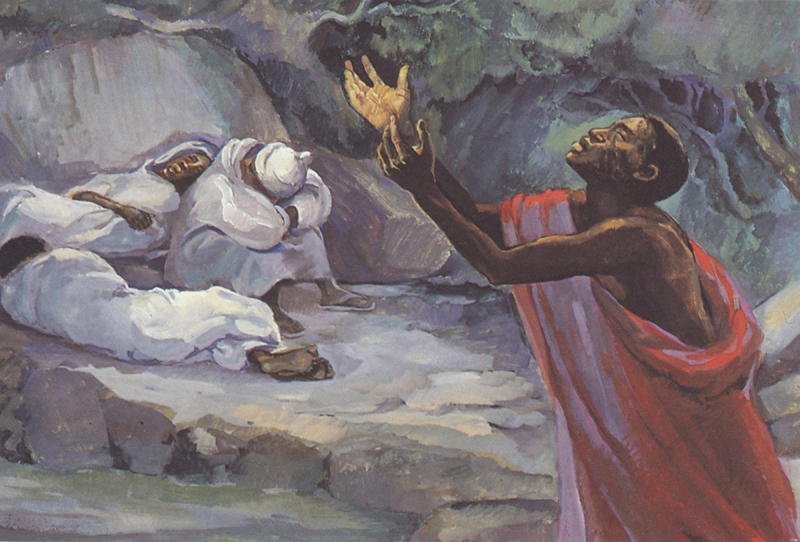
From Art in the Christian Tradition , a project of the Vanderbilt Divinity Library, Nashville, TN. Image retrieved March 23, 2026. Original source: librairie-emmanuel.fr.
The following is a stained glass window from 1906 and made by R. T. Giles & Co. of Minneapolis for the First Presbyterian Church, Salt Lake City, Utah :

Photo by NateBergin, hosted by Wikimedia Commons under a Creative Commons Attribution 4.0 International license

Stained glass is not just highly decorative, it’s a medium which has been used to express important religious messages for centuries. Literacy was not widespread in the medieval and Renaissance periods and the Church used stained glass and other artworks to teach the central beliefs of Christianity. In Gothic churches, the windows were filled with extensive narrative scenes in stained glass — like huge and colorful picture storybooks — in which worshipers could ‘read’ the stories of Christ and the saints and learn what was required for their religious salvation. (Source: Victoria and Albert Museum )
complete verse (Matthew 26:38)
Following are a number of back-translations of Matthew 26:38:
- Uma: “He said to them: ‘My heart is very sad, I feel like I’m going to die. You stay here for now, watch/guard long with me.'” (Source: Uma Back Translation)
- Yakan: “So-then he said to them, ‘My liver is very grieved, it is almost killing me. Stay here now and keep watch.'” (Source: Yakan Back Translation)
- Western Bukidnon Manobo: “And he said to them, ‘My breath is very painful. It’s as if I am dying. You stay here and don’t you sleep.'” (Source: Western Bukidnon Manobo Back Translation)
- Kankanaey: “and he said to them, ‘My sadness is excessive. It’s as if this will be my death. You stay here to companion-me. Don’t go to sleep.'” (Source: Kankanaey Back Translation)
- Tagbanwa: “He said to those three, ‘I am really very sad/troubled like it would kill me. I ask you please to wait here and don’t go to sleep. Stay awake with me.'” (Source: Tagbanwa Back Translation)
- Tenango Otomi: “He said to those with him: ‘Very much is my heart sad, I feel that I am going to die from it. Wait here now, but don’t sleep. Let us keep awake.'” (Source: Tenango Otomi Back Translation)
1st person pronoun referring to God (Japanese)
Click or tap here to see the rest of this insight.
Like a number of other East Asian languages, Japanese uses a complex system of honorifics, i.e. a system where a number of different levels of politeness are expressed in language via words, word forms or grammatical constructs. These can range from addressing someone or referring to someone with contempt (very informal) to expressing the highest level of reference (as used in addressing or referring to God) or any number of levels in-between.
One way Japanese shows different degree of politeness is through the choice of a first person singular and plural pronoun (“I” and “we” and its various forms) as shown here in the widely-used Japanese Shinkaiyaku (新改訳) Bible of 2017. The most commonly used watashi/watakushi (私) is typically used when the speaker is humble and asking for help. In these verses, where God / Jesus is referring to himself, watashi is also used but instead of the kanji writing system (私) the syllabary hiragana (わたし) is used to distinguish God from others.
(Source: S. E. Doi, see also S. E. Doi in Journal of Translation, 18/2022, p. 37ff. )
See also pronoun for “God”.
Honorary "are" construct denoting God ("say")
Click or tap here to see the rest of this insight.
Like a number of other East Asian languages, Japanese uses a complex system of honorifics, i.e. a system where a number of different levels of politeness are expressed in language via words, word forms or grammatical constructs. These can range from addressing someone or referring to someone with contempt (very informal) to expressing the highest level of reference (as used in addressing or referring to God) or any number of levels in-between.
One way Japanese shows different degree of politeness is through the usage of an honorific construction where the morpheme are (され) is affixed on the verb as shown here in the widely-used Japanese Shinkaiyaku (新改訳) Bible of 2017. This is particularly done with verbs that have God as the agent to show a deep sense of reverence. Here, iw-are-ru (言われる) or “say” is used.
(Source: S. E. Doi, see also S. E. Doi in Journal of Translation, 18/2022, p. 37ff. )
Sung version of Matthew 26
Translation commentary on Matthew 26:38
My soul is a typical Semitic way of referring to oneself, especially when deep emotions are involved. As indicated in verse 37, the adjective very sorrowful is derived from the same stem as the verb “to be sorrowful,” except that the adjective is a more intensive form. My soul is very sorrowful is translated “My heart is ready to break with grief” by New English Bible. Die Bibel im heutigen Deutsch uses an idiomatic expression: “On me there lies a burden, which has almost crushed me.” When the sorrow is even to death, the meaning is that it is so great it could even bring on the death of the person. Some translators then add the phrase “I could even die (from the sorrow),” but others use intense expressions such as “crushes” of Good News Translation and Die Bibel im heutigen Deutsch, or sentences such as “the grief that I feel is so great it could overcome (or, destroy) me.”
Remain translates a verb which is used frequently in the Gospel of John (forty times), and often with a figurative sense; Matthew uses the verb only three times (elsewhere 10.11; 11.23), and the meaning is always obvious.
Watch (RSV footnote “keep awake”) is used twice again in the Gethsemane narrative (verses 40, 41); elsewhere in the Gospel it is used in an appeal for alertness for the coming of the Son of Man (24.42, 43; 25.13). Good News Translation has “keep watch with me,” and Barclay has “share my vigil.”
With me is not found in Mark (14.35). Throughout the Gethsemane account Matthew emphasizes the relationship between Jesus and his disciples in a way that Mark does not; note, for example, the phrase “to the disciples” (verses 40, 45), as well as “with them” of verse 36.
Quoted with permission from Newman, Barclay M. and Stine, Philip C. A Handbook on the Gospel of Matthew. (UBS Handbook Series). New York: UBS, 1988. For this and other handbooks for translators see here .
Leave a Reply
You must be logged in to post a comment.