Lloyd Peckham explains the Mairasi translation: “In secret stories, not knowable to women nor children, there was a magical fruit of life. If referred to vaguely, without specifying the specific ‘fruit,’ it can be an expression for eternity.”
Following are a number of back-translations of John 4:36:
Uma: “The people who harvest certainly receive their salary, with the result that the harvesters and the planters will be glad together. The fruit that they harvest, its meaning [is] people who receive good life until forever.” (Source: Uma Back Translation)
Yakan: “The people who gather them to bring to me get a good reward. And the people they gather are given life forever. Therefore the ones planting and the ones gathering are equally happy/joyful.” (Source: Yakan Back Translation)
Western Bukidnon Manobo: “And he who harvests, which is to say, he who caused them to understand so that they might believe in me, God has a reward for him. And those people whom he harvests, they will be given eternal life. Therefore the one who plants the word of God and the one who harvests the fruit of the word of God, they will all rejoice.” (Source: Western Bukidnon Manobo Back Translation)
Kankanaey: “Those who harvest, they will be salaried, and the people whom they harvest, they will gain life that has no end. Therefore those who planted (used of rice seedlings) the word of God, they will rejoice-with the harvesters.” (Source: Kankanaey Back Translation)
Tagbanwa: “Therefore it would be good if you start now to harvest. It’s really assured that God will give a reward for what you will have done, which is to cause people to believe-in/obey me so that life without ending can be theirs. Really far-from-ordinary is the happiness of that harvester, likewise the field-cultivator.” (Source: Tagbanwa Back Translation)
Tenango Otomi: “He who harvests gets a wage. In like manner he who encourages the people so they believe in me will get a wage. And those people who believe in me will have the new life forever. Therefore he who first gives the word and he who encourages the people so they believe in me together will rejoice.” (Source: Tenango Otomi Back Translation)
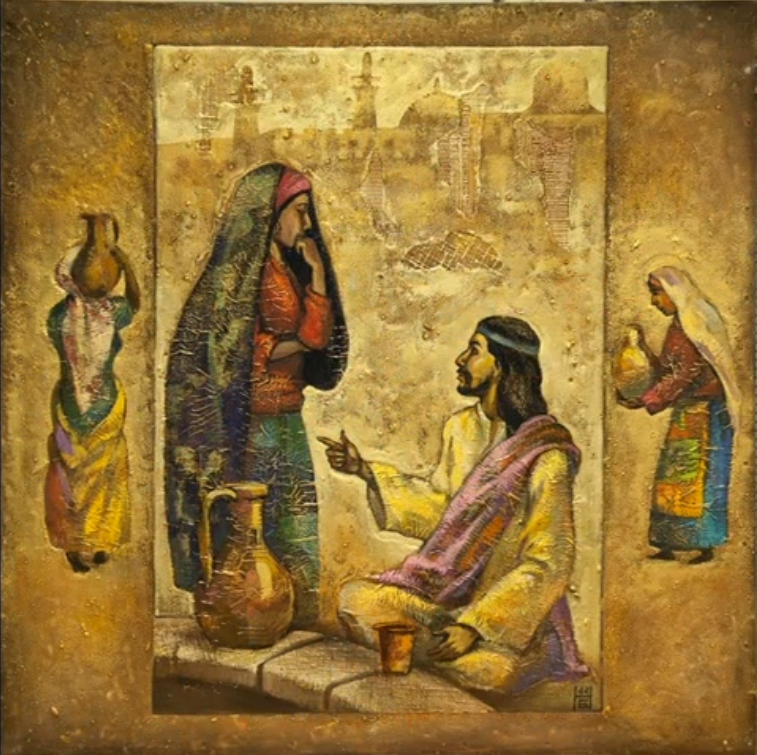
“Jesus is dressed in a different style of clothing than the style of the woman who is shown as a Lanna Thai northerner. It is unusual for him to talk to a person from a different region, especially a woman. The clothes, the roof of the house in the background, and the dipper for water all indicate that this is in northern Thailand.”
Ketut Lasia is one of the last traditional Balinese painters in the Ubud style. As an adult, Lasia converted from Hinduism to Christianity, and he paints primarily biblical scenes. You can find artwork from Ketut Lasia in a variety of formats for sale at Fine Art America .
Noongar: koort-kwabba-djil or “heart very good” (source: Warda-Kwabba Luke-Ang)
Chicahuaxtla Triqui: “refreshed heart” (source: Waterhouse / Parrott in Notes on Translation October 1967, p. 1ff.).
HausaCommon Language Bible: farin ciki or “white stomach.” Other languages that use the same expression include Southern Birifor (pʋpɛl), Dera (popolok awo), Reshe (ɾipo ɾipuhã). (Source: Andy Warren-Rothlin)
The Greek that is typically translated with a generic expressions such as “he who,” “whoever,” or “if anyone” in English is translated with the plural form (“they”) in Daga. “A literal translation of these conveys the idea that one specific unnamed individual is being discussed. Thus, for instance, in John 5:24 ‘he who hears my word and believes in him who sent me has eternal life’ meant in Daga that there was one fortunate individual to whom it applied.”
This verse contrasts the natural crops and the “spiritual crops.” There is an interval of four months between sowing and harvesting natural crops, but it may be that this passage suggests that with the “spiritual crops” the results are immediate. What is emphasized is the joy which both the one who plants and the one who reaps have in common.
Good News Translation makes explicit the object of the verb reaps (that is, the harvest), which is unexpressed in Greek. Gathers the crops for eternal life is literally “gathers fruit for eternal life,” but the use of the plural crops is more natural in English than the singular “fruit.” In this context the crops are people who believe, while the phrase for eternal life means “that these people who believe may have eternal life.” However, though the sense of the imagery that Jesus uses may be explained in this way, it is usually unwise to remove the metaphor (“demetaphorize”) when translating. Here, as in other passages of John, the imagery is so closely tied to the event to which it refers that to “demetaphorize” in translation may require so much reworking as to go beyond the legitimate limits of translation.
The phrase the man who reaps the harvest may be translated as more or less equivalent to “the man who harvests” or “the man who cuts the grain” or even “the man who brings the grain in from the field.” The choice of a term or phrase will depend upon the most natural way of speaking about harvesting in the language concerned.
The passive expression is being paid may be made active by indicating the agent, who would be God, that is, “God pays the man who harvests.” However, the introduction of God as the agent of the paying may be misunderstood. It may be better to use a so-called pseudo-passive, for example, “receive pay,” since the pay the harvester receives is essentially eternal life. Here reaping the harvest and gathering the crops refer to the same process.
Quoted with permission from Newman, Barclay M. and Nida, Eugene A. A Handbook on the Gospel of John. (UBS Handbook Series). New York: UBS, 1980. For this and other handbooks for translators see here .
Already the reaper draws his wages: There is an interpretation issue here. There are two words that the word Already could be connected to.
(1) The word Already connects with (or modifies) the word draws and belongs to verse 36. For example:
Already the one who reaps is receiving wages (English Standard Version)
(Berean Standard Bible, New International Version, New Jerusalem Bible, New American Standard Bible, New Revised Standard Version, English Standard Version, God’s Word, Contemporary English Version)
(2) The word Already connects with (or modifies) the word white (or ripe) and belongs to verse 35. For example:
the fields are already white for harvest! (NET Bible)
(Revised English Bible, King James Version, Revised Standard Version, NET Bible, New Living Translation (2004), New Century Version)
The New Jerusalem Bible translates Already in both verses. The UBS Handbook Greek text supports interpretation (1), as do most commentaries. It is recommended that you follow interpretation (1) as well.
the reaper: A reaper is someone who harvests crops. This is a metaphor. People (like the Samaritan woman) who bring people to Jesus are like people who reap or harvest a field. The point of comparison is that they both gather things that are ready. A reaper gathers a crop, while a person who shares the gospel gathers people into God’s kingdom.
In some languages a metaphor like this is not clearly understood. It may be necessary to explain the metaphor. For example:
The one who gathers the harvest/people ⌊to bring to me⌋ -or-
Those who cause others to come to me -or-
And he who harvests, ⌊that is, he who caused them to understand so that they might believe in me⌋
draws his wages: This is a metaphor. It refers to receiving a benefit or reward for one’s work. The reaper is like someone who tells others about Jesus and persuades them to believe in him. Those evangelists are like people who earn wages, because they receive benefit (in the form of blessings) from their work. In some languages a metaphor like this is not clearly understood.
Here are some other ways to translate this metaphor:
• Change the metaphor into a simile. For example:
A person who leads others to me is like a reaper receiving his wages. -or-
He who harvests gets a wage. In a similar way he who causes people to believe in me will get a reward.
• Make the meaning of the figure of speech explicit. For example:
The person who gathers others and brings them to me is receiving a reward from God. -or-
God will give you a reward when you cause people to believe in me.
4:36b
and gathers a crop for eternal life: This is a metaphor referring to the harvest. The metaphor gathers a crop refers to leading people to Jesus. Those who believe and follow Jesus receive eternal life.
There are several ways to translate this metaphor:
• Keep the figure of speech. For example:
he harvests the crop for eternal life (New International Version)
• Change the metaphor to a simile. For example:
The people they bring to me are given life forever. They are like the crop that a farmer gathers. -or-
As a farmer harvests a crop, so they are leading people to me to receive eternal life.
• Keep the metaphor and explain the meaning. For example:
the fruit they harvest is people brought to eternal life (New Living Translation (2004))
eternal life: The word eternal refers to something that does not end. The phrase eternal life refers to the new spiritual life that God gives us when we believe in Jesus. It is life that never ends. See the note at 3:15 and how you translated the phrase there and in 4:14c. Here are some other ways to translate this phrase:
forever life ⌊from God⌋ -or-
⌊spiritual⌋ life that never ends -or-
living forever ⌊with God⌋
4:36c
so that the sower and the reaper may rejoice together: The Greek word that the Berean Standard Bible translates as so that indicates the purpose of the reaper gathering fruit. He does that so that both he and the sower may rejoice together. A sower is one who plants seeds. A reaper is one who harvests the crop. At harvest time, both the sower and the reaper can be glad when they see the result of their work.
Here is another way to translate this clause:
So the person who plants the grain and the person who harvests it are happy together (God’s Word)
The word sower is a metaphor for the person who speaks God’s message. The word reaper is a metaphor for the person who helps others accept the message. In some languages a metaphor like this may not be clearly understood. It may be necessary to change the metaphor to a simile and explain the meaning. For example:
⌊The one who tells others about me is like⌋ a person who sows seed. ⌊And the one who helps people to accept me is like⌋ the one who reaps the crop. They will rejoice together.



Leave a Reply
You must be logged in to post a comment.