complete verse (John 4:37)

Following are a number of back-translations of John 4:37:

  • Uma: “So, the saying is true that says: ‘One plants, another harvests.'” (Source: Uma Back Translation)
  • Yakan: “This saying is true, they say, ‘One plants and another harvests.'” (Source: Yakan Back Translation)
  • Western Bukidnon Manobo: “It is very true the word of God which says, ‘One plants and another harvests.'” (Source: Western Bukidnon Manobo Back Translation)
  • Kankanaey: “The saying of people is true (appreciation particle) which says, ‘One transplants, another also harvests.'” (Source: Kankanaey Back Translation)
  • Tagbanwa: “For herein, what the saying says is true that the cultivator and the harvester are not the same person.” (Source: Tagbanwa Back Translation)
  • Tenango Otomi: “There is a saying which goes: ‘One plants, another harvests.'” (Source: Tenango Otomi Back Translation)

He deliberately took time to draw near to social outcasts (image)

“Jesus is dressed in a different style of clothing than the style of the woman who is shown as a Lanna Thai northerner. It is unusual for him to talk to a person from a different region, especially a woman. The clothes, the roof of the house in the background, and the dipper for water all indicate that this is in northern Thailand.”

Drawing by Sawai Chinnawong who employs northern and central Thailand’s popular distinctive artistic style originally used to depict Buddhist moral principles and other religious themes; explanation by Paul DeNeui. From That Man Who Came to Save Us by Sawai Chinnawong and Paul H. DeNeui, William Carey Library, 2010. . For more images by Sawai Chinnawong in TIPs see here.

See also The woman at the well (image).

Learn more on Bible Odyssey: Woman at the Well .

The woman at the well


Following is a painting in the Hamzanama style:

The woman at the well, 2017-2018, Paul Abraham with Manish Soni, Opaque watercolour and natural pigments on hand-made paper, © Sarmaya Arts Foundation. (2018.33.5)

Following is a painting by Ketut Lasia (b. 1945):

Ketut Lasia is one of the last traditional Balinese painters in the Ubud style. As an adult, Lasia converted from Hinduism to Christianity, and he paints primarily biblical scenes. You can find artwork from Ketut Lasia in a variety of formats for sale at Fine Art America .

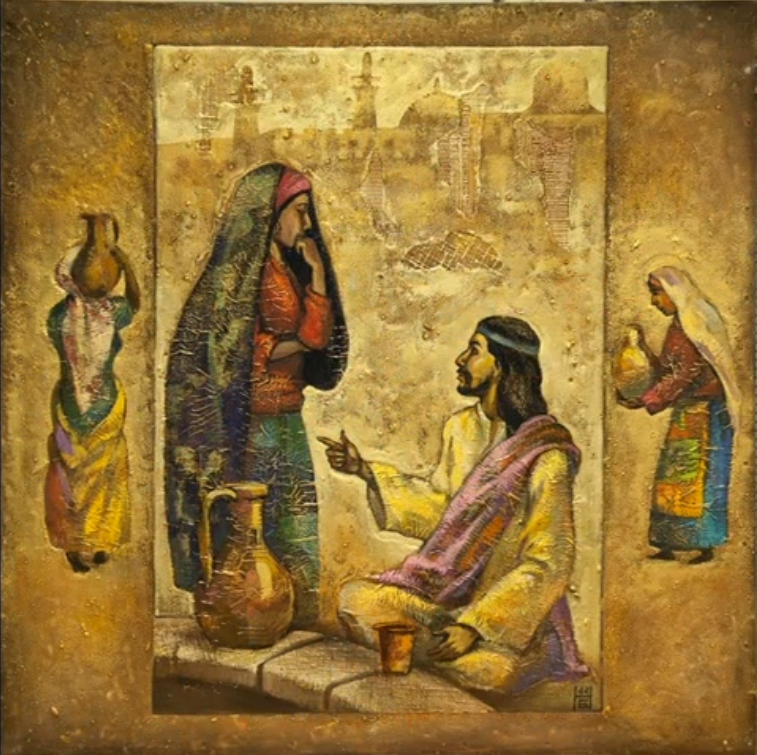
See also He deliberately took time to draw near to social outcasts (image).

The following artwork is part of a series of 56 paintings on biblical themes by Kazakh artist Nelly Bube (born 1949):

Copyright by Norwegian Bible Society , used with permission.

For other images of Nelly Bube in TIPs, see here.

Translation commentary on John 4:37

This verse begins with three Greek words which may be translated literally “for in this.” The purpose of this expression is to tie the proverb to its application, and it is probable that the application of the proverb is found in verse 38, not in verse 36. Good News Translation does not render these words explicitly, though some translations have “for here…” (Jerusalem Bible “For here the proverb holds good:”).

In some languages it is important to make a distinction in verbs for “planting.” In one instance it may be the process of setting plants into the ground; in another, a matter of scattering seed. In this context a verb for scattering (or planting) seed is appropriate.

In some languages the saying is true may be translated “what people so often say is true” or “what people are in the habit of repeating is true.” The connection between this saying and verse 38 may be indicated by an introductory expression, for example, “it is like this” or “that is how it is.”

Quoted with permission from Newman, Barclay M. and Nida, Eugene A. A Handbook on the Gospel of John. (UBS Handbook Series). New York: UBS, 1980. For this and other handbooks for translators see here .

SIL Translator’s Notes on John 4:37

4:37

For in this case: The Greek expression that the Berean Standard Bible translates as For in this case is more literally “For in this.” For means “because” and indicates that what follows explains why the sower and reaper may rejoice together (4:36). The reason is that they are not the same person.

The Greek phrase translated this case points forward to 4:38. The saying in 4:37 (“one sows and another reaps”) is true in the situation that Jesus describes in 4:38. That means that the disciples reaped (harvested), but someone else sowed (planted). Indicate that the following saying refers to 4:38 in a way that is natural in your language.

the saying ‘One sows and another reaps’ is true: Another common saying or proverb was that one person sows seed and another reaps the harvest. Not everyone does the same thing. Here are other ways to translate this clause:

the saying proves true, “Some plant the seed, and others harvest the crop.” (Contemporary English Version)
-or-
You know the saying, ‘One plants and another harvests.’ And it’s true. (New Living Translation (2004))

In some languages it may be natural to translate the saying as indirect speech. For example:

the saying is true in this case that one person sows/plants and another one harvests

© 2020 by SIL International®
Made available under the terms of a Creative Commons Attribution-ShareAlike 4.0 License (CC BY-SA) creativecommons.org/licenses/by-sa/4.0.
All Scripture quotations in this publication, unless otherwise indicated, are from The Holy Bible, Berean Standard Bible.
BSB is produced in cooperation with Bible Hub, Discovery Bible, OpenBible.com, and the Berean Bible Translation Committee.