
The Greek in John 4:35 that is translated as “Do you not say, ‘Four months more, then comes the harvest’?” or similar in English is translated in the German New Testament translation by Berger / Nord (publ. 1999) as Ihr kennt doch die alte Bauernregel: ‘Nach der Saat der Monde vier, steht die Ernte vor der Tür’ or “You know the old country lore: ‘After sowing the moons are four, then the harvest knocks at the door.'” The “country lore” is written exactly in the style of a German country lore, including the rhythm of the language and the rhyme at the end of the lines.
crops are white
The phrase in John 4:35 that is translated as “the crops white (or: ripe) for harvest” in English is translated in Hiri Motu as “the crops are ripe and big and ready to eat.” The word for “ripe” hints at bananas and the word for “big” hints at sweet potatoes.
In Chokwe the white seed “mystified the reader (…) Ripe harvest-ready grains is ‘red,’ which in this land of few colour distinction is about the equivalent of ‘golden.’ To make send for the passage we felt justification in changing ‘white’ to ‘red.'” (Source: D. B. Long in The Bible Translator 1952, p. 87ff. )
formal pronoun: Jesus addressing his disciples and common people
Like many languages (but unlike Greek or Hebrew or English), Tuvan uses a formal vs. informal 2nd person pronoun (a familiar vs. a respectful “you”). Unlike other languages that have this feature, however, the translators of the Tuvan Bible have attempted to be very consistent in using the different forms of address in every case a 2nd person pronoun has to be used in the translation of the biblical text.
As Voinov shows in Pronominal Theology in Translating the Gospels (in: The Bible Translator 2002, p. 210ff. ), the choice to use either of the pronouns many times involved theological judgment. While the formal pronoun can signal personal distance or a social/power distance between the speaker and addressee, the informal pronoun can indicate familiarity or social/power equality between speaker and addressee.
Here, Jesus is addressing his disciples, individuals and/or crowds with the formal pronoun, showing respect.
In Nepali translations, Jesus addresses his disciples and other people with the medium honorific pronoun timīlē (तिमीले) or timīlēharū (तिमीलेहरू). His disciples respond with a high honorific pronoun. (Source: Chitra Chhetri in The Bible Translator 2009, p. 73ff. )
In most Dutch translations, Jesus addresses his disciples and common people with the informal pronoun, whereas they address him with the formal form.
rhetorical questions (John 4:35)
During the translation of the New Testament into Huixtán Tzotzil, translation consultant Marion Cowan found that questions where the answer is obvious, affirmative rhetorical questions, as well questions raising objections tended to cause confusion among the readers. So these are rendered as simple or emphatic statements.
Accordingly, John 4:35a reads “Thus you say: It still lacks four months to reach the time of harvest, you say.”
Source: Marion Cowan in The Bible Translator 1960, p. 123ff.
complete verse (John 4:35)
Following are a number of back-translations of John 4:35:
- Uma: “You usually say this saying [lit., golden word]: Four more months and then we will harvest. But I say to you: Look, over there [at a distance, in sight, diffuse location] is a field whose rice is gleaming so and is all ready to be harvested.” (Source: Uma Back Translation)
- Yakan: “Don’t you have a saying, you say, ‘It is yet four months to the harvest?’ But I tell you,’ said Isa, ‘the harvest has already come. Look at the people who are coming here. If compared to rice, they are ripe already and ready to be harvested. It means they will soon believe in me.” (Source: Yakan Back Translation)
- Western Bukidnon Manobo: “‘You say that four more months from now and then is the harvest. But if I am the one who speaks, it is already harvest now. Because look at these many people. They are like a plant that is ready for harvesting because this now is the time for them to believe in me.” (Source: Western Bukidnon Manobo Back Translation)
- Kankanaey: “There is a saying of yours which says, ‘There are still four months, then harvest-time will arrive.’ Look (strong command) at the people who are coming. They are the ones I am comparing to ripe rice in the field, because they ought to be harvested.” (Source: Kankanaey Back Translation)
- Tagbanwa: “Isn’t it so that you say there are still four months then it’s harvest? But this is what I say to you, it’s already like it’s harvest. For look at those crowds of people coming towards us. As for them, what they’re like are plants ready for harvest.” (Source: Tagbanwa Back Translation)
- Tenango Otomi: “You say that the harvest lacks four months. But I tell you to look at the people coming here. You will not have to wait any longer before the people will believe in me.” (Source: Tenango Otomi Back Translation)
He deliberately took time to draw near to social outcasts (image)

“Jesus is dressed in a different style of clothing than the style of the woman who is shown as a Lanna Thai northerner. It is unusual for him to talk to a person from a different region, especially a woman. The clothes, the roof of the house in the background, and the dipper for water all indicate that this is in northern Thailand.”
Drawing by Sawai Chinnawong who employs northern and central Thailand’s popular distinctive artistic style originally used to depict Buddhist moral principles and other religious themes; explanation by Paul DeNeui. From That Man Who Came to Save Us by Sawai Chinnawong and Paul H. DeNeui, William Carey Library, 2010. . For more images by Sawai Chinnawong in TIPs see here.
See also The woman at the well (image).
Learn more on Bible Odyssey: Woman at the Well .
The woman at the well
Following is a painting in the Hamzanama style:

The woman at the well, 2017-2018, Paul Abraham with Manish Soni, Opaque watercolour and natural pigments on hand-made paper, © Sarmaya Arts Foundation. (2018.33.5)
Following is a painting by Ketut Lasia (b. 1945):

Ketut Lasia is one of the last traditional Balinese painters in the Ubud style. As an adult, Lasia converted from Hinduism to Christianity, and he paints primarily biblical scenes. You can find artwork from Ketut Lasia in a variety of formats for sale at Fine Art America .
See also He deliberately took time to draw near to social outcasts (image).
The following artwork is part of a series of 56 paintings on biblical themes by Kazakh artist Nelly Bube (born 1949):
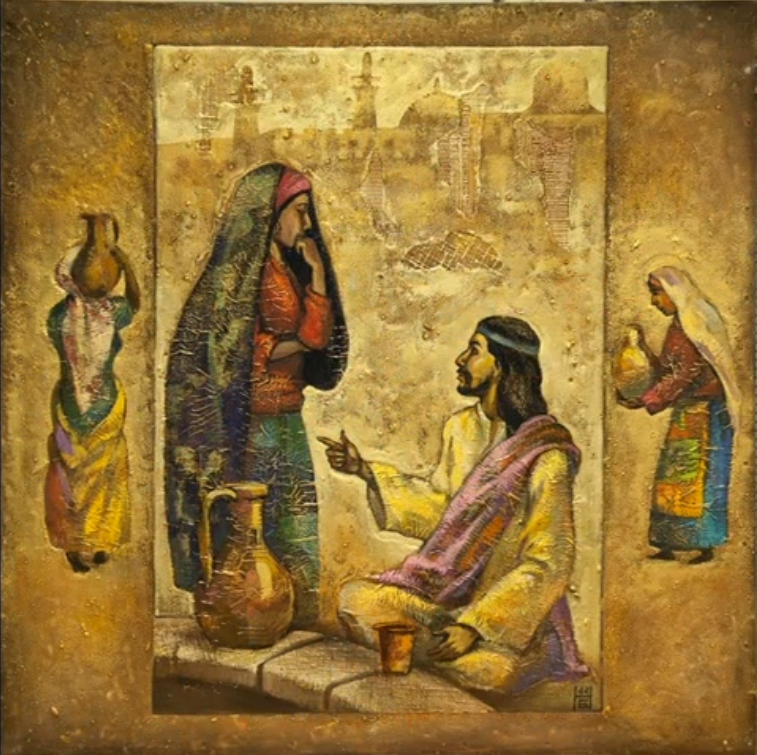
Copyright by Norwegian Bible Society , used with permission.
For other images of Nelly Bube in TIPs, see here.
formal 2nd person plural pronoun (Japanese)
Click or tap here to see the rest of this insight.
Like a number of other East Asian languages, Japanese uses a complex system of honorifics, i.e. a system where a number of different levels of politeness are expressed in language via words, word forms or grammatical constructs. These can range from addressing someone or referring to someone with contempt (very informal) to expressing the highest level of reference (as used in addressing or referring to God) or any number of levels in-between.
One way Japanese shows different degree of politeness is through the choice of a formal plural suffix to the second person pronoun (“you” and its various forms) as shown here in the widely-used Japanese Shinkaiyaku (新改訳) Bible of 2017. In these verses, anata-gata (あなたがた) is used, combining the second person pronoun anata and the plural suffix -gata to create a formal plural pronoun (“you” [plural] in English).
(Source: S. E. Doi, see also S. E. Doi in Journal of Translation, 18/2022, p. 37ff. )
Leave a Reply
You must be logged in to post a comment.