
The Greek that is translated as “told a parable” or sometimes just “said” as an introduction to a parable is translated in Dagbani very explicitly as ŋahi ba ŋahili or “parabled a parable.” (Source: André Wilson in The Bible Translator 1972, p. 135ff. )
The Parable of the Sower
The parable of The Parable of the Sower is illustrated for use in Bible translations in West Africa by Wycliffe Cameroon like this:

Illustration 1999 Mbaji Bawe Ernest, © Wycliffe Bible Translators, Inc. Used with permission.
The following artwork is part of a series of 56 paintings on biblical themes by Kazakh artist Nelly Bube (born 1949):
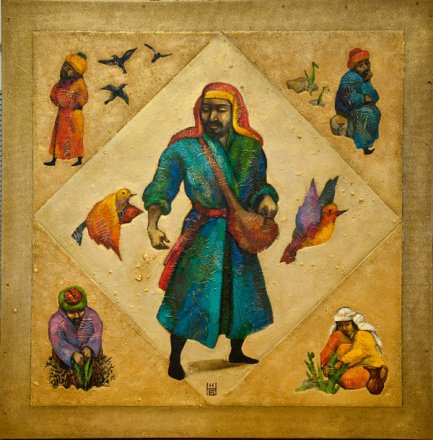
Copyright by Norwegian Bible Society , used with permission.
For other images of Nelly Bube in TIPs, see here.
parable
The Greek that is usually translated as “parable” in English is translated in other languages in a number of ways:
- Piro: “picture with words”
- Pamona: “message in the manner of a comparison”
- Highland Totonac and South Bolivian Quechua: “comparison word”
- Tzeltal: “picture story”
- Yucateco and Central Tarahumara: “likeness word”
- Cashibo-Cacataibo: “story which says like that”
- Chicahuaxtla Triqui and Wayuu: “story told for teaching”
- Navajo (Dinė): “story from which understanding comes”
- Western Kanjobal: “notice from which comes teaching” (source for this and all above: Bratcher / Nida)
- North Alaskan Inupiatun: “story with a meaning”
- Kekchí: “changed, or, turned-about word” (source for this and one above: Reiling / Swellengrebel)
- Palantla Chinantec: “double talk” (source: B. Moore / G. Turner in Notes on Translation 1967, p. 1ff.)
- Mairasi: “example” (source: Enggavoter 2004)
- Low German: “picture” (translation by Johannes Jessen, publ. 1933, republ. 2006).
- Mandarin Chinese: bǐyù (比喻), lit. “comparison explanation” (source: Zetzsche)
In British Sign Language it is translated with a sign that combines the signs for “tell-a-story” and “compare.” (Source: Anna Smith)
“Parable” in British Sign Language (source: Christian BSL, used with permission)
Scot McKnight (in The Second Testament, publ. 2023) translates it into English as analogy because “the Greek word has the sense of tossing down something alongside something else. Hence an analogy.”
See also image and figures of speech.
complete verse (Luke 8:4)
Following are a number of back-translations of Luke 8:4:
- Noongar: “Many people came to Jesus from all the towns. When they came together, Jesus told them this story:” (Source: Warda-Kwabba Luke-Ang)
- Uma: “There was no end to people from other towns who came to Yesus. When many people had gathered, Yesus spoke to them with this parable, he said:” (Source: Uma Back Translation)
- Yakan: “One day when many people gathered to Isa and kept coming from the villages Isa spoke to them in a parable. He said,” (Source: Yakan Back Translation)
- Western Bukidnon Manobo: “And at that time there were always people who were gathered to Jesus, and they came from all the towns. And when a great many people had gathered there, Jesus told them a parable. He said,” (Source: Western Bukidnon Manobo Back Translation)
- Kankanaey: “In-a-large-group were the people who were going to where Jesus was from the many-towns he had been visiting. When they gathered where he was, then he related to them this parable.” (Source: Kankanaey Back Translation)
- Tagbanwa: “People kept on arriving coming from the towns gathering around Jesus. When there were many people now, Jesus used an illustration in teaching, saying,” (Source: Tagbanwa Back Translation)
location (of God) (Japanese honorifics)
Click or tap here to see the rest of this insight.
Like a number of other East Asian languages, Japanese uses a complex system of honorifics, i.e. a system where a number of different levels of politeness are expressed in language via words, word forms or grammatical constructs. These can range from addressing someone or referring to someone with contempt (very informal) to expressing the highest level of reference (as used in addressing or referring to God) or any number of levels in-between.
One way to do this is through the usage (or a lack) of an honorific prefix as shown here in the widely-used Japanese Shinkaiyaku (新改訳) Bible of 2017. When the referent is God, the “divine” honorific prefix mi- (御 or み) can be used, as in mi-moto (みもと) referring to the location (of God) in the referenced verses.
(Source: S. E. Doi, see also S. E. Doi in Journal of Translation, 18/2022, p. 37ff. )
Honorary "are" construct denoting God ("speak")
Click or tap here to see the rest of this insight.
Like a number of other East Asian languages, Japanese uses a complex system of honorifics, i.e. a system where a number of different levels of politeness are expressed in language via words, word forms or grammatical constructs. These can range from addressing someone or referring to someone with contempt (very informal) to expressing the highest level of reference (as used in addressing or referring to God) or any number of levels in-between.
One way Japanese shows different degree of politeness is through the usage of an honorific construction where the morpheme are (され) is affixed on the verb as shown here in the widely-used Japanese Shinkaiyaku (新改訳) Bible of 2017. This is particularly done with verbs that have God as the agent to show a deep sense of reverence. Here, hanas-are-ru (話される) or “speak” is used.
(Source: S. E. Doi, see also S. E. Doi in Journal of Translation, 18/2022, p. 37ff. )
Translation commentary on Luke 8:4
Exegesis:
suniontos de ochlou pollou ‘when a great crowd was gathering,’ without indication as to place or time, but placing the following event during (the course of) Jesus’ going through towns and villages (cf. v. 1). suneimi.
kai tōn kata polin epiporeuomenōn pros auton lit. ‘and the people from town after town were journeying to him,’ best understood as an elaboration of the preceding clause, and hence making clear that the crowd which was gathering were the people from town after town. The phrase tōn kata polin recalls kata polin kai kōmēn in v. 1.
epiporeuomai ‘to journey,’ ‘to travel.’
eipen dia parabolēs ‘he said in a parable,’ virtually equivalent to eipen parabolēn ‘he told a parable’ (cf. e.g. 4.23; 5.36; 6.39; 12.16, 41).
Translation:
The second clause, containing the more general statement, may better be placed first, cf. Good News Translation.
Came to him, he said. One of the pronouns will often have to be specified.
Town, see on “city” in 1.26.
He said in a parable, or, ‘he said using a parable, or, by means (lit. on the way) of a parable’ (Tae’), ‘he lined up and made even with a story’ (Tabasco Chontal), ‘he told/uttered a parable,’ ‘he used-a-simile/proverb/parable’ (Batak Toba). Some other descriptive renderings are, ‘story with a meaning’ (Barrow Eskimo), ‘change, or, turned-about word’ (Kekchi, San Miguel El Grande Mixtec, referring to the metaphorical character of a parable); Sranan Tongo distinguishes between ‘likeness story,’ traditionally used for ‘parable’ in the Bible, and ‘experience story,’ which probably would be a better translation. — The narrative that forms the parable has sometimes to be introduced by some word or phrase, which serves to mark the beginning of a story and/or its imaginary character, e.g. ‘once there was,’ ‘it-is-told,’ cf. on 1.5, and on “a certain” in 7.41.
Quoted with permission from Reiling, J. and Swellengrebel, J.L. A Handbook on the Gospel of Luke. (UBS Handbook Series). New York: UBS, 1971. For this and other handbooks for translators see here . Make sure to also consult the Handbook on the Gospel of Mark for parallel or similar verses.
SIL Translator’s Notes on Luke 8:4
Section 8:4–8
Jesus told a parable about seeds falling on different types of soil
In this section Jesus told a parable about different types of soil and what happens when seed falls on them. The parable illustrated how different people receive the word of God. In the parable, a man scattered seeds that fell on different types of soil (8:5–8). After Jesus told this parable, he explained why he used parables (8:9–10). He explained the meaning of the parable in 8:11–15. The same parable and discussion are in Matthew 13:3–23 and Mark 4:3–20.
The events in this section probably happened during the period of time that was described in 8:1–3. At that time Jesus was traveling from town to town to preach to people about the kingdom of God.
It is good to translate this section before you decide on a heading for it. Some other possible headings for this section are:
A Story About a Farmer (God’s Word)
-or-
Parable of the Farmer Scattering Seed (New Living Translation (2004))
-or-
Jesus illustrated different ways that people hear the word of God
Paragraph 8:4–8
8:4a
While: This verse begins with a Greek conjunction that connects this paragraph to the preceding section. While Jesus was going from town to town (8:1), many people came to him and followed him from those towns. He told the parable in this section while those people were with him.
Connect this verse to the preceding section in a natural way in your language. Some ways to do this in English are:
When a large crowd had gathered (God’s Word)
-or-
People kept coming to Jesus…and when a great crowd gathered (Good News Translation)
a large crowd was gathering and people were coming to Jesus from town after town: This clause indicates that people were coming to Jesus from various towns. These people became a large crowd that continued to get larger as more people came. Other ways to translate this are:
a large crowd was gathering as people came to Jesus from town after town
-or-
as many people from different towns gathered around Jesus
In some languages, it may be more natural to change the order of the clauses. For example:
People kept coming to Jesus from one town after another; and when a great crowd gathered… (Good News Translation)
crowd: The word crowd refers to a large number of people who are together in one place. Other ways to translate crowd are:
many people
-or-
a big group of people
was gathering…were coming: The forms of these verbs in Greek indicates that the actions continued over a period of time. More people continued to come until they formed a large crowd. If you have a way to indicate this type of continual or gradual action in your language, you may be able to use it here.
town after town: The Greek phrase that the Berean Standard Bible translates as town after town means “many different towns.”
8:4b
this parable: The phrase this parable refers to the parable that follows in 8:5–8.
parable: The Greek word that the Berean Standard Bible translates as parable is literally “comparison.” A parable teaches a lesson or truth by showing how it is like something that people already know. Jesus used several types of parables including symbolic stories, metaphors, proverbs, illustrations, and wise sayings.
Some ways to translate parable are:
• Use a general term in your language that can be used to describe the different types of parables. Some English examples are:
illustration
-or-
metaphor
• Use a descriptive term. For example:
symbolic saying/words/story
-or-
comparison
This word also occurs in 5:36a. See also parable, Type 2, in the Glossary.
© 2009, 2010, 2013 by SIL International®
Made available under the terms of a Creative Commons Attribution-ShareAlike 4.0 License (CC BY-SA) creativecommons.org/licenses/by-sa/4.0.
All Scripture quotations in this publication, unless otherwise indicated, are from The Holy Bible, Berean Standard Bible.
BSB is produced in cooperation with Bible Hub, Discovery Bible, OpenBible.com, and the Berean Bible Translation Committee.
Leave a Reply
You must be logged in to post a comment.