The Greek and Hebrew terms that are often translated as “leprosy (or: defiling/skin disease)” or “leprous (person)” in English is translated in Mairasi as “the bad sickness,” since “leprosy is very common in the Mairasi area” (source: Enggavoter 2004).
Usila Chinantec “sickness like mal de pinta” (a skin disease involving discoloration by loss of pigment) (source: B. Moore / G. Turner in Notes on Translation 1967, p. 1ff.)
Hiligaynon: “dangerous skin disease” (source: Hiligaynon Back Translation)
Kankanaey: “fearful skin disease” (source: Kankanaey Back Translation)
Tenango Otomi: “terrible rotting” (source: Tenango Otomi Back Translation)
Newari: “infectious skin disease” (source: Newari Back Translation)
Targumim (or: Targums) are translations of the Hebrew Bible into Aramaic. They were translated and used when Jewish congregations increasingly could not understand the biblical Hebrew anymore. Targum Onqelos (also: Onkelos) is the name of the Aramaic translation of the Torah (the first five books of the Hebrew Bible) probably composed in Israel/Palestine in the 1st or 2nd century CE and later edited in Babylon in the 4th or 5th century, making it reflect Jewish Babylonian Aramaic. It is the most famous Aramaic translation and was widely used throughout the Jewish communities. In Leviticus 13 and 14 it translates tzaraat as a “quarantining affliction” — focusing “on what occurs to individuals after they suffer the affliction; the person is isolated from the community.” (Source: Israel Drazin in this article ). Similarly, the English Jewish Orthodox ArtScroll Tanach translation (publ. 2011) transliterates it as tzaraat affliction.
The Hebrew and Greek that is translated as “village” or “town” in English is translated in Noongar as karlamaya or “fire (used for “home“) + houses” (source: Warda-Kwabba Luke-Ang).
In Elhomwe it is typically translated as “place.” “Here in Malawi, villages very small, so changed to ‘places,’ since not sure whether biblical reference just to small villages or also to bigger towns. (Source: project-specific translation notes in Paratext)
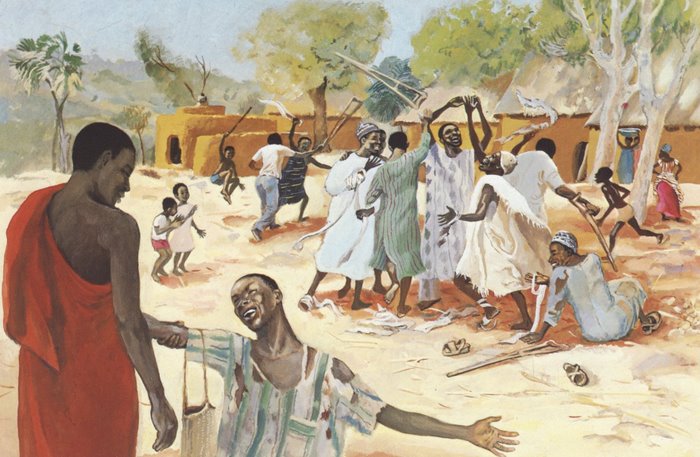
Following is a 1973 painting of the JESUS MAFA project, a response to New Testament readings from the Lectionary by a Christian community in Cameroon, Africa. Each of the readings was selected and adapted to dramatic interpretation by the community members. Photographs of their interpretations were made, and these were then transcribed to paintings:
This beautiful rendering of the healing of the ten lepers sets the tone as one of joyous celebration. Jesus has just restored the health of ten people and only one has returned in thanksgiving, but this fact from the story does not impact the painting negatively. The one has knelt before Jesus to offer his gratitude while the other nine rejoice in the background. The piece is dynamic as we see arms thrown in the air in elation while onlookers are also rejoicing at this miracle. The smiling faces in this painting are contagious as the viewer can join in applause and praise of God for such wonderful works.
From Art in the Christian Tradition, a project of the Vanderbilt Divinity Library, Nashville, TN. Image retrieved March 23, 2026. Original source: librairie-emmanuel.fr.
Following are a number of back-translations of Luke 17:12:
Noongar: “Jesus was going to a village. Ten men came to him. They had a bad skin-disease and stood at a distance” (Source: Warda-Kwabba Luke-Ang)
Uma: “When/As he entered the town, ten lepers came to meet him. They called from far away,” (Source: Uma Back Translation)
Yakan: “When he came close to a village, ten lepers came to him. They stood far off,” (Source: Yakan Back Translation)
Western Bukidnon Manobo: “He arrived in the village, and there were there ten men who met him, and they were lepers. Because they were lepers, they did not come close to Jesus, but rather they stayed afar off.” (Source: Western Bukidnon Manobo Back Translation)
Kankanaey: “Arriving then at a certain town, ten who were sick with a fearful skin disease went and met him. They stood at a short-distance” (Source: Kankanaey Back Translation)
Tagbanwa: “Just as he was entering one of the barios, he was met by ten lepers. They stopped at a distance,” (Source: Tagbanwa Back Translation)
God transcends gender, but most languages are limited to grammatical gender expressed in pronouns. In the case of English, this is traditionally confined to “he” (or in the forms “his,” “him,” and “himself”), “she” (and “her,” “hers,” and “herself”), and “it” (and “its” and “itself”).
Modern Mandarin Chinese, however, offers another possibility. Here, the third-person singular pronoun is always pronounced the same (tā), but it is written differently according to its gender (他 is “he,” 她 is “she,” and 它/牠 is “it” and their respective derivative forms). In each of these characters, the first (or upper) part defines the gender (man, woman, or thing/animal), while the second element gives the clue to its pronunciation.
In 1930, after a full century with dozens of Chinese translations, Bible translator Wang Yuande (王元德) coined a new “godly” pronoun: 祂. Chinese readers immediately knew how to pronounce it: tā. But they also recognized that the first part of that character, signifying something spiritual, clarified that each person of the Trinity has no gender aside from being God.
While the most important Protestant and Catholic Chinese versions respectively have opted not to use 祂, some Bible translations do and it is widely used in hymnals and other Christian materials. Among the translations that use 祂 to refer to “God” were early versions of Lü Zhenzhong’s (呂振中) version (New Testament: 1946, complete Bible: 1970). R.P. Kramers (in The Bible Translator 1956, p. 152ff. ) explains why later versions of Lü’s translation did not continue with this practice: “This new way of writing ‘He,’ however, has created a minor problem of its own: must this polite form be used whenever Jesus is referred to? Lü follows the rule that, wherever Jesus is referred to as a human being, the normal tā (他) is written; where he is referred to as divine, especially after the ascension, the reverential tā (祂) is used.”
In that system, one kind of pronoun is used for humans (male and female alike) and others for natural elements, non-liquid masses, and some spiritual entities (one other is used for large animals and another one for miscellaneous items). While in these languages the pronoun for spiritual entities used to be employed when referring to God, this has changed into the use of the human pronoun.
Lynell Zogbo (in The Bible Translator 1989, p. 401ff. ) explains: “From informal discussions with young Christians especially, it would appear that, at least for some people, the experience and/or concepts of Christianity are affecting the choice of pronoun for God. Some people explain that God is no longer ‘far away,’ but is somehow tangible and personal. For these speakers God has shifted over into the human category.”
In Kouya, God (the Father) and Jesus are referred to with the human pronoun ɔ, whereas the Holy Spirit is referred to with a non-human pronoun. (Northern Grebo and Western Krahn make a similar distinction.)
Eddie Arthur, a former Kouya Bible translation consultant, says the following: “We tried to insist that this shouldn’t happen, but the Kouya team members were insistent that the human pronoun for the Spirit would not work.”
In Burmese, the pronoun ko taw (ကိုယ်တော်) is used either as 2nd person (you) or 3rd person (he, him, his) reference. “This term clearly has its root in the religious language in Burmese. No ordinary persons are addressed or known by this pronoun because it is reserved for Buddhist monks, famous religious teachers, and in the case of Christianity, the Trinity.” (Source: Gam Seng Shae in The Bible Translator 2002, p. 202ff. )
In Thai, the pronoun phra`ong (พระองค์) is used, a gender-neutral pronoun which must refer to a previously introduced royal or divine being. Similarly, in Northern Khmer, which is spoken in Thailand, “an honorific divine pronoun” is used for the pronoun referring to the persons of the Trinity (source: David Thomas in The Bible Translator 1993, p. 445 ). In Urak Lawoi’, another language spoken in Thailand, the translation often uses tuhat (ตูฮัด) — “God” — ”as a divine pronoun where Thai has phra’ong even though it’s actually a noun.” (Source for Thai and Urak Lawoi’: Stephen Pattemore)
The English “Contemporary Torah” addresses the question of God and gendered pronouns by mostly avoiding pronouns in the first five books of the Hebrew Bible/Old Testament (unless God is referred to as “lord,” “father,” “king,” or “warrior”). It does that by either using passive constructs (“He gave us” vs. “we were given”), by using the adjective “divine” or by using “God” rather than a pronoun.
Some Protestant and Orthodox English Bibles use a referential capitalized spelling when referring to the persons of the Trinity with “He,” “His,” “Him,” or “Himself.” This includes for instance the New American Standard Bible or The Orthodox New Testament, but most translations do not. Two other languages where this is also done (in most Bible translations) are Twents as well as Indonesian and Malay. In the latter two languages this follows the language usage according to the Qur’an, which in turn predicts that usage (see Soesilo in The Bible Translator 1991, p. 442ff. and The Bible Translator 1997, p. 433ff. ).
Living Water is produced for the Bible translation movement in association with Lutheran Bible Translators. Lyrics derived from the ESV® Bible (The Holy Bible, English Standard Version®).
eiserchomenou autou eis tina kōmēn ‘when he was entering a village.’ Since lepers were not admitted to the community the clause is best understood as, ‘when he was on the point of entering,’ or, ‘when he was approaching a village.’
apēntēsan [autō] deka leproi andres lit. ‘ten lepers met him,’ but, as idōn ‘when he saw them’ in v. 14 shows, Jesus did not immediately notice them.
apantaō ‘to meet,’ ‘to come towards.’
hoi estēsan porrōthen lit. ‘who took their stand,’ i.e. ‘who stopped at a distance,’ cf. on 6.8.
porrōthen lit. ‘from a distance,’ hence ‘at a distance.’
Translation:
He was met by ten lepers, or, ‘ten lepers encountered him, or, came towards him,’ cf. on 8.27. For leper see 4.27.
At a distance, or, ‘some way off (but within hearing distance)’; and cf. on 15.20.
Quoted with permission from Reiling, J. and Swellengrebel, J.L. A Handbook on the Gospel of Luke. (UBS Handbook Series). New York: UBS, 1971. For this and other handbooks for translators see here . Make sure to also consult the Handbook on the Gospel of Mark for parallel or similar verses.
As He entered one of the villages, He was met by ten lepers. They stood at a distance: In this verse Jesus was approaching a village to enter it. The context implies that he had not yet entered the village, because ten lepers came toward him. Lepers were not allowed to enter villages where healthy people lived. They also were not allowed to come near healthy people.
The lepers in this verse were probably living some distance from the village. They were not coming out of the village to meet Jesus. In some languages a phrase like He was met may not fit with the phrase stood at a distance. When you translate this verse, be sure that the phrases you use fit the situation and do not contradict each other. One way to do this in English is:
As he approached a village, ten lepers came toward him and stood some distance from him. -or-
…as he was approaching a village, ten lepers met him. They kept their distance (Phillips’ New Testament in Modern English)
17:12a
As He entered one of the villages: Jesus was going toward a village to enter it. Here is another way to translate this:
as he was approaching a village (Phillips’ New Testament in Modern English)
He: The focus is on Jesus here, but the disciples were still following him. Consider how to imply that in your language while keeping the focus on Jesus.
17:12b
lepers: The Greek word that the Berean Standard Bible translates as lepers refers to people afflicted with several different skin diseases. Scholars disagree as to whether these diseases included modern-day leprosy (Hansen’s disease). They agree that in New Testament times the Greek word referred to dreaded skin diseases.
People believed that these diseases were spread by contact with someone who had the disease. A person who had one of these diseases was also considered ritually unclean. Some ways to translate this word are:
• Use a general phrase that describes the nature or significance of the disease. For example:
a skin disease (God’s Word) -or-
a dreaded skin disease (Good News Translation) -or-
a contagious skin disease
• Use a term that refers specifically to leprosy. For example:
leprosy -or-
something like leprosy
A term that refers specifically to leprosy may be appropriate in areas where readers are already familiar with the term “leprosy.” If you decide to use a word meaning “leprosy,” it is recommended that you add a footnote to give more information. For example:
The disease that is mentioned here refers to various contagious and dreaded skin diseases. A person who had one of these diseases was considered ritually unclean. According to the Jewish law, he was not allowed to associate with other people or to worship in the Temple.
This word also occurred in 7:22.
17:12c
They stood at a distance: The phrase stood at a distance indicates that they did not come near Jesus. Some other ways to translate this are:
They did not come close to Jesus (New Century Version) -or-
They stood apart from ⌊Jesus⌋
General Comment on 17:12b–c
In some languages it may be natural to combine the phrases “met him” and “they stood at a distance.” For example:
ten lepers stood at a distance (New Living Translation (2004)) -or-
ten lepers stopped a short distance away

Leave a Reply
You must be logged in to post a comment.