
The Greek that is typically translated in English as “sign” is translated in Huehuetla Tepehua as “thing to be marveled at” (source: Larson 1889, p. 279) and in Mairasi as “big work” (source: Enggavoter 2004).
a woman clothed with the sun - with the moon under her feet - and on her head a crown of twelve stars
The following is the 16th century image of the Our Lady of Guadalupe in the Basilica of Our Lady of Guadalupe in Mexico City. The imagery is partly based on Revelation 12:1: “clothed with the sun” (around her), “moon under her feet” (below her), and “stars” (on her cloak).
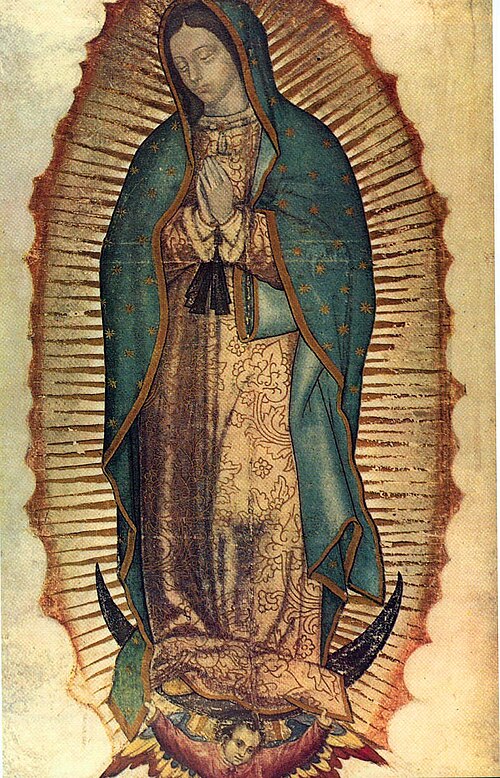
Public domain
See also Mary (mother of Jesus).
complete verse (Revelation 12:1)
Following are a number of back-translations of Revelation 12:1:
- Uma: “From there, I saw, there was in the sky a sign that was no kidding its surprisingness: a woman who was dressed with the sun and who stood on top of the moon. On her head was a hat that was made from twelve stars.” (Source: Uma Back Translation)
- Yakan: “So-then, I saw a very amazing sign appear in the sky. I saw a woman dressed in (something) like the brightness of the sun. She stood on the moon and twelve stars were like a crown on her head.” (Source: Yakan Back Translation)
- Western Bukidnon Manobo: “And then I saw in heaven the shadowing of that which will happen. I saw a woman who was clothed with the sun, and underneath her feet was the moon, and placed on her head was a crown which was twelve stars.” (Source: Western Bukidnon Manobo Back Translation)
- Kankanaey: “When that was finished, there was an amazing sign that could be seen in the sky. Because a woman appeared standing on the moon who was dressed in that which dazzled like the sun. She was crowned with twelve stars.” (Source: Kankanaey Back Translation)
- Tagbanwa: “The next thing which was shown to me in heaven was an amazing sign. For I saw a woman whose clothing was the sun. She was standing on the moon, and her head was crowned with twelve stars.” (Source: Tagbanwa Back Translation)
- Tenango Otomi: “There in heaven appeared a sign, a woman who was dressed in a cloth that had a shine like that of the sun. There where she stood it was seen that she stood on the moon. On her head she wore a crown which has twelve stars.” (Source: Tenango Otomi Back Translation)
sky
Greek, Hebrew, Latin, Ge’ez, and Aramaic all have one term only that refers to what can be expressed in English as “sky” or “heaven(s)” (as a physical and spiritual entity). While there is a slight overlap between the meaning of the two English terms, “sky” (from Old Norse sky meaning “cloud”) typically refers to the physical entity, and “heaven” (from Old English heofon meaning “home of God”) typically refers to the spiritual entity. While this enriches the English lexicon, it also forces English Bible translators to make decisions that can be found only in the context in the Greek, Hebrew, and Aramaic texts. Most versions tend to use “heaven(s)” even if the meaning is likely “sky,” but the Contemporary English Version (NT: 1991, OT: 1995, DC: 1999) is an English translation that attempted to be more specific in the separation of the two meanings and was used as the basis for the links to verses used for this and this record (“heaven”).
Norm Mundhenk (in The Bible Translator 2006, p. 92ff. ) describes the difficulty that English translations face (click or tap here to see more):
“A number of years ago an old lady asked me a question. What did Jesus mean when he said, ‘Heaven and earth will pass away, but my words will never pass away’? I do not remember what answer I gave, but I was surprised at how concerned she seemed to be about the verse. It was only later, after I had left her, that I suddenly realized what it was that she was so concerned about. She knew that death could not be far away, and all her life she had looked forward to being with God in heaven. But this verse said that ‘heaven will pass away’! What did that mean for her hopes? In fact, of course, in this verse Jesus was talking about the skies or the heavens, not about Heaven as the place of God’s presence. If I had realized the problem in time, I could easily have set the lady’s mind at rest on this question that was troubling her so much. However, I suspect that she is not the only person to be misled by the wording of this verse. Therefore, it is very surprising to find that even today many English versions (including the New International Version, New Revised Standard Version, Revised English Bible, Good News Translation) still say ‘heaven and earth’ in verses like Matt 24:35 and its parallels (Mark 13:31 and Luke 21:33). The Contemporary English Version (CEV) and Phillips’ translation seem to be aware of the problem, and in Mark 13:31 both of these have ‘earth and sky’ instead of ‘heaven and earth.’ But in some other passages (such as Matt 5:18) the traditional wording is still found in both of those translations. The New Century Version (NCV) does have ‘earth and sky’ more consistently, and the New Jerusalem Bible (NJB) has ‘sky and earth’ in these passages. (Although ‘sky and earth’ is closer to the Greek, it seems more natural in English to say ‘earth and sky’; but either way, at least the meaning is correct.)
“Louw and Nida’s Lexical Semantics of the Greek New Testament (publ. 1992) suggests that the Greek expression being translated here, ho ouranos kai he ge is ‘a more or less fixed phrase equivalent to a single lexical unit’ and that it means everything that God created, that is, the universe. They then quote Mark 13:31 as an example, using ‘heaven and earth’ in their translation of it. However, they go on to say that there ‘may be certain complications involved in rendering ho ouranos kai he ge as ‘heaven and earth,’ since ‘heaven’ might be interpreted in some languages as referring only to the dwelling place of God himself. The referents in this passage are ‘the sky and the earth,’ in other words, all of physical existence, but not the dwelling place of God, for the latter would not be included in what is destined to pass away.’ In my opinion, English itself is one of the languages where the word ‘heaven’ will be interpreted as referring only to the dwelling place of God himself, and translations into English should not use ‘heaven’ in these passages. It is probably because these passages are so very familiar that translators do not realize the meaning they are giving their readers when they use the expression ‘heaven and earth’ here. In modern English we might talk about a rocket ‘soaring into the heavens,’ but we would certainly not describe it as ‘soaring into heaven,’ because ‘heaven’ is not another way of referring to the sky or to outer space.
“In fact, it is surely important in all languages to have some way of distinguishing the concept of ‘sky’ from the concept of ‘dwelling place of God.’ In these passages translators should never use a term meaning ‘the dwelling place of God.’ It may not be necessary to use a term meaning ‘sky’ either, if there is some other expression in the language which gives the correct meaning of ‘everything that has been created’ or ‘the universe.’ There are of course places in the New Testament where Heaven, as the place where God lives, is contrasted with the earth. In these passages, translators should be careful to give the correct meaning. A good example of this is in the Lord’s Prayer, in Matt 6:10: ‘Your will be done, on earth as it is in heaven.’ Similarly, 1 Cor 15:47 says that ‘the first man [a reference to Adam] was from the earth, a man of dust; the second man is from heaven.’ Passages like these are referring to Heaven, not to the sky. Other NT passages where heaven refers to God’s dwelling place, in contrast with earth, are Matt 5:34-35, 16:19, 18:18, Acts 7:49, James 5:12, and Rev 5:3.
“Sometimes in the New Testament, the word ‘heaven’ is used because of the Jewish reluctance to use the name of God. ‘Heaven’ in these cases is used in place of ‘God’ and refers to God himself. This is the case in the many references in Matthew to ‘the kingdom of heaven’ where other gospels have ‘the kingdom of God’ (e.g., compare Matt 4:17 with its parallels in Mark 1:15 and Luke 10:9). It is also most likely the case in references like Matt 16:1, Luke 20:4, 5, John 3:27, and even perhaps Col 1:5.
“There are some places, such as Matt 11:25, where God is called ‘Lord of heaven and earth.’ Since God is of course the Lord of Heaven as well as of the universe, it may not matter so much which interpretation is given in these passages (others are Luke 10:21 and Acts 17:24). Nevertheless, the intended meaning here is likely to be ‘the universe.’ This is because this expression in Greek, as Louw and Nida say, is a set expression referring to everything that has been created. Acts 17:24 in fact combines the idea of the creation of the universe with the idea of God as Master or Lord of the universe. (…)
“Old Testament background The use of ‘heaven and earth’ in the New Testament is very similar to what we find in the Old Testament, because it is largely based on the Old Testament.
“The Old Testament begins with the story of creation, which is presented as the creation of the heavens and the earth, with lights to shine in the heavens and give light to the earth. Birds are created to live in the heavens, animals to live on earth, and fish to live in the sea (Gen 1:1-2:4).
“As we can see from the way the creation story is told, it is meant to be understood as the creation of the universe. Although in English the regions above the earth have traditionally been called ‘the heavens’ in the story of creation, they cannot be called ‘Heaven,’ in the sense of the place where God dwells. In terms of modern English, it would probably be better to say ‘the sky and the earth’ or ‘the earth and the sky.’ The story of creation then becomes an important theme throughout the Old Testament. (…)
“In most passages, whether in the Old Testament or the New Testament, when ‘heaven and earth’ or ‘the heavens and the earth’ are mentioned, the meaning is the created universe. It is not a reference to Heaven, as the dwelling place of God. In English, translators have not been careful to keep this distinction clear, and this is probably true in many other languages as well. However, as we have seen, this can lead to real confusion for ordinary Bible readers. It is better if translators find ways to make the meaning clear in these passages. ‘Heaven’ should be mentioned only in passages which clearly mean the dwelling place of God. In other passages, an expression should be used which means only ‘sky.’ Or else, the whole expression ‘heaven and earth’ can be translated in a way to show that the whole universe is meant.”
Other languages that have a semantic distinction similar to English include:
- Hungarian: ég — “sky”; menny — “heaven”
- Tagalog: kalawakan — “sky”; langit/kalangitan — “heaven”
- Swedish: sky — “sky”; Himmel — “heaven”
- Loma: “up” — “sky”; “God’s place” — heaven”
- Mossi: saase — “sky”; nyingeri — “the up above”(source for Loma and Mossi: Bratcher/Nida)
- Roviana: mamaṉa — “sly”; maṉauru — “heaven” (an old word, meaning “empty, open space of the sky”) (source: Carl Gross)
- Kayaw: mô̄la or “canopy-under”/mô̄khû̄la or “canopy-above-under” — “sky” (atmosphere where there is just air); mô̄khû̄ or “canopy-on/above” — “heaven” (invisible abode of God and angels)
- Burmese: မိုး ကောင်း ကင်/moe kaungg kain — “sky”; ကောင်း ကင်/kaungg kain — “sky” or “heaven”; ကောင်း ကင်ဗုံ/kaungg kain bone — “heaven”
- Mairasi: Sinyavi — an indigenous term that is used for both “sky” and heaven”; Surga — loanword from Sanskrit via Indonesian referring to “heaven” (source: Enggavoter 2004)
- Noongar: worl — “sky”; Boolanga-Yirakang Boodjer — “Country of God” (source: Warda-Kwabba Luke-Ang)
- Kupsabiny: “up” for “sky” vs. “God’s Homestead” for “heaven” (source: Kupsabiny Back Translation)
In some languages, such as Yagaria, a term that was originally used as “sky” (gokudana) was adopted by the Christian community as “heaven.” This resulted in a language shift so that now all communities uses “empty space / air” (galogina or hakalogina) as “sky” and gokudana is exclusively used for the Christian concept of heaven. (Source: Renck 1990, p. 133)
Many languages follow the original biblical languages in not making that distinction, such as:
- Latin: caelum
- Portuguese: céu
- French: ciel
- Italian: cielo
- Catalan: cel
- Russian and Ukrainian: небо/‘nebo
- Finnish: taivas
- Estonian: taevas
- Dutch: hemel
- Czech: nebe
- Slovak: nebo
- Danish: himmel
- German: Himmel
- Matumbi: kunani (lit. “up”) (source: Pioneer Bible Translators, project-specific notes in Paratext)
- Cherokee: galaladi (ᎦᎸᎳᏗ) or “up” — Bender / Belt (2025, p. 23) note that there is a related term — galvlohi (ᎦᎸᎶᎯ) — that is used “for the upperworld of Cherokee cosmology, [but] was not used, possibly to communicate a sharp distinction.”
- Mandarin Chinese: 天/tiān
- Korean: 하늘/haneul
- Amele: sao (source: John Roberts)
- Kamo: yamba, which, when capitalized (Yamba), means “God” (source: David Frank)
- Manchu: ᠠᠪᡴᠠ/abka
In some languages, such as Wandala, the vocabulary for terms for either “heaven” or “sky” is much richer than just to include those two distinction. While zhegela, the term that is specifically used for the physical sky was only used in early translations of the New Testament for “sky,” other terms such as samaya (used for both “sky” and “heaven”), zlanna (specifically used for the perfect abode of God and the goal of the faithful, as in Matthew 8:11), kwárá (a locational term used to speak of a chief’s rule [lit., “voice”] such as Matthew 3:2), or sleksire (“chieftaincy,” “kingship,” or “royalty” [originally from slekse “chief”] and used where there are no locational overtones, such as in Matthew 16:28) are used. (Source: Mona Perrin in Notes on Translation 1/1999, p. 51ff.)
The English translation by Sarah Ruden (2021) uses “sky” throughout. Ruden explains (p. li): “The Greek word ouranos refers evenhandedly to the physical sky and the place—often pictured as a royal court — where supreme divinity resides. ‘Sky’ seems generally better, first of all in avoiding the wackier modern imagery that comes with the English ‘heaven.’ And even when a supernatural realm is meant, ‘sky’ will often do, because the divine realm was thought to be located there, in addition to the weather and the heavenly bodies, whereas ‘heaven’ to us is fundamentally a religious term, and the ancients did not tend to separate linguistic domains in this way. I have retained the plural ‘skies’ where I see it in the Greek, because it is a Hebraism familiar in English translations of scripture and (I hope) not too archaic or jarring.”
Translation commentary on Revelation 12:1
And a great portent appeared in heaven: the word translated portent usually means “sign,” “symbol,” that is, an object or event that has spiritual significance. As such it is a keyword in the Gospel of John (see John 2.11 and throughout the Gospel, where it is translated “sign” in Revised Standard Version). Here it means “an extraordinary sight,” “the appearance of an unusual (or, unique) event.” Good News Translation tries to bring out the component of hidden meaning by translating “a great and mysterious sight.” Barclay has “a sight full of meaning.” The adjective great here does not refer to size but to its effect, which New International Version tries to bring out by translating “A great and wondrous sign.” Another possible translation is “A great sign (or, sight) that amazes everyone.”
Here and in verse 3 the writer uses appeared, which in Greek is a passive verb, instead of the active “I saw,” which he usually employs (see the next vision, 13.1). This is significant, and if possible something like appeared in English and other languages should be used. A translation should not say “I saw a mysterious sight….”
In languages that have two different words for heaven, as the dwelling place of God, and the sky, the translation here and in verse 3 should say “the sky” (Good News Translation), not heaven.
A woman clothed with the sun: for the verb clothed see “wrapped” in 10.1. It may be difficult to speak of the sun as the garment worn by the woman, but the figure should be maintained: “a woman who had (or, used) the sun around her like a dress (or, clothes),” or “a woman whose dress was the sun.”
The moon under her feet: the picture does not seem to portray the woman as standing on the moon, but that she was seated, and the moon served as a footstool on which she rested her feet. The meaning may be expressed by “and her feet were resting on the moon.”
A crown of twelve stars: for crown see 4.4. The meaning may be expressed by “a crown made of twelve stars” or “a crown that had twelve stars in it.”
Quoted with permission from Bratcher, Robert G. and Hatton, Howard A. A Handbook on The Revelation to John. (UBS Handbook Series). New York: UBS, 1993. For this and other handbooks for translators see here .
SIL Translator’s Notes on Revelation 12:1
Section 12:1–17
The woman fled from the dragon
In this section, John saw several signs or symbols representing spiritual reality. The first sign was a woman, representing the people of God. The second sign was a dragon, representing Satan. The woman was about to give birth, and the dragon wanted to kill the child. The child is symbolic of Jesus as the Christ. God took the son to heaven and protected the woman.
In 12:7–12, John interrupted the story of the woman and the dragon to tell about the war between the dragon and the angels. These verses help explain why the dragon wanted to kill the woman. In 12:13, John continued the story of the woman and the dragon.
Other examples of headings for this section are:
The sign of the dragon chasing the woman
-or-
The vision of the woman and the dragon
-or-
The ⌊spiritual⌋ conflict of God’s people and Satan
Paragraph 12:1–2
12:1a
And a great sign: The Greek phrase that the Berean Standard Bible literally translates as a great sign refers to something that has a symbolic meaning. A sign suggests or points to something other than itself. Other ways to translate the Greek phrase are:
a great and wondrous sign (New International Version (1984))
-or-
a great and mysterious sight (Good News Translation)
-or-
a great portent (Revised Standard Version)
-or-
a great wonder (King James Version)
great: Here the word great refers to the intensity or importance of the sign. The word does not refer to size here. Other ways to translate this word are:
spectacular
-or-
amazing
appeared: This word indicates that before this time the sign was not visible and then suddenly it was visible.
heaven: The Greek word can mean either “heaven” or “sky.” There are two ways to interpret the Greek word:
(1) The word means heaven here, as in the Berean Standard Bible. This word refers generally to the location where John saw these things. The vision appeared or occurred in the spiritual realm.
(2) The word means sky here. This word further indicates that the sign appeared above the ground with the sky as its background. For example:
the sky (Good News Translation)
People in John’s time generally understood the spiritual realm to be up in the sky. Greek only has one word to refer to both heaven and sky. Some languages, like English, have two different words. If that is true in your language, it is recommended that you follow interpretation (1), because the same Greek word in 11:19 clearly refers to heaven.
12:1b–c
The symbols of the sun, moon, and twelve stars indicate that the woman probably represents Israel. Or it may represent all people who believe in Jesus as the Christ. These believers are then represented as the spiritual Israel. In either case, the woman represents the people of God.
12:1b
a woman clothed in the sun: This clause refers to the sun covering the woman like clothing covers a person. Other ways to translate this clause are:
a woman whose clothes were the sun (Contemporary English Version)
-or-
a woman robed with the sun (Revised English Bible)
with the moon under her feet: This phrase can mean either:
(1) The bottom of the woman’s feet touched the moon.
(2) The moon was a small distance below her feet.
Translate this phrase so that it allows both meanings. Other ways to translate this phrase are:
and who had the moon under her feet (Good News Translation)
-or-
and the moon was under her feet (New Century Version)
12:1c
a crown of twelve stars on her head: The phrase on her head is emphasized in the Greek. For example:
on her head a crown of twelve stars (Revised Standard Version)
-or-
her head was crowned/wreathed with twelve stars
If possible, emphasize the phrase on her head in a way that is natural in your language.
a crown of twelve stars: This phrase probably indicates that the stars were placed around her head like a crown. Other ways to translate this phrase are:
a crown/wreath made of twelve stars
-or-
twelve stars ⌊in a circle⌋ like a crown
crown: The Greek word that the Berean Standard Bible translates as crown refers to a victor’s wreath. It was worn on the head as a sign of having won a contest.
But here, the word probably refers to the twelve stars placed around her head so that it looked like a wreath of stars. Other ways to translate this word are:
wreath
-or-
headdress
© 2020 by SIL International®
Made available under the terms of a Creative Commons Attribution-ShareAlike 4.0 License (CC BY-SA) creativecommons.org/licenses/by-sa/4.0.
All Scripture quotations in this publication, unless otherwise indicated, are from The Holy Bible, Berean Standard Bible.
BSB is produced in cooperation with Bible Hub, Discovery Bible, OpenBible.com, and the Berean Bible Translation Committee.
Leave a Reply
You must be logged in to post a comment.